AP Physics 1
 Call Kai
 Learn
Learn Practice Test
 Spaced Repetition
 Match
Match Flashcards
 Knowt Play
1/38

There's no tags or description
Looks like no tags are added yet.
Name | Mastery | Learn | Test | Matching | Spaced | Call with Kai |
|---|
No analytics yet
Send a link to your students to track their progress
39 Terms
vectors are in the form _____
_i + _j
i in a vector is
horizontal
j in a vector is
vertical
when adding, subtracting, or multiplying vectors make sure you
do it to each individual component. ALSO pay attention to the direction of the vectors too (because negatives matter)
to get the direction of a vector
use tan-1 ( ) to get the degrees (can be clockwise or counterclockwise)
average velocity is
displacement over time
acceleration is 0 only when
the velocity is constant, NOT speed
at the end of a projectile motion, remember that the resultant speed is equal to
the Pythagorean theorem for BOTH components
always remember that speed is the ____ of velocity
magnitude
newtons first law is
the law of inertia
newtons second law is
Net force = ma
newtons third law is
equal and opposite reactions
what are action reaction pairs? (3rd law)
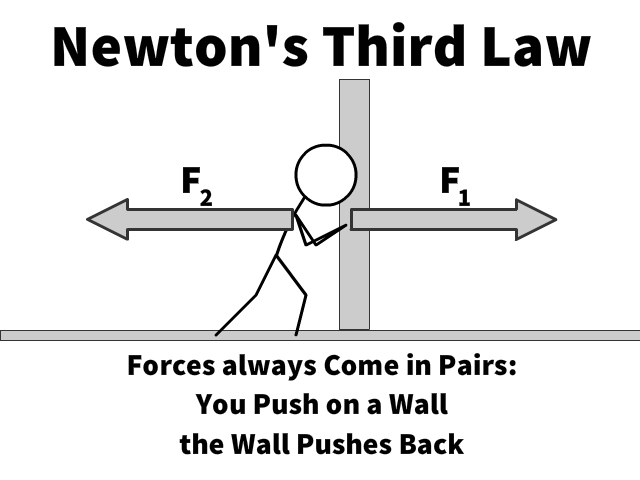
action reaction pairs always happen on 2 _____ objects
DIFFERENT
equal and opposite forces do _____ act on the same object
NOT
even if the speed of an object in circular motion is constant, the velocity
is not constant because its always changing directions!
acceleration centripetal and force centripetal formulas
ac = v²/r Fc = mv²/r
can a force centripetal do work?
NO! its motion is always perpendicular to the force
other than tension, what other forces can provide centripetal forces?
GRAVITATIONAL (what keeps a planet in orbit) and FRICTION (what allows cars and people to turn, imagine trying to turn in a circle in a car on frictionless ice)
The centripetal force is the force required to
keep an object in circular motion. if the force is too high it wont be able to move in a circle
remember that one revolution per second means
velocity = 2(pi)r
when calculating work the force and distance
must be parallel! they can be opposite too
work is negative when
the force is opposite of the motion
if there is a force on an object pulling it up the force normal can be
the force normal can be reduced
if force isn’t constant then the work is equal to
the area under a Force vs Displacement graph or the integral of the force function
total work is equal to
change in Kinetic energy, or final ke - initial ke
work done by gravity is equal to
-(final potential energy - initial potential energy)
if no nonconservative forces (like friction) are acting then the energy
is conserved by the law of conservation of energy
if a nonconservative force is present then how does the mechanical energy formula change
KE initial + U initial + Work of Nonconservative force = KE final + U final
please know that there is a HUGE difference when they ask for displacement or _____
distance!!!!!! area under the curve is much different
what is momentum equal to
p = mv
what is force equal to (momentum)
F = (change in momentum) / (change in time)
what is impulse equal to
change in momentum
when is momentum conserved? (law of conservation of momentum)
when there are no external forces acting on the system (such as friction or air resistance)
what is distance equal to?
velocity times time
elastic vs inelastic collision
elastic is when they bounce off in opposite directions, and inelastic is when they move in the same direction after they collide
when is a collision perfectly inelastic?
when the final velocity of both objects are the same
when is kinetic energy NOT conserved in collisions
when its an INELASTIC collision, and even less is conserved in a perfectly inelastic one
why is direction so important to remember in momentum problems???
because it can make the momentum turn NEGATIVE or POSITIVE