Astro Complete
 Call Kai
 Learn
Learn Practice Test
 Spaced Repetition
 Match
Match Flashcards
 Knowt Play
1/139

There's no tags or description
Looks like no tags are added yet.
Name | Mastery | Learn | Test | Matching | Spaced | Call with Kai |
|---|
No analytics yet
Send a link to your students to track their progress
140 Terms
Kepler (not including his laws)
Sun = center of universe
Planets rotate around the sun in elliptical orbits
What are keplers laws
1) The orbit of each planet about the Sun is an ellipse with the Sun at one focus
2) A planet moves faster in the part of its orbit nearer the Sun and slower when farther from the Sun, sweeping out equal areas in equal times.
3) Most distant planets orbit the Sun at slower average speeds, obeying the relationship p2=a3
Newton
1665:
Invented calculus
Law of gravitation
First reflective telescope
1667:
Mathematical principals of natural philosophy
Newton's laws of motion
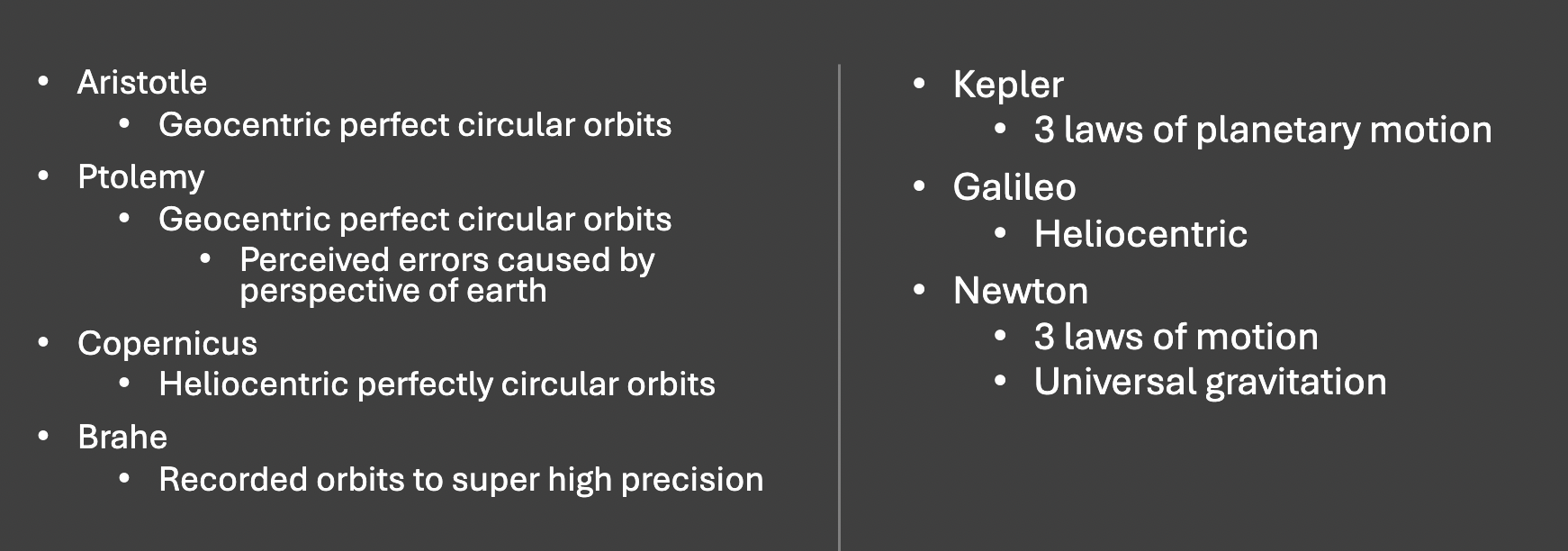
Key people (ancient)
What chronological order do the ancients go in?
Aristotle, Ptolemy, Copernicus, Brahe, Kepler, Galileo, Newton
What chronological order do the moderns go in?
Tsiolkovsky, Goddard, Von Brahn
Konstantin Tsiolkovsky
Father of Russian cosmonautics
Invented the delta v equation
Demonstrated why rockets would be needed for space exploration
Robert Goddard
Father of modern rocketry
Experiments with both solid and liquid fueled rockets were basis for development of ballistic missile, earth-orbiting satellites, and interplanetary exploration
Werner von Braun
Created the V2 rocket
What year was Sputnik
1957
What year was laika
1957
What year was Sputnik 3
1958
In what order were GRAB-1 (first successful recon sat), Sputnik, and USAFA Dept. Astro created?
Sputnik, Dept Astro, GRAB-1
In what order were GPS, returnable first-stage rocket, and sea-launched ASAT created?
GPS, ASAT, first stage
What year did the us launch their first satellite, and what was the name
Explorer 1, 1958
In 1958 & 1960, what programs did the US create
1958:
Air force's space and ballistic missile program
NASA
1960:
NRO
When was AF space command first established
1982
When was the US space command and US space force established
2019
What altitude is orbit sustained
130 km
What altitude does space begin, what it it called
100 km, karman line
Why do objects stay in orbit at 130 km
Drag decreases as density decreases
What are the effects on spacecraft from Charged particles
Spacecraft charging, Sputtering (sandblasting): Degrade solar panels, impact optics sensing. Mitigate by making redundant systems or shielding components
What are the effects of EM radiation
Generate electrical power = good, Heats up spacecraft = good and bad, Damage electrical equipment = bad, Disrupt communications = bad
Mitigate by making redundant systems or shielding components
What are the effects of a Free fall environment
Makes fluid measurements and delivery more difficult "sloshy" = bad, but allows us to develop super alloys and medicines = good.
No mitigation
What are the effects of Earth’s atmosphere
Drag: Difficult to predict but negligible above 600 km. Atomic oxygen: weakens structures and degrades sensors.
Mitigate through new coatings and physical protections.
What are the effects of the vacuum of space
Outgassing, cold welding, Limited heat transfer: conduction (can lead to cold welding), convection (there's no airflow), radiation (works great)
Mitigation: none
What are the effects of micrometeoroids and space junk
Can cause lots of damage at high speeds, difficult to track (the SSN is tracking 60,000 pieces)
What are the different manmade hazards
Space debris (old satellites, rocket bodies, launch vehicle shrouds), EM interference, and EMP
What are all orbits shaped like
Conic sections:
Circle
Ellipse
Parabola
Hyperbola
When does a satellite stay in orbit
Horizontal velocity allows the horizon to drop away before the spacecraft
For a orbit, what is the tradeoff for a satellite between
Coverage, latency, and vulnerability
What are LEO orbits and give some characteristics and missions
Low earth orbits
Closer and faster
Better resolution with worse coverage
ISR, communications
What are MEO orbits, give characteristics, and missions
Medium earth orbit: between leo and geo
Moderate coverage, affected by radiation belts
PNT (GPS, Galileo, GLONASS, BeiDou)
What are GEO orbits and give some characteristics and missions
Geo-synchronous/stationary earth orbits Closer
Farther away and slower
Better coverage and worse resolution
Continuous comms, missile warning, weather
What are HEO orbits and give some characteristics and missions
Highly elliptical orbit with long dwell over high latitudes
Great for polar coverage
Communications, ISR, missile warnings
What are the 6 Military Space Ops
SATCOM, PNT, Combat Power Projection, SDA, ISR, Detections Monitoring and Warning
Describe PNT usage, satellite coverage, and examples
Precision strike, logistics, maneuver support
Requires 4 satellites for location and time
GPS, JDAM, Blue force tracker
Describe SATCOM usage and examples
Beyond line of sight communications
Enables global C2 and secure links
Military SATCOM networks, AEHF
Describe ISR usage
Imagery and signals intelligence
Detects changes across the em spectrum
Supports operation planning and situational awareness
What does the SDA do
Tracks over 60000 objects in orbit
Prevents collisions and identifies threats
Uses ground and space based sensors
Describe the core military mission of Detections Monitoring and Warning usage and examples
Infrared sensors detect launches
Strategic and tactical alerting
Weather satellites aid mission planning
SBIRS constellation
Describe core military mission of Combat Power Projection usage
Space superiority is necessary precondition for joint force success
Space control includes
Orbital strike, space link interdiction, and terrestrial strike via jamming, EM, cyber, kinetic strikes
What are the components of a space system (threat assessment)
Space segment, link segment, ground segment, user segment
What is the USSF doctrine
Maps the operational environment of space to provide warfighters a complete picture of the threat environments fused with intelligence
What are the four dimensions of space domain awareness
Physical, virtual, information, and human
What is the defense/mitigaiton against electronic warfare
Nulling, frequency hopping, proliferation, direct attack
Defense/mitigation for cyber attacks
Cybersecurity, Encryption, Nulling
What is directed energy
Offer broad range of effects using lasers, high powered microwave or millimeter wave emitters, and particle beam weapons
Defense/mitigation for directed energy
Physical hardening, shielding, coatings
Proliferation
Decoys
Direct attacks
Defense/mitigation against orbital threats
Proliferation
Maneuver
Decoys
Direct attacks
Defense/mitigation against ASAT kinetic weapons
Proliferation
Maneuver
Decoys
Direct attack
Defense/mitigation against high altitude nuclear detonation
Radiation hardening
What are the 2BEOM assumptions?
Drag negligible
No Maneuvers
No 3rd body
Only Forces are due to gravity
Mass of Earth >> Satellite
Earth is a point mass
Mass of Satellite is constant
Inertial Frame
Which assumptions are false?
Earth as point mass - it is actually oblate, causing the J2 effect, affecting RAAN and Arg. Perigee
Drag as negligible - it is not, it actually affects a (semimajor axis) and e (eccentricity)
What orbits take advantage of the J2 effect?
Molniya (63 degrees, highly eccentric, focuses on northern hemisphere)
Tundra (115 degrees, almost geostationary but not over equator)
Sun-synchronous (passes same spot at same time every day)
Active Sensor and examples
Emit electromagnetic radiation and collect reflection - SAR, liDar
Passive Sensor and examples
Collect electromagnetic radiation emitted or reflected by subject - visible, infrared
Stephan Boltzmann Law
Defines the total power (W) emitted by an object given a temperature

Weins Law
Defines the wavelength of peak emission
Field of View
Angle that a satellite can see
Swath Width
The distance the satellite can see on the ground
What limits the minimum altitude of a satellite?
Swath width
What limits the maximum altitude of a satellite?
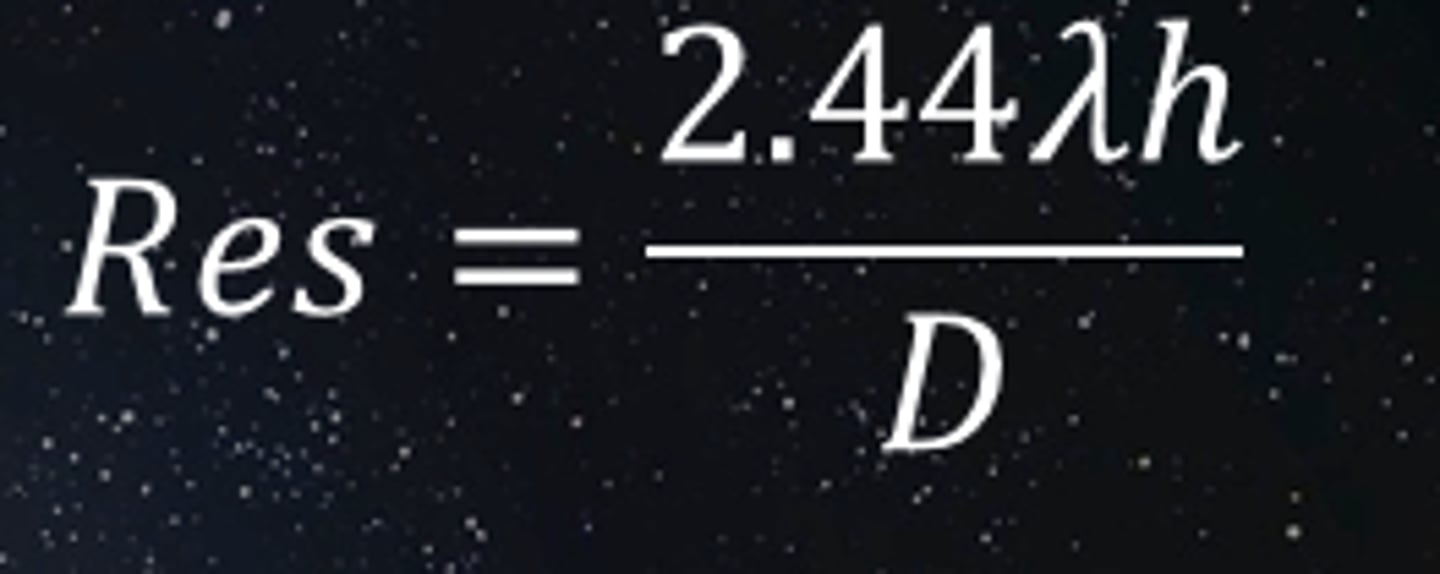
Resolution
Spatial Resolution
The size of the smallest object that can be identified in an image
Ground Sampling Distance
Distance between the centers of two consecutive pixel measurements on the ground. Ex: GSD=1 then each pixel is 1m x 1m
National Image Interpretability Rating Scale (NIIRS)
Subjective scale of readability assigned to an image by an analyst
Electromagnetic Field
Accelerated electric charge that creates radiation waves that convey/carry energy
Antennas
Transducer between guided RF wave and Free space RF wave, usually metallic
Gain
the ratio of power/RF energy directed in a particular direction, ie how strong your RF energy is
Loss
Gain less than 1
Isotropic Radiator
The baseline measurement where gain=0 and goes in any direction
Modulation
Putting information (the message signal) onto an RF carrier by altering the pure carrier signal (wave)
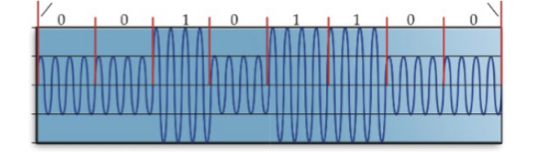
AM (amplitude modulation)
a high or low amplitude corresponds to 0 or 1
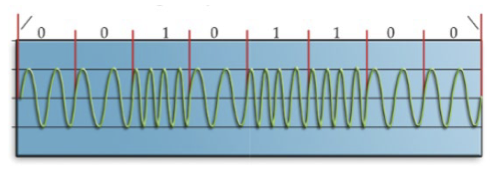
FM (frequency modulation)
where the instantaneous frequency shifts to, compared to the carrier frequency, corresponds to 0 or 1
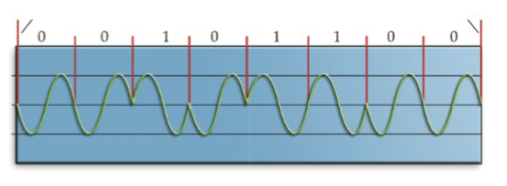
Phase shift keying
the length of the phase corresponds to a 0 or 1
Uplink
ground station to satellite
Crosslink
satellite to satellite
Downlink
satellite to ground station
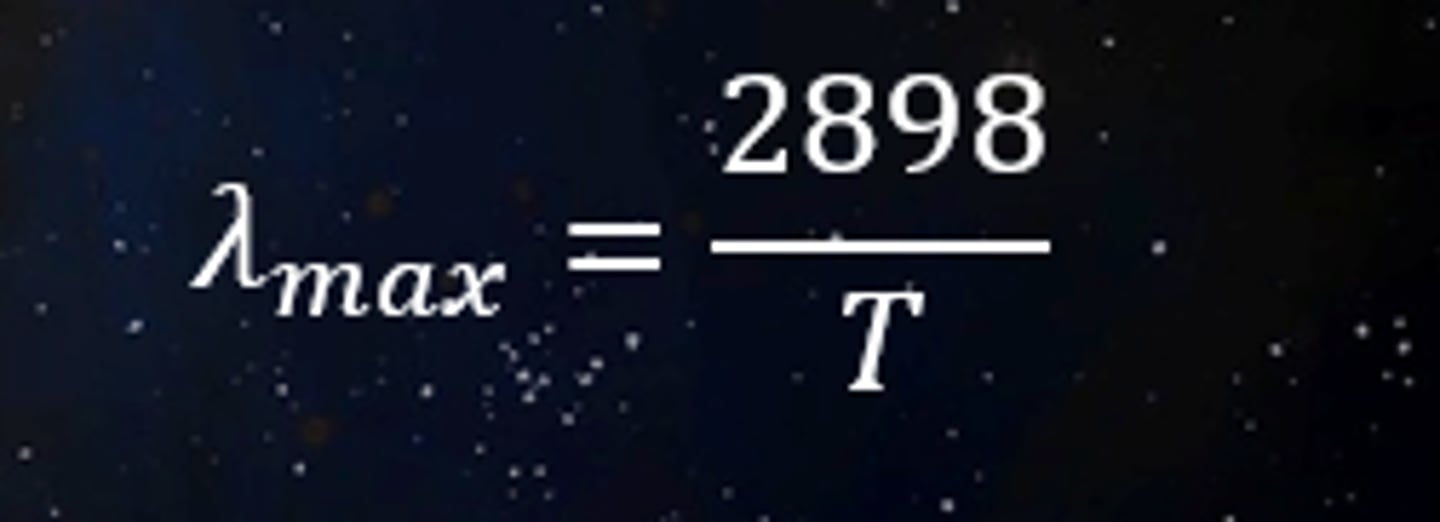
Wien’s Law
max wavelength (lambda max) = 2898/T (temp in Kelvin)
Free Space Loss
Signal spread out on surface of a sphere centered on the transmit antenna, as signal goes further the sphere expands and the power is dispersed, leading to loss
Figure of Merit for an Antenna
A single quantitative measure that combines the most important antenna performance characteristics into one value so different antennas can be compared for a specific mission or application
Gr/T
Figure of Merit for receive antennas, gain of antenna over Temperature, measures how well it can receive weak signals compared to the noise it produces
RF noise
Pn = k *T * B , more noise = higher equivalent temperature
Signal to Noise Ratio (SNR)
Quality rating of RF link, bigger is better, C/N = Signal power/ noise power
Eb/No
The SNR in digital satcom
Equivalent Isotropic Radiated Power (EIRP)
Figure of merit for transmit antennas, RF power equivalent to that radiated from a single point in all directions
Closed loop control system
Input, Controller, Actuator, Plant, Output, Sensor
Difference between open and closed loop systems
Open loop systems do not have a sensor - they cannot gather feedback from the system and use it to make decisions in the future
Input
An order
Controller
Translates and inputs order into an action command
Actuator
Takes commands from controller
Plant
System being manipulated
Output
desired effect
Sensor
Measures output and gives info to controller
Attitude
The rotational orientation of an object with respect to a particular reference frame
Disturbance Torques
Aerodynamic Drag, Gravity Gradient, Solar Radiation Pressure, Magnetic Torque
Active Actuators
Thrusters, Magnetorquers, Reaction wheel, Momentum wheel, Control Moment Gyro
Passive Actuators
Gravity-gradient stabilization, spin stabilization, dampers
Attitude Sensors
sun/earth/star sensors, gyroscope, magnetometer, differential GPS
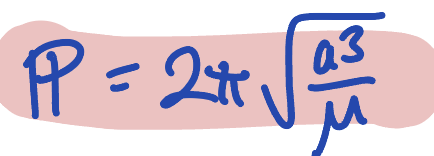
Equation to find period from altitude/height
where a = Radius(earth) + h