L5 - Mechanical Properties: Tensile
 Call Kai
 Learn
Learn Practice Test
 Spaced Repetition
 Match
Match Flashcards
 Knowt Play
1/32

There's no tags or description
Looks like no tags are added yet.
Name | Mastery | Learn | Test | Matching | Spaced | Call with Kai | Chat |
|---|
No analytics yet
Send a link to your students to track their progress
33 Terms
What can the mechanical properties of a material be affected by?
Alloying
Temperature
Previous working
Heat Treatments
The Tensile Test
The applied load (or force), F, and the extension dl = l - lo are continuously measured as the test piece is extended at a constant extension rate
What does the extensiometer do?
It measures local specimen strain (extension)
Tensile test graph
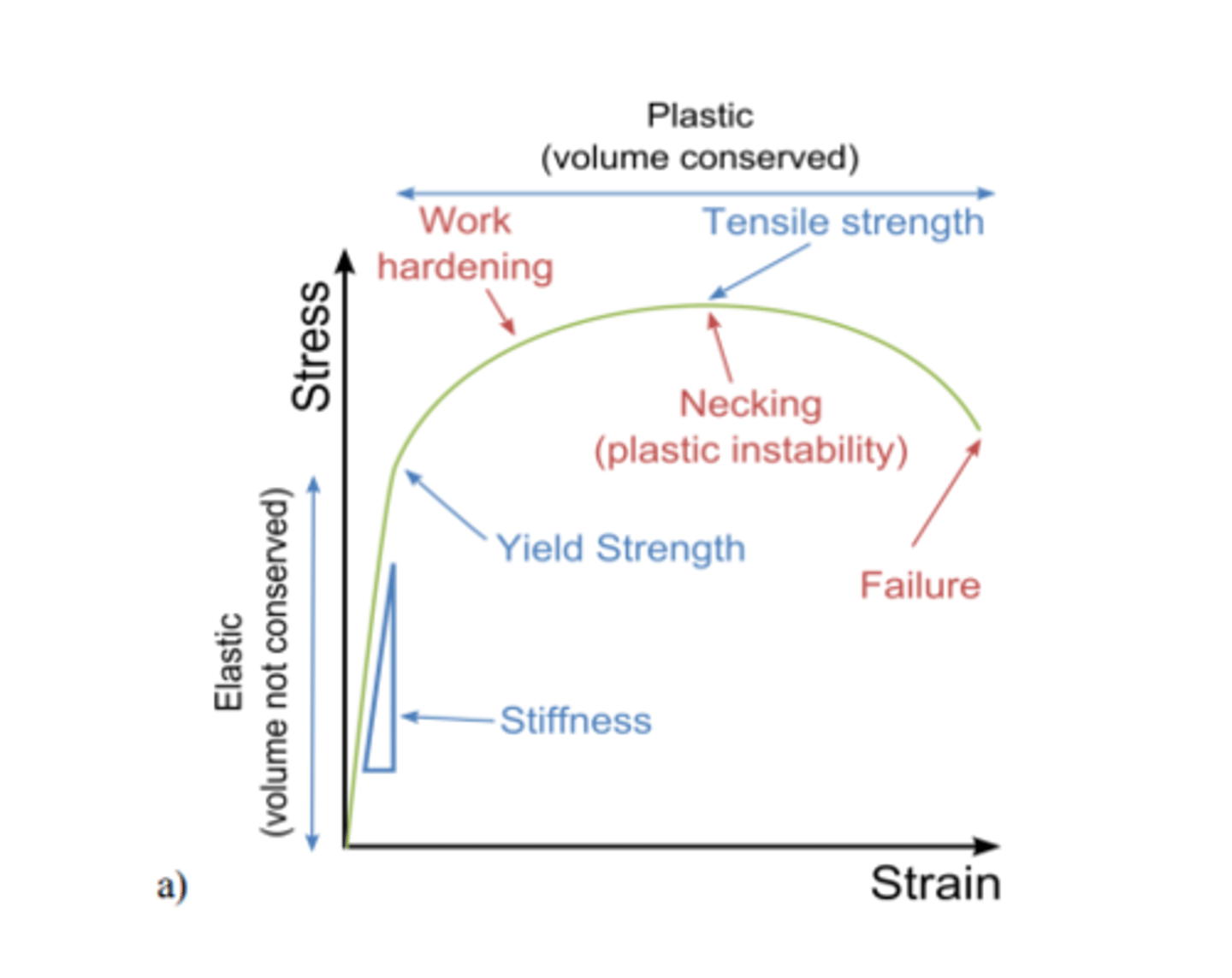
Which section of the graph shows Elastic deformation?
The linear part, as at this section, the material can return to its original length when the stress is removed
Which section of the graph shows Plastic deformation?
The section after the linear part, at this section, if the load is removed the material will never return to its original shape
What is the point from which the material switches from elastic to plastic deformation called?
Yield Stress
What is Stress?
It is the force, F, acting during deformation, divided by the cross-sectional area of the material, A, over which the force acts: σ = F/A, units - Pa
What is Strain?
Strain, e, is the fractional amount by which a material deforms (e.g. extends)
ε = (I - Io)/Io = ΔI/Io, no units - its dimensionless
What is Hooke's Law?
The applied load F, is linearly proportional to the extension ΔI, for elastic deformation
σ = E x ε, E = Young's Modulus
What is the Young's Modulus?
It is a measure of a material's stiffness, equal to the gradient of the linear (Hooke's law) region of the stress-strain plot
Like other mechanical properties of a material, is the Young's Modulus affected by alloying or heat treatment?
No.
Unlike strength and ductility, Young's modulus is not affected
What does work-hardening mean?
When a metal is plastically deformed, dislocations in its crystal structure multiply and tangle, making further deformation increasingly difficult.
This makes the metal stronger and harder, but less ductile.
What are Luders bands?
Lüders bands are visible lines or markings that appear on the surface of a metal when it beings to yield.
These are caused by localised plastic deformation spreading across the material, before uniform plastic flow beings
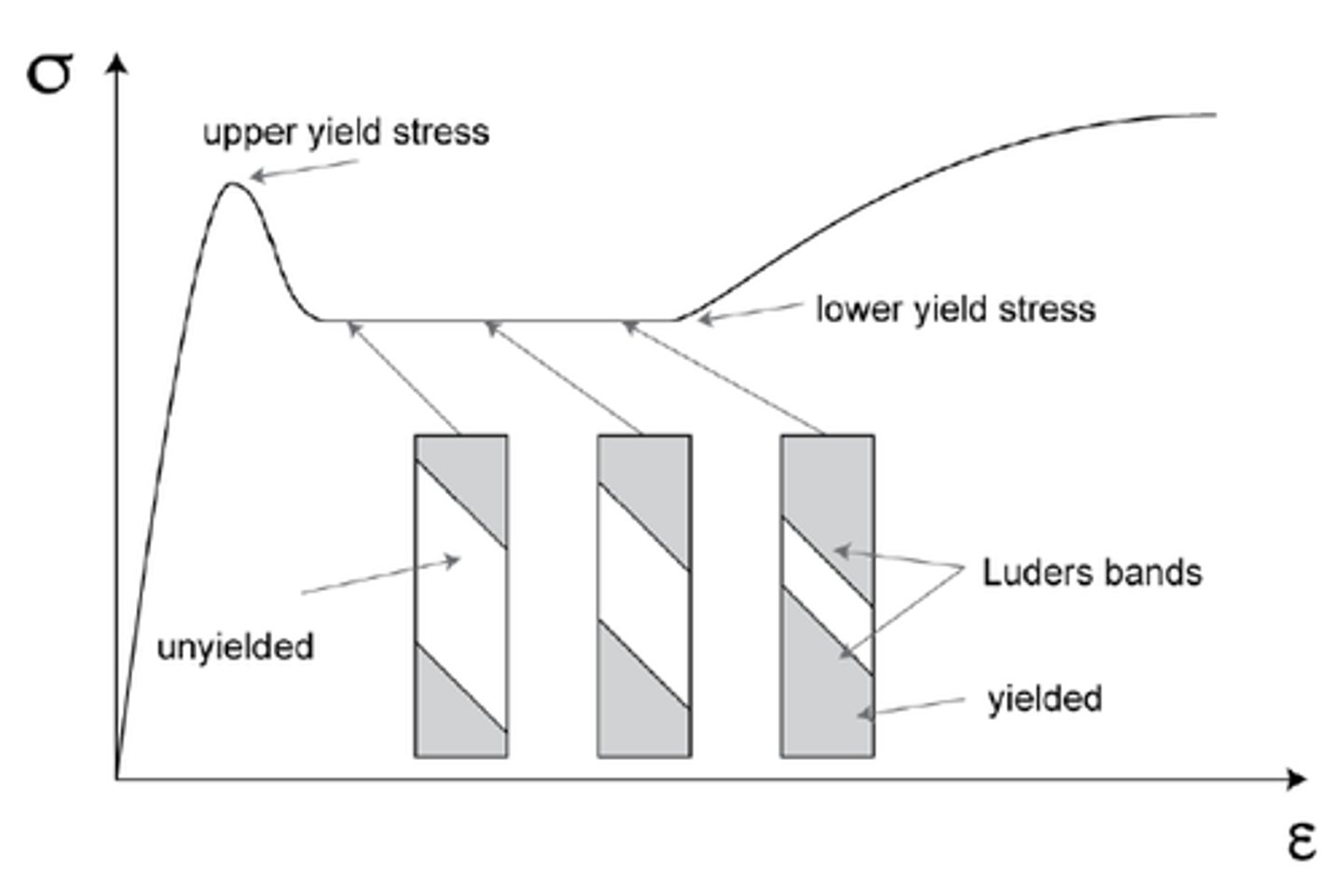
What happens at the Upper Yield Strength in terms of Lüders Bands?
One or more Lüders bands of plastic deformation spread across the specimen.
Outside the band, all deformation remains elastic
What happens at the Lower Yield Strength in terms of Lüders Bands?
Each band spreads sideways until the entire length of the specimen has yielded
What is Proof Stress?
It is the stress necessary to produce a plastic strain
What happens to the specimen after the UTS?
A 'neck' forms
As after the UTS all plastic deformation is concentrated in the neck
Final fracture occurs in the neck
Define Ductility.
A material's ability to be plastically deformed without breaking under tensile loads (e.g. stretching, or in a tensile test)
Define Malleability.
A material's ability to be plastically deformed without breaking under compressive loads (e.g. forging, rolling, or in a compression test)
What does it mean when a material is described as brittle?
It has low ductility, meaning it undergoes a very little amount of plastic deformation before it fractures
How can the ductility and malleability of a material be improved?
By heating - hence forging, rolling etc are often done hot.
What happens to some steels at low temperatures?
Some steels become very brittle, very quickly
What does the area under a stress-strain curve represent?
Energy per unit volume (Jm^-3) required to deform the material.
What mechanical properties do 'tough' materials have then?
They are strong and ductile
What does plastic deformation require?
It requires dislocations to move 'slip' through the crystalline latice.
How can you increase yield strength?
You can change the microstructure of a material in various ways so that it hinders the movement of the dislocations
Alongside work-hardening, what other methods could you do to increase the strength of a material?
Grain size reduction
Solid-solution strengthening
Precipitation strengthening
How does reducing the grain sizes mean stronger materials?
- Dislocations can't slip across grain boundaries
- So, after slipping through the grain lattice, they will get stuck at the first grain boundary.
- They'll meet and pile up and then can't contribute to further plastic deformation shape change.
- Smaller grains means more grain boundaries
- So shorter dislocation-slip distances before they get stuck on a grain boundary.
- Hence the dislocations can't slip as far under stress
- Which means more applied stress is needed to plastically deform the material
- Thus the material is stronger
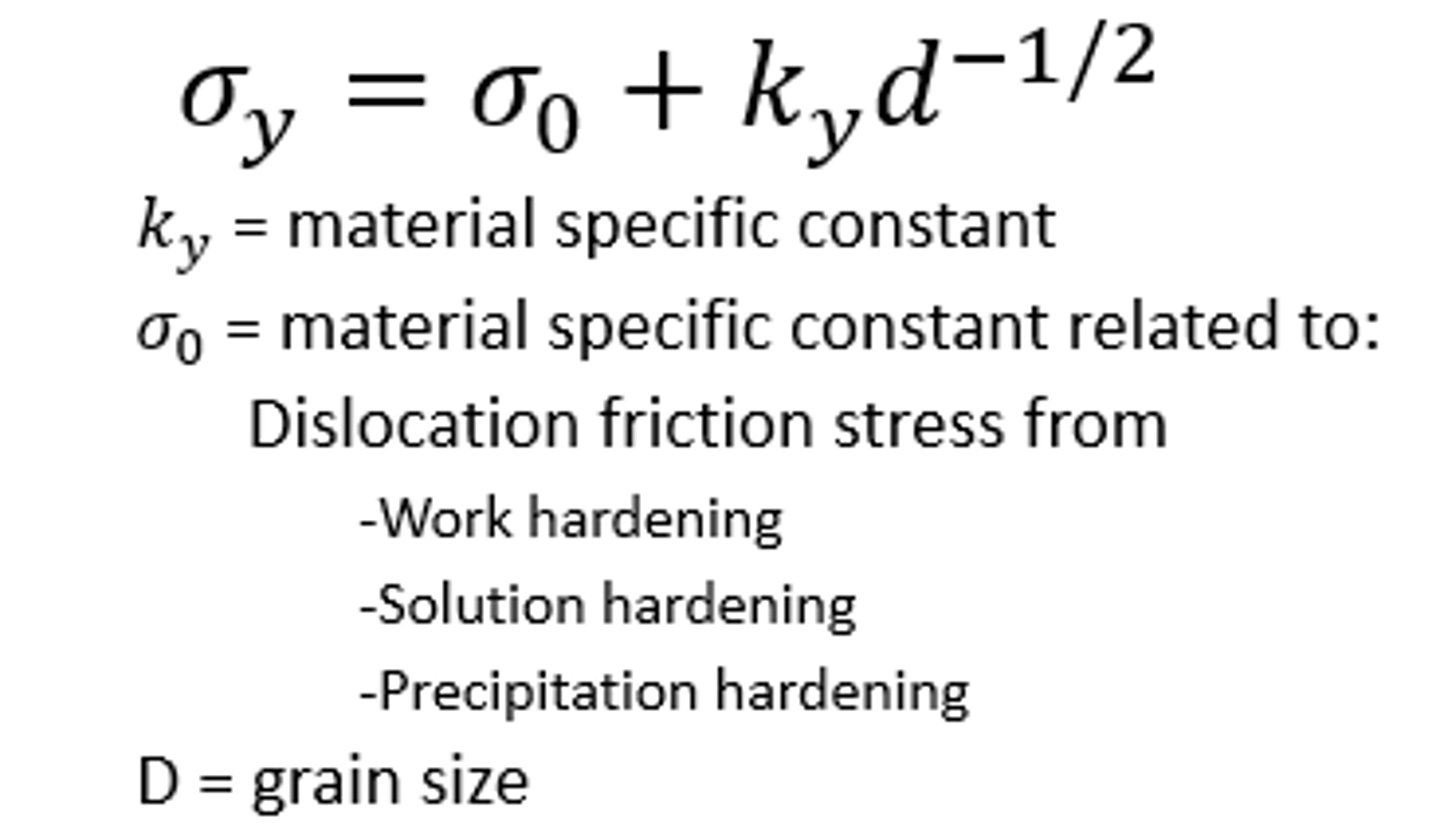
What is the Hall-Petch equation?
The relationship between yield stress and grain size for some metals.
I.e. the strength is inversely proportional to the square root of average grain size
How does Solid-solution strengthening work?
- A different individual alloy atom is added which causes the lattice around it to become distorted
- The associated stress field around it acts to hinder dislocations moving when a load is applied
- Making the alloy stronger (increasing the yield stress and strength)
How does Precipitation strengthening work?
- The different alloy atoms can react to form chemical compounds
- Creating very small intermetallic compound precipitates of fixed composition within the solid metal
- The distortion and strain fields locally around each precipitate hinders the slip of dislocations during deformation
- This increases the yield stress and strength
What does precipitation strengthening usually require?
Very careful alloying and heat-treatment (sometimes called ageing)