Exam 3: Chapter 18 Integrated Marketing Communications Vocab
 Call Kai
 Learn
Learn Practice Test
 Spaced Repetition
 Match
Match Flashcards
 Knowt Play
1/18

There's no tags or description
Looks like no tags are added yet.
Name | Mastery | Learn | Test | Matching | Spaced | Call with Kai |
|---|
No analytics yet
Send a link to your students to track their progress
19 Terms
Promotional Mix
combination of one or more communication tools used to
inform prospective buyers about benefits of the product
persuade them to try it
remind them later about the benefits they enjoyed by using the product
Advertising
any paid form of nonpersonal communication about an organization, product, service, or idea by an identified sponsor
Personal Selling
2 way flow of communication between a buyer and seller designed to influence a person’s or group’s purchase decision
usually face-to-face communication between sender and receiver
controls who they are talking to and does not waste communication with people they don’t want to target
Public Relations
form of communication that seeks to influence the feelings, opinions, or beliefs held by customers, prospective customers, stockholders, suppliers, employees, and other publics about a company and its products or services
Sales Promotion
short-term inducement of value offered to arouse interest in buying a product or service
Direct Marketing
use direct communication with consumers to generate a response in the form of an order, a request for further information, or a visit to a retail outlet
Product life Cycle and Promotion Strategy
Introduction: to inform
Growth: to persuade
Maturity: to remind
Decline: to phase out
Product Characteristics
Complexity: the technical sophistication of the product and the amount of understanding required to use it
Risk: amount of risk represented by the product’s purchase, for the buyer it can be assessed in terms of financial, social, and physical risk (greater the risk, the greater the need for personal selling)
Ancillary Services: degree of service or support required after the sale
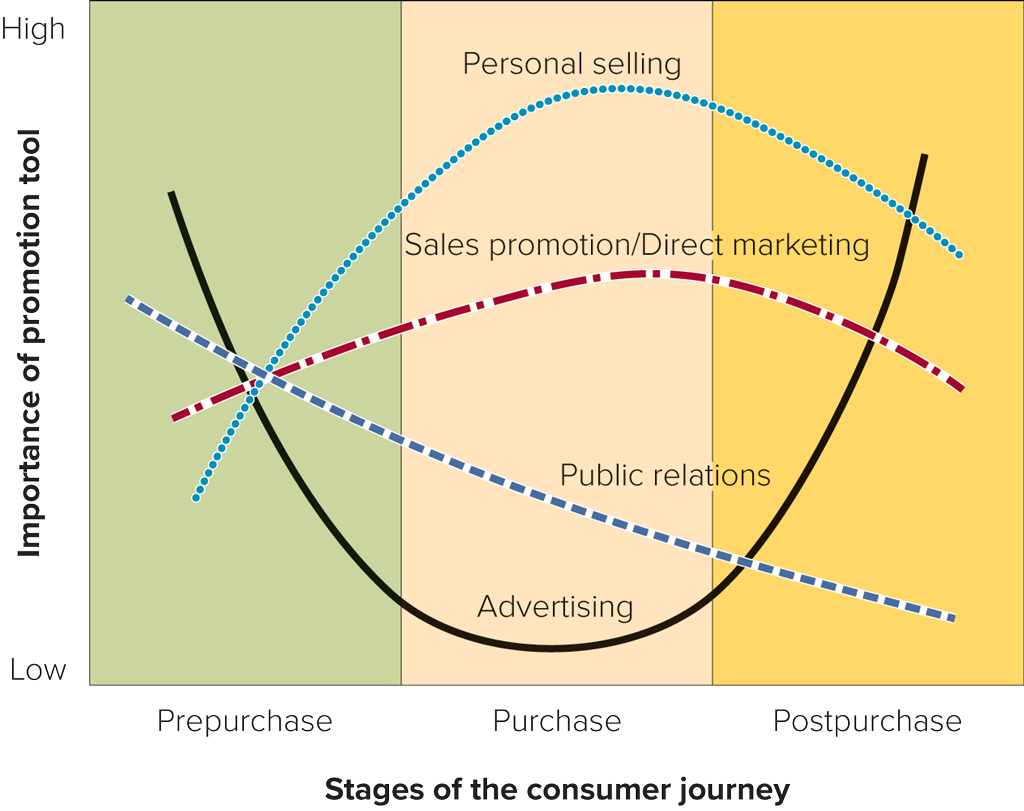
Stages of the Consumer Journey
Repurchase Stage: advertising is more helpful than personal selling because advertising informs potential customer of the existence of the product and the seller
Purchase Stage: importance of personal selling is highest
Post Purchase Stage: salesperson is still important, the more personal contact after the sale the more the buyer is satisfied
Push Strategy
directing the promotion mix to channel members to gain their cooperation in ordering and stocking the product
Pull Strategy
directing promotional mix at ultimate consumers to encourage them to ask the retailer for a product
Promotional Decision Process
Who is the target audience?
What are the promotion objectives, the amounts of money that can be budgeted for the promotion program, and the kinds of promotion to be used?
Where should the promotion be run?
When should the promotion be run?
Percentage of Sales Budgeting
allocating funds to promotion as a percentage of past or anticipated sales, in terms of either dollars or units sold
Competitive Parity Budgeting
allocating funds to promotion by matching the competitor’s absolute level of spending or the proportion per point of market share
All-You-Can-Afford Budgeting
allocating funds to promotion only after all other budget items are covered
Objective and Task Budgeting
allocating funds where the company
determines promotion objectives
outlines the tasks to accomplish those objectives
determines the promotion cost of performing those tasks
Direct Orders
the result of directing marketing offers that contain all the information necessary for a prospective buyer to make a decision to purchase and complete the transaction
AKA the customer can act right away(buy, sign up, order) based on the message
Lead Generation
result of an offer designed to generate interest in a product or service and a request for additional information
generating leads
Traffic Generation
outcome of an offer designed to motivate people to visit a business