ANTH 168 Ch 10/11
 Call Kai
 Learn
Learn Practice Test
 Spaced Repetition
 Match
Match Flashcards
 Knowt Play
1/42

Earn XP
Description and Tags
Early Members of the Genus Homo and Archaic Homo
Name | Mastery | Learn | Test | Matching | Spaced | Call with Kai |
|---|
No analytics yet
Send a link to your students to track their progress
43 Terms
Definition of the genus Homo
has characteristics that define humanness, such as large brain size, smaller & flatter face, smaller jaws & teeth, increased use of culture, larger overall body size, longer legs, and shorter arms
implements adaptive strategies and use of the environment
Climate change
a big factor that influences human evolution and can be assessed in several ways
Climate change during the Pliocene
2.3-5.6 mya, cool and drier climate, warmer than today
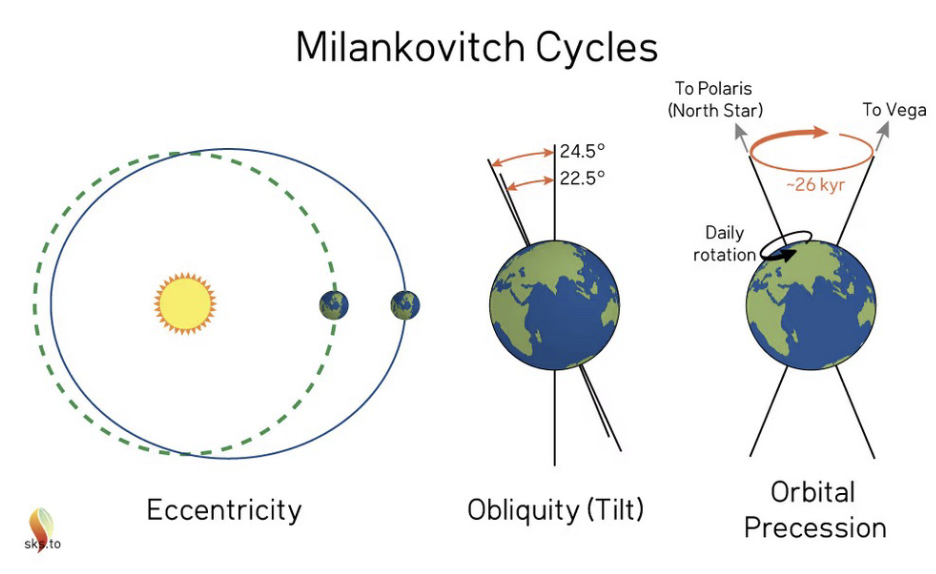
Milankovitch Cycles and Global Cooling
describes the collective, long-term changes in Earth's movements: eccentricity (100k years), tilt/obliquity (26k years), ice age periodicity of 100k years
Eccentricity
the shape of Earth’s orbit around the Sun fluctuates from less to more elliptical, changing the amount of exposure to solar energy, which has a full cycle of 100k years
Tilt/Obiquity
The angle of Earth’s axis tilt changes every 26k years. A smaller tilt means less seasonal contrast and cooler summers, which allows ice to build up in high latitudes
Pleistocene Epoch Climate Change
11kya - 2.6mya, cycles between interglacial and glacial, geography and climate affect hominin migration, paleoclimate of africa
Homo adaptions to climate change
new foods, cultural solutions, behavorial change
Places where water locked up during glacial periods
indonesia, sumatra, borneo, java connected to southeast asia mainland
geographical changes due to climate change
new guinea becomes a part of africa
siberia and alaska are connected viz Beringia (land bridge)
Homo habilis
1.7-2.5 mya, 650 cc, rounded skull — less facial prognathism, smaller teeth, thinner enamel — parabolic dental arcade, postcrania similar to Australopithecus
found in east and south africa
Controversy on H. habilis
brain size very variable, more arboreal, body proportions unknown, suspected Au. behaviors, and statistical analyses support a separate genus designation
Culture and Lifeways of the H. habilis
Oldowan — oldest stone tool industry, 1.6 - 2.5 mya, “flake and chopper” tools used to butcher animals
indicates that H. habilis are meat eaters and ingest more protein and calories
Evidence of Stone Tools and Diet (H. habilis)
cut marks on bone, leg bones often cracked open to extract nutritious marrow
scavenging carcasses from large cats
microscopic wear patterns (phytoliths) suggest plant processing, such as: wood, tubers, and grass seed
Homo erectus
200 kya - 1.8 mya, 900cc long low skull, thick cranial bones, sagittal keel, less prognathism, smaller teeth, receding chin, more modern body size and proportions
found in africa, asia, and europe
African H. erectus vs Asian H. erectus traits
Asian specimen displays a thicker skull, larger sagittal keel and larger brow ridges than African specimen
splitters classify the Asian specimen as H. erectus, but the Africa specimen as H. ergaster
H. erectus tool making and use
1.5 mya, Acheulean tool industry, symmetrical bifacial flaking —- shows signs of planning, skill, coordination, cooperation
forms: handaxes, scrapers, cleavers, flake tools
H. erectus subsistence and diet
more meat eating, large brain (brains consume 20% of caloric intake), scavenging or hunting (?), more dietary variability: primarily roots, bulbs, tubers
H. erectus food cooking consequences
smaller tooth & jaw size, larger brain, larger body, smaller gut
signs of earliest fire (H. erectus)
Kenya, 1.5 mya
Life history of H. erectus implications
overall pattern of growth, development, and reproduction
modern hunter-gatherer societies, mosaic evolution, multiple species (?), developmental plasticity.
breaking the stigma of homo ancestors
caveman depictions in media are overly simplistic, misleading, and ultimately incorrect — we share a great deal with our archaic Homo ancestors
changing environments during the mid pleistocene epoch
impact on temperatures and sea levels, glaciation, interglacials, dramatic swings in climate — 15 major and 50 minor glacial events in Europe alone
Interglacial events
alternation between glacial and warm periods
Glacial Refugium
global cooling periods shift plant and animal communities to lower latitudes
Surviving the Middle Pleistocene
easier to survive with generalistic compared to specialist traits (e.i. raccoons), archaic ancestors would adapt to shifting landscapes, migratory changes, and latitude changes in biota
Defining characteristics of the old world/middle pleistocene
200-600kya, transition between H. erectus and H. sapiens
splitters schizo-calling transition species between H. erectus and H. sapiens
H. antecessor, H. heidelbergensis, H. georgicus, H. neanderthalensis, H. rhodopensis
Archaic Homo
<1100 cc, less angular and higher skulls & smaller brow ridges than erectus, also wider nasal apertures, midfacial prognathism, robust post cranial regional variation
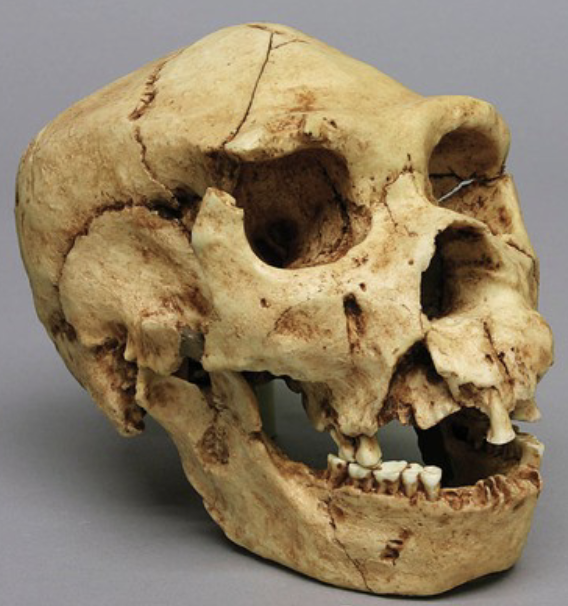
Examples of the archaic homo
Broken Hill man — found in Zambia, H. erectus-like skull
Atapuerca 5 archaic H. sapiens — found in Northern Spain, nearly complete skeleton w/ traits foreshadowing Neanderthals
H. neanderthals
35-150 kya, 1500 cc, adapted to ice age climate, extreme and robust version of traits seen in other archaic H. sapiens (basically think everything like big), postcranial — short and stocky body, increased musculature, barrel-shaped chest
found in Neander valley, western Europe, middle east, western asia
H. neanderthals culture and behavior
Mousterian tools: lavallois technique
smaller, thinner, and lighter than Acheulian axe, removed edges of cortex before removing ‘lid’
flakes then used as cutting tools
saved, re-used tools (not single-use)
Glue, close-range hunting, care-taking, deliberate burials (first of its kind), grave goods, ritual, communication, intelligence
fastened/hafted stone tools on short pieces of wood or antler bone
hunted in large-bodied animals in groups
had injuries in head, beck, and back similar to rodeo riders
H. neanderthals diet
isotopes suggest a diet high in meat (80%, like wolves)
ibex, seals, rabbits, and pigeons
Iraqi specimens showed more varied diets with date palms, wheat, barley
Significance of Shanidar 1
a H. neanderthals skull that showed evidence of healed facial injury leading to blindness, lower right arm was missing and right humerus showed extreme atrophy
healing suggests care-taking behavior, which was thought to be a human characteristic (taking care of sick, injured elderly)
H. neaderthals burial practices
bodies interred into flexed position, debates over pollen, grave goods, and other ornamentation placed into grave sites
red ochre and manganese dioxide found at site and used for artistic impressions
Dr. Svante Pääbo
from the Max Plank Institute of Evolutionary Anthro
won Nobel in 2022 for sequencing the first Neanderthal genome
formalized a new field of study in anthropology, paleogenomics
H, neanderthals vocal speech
throat anatomy and genetic evidence support this — hyoid bone found at sites indicating the ability to control vocal chords — alleles on FOXP2 gene shared w/ humans
H. neanderthals African contemporaries
middle stone age (MSA) fossils
30-300 kya, anatomical features correspond to modern H. sapiens
some stone tools resemble Mousterian, some Levallois
flexibility of behavior and adaptability to local environment
The end of Neanderthals!!!?
climate change, volcano in Europe, lack of innovation, brain differences, reproduction, modern human expansion…?
we don’t know lol
Homo Naledi
236-335 kya, 500 cc, derived and precise hand characteristics, smaller bodied like larger Au., defined supraorbital torus, sagital keeling smaller than H. erectus, mandible more gracile than other Homos, no mental eminence, probable tool use, evidence for use of fire and purposeful burial
found in Rising Star Cave, South Africa
Homo floresiensis AKA the dwarf
50-190 kya, 400 cc, like 3-4 ft tall, large teeth for small size, no mental eminence (small), receding forehead
found in Flores, Indonesia
H. florensiensis diet and culture
hunted small elephants and large rodents
made and used stone tools, and fire
Nuchal Torus vs Occipital Bun
ridge on back of skull, lower vs fully rounded extension