Psychopharmacology: Exam 2 Review
 Call Kai
 Learn
Learn Practice Test
 Spaced Repetition
 Match
Match Flashcards
 Knowt Play
1/88

There's no tags or description
Looks like no tags are added yet.
Name | Mastery | Learn | Test | Matching | Spaced | Call with Kai |
|---|
No analytics yet
Send a link to your students to track their progress
89 Terms
To review: What is a half-life of a drug?
The time that it takes for a drug concentration in the body to be reduced by 50%
(Drugs with a long half-life stay in the body for longer, at close to their initial strength)
Subsection 1: Pharmacodynamics
What is a dose-response curve?
Measures the magnitude of a drug’s effects as a function of the dose
Relatedly: What is potency?
The amount of drug needed for a desired effect
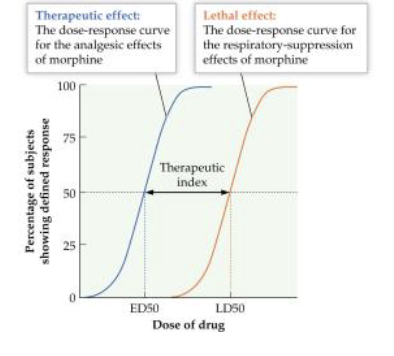
What is the Therapeutic Index & Margin of Safety? What does it measure?
Assesses the ‘safety of a drug’
*The lower an Index score is, the more dangerous the drug!
In most cases, what is the standard formula for the Therapeutic Index & Margin of Safety?
*Lethal dose/desired effect OR LD50/ED50
*The lethal dose is ‘lethal’ for at least 50% of the general population!
Relatedly (Therapeutic Index & Margin of Safety), what is the danger of an index margin that is too close together?
This is a dangerous margin: there is little to no differentiation between lethal effects and recreational ‘harmlessness’
What is a pharmacodynamic drug interaction?
When drugs affect each other at a receptor site
Example: alcohol + benzodiazepines = “enhanced sedation”
What is tolerance?
When a sustained amount of drug is needed to produce the same effects
What are the three main types of tolerance (or the ways that tolerance presents)?
Cellular
Behavioral
Metabolic
What is withdrawal?
The onset of physiological symptoms that occur after drug discontinuation
Subsection 2: Intro to Stimulants
What is a stimulant?
Any substance that increases activity in the central nervous system (CNS)
Alertness, attention, energy & mood are boosted
What are some examples of popular stimulants?
Cocaine
Caffeine
Nicotine
Prescription medications like Adderall
How is cocaine made?
Active ingredient: coca (from the coca plant, native to South America)
First isolated from plant in 1855
What were some of the main uses of cocaine?
Among Indigenous peoples in South America’s Andes region: coca leaves were chewed and used in teas
Used as a “nerve blocker”/anesthetic in the 1800s
Coca: added to French wines and Coca-Cola
When was cocaine re-popularized?
The “cocaine boom”: 1970s-1980s
*High-class status symbol → crack cocaine and social stereotypes
What are the forms of cocaine?
Coca leaves (oral administration, lower ‘cocaine’ concentration)
Powder (intra-nasally, often combined with cornstarch)
Freebase (chemical ‘base’ removed): separates cocaine from acid to improve lipid solubility
Crack (quicker high) separated by using baking soda
Arrange these modes of administration by ‘speed of entry’ (to the brain, fastest to slowest):
injected, snorted, oral, and smoked
Smoked → injected → snorted → oral
What major enzyme system allows cocaine to be metabolized?
The cytochrome P450 enzyme in liver
(from cocaine to norcocaine)
What bodily pathways does cocaine inhibit? What endogenous hormones are blocked or secreted?
*Cocaine blocks sodium channels in the body’s “pain pathways”
The re-uptake of dopamine, norepinephrine & serotonin is blocked!
Once the re-uptake of dopamine is inhibited by cocaine, what changes are created in the brain?
*Blocked re-uptake leads to INCREASED dopamine in:
Basal ganglia: movement
Prefrontal cortex: decision-making
Ventral tegmental area & nucleus accumbens: reward and motivation
What additional endogenous hormones are INCREASED when dopamine is inhibited by cocaine?
Increased serotonin: affects mood, sleep, and appetite
Increased norepinephrine: ‘fight or flight’ reactions
What is one particular class of cocaine’s acute effects?
*Sympathomimetic effects: mimic effects of the sympathetic nervous system
Examples include: anxiety, increased heart rate, arrhythmia
What are some adverse effects of cocaine? How many times must a drug be used before effects are seen?
Irritability, hostility, anxiety, heart attack
* Some effects depend on the route of administration, but effects can happen after just one use!
How much larger than the “typical dose” must a single dose be in order to be considered fatal (to the general population)?
A dose 15 times larger than usual can be fatal in 50% of people
(remember: LD50)
What term refers to the pharmacodynamic drug interaction that occurs between cocaine and heroin?
“Speedballing”: the combination of a stimulant and a depressant (opioid)
What are the dangers of cocaine use during pregnancy?
*Constricts blood flow to the placenta
(Long-term effects are unclear)
Dependence: Are there any FDA-approved addiction treatments for cocaine use?
Not at this time
Stimulants: Micro-section/ Intro to Amphetamines
What are some characteristics of amphetamines? How does it differ from cocaine?
Globally, amphetamines are more popular than cocaine
More potent
Easily synthesized
Many more routes of administration
From which plant are amphetamines derived?
Derived from ma huang (used in traditional Chinese medicine)
Ma huang was originally used as a decongestant (for asthma, etc.)
What are some significant time periods in the history of amphetamines?
1930s-1960s: amphetamine “boom”
By 1960s: “Speed Kills” anti-drug campaigns
What are common uses for amphetamines?
*Used to treat ADHD and narcolepsy (tendency to fall asleep in relaxing settings)
What are the different molecular “hands” of an amphetamine?
Amphetamines: left and right-handed molecules (also called mirror-image molecules)
*Left-hand: levo-amphetamine
*Right-hand: dextro-amphetamine
What does each “hand” of an amphetamine do?
Levoamphetamine (left hand): A less potent CNS stimulant, provides longer duration of action
Dextroamphetamine (right hand): A stronger CNS stimulant (used to treat ADHD/narcolepsy) that increases neurotransmitter activity in the brain
How is methamphetamine created? How does it differ from an amphetamine?
Methamphetamine created by: adding a methyl group to dextroamphetamine (right-handed molecule)
**Methamphetamine is lipid soluble and enters the brain more easily
How are methamphetamines metabolized?
Methamphetamine → converted to amphetamine
(By cytochrome P450 enzyme)
/
*methamphetamine effects last for 8 hours (shorter duration of action!), amphetamines for 12
(Pharmacokinetics) What are the effects of amphetamine on the body? (endogenous substances?)
Increases postsynaptic levels of dopamine, norepinephrine, serotonin
Amphetamines: What is the MAO enzyme? What does it do?
Mono-amine oxidase: ‘degrades’ amphetamine in the body
What are some medical and therapeutic uses of amphetamines? What is their drug schedule?
**Amphetamines are a Schedule II drug!
Approved to treat:
ADHD
Narcolepsy
Weight concerns
What are some other types of stimulants?
*Cathinone (khat): similar to amphetamines— more potent
*Bath salts: Synthetic derivatives of cathinone— Schedule 1 drugs, mostly inhibit dopamine
Subsection 3: Intro to Hallucinogens
What are hallucinogens?
Drugs that distort perceptions of reality after relatively low doses
What is a hallucination?
Experiences of things (perceptions, visions) that are not present
What are illusions?
Altered & distorted perceptions, thoughts, and feelings
What are some popular types of hallucinogens?
Psilocybin mushrooms
Peyote cactus
DMT (dimethyltryptamine)
Ayahuasca
What is the popular hallucinogen LSD? From which source does it derive?
LSD: stands for lysergic acid
*Derived from ergot, a fungus
Who was Albert Hofmann? Why was he integral to the history of LSD?
Hofmann was a Swiss chemist:
the first to ever synthesize (1938) and ingest LSD (1943)
What was the CIA’s MK-ULTRA program? How was LSD used for human experimentation?
A ‘human experimentation’ program incentivized by the Cold War:
LSD used as a “mind control” drug/tool to determine whether: Americans were ‘informants’ for North Korea & China AND if LSD could be used on foreign leaders
Who was Timothy Leary? How did he contribute to the endorsement of LSD as a therapeutic drug?
Timothy Leary: a psychologist who coined the term “set and setting”
What is MDMA (hallucinogen)? What is its alternative name and drug schedule?
Also called ecstasy: a Schedule 1 drug
Originally synthesized in 1912 and used as a psychotherapy drug
*Became a street drug in the 1980s
What do the hallucinogens PCP and ketamine have in common?
*Both were first used as anesthetics (mainly for children’s surgeries)
PCP = Schedule 2 drug Ketamine = Schedule 3
*Ketamine is FDA-approved for depression treatment (as a last-resort option!)
About how many people use hallucinogens in the U.S.?
About 1.2 million hallucinogen users (about 0.5% of U.S. population)
What are the THREE main types of hallucinogens?
1.)Psychedelics
2.) Deliriants
3.) Dissociatives
What are some examples of naturally-occurring hallucinogens?
Peyote
Morning glory (flowers)
Salvia
What are some examples of synthetic hallucinogens?
LSD
MDMA
PCP
Ketamine
What are indoleamines? What endogenous chemicals do they mimic?
Monoamine neurotransmitters that mimic effects of serotonin: controls mood and sleep
What are phenylethylamines (PEAs)? What endogenous substance do they mimic?
Structurally similar to dopamine & norepinephrine (found in antidepressants!)
What effect do deliriant hallucinogens have on cognition?
Create mental confusion, restrict memories
(such as in the belladonna flowering plant)
What effects do dissociative hallucinogens have on cognition?
Cause amnesia/detachment
(such as with PCP, ketamine, and salvia!)
Of all of the hallucinogens, which substance is the MOST psychoactive/immediately effective?
What minimum quantity/dosage size allows effects to be seen?
LSD = Most psychoactive substance!
*Only 25 micrograms needed to see effects
On LSD: What are the THREE stages of LSD activation?
Stage 1: Sympathetic nervous system is activated
Stage 2: Alterations in perception & sensation (synesthesia!)
Stage 3: Self-perceptions of space and time, emotional shifts
After consuming LSD, how long does it take for effects of the drug to appear? After what dosage size (relative to an inanimate object)?
Only 11 hours are needed to see effects
*After consuming a dosage a fraction of the size of a postage stamp
What are the effects of psychedelic hallucinogens?
Affect serotonin & brain areas linked to mood and emotion
(such as with LSD, DMT, and psilocybin mushrooms)
Relatedly, which type of serotonin receptor is affected by psychedelic hallucinogens?
*The 5-HT2A receptor: a protein receptor that impacts the CNS (hippocampus, basal ganglia, a.k.a. memory and perception)
Reminder: What are some examples of deliriant hallucinogens?
Belladonna and datura plants
Amanita mushrooms
What types of cognitive effects are triggered by deliriant hallucinogens?
Hallucinations rather than delusions!
*Remember: Experiences of things (perceptions, visions) that are not present
Relatedly, which receptors do amanita mushrooms bind to?
Bind to GABA & glutamate receptors (excitatory)
Conversely, which receptors do PCP and ketamine bind to?
Bind to NMDA receptors!
(ligand-gated ion channels) (affect plasticity, learning, and memory)
What bodily system does MDMA affect?
*Affects sympathomimetic responses (fight-or-flight responses)
What are some examples of ‘toxic’ reactions to MDMA?
Hyperthermia
Low sodium levels in plasma
‘Serotonin syndrome’ (constant release)
What are some risk factors for ketamine and PCP use?
High doses can lead to:
Coma
Death
Respiratory failure
AND K-holes! (‘outside-in’ hallucinations)
Subsection 4: Intro to Opioids
From what source are opiates derived?
Naturally extracted from opium poppy (flower)
When was opium use most prevalent?
Opium use skyrocketed in the 19th century
→ Due to the invention of the hypodermic syringe
What is the form of opioid that can be dissolved in water?
Laudanum: contains morphine and codeine, and is prepared in alcohol
What makes opium significant in relation to the larger topic of drugs?
*One of the oldest drugs in recorded history
What are some synthetic forms of opium?
Methadone, fentanyl, and Demerol
Of all narcotics (opioids), which are the most used by Americans? How do our drug use pattens compare to the rest of the world?
Americans consume more narcotic medication than any other nation
*Oxycontin is the most consumed!
Heroin (opioid) is an example of which type of opioid? How is it made?
A semi-synthetic opioid: made by adding 2 acetyl groups to codeine
What are the THREE main types of opioid receptors?
Mu, Delta, and Kappa receptors
What are the differentiations between the three main opioid receptors? What do they control/how do they respond to drugs?
Mu receptors: drugs cause sensory and motor change
Delta receptors: control executive functions
Kappa receptors: controls addiction and pain
What is the opioid “triad”?
Three main opioid drug effects:
1.) Coma
2.) Depressed respiration
3.) Pin-point pupils
Subsection 5: Intro to Marijuana
What percentage of Americans support marijuana legalization?
70% of Americans believe marijuana should be legalized
What is THC? What does it stand for?
(stands for tetrocannabinoid)
A psychoactive chemical responsible for the “high sensation”
What is CBD? How does it differ from THC?
(stands for cannabidiol) A non-psychoactive compound derived from cannabis stem
*Does not necessarily cause a “high”!
Which brain structure is impacted the MOST by marijuana?
The hippocampus: no new memories are formed when ‘high’
Basal ganglia, prefrontal cortex, amygdala, eyes, and reproductive organs can also be longitudinally affected!