Week 6: Osmoregulation & Digestion
 Call Kai
 Learn
Learn Practice Test
 Spaced Repetition
 Match
Match Flashcards
 Knowt Play
1/39

There's no tags or description
Looks like no tags are added yet.
Name | Mastery | Learn | Test | Matching | Spaced | Call with Kai |
|---|
No analytics yet
Send a link to your students to track their progress
40 Terms
T/F: Cells can regulate their internal osmotic pressure by controlling the solute concentration inside of the cell.
True
T/F: In most organisms, the excretion of wastes is closely tied to the maintenance of water and electrolyte balance.
True
Two solutions of water with dissolved potassium and glucose are separated by a selectively permeable membrane that only permits the passage of water. If the two solutions have the same total solute concentration, but solution 1 has a higher concentration of potassium and a lower concentration of glucose than solution 2, which of the statements is correct?
There will be net water movement from solution 1 to solution 2.
There will be net water movement from solution 2 to solution 1.
There will be net glucose movement from solution 2 to solution 1.
There will be no net movement of water molecules between the solutions.
There will be net potassium movement from solution 1 to solution 2.
There will be no net movement of water molecules between the solutions.
If solution X has a 2% concentration of salt (NaCl) and solution Y has an 8% concentration of NaCl, which of the statements is correct?
Solution X has a lower concentration of water than solution Y.
Solution X has a higher solute concentration than solution Y.
Solution X is hypotonic relative to solution Y.
Solution X is hypertonic relative to solution Y.
Solution X has a higher osmotic pressure than solution Y.
Solution X is hypotonic relative to solution Y.
Fish in a marine environment must maintain a relatively constant ion concentration in their tissues and blood.
How do the chloride cells in the gills aid fish in the removal of excess ions?
The chloride cells create a countercurrent system where ions are lost from the body and water is absorbed to dilute other ions.
The chloride cells actively remove ions from the body and water follows by osmosis.
The chloride cells actively move ions into the body and water follows by osmosis.
The chloride cells create a countercurrent system where water is lost from the body and chloride ions are absorbed.
The chloride cells actively remove ions from the body and water follows by osmosis.
The body fluid of sharks has a much lower concentration of sodium chloride than that of the surrounding seawater, and sharks are able to remain in osmotic equilibrium with the external environment.
How can this be the case?
Sharks drink large volumes of seawater to compensate for the low salt concentration of their body fluids.
Sharks are osmoregulators.
Sharks maintain high levels of sodium chloride in their skin.
None of the other answer options is correct.
Sharks store enough urea to match the total solute concentration of the surrounding seawater.
Sharks store enough urea to match the total solute concentration of the surrounding seawater.
Osmoregulators _____ internal solute concentrations compared to their external environment.
always have lower
have different
always have higher
have the same
have different
Most mammals excrete _____; most aquatic animals excrete _____; birds, insects, and many reptiles excrete _____.
uric acid; urea; ammonia
ammonia; urea; uric acid
uric acid; ammonia; urea
urea; uric acid; ammonia
urea; ammonia; uric acid
urea; ammonia; uric acid
Which process is responsible for creating most of an animal's nitrogenous waste?
respiration
toxins in the environment
protein breakdown during metabolism
carbohydrate breakdown during metabolism
protein breakdown during metabolism
T/F: Metanephridia differ from protonephridia in that selective reabsorption of materials occurs via cells lining the tubules in protonephridia and via capillaries in metanephridia.
True
You discover a new type of marine organism that has the kidneys of a fish but no gills. Gills are important for NaCl transport, but kidneys can also transport nitrogenous wastes.
Based on what you know about other aquatic organisms, the newly discovered organism is _____ compared to the surrounding water.
hypertonic
isotonic
hypotonic
hypotonic
Which of the statements about the protonephridia of freshwater flatworms is accurate?
Muscular contractions drive fluid movement through the excretory tubules.
Protonephridia are surrounded by a capillary network to allow for selective reabsorption and secretion.
The urine leaving the body of a freshwater flatworm is more concentrated than its body fluids.
Fluid from the body enters the protonephridia without first being filtered.
Fluid from the body enters the protonephridia without first being filtered.
What is the function of the vasa recta?
It helps determine the final concentration of the urine.
It secretes the hormone renin in response to a drop in blood pressure.
It maintains the concentration gradient established by the loop of Henle.
It filters the blood within the glomerulus.
It maintains the concentration gradient established by the loop of Henle.
Which of the statements about the control of blood volume and blood pressure is false?
A drop in blood pressure stimulates the cells of the juxtaglomerular apparatus to release renin.
Inactive angiotensinogen is converted to angiotensin II by an enzyme released from the lungs.
Angiotensin II causes the smooth muscle in the walls of the arterioles to contract.
Angiotensin II stimulates the release of antidiuretic hormone, which increases salt and water uptake by the distal convoluted tubule.
Angiotensin II stimulates the release of antidiuretic hormone, which increases salt and water uptake by the distal convoluted tubule.
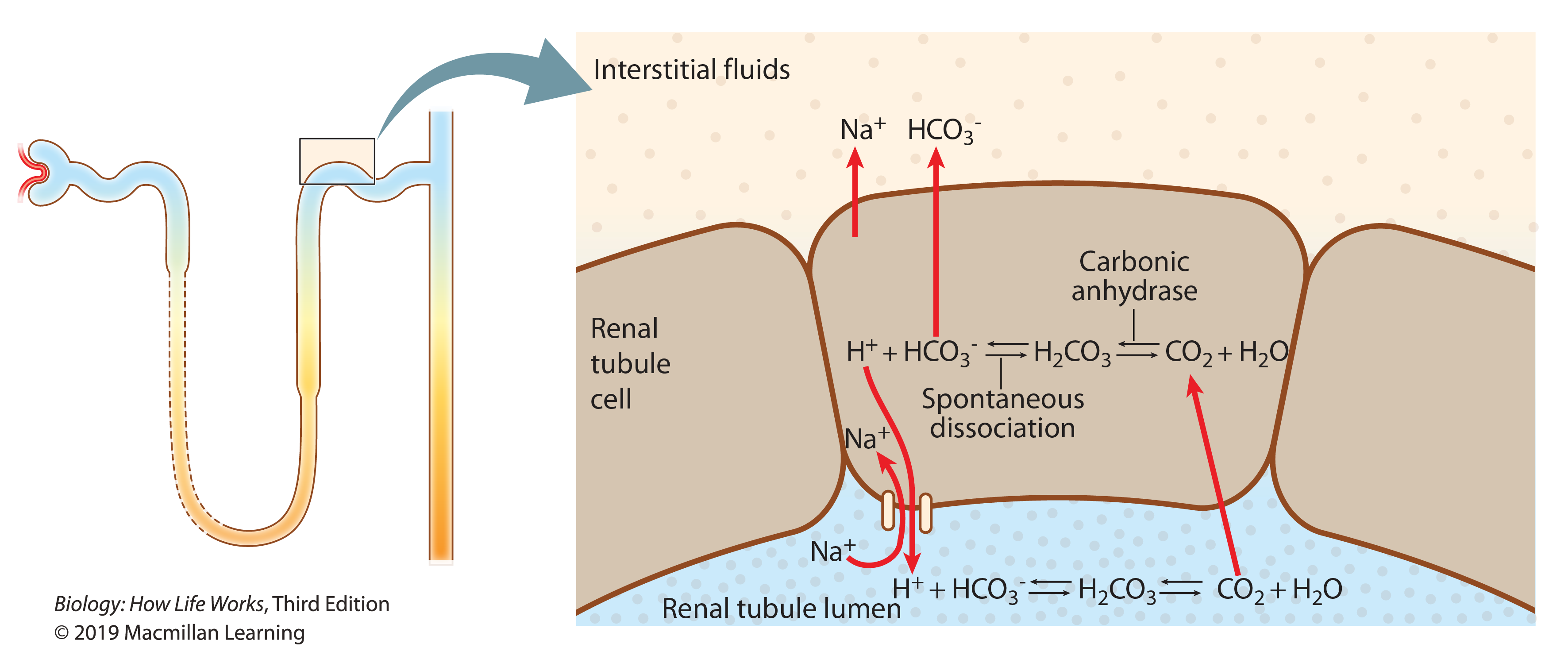
One of the roles of the kidneys is to help buffer body fluids, to keep fluids from becoming too acidic or too basic. The cells of the renal tubule wall secrete H+ into the tubule lumen and absorb bicarbonate, passing it into the tissue fluid. Consider the reaction catalyzed by the enzyme carbonic anhydrase, shown in the accompanying figure.
T/F: During heavy exercise, the reaction shifts to the right in the renal tubule cell of the nephron.
False
A person's blood pressure falls. Which of the answer choices would you expect to occur? Select all that apply.
Circulating concentrations of aldosterone will decrease.
Circulating concentrations of renin will increase.
Circulating concentrations of angiotensin II will decrease.
Water uptake by the distal convoluted tubule will increase.
Circulating concentrations of renin will increase.
Water uptake by the distal convoluted tubule will increase.
Water levels are adjusted to meet the osmoregulatory needs of the organism in the _____ of the nephron under the control of _____, also called vasopressin.
loops of Henle; antidiuretic hormone
distal convoluted tubule; antidiuretic hormone
distal convoluted tubule; antidiuretic hormone
Which of the answer choices correctly describes the path of excretory fluids through a mammalian nephron?
glomerulus, Bowman's space, loop of Henle, proximal convoluted tubule, distal convoluted tubule, collecting duct
collecting duct, proximal convoluted tubule, loop of Henle, distal convoluted tubule, Bowman's space, glomerulus
glomerulus, Bowman's space, proximal convoluted tubule, distal convoluted tubule, loop of Henle, collecting duct
glomerulus, Bowman's space, proximal convoluted tubule, loop of Henle, distal convoluted tubule, collecting duct
Bowman's space, glomerulus, proximal convoluted tubule, distal convoluted tubule, loop of Henle, collecting duct
glomerulus, Bowman's space, proximal convoluted tubule, loop of Henle, distal convoluted tubule, collecting duct
Which of these processes occur within Bowman's capsule?
filtration, selective reabsorption, and secretion
filtration and selective reabsorption
filtration
secretion
selective reabsorption
filtration
An increase of _____ increases the permeability of the collecting duct to water.
alcohol
caffeine
ADH (antidiuretic hormone)
diuretic drug
ADH (antidiuretic hormone)
An animal's metabolic rate is best defined as:
a measure of how quickly food is digested.
the total amount of food consumed by an animal.
its overall activity level.
a measure of how quickly ATP is produced by body cells.
its overall rate of energy use.
its overall rate of energy use.
Endotherms usually, though not always, maintain a _____ body temperature that is _____ that of the environment.
constant; identical to
fluctuating; higher than
constant; higher than
fluctuating; identical to
constant; lower than
constant; higher than
Which of the groups of molecules commonly serve as sources of energy for animals?
proteins, lipids, and carbohydrates
carbohydrates and lipids
proteins and lipids
proteins and carbohydrates
carbohydrates, nucleic acids, and lipids
proteins, lipids, and carbohydrates
T/F: Ectotherms always have a higher metabolic rate than endotherms of the same size.
False
Biological food sources are broken down into a form of energy that cells use to do work. This usable form of energy is _____, which is a(n) _____.
glucose; carbohydrate
ATP; amino acid
ATP; nucleotide triphosphate
ADP; nucleic acid
cAMP; nucleotide triphosphate
ATP; nucleotide triphosphate
An individual with vitamin D deficiency will experience:
difficulty absorbing sufficient amounts of calcium from their diet.
bleeding gums and loss of teeth.
nervous system disorders.
slow wound healing.
anemia.
difficulty absorbing sufficient amounts of calcium from their diet.
T/F: During starvation, humans and other animals deplete glycogen and fat reserves first, followed by protein.
True
An essential amino acid is defined as one that:
cannot be synthesized by an organism’s cellular biochemical pathways.
is required in large amounts.
is necessary for building proteins.
cannot be obtained through the diet.
functions as a vitamin.
cannot be synthesized by an organism’s cellular biochemical pathways.
Glucose transport out of intestinal cells into the bloodstream requires which of these events? Select all that apply.
a Na+‑glucose cotransporter in the membrane facing the blood
a higher concentration of glucose in the intestinal cells
a Na+ concentration gradient between the blood and the intestinal cell
Na+ channel connecting the intestinal cell to the blood stream
a glucose channel protein on the cell surface facing the blood
a higher concentration of glucose in the intestinal cells
a glucose channel protein on the cell surface facing the blood
When an individual has an energy surplus, he or she stores the extra energy as:
nucleic acids.
proteins.
carbohydrates.
None of the other answer options is correct.
lipids.
lipids.
Continued glucose transport into cells lining the lumen of the small intestine requires a _________ concentration gradient and a transmembrane protein that is a _________.
K+; K+-glucose cotransporter
Na+; Na+-glucose cotransporter
glucose; glucose channel protein
K+; glucose channel protein
Na+; K+-glucose cotransporter
Na+; Na+-glucose cotransporter
Which of the choices is/are secretions produced by the pancreas? Select all that apply.
lipase for fat digestion
gastrin to stimulate HCl production
trypsin for further protein digestion
methane from fermentation
bicarbonate ions to neutralize stomach acid
lipase for fat digestion
trypsin for further protein digestion
bicarbonate ions to neutralize stomach acid
The digestive tract is well-adapted for digestion and absorption. For most nutrients, once material is in the digestive tract, the digestive system does not vary its rate of absorption according to body needs.
This is an example of a homeostatic negative feedback mechanism.
This response is not homeostatic.
This is an example of a homeostatic positive feedback mechanism.
This response is not homeostatic.
Which part of the digestive tract is the predominant location for water and mineral absorption?
foregut
hindgut
crop
midgut
hindgut
Which of the statements about gastrin is false?
A low pH in the stomach inhibits the secretion of gastrin.
Gastrin is produced by cells lining the stomach.
Gastrin stimulates the production of HCl.
Gastrin secretion is initiated in response to the sight or smell of food.
Gastrin secretion is initiated in response to the sight or smell of food.
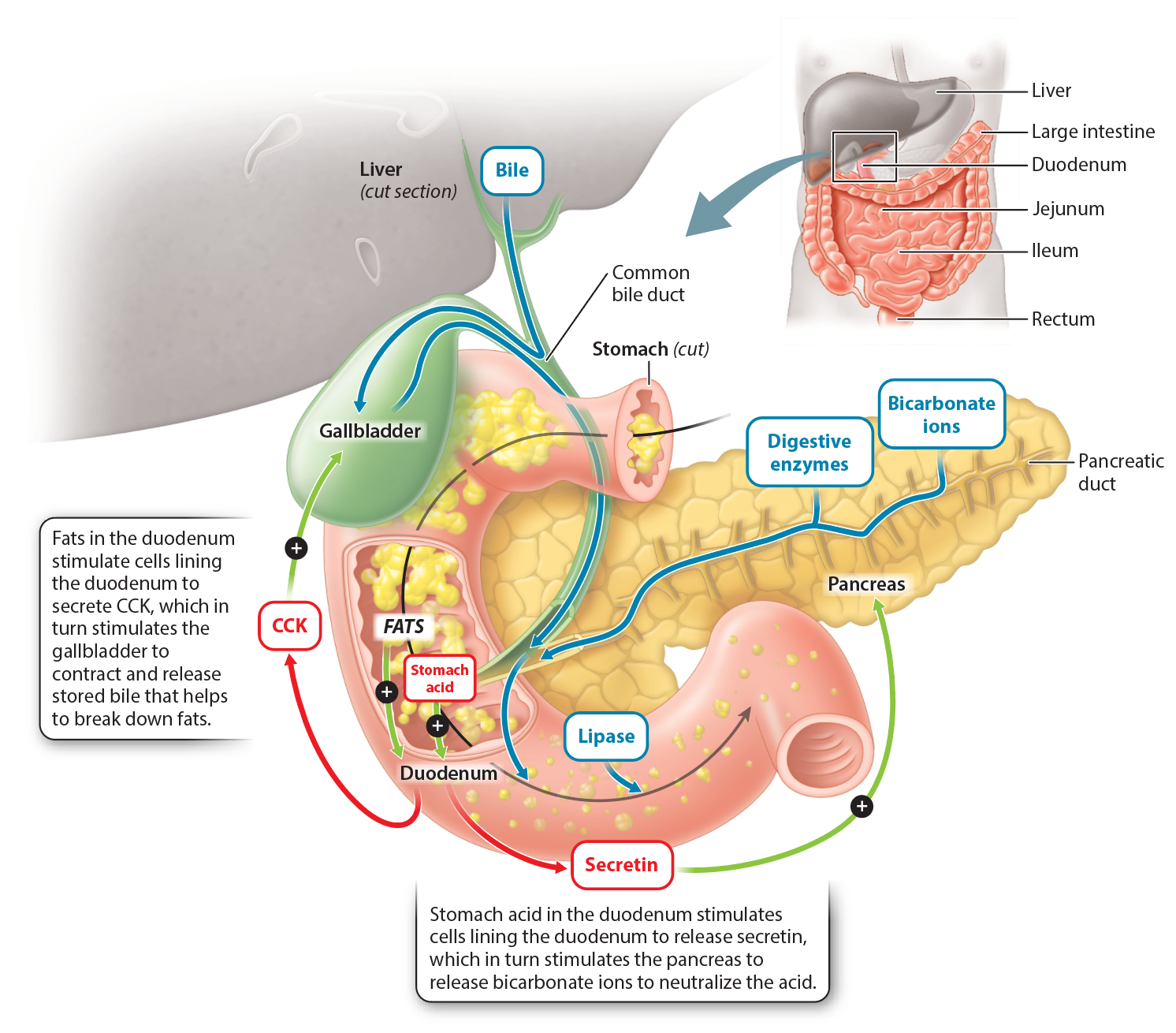
In the figure shown, digestion in the small intestine is aided by secretions from the liver, gall bladder, and pancreas.
T/F: Secretin, a hormone produced by cells lining the duodenum, stimulates the pancreas to release bicarbonate ions.
True
Salivary amylase starts the chemical digestion of:
proteins in the stomach.
carbohydrates in the stomach.
fats in the mouth.
carbohydrates in the mouth.
proteins in the mouth.
carbohydrates in the mouth.
What function does the low pH of the stomach serve?
All of these choices are correct.
The acidic conditions break down foods directly.
It allows gastric enzymes to work.
It allows for the activation of pepsinogen into pepsin.
All of these choices are correct.
The _____ is the first section of the small intestine, where food enters from the stomach.
jejunum
ileum
duodenum
gizzard
duodenum
Which of the statements is false?
As food passes through the liver, it is mixed with bile, which breaks large clusters of fats into smaller droplets.
Nutrient absorption takes place primarily in the jejunum and ileum.
Lipases in the small intestine break lipids into glycerol and free fatty acids.
The hormone cholecystokinin stimulates the release of bile from the gall bladder.
As food passes through the liver, it is mixed with bile, which breaks large clusters of fats into smaller droplets.