11 Metabolism
 Call Kai
 Learn
Learn Practice Test
 Spaced Repetition
 Match
Match Flashcards
 Knowt Play
1/46

There's no tags or description
Looks like no tags are added yet.
Name | Mastery | Learn | Test | Matching | Spaced | Call with Kai |
|---|
No analytics yet
Send a link to your students to track their progress
47 Terms
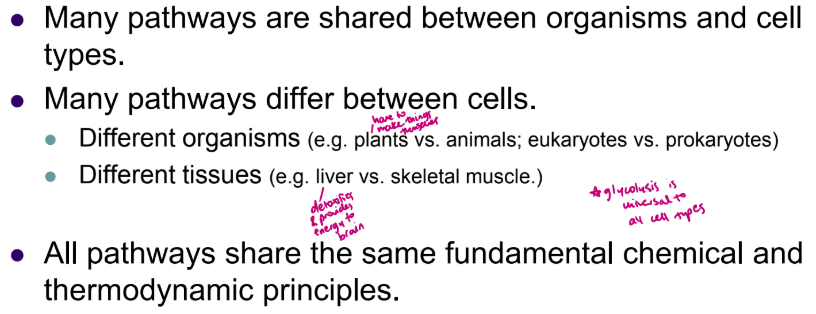
what are metabolic pathways
Series of enzyme-catalyzed reactions
Metabolites or metabolic intermediates are the chemical intermediates - that come as a product of a chemical rxn
Substrates, pathway intermediates and products
what are the principles of metabolic pathways
A metabolic pathway is a series of consecutive, enzyme-catalyzed reactions producing a specific product from a specific starting metabolite.
Pathways are directional. To occur, a pathway must have an overall negative ∆G i.e. be energetically “downhill.” Because of this, a metabolic pathway is, effectively, irreversible.
Individual steps in a pathway may be reversible, their direction determined by concentration of substrates and products.
Opposing pathways do occur, but they must both be energetically “downhill.” (∆G <<0).
Opposing pathways may share reversible reactions but always have unique exergonic steps.
Opposing pathways are reciprocally regulated, to ensure that only one is primarily operational at any time.
The rate of flow of metabolites through a pathway is tightly controlled by regulating the speed of key reaction(s). These key reactions are called the rate-limiting step(s).
The rate-limiting steps are always irreversible, exergonic reaction(s). The activity of the enzyme(s) that catalyze rate-limiting steps is very carefully regulated.
Reversible reactions are not regulated.
Metabolic intermediates are maintained in a “steady-state.”
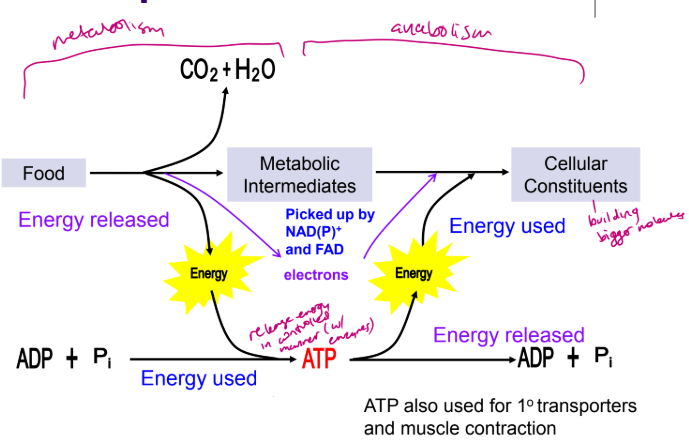
what are the purposes of metabolism
produce ATP - by breaking down molecules with catabolism
build important molecules - needs energy with anabolism
maintain homeostasis
whats the difference between ΔG°' and ΔG'
ΔG°' - standard free energy change measured at standard conditions, if - its favourable if + its unfavourable under these conditions
ΔG' - actual free energy change measured under real conditions in the cell, if - its favourable if + its unfavourable under these conditions
why is ATP a high energy molecule
because when you break it into an inorganic phosphate which has more resonance and ADP has decreased electrostatic repulsion so its more stable and has a ΔG°' of -30 kJ/mol
what role do nucleotides play in metabolism
as electron carriers
Nicotinamide adenine dinucleotide (NAD+)
Flavin adenine dinucleotide (FAD)
Both are cofactors - helps the enzymes and both are coenzymes
FAD is a prosthetic group (attached to protein permanently) and NAD+ is a co-substrate
what does the nitrogen base of the nucleotides allow them to do
The nitrogen base portion of these dinucleotides enables them to undergo a reversible reduction reaction.
Nicotinamine and flavin bases
Not the adenine base
what is the difference between proton, hydrogen atom, hydride ion
Proton → H+
Hydrogen atom → H. like FAD
Hydride ion → H.. (-) like NAD+
what do NAD+ and NADPH look like
NAD+ (NADP+) is the oxidized form and when you remove H.. (-) you get the reduced form which is NADH (NADPH)
its a high energy molecule bc its carrying 2 electrons
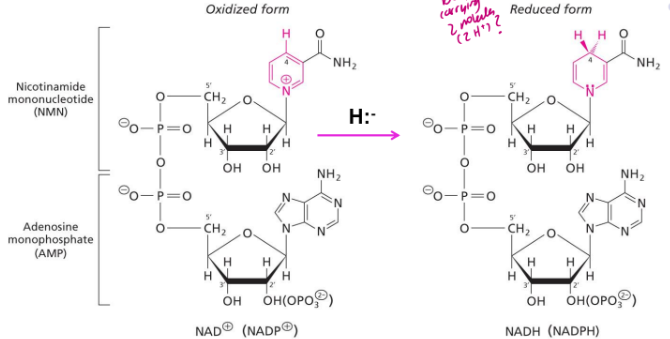
what is the net charge of NAD+
-1
the + just says wether its reduced or oxidized
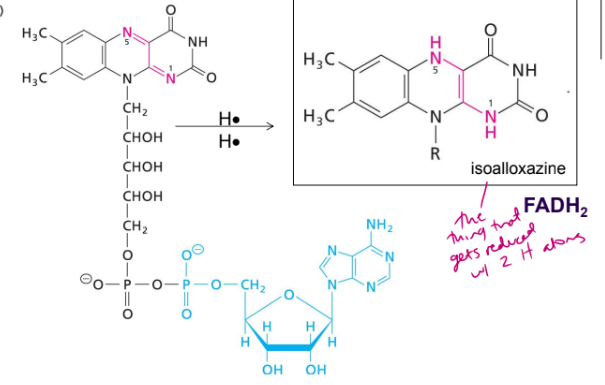
what does FAD look like
the isoalloxazine is the thing that gets reduced with 2 H atoms to make FADH2
the adenine base does not undergo reversible oxidation/reduction
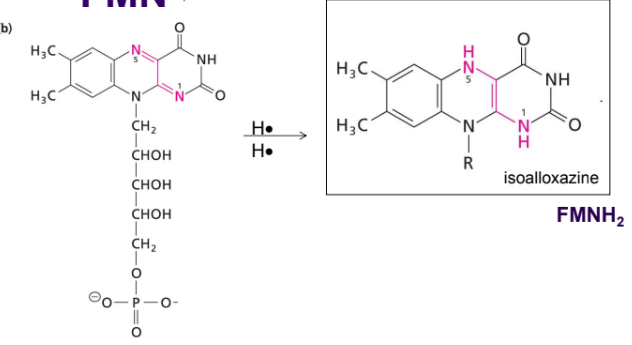
what does FMN look like
flavin mono nucleotide
the isoalloxazine is getting oxidized with 2 H. to make FMNH2
doesnt have adenine
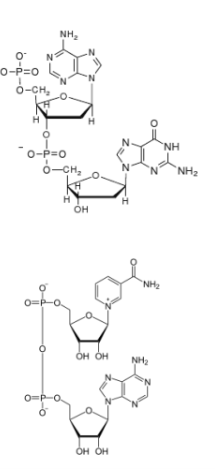
what are dinucleotides
Nucleotides linked via a phosphodiester bond or
Nucleotides linked via a phosphoanyhdride bond
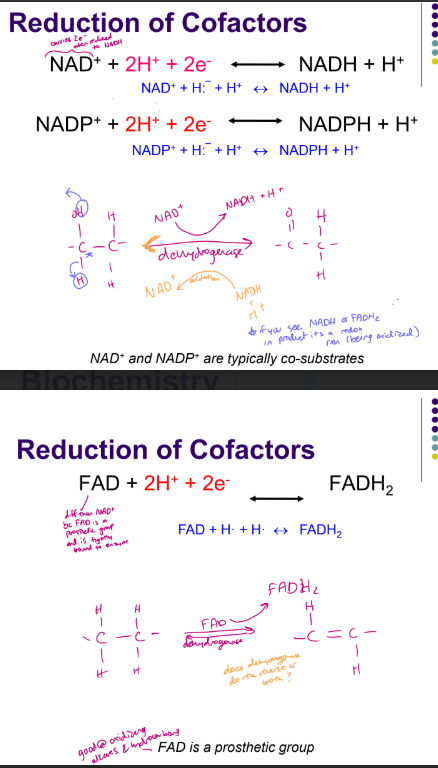
what are the reactions to reduce the cofactors NAD+, NADP+, and FAD
NAD+ + H+ + 2e- <→ NADH
NADP+ + H+ + 2e- <→ NADPH
FAD + 2H+ + 2e- <→ FADH2
NAD+ and NADP+ are typically cosubstrates (loosely associated with enzyme), FAD is a prosthetic group (tightly associated with enzyme)
These are formal statements of the redox half reactions and NOT actually steps in the reaction mechanism
what is the difference between catabolism and anabolism
catabolism - taking macromolecules and inputing a small amt of energy to make free energy and building blocks, its oxidative so electrons are removed as bonds are broken, you describe the oxidation of the fuel molecule and not the reduction of the cofactor (oxidizing glucose)
anabolism - your taking building blocks and energy to mack macromolecules, reductive so electrons are used to make new bonds, you describe the reduction of the building blocks and not the oxidation of the cofactor (reducing NADPH)
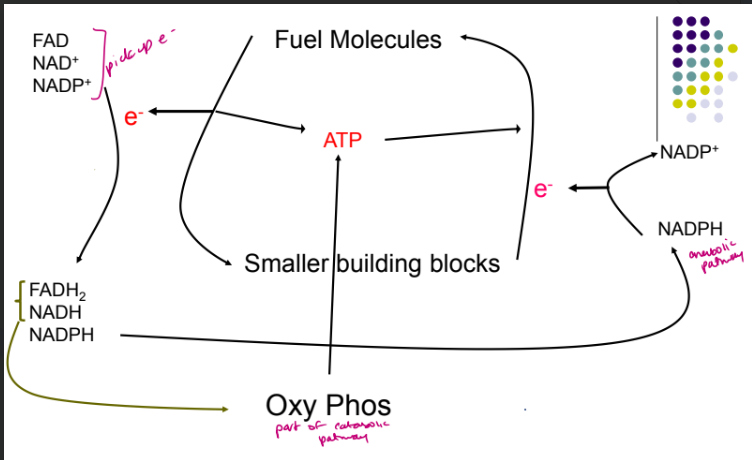
what are the dietary macromolecules
Nucleic Acids - Nucleotides, not a significant fuel source
Proteins - Amino acids
Polysaccharides (complex carbohydrates) - Monosaccharides (simple sugars), doesnt have as much electrons as fats
Triacylglycerol (Fat) - Fatty acids
last 2 is the most significant fuel sources bc theres a lot of energy in those bonds
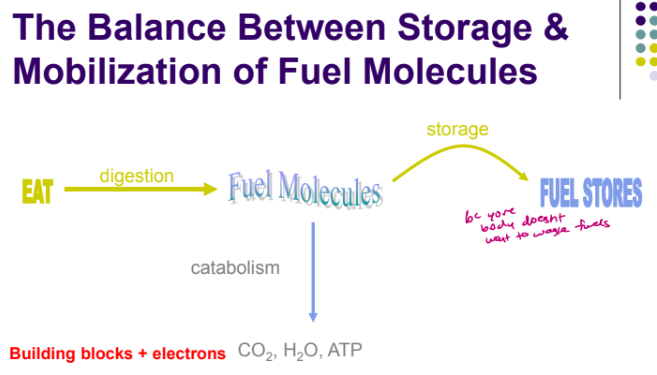
what is the chemical standard state
pH = 0, [H+] = 1M
[S] & [P] = 1M
Temperature = 25oC/298K
Pressure = 1 atm
what is the biochemical standard state
pH = 7
[S] & [P] = 1M
Temperature = 25oC/298K
Pressure = 1 atm
[H2O] = 55M
what are the different free energy changes
Standard free energy of a reaction is a thermodynamic term:
Biochemical standard state
ΔG′° = G'° products - G'° reactants
if its - it means that it happens spontaneously and equilibrium favours products and you dont have to put in energy
ΔG′° = ΔH – TΔS
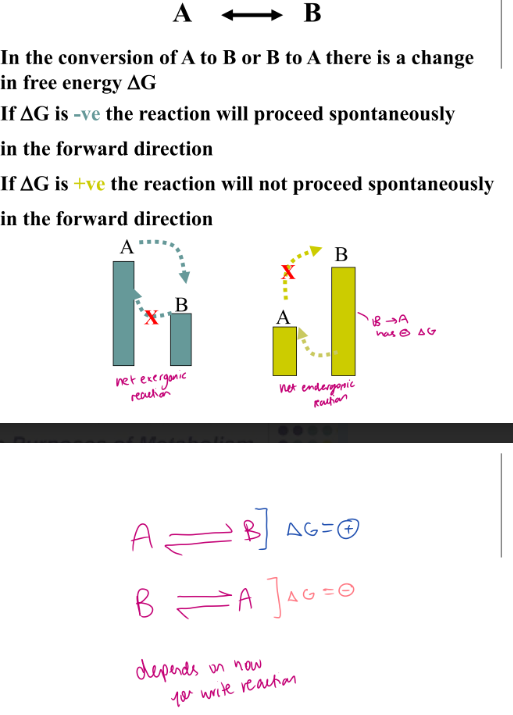
what does the free energy diagram for an exergonic rxn look like
A reaction will only proceed in the forward direction when the associated value of ∆G is negative (<0).
∆G gives NO information regarding rate of reaction - determined by activation energy
products have to be more stable than reactants
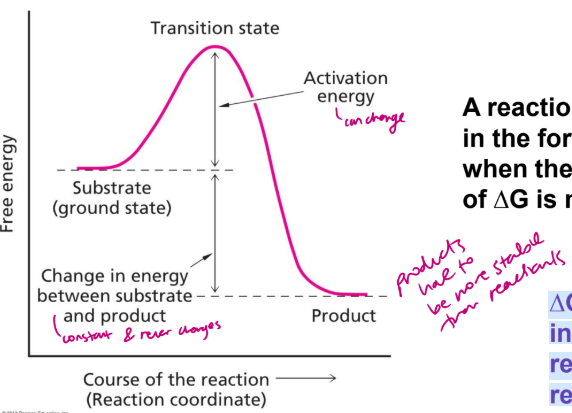
when is a reaction considered reversible and irreversible
∆G > 0 - Reaction will not occur (in forwards direction)
∆G < 0 - Reaction will occur (spontaneous)
∆G ~ 0 - Reaction may be considered “reversible” - main reactions exist here to maintain homeostasis
∆G << 0 - Reaction is considered “irreversible” under cellular conditions, bc they need more work to go reverse and in a lab you can reverse it
what are two measures for a reactions tendency to proceed spontaneously
Keq (drive for rxn to reach equilibrium) and ∆G'° are measures of a reactions tendency to proceed spontaneously
∆G gives us information regarding driving force to reach equilibrium
sense of direction and magnitude, negative means a drive to get to products and a larger negative value means youre far away from products
see slide 31-32
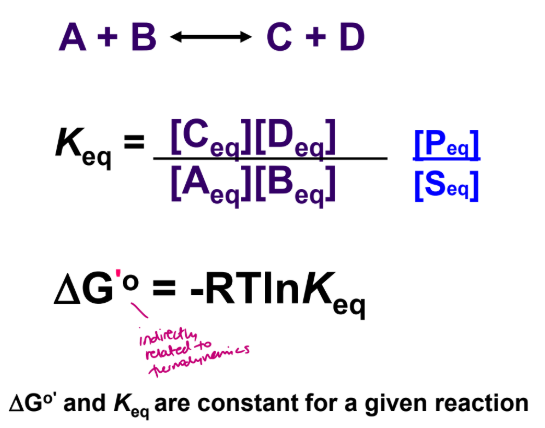
what does the actual free energy change depend on
Actual free energy changes depend on reactant and product concentrations
if its spontaneous in experiment it might not be spontaneous in cellular level
∆G' = constant + variable parts
A reaction with a positive ΔG′° may have a negative ΔG' under cellular conditions
see slide 34
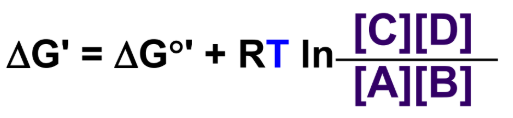
what are the different free energy quantities
ΔG° - standard free energy change under standard chemical conditions, pH = 0/1
ΔG′° - standard free energy change under biological standard conditions, pH = 7
ΔG′ - actual free energy under cellular conditions, pH = 7
ΔG - actual free energy change under whatever conditions are being considered
what happens if ΔG′ is close to zero
If ΔG′ is near zero, system is close to equilibrium but still not at equil.
Changes in concentration of either B or C may change the direction of the reaction
These are also called near-equilibrium reactions.
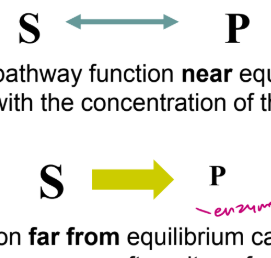
what pathway do most enzymes take
Most enzymes in a pathway function near equilibrium and their net rates vary with the concentration of their substrates.
Enzymes that function far from equilibrium catalyze irreversible reactions. These enzymes are often sites of regulation (regulatory enzymes) and their activities are increased or decreased in response to signaling molecules.
enzyme is so slow that youll always have a high concentration of substrate
what do the series of enzyme catalyzed chemical reactions look like for metabolic pathways
∆G –ve irreversible, Enzyme “slow”, insufficient catalytic activity, Enzyme regulated, Rate limiting, Can be reversed (in a test tube) by increasing [B], first and last rxn are usually irriversable and far from equilibrium
∆G ~ 0 Reversible, Enzyme “on”, Rate driven by [C] and [D]
Each individual reaction obeys thermodynamic laws: Free energy change must be negative (∆G < 0) to proceed forward
see slide 41
![<p>∆G –ve irreversible, Enzyme “slow”, insufficient catalytic activity, Enzyme regulated, Rate limiting, Can be reversed (in a test tube) by increasing [B], first and last rxn are usually irriversable and far from equilibrium </p><p>∆G ~ 0 Reversible, Enzyme “on”, Rate driven by [C] and [D]</p><ul><li><p> Each individual reaction obeys thermodynamic laws: Free energy change must be negative (∆G < 0) to proceed forward</p></li></ul><p>see slide 41</p>](https://assets.knowt.com/user-attachments/f471f563-e960-4d8e-a4cb-e394f7401fa7.png)
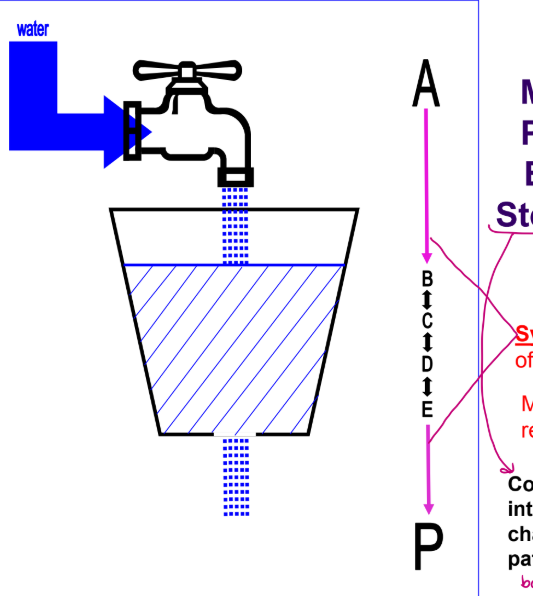
what state do metabolic pathways exist in
steady state
Synchronous regulation of irreversible reactions, Most reactions are reversible
Concentrations of metabolic intermediates often do not change significantly once a pathway begins to operate bc you regulate first and last rxn
what are the three major types of high energy intermediates
Three major types: Compounds which contain “usable” chemical energy, Energy can be recovered or used
Electron carriers (NADH, NADPH, FADH2 , FMNH2)
NAD+ , NADP+ , FAD and FMN are electron acceptors, not considered high- energy molecules.
Nucleoside triphosphates (NTPs: ATP, UTP, GTP) - Also have other types of high-energy phosphate molecules e.g. phosphocreatine
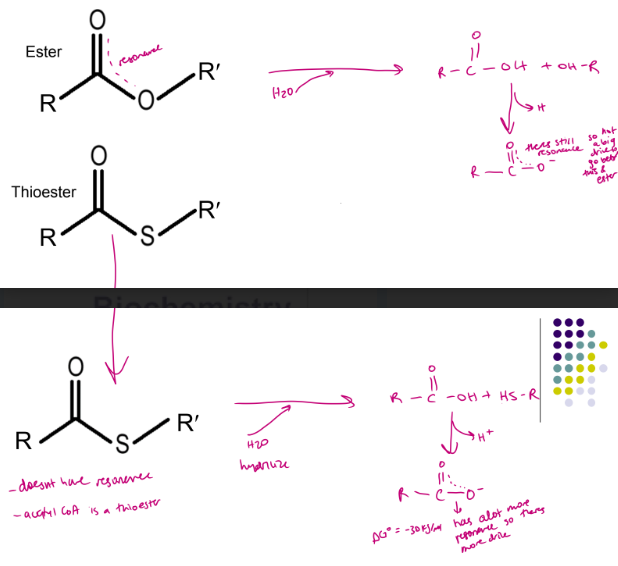
Thioesters - can be hydralyzed to more stable products
what are oxidation and reduction reactions
Catabolism is oxidative
Metabolites are oxidized (lose electrons)
Cofactors are reduced (“oxidizing agents”)
Typically, NAD+ and FAD - NADP+ ( electrons in NADH and FADH2 primarily destined for the ETC)
Anabolism is reductive - two small building blocks come together
Metabolites are reduced (gain electrons)
Cofactors are oxidized (“reducing agents”)
Typically, NADPH - NADH
what are the different oxidized states of carbon
alkane - with fatty acids and FAD is good at oxidizing it, the most reduced form bc EN is not significant enough
alcohol - with sugars and NAD+ is good at oxidizing it bc of electron affinity
aldehyde (ketone) - central carbon has less electrons around it
carboxylic acid
carbon dioxide - most oxidized carbon and the end goal is to breath it out
as you go down the carbon is more oxidized
see slides 46 -
how much energy is in the hydrolysis and formation of a phosphoanhydride bond
∆G ‘° approx -30 kJ/mol for the hydrolysis of a phosphoanhydride bond
∆G ‘° approx +30 kJ/mol for formation of a phosphoanhydride bond
what is ATP
“Energy currency” - a lot of enzymes need to use ATP
Common in multiple systems.
Phosphoanhydride bond makes it “high-energy.”
how is ATP generated
Generated by catabolism
Directly - No oxygen required, anaerobic metabolism
Via reoxidation of NADH/FADH2 by ETC (~95%) - Oxygen required, majority, gives proton gradient, aerobic metabolism
where is ATP used
Driving unfavourable reactions (coupling)
Movement (muscle, flagella)
Primary active transport (ion pumping)
what are thioesters
High-energy compounds
Similar to esters but with no e- delocalization
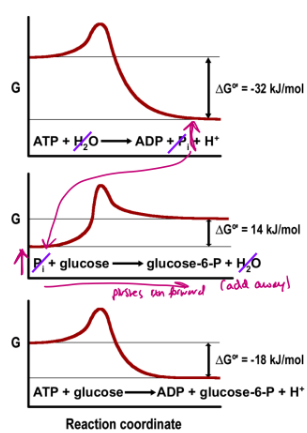
true or false if ∆G > 0 the rxn will not occur
false - it can occur in the reverse rxn but not in the forward rxn, you can make it favourable in the forward rxn by adding energy (ATP), increasing the ratio of products and reactants, or adding heat (not controlled)
what are coupled reactions and the conditions that need to be met
Free energy changes of reactions are additive, take an unfavourable rxn and adding a favourable one to it
Energy released by an exergonic process can drive an endergonic process.
2 conditions:
But only if the two processes are LINKED by a common intermediate.
Energy released by one reaction is more than the energy to drive the other reaction
see slide 57-58
what is the coupling of free energies
Free energy changes for reactions are additive.
A reaction with an overall unfavourable free energy change (∆G > 0) can occur when another favourable reaction (∆G < 0) occurs in concert.
The combined reactions must have an overall ∆G < 0 to be spontaneous.
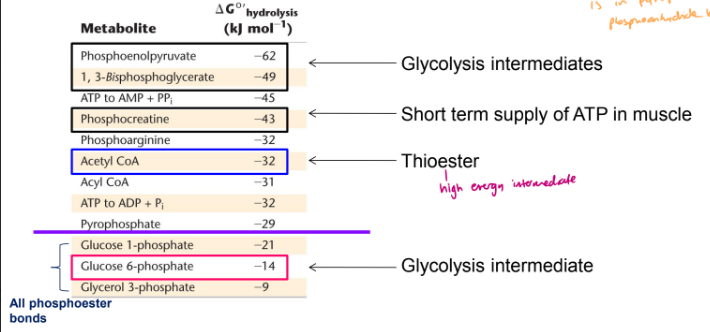
what are the different ∆G ‘° free energy of hydrolysis for important intermediates
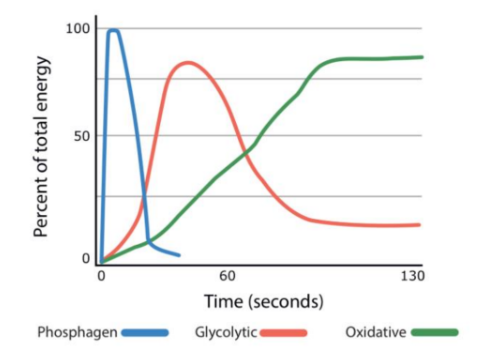
what are the different sources of ATP for muscle contraction
A phospagen is a high-energy phosphate compound capable of making ATP without oxygen
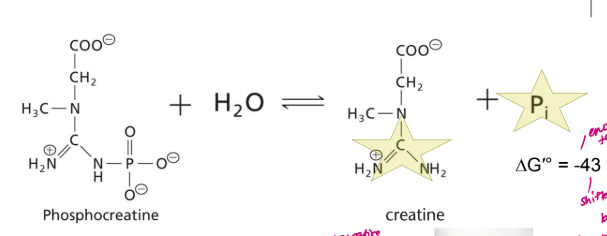
what does the hydrolysis of phosphocreatine look like
phosphocreatine + ADP ←→ creatine + ATP
uses creatine kinase, in forward direction when execrising and in reverse when storing ATP to relax
gives ∆G′° = -43 kJ/mol, enough energy to couple it with the rxn below
what does enzyme regulation in metabolism look like
Irreversible steps are usually regulated.
Reversible steps are not usually regulated - In this example, the enzymes E1 and E4 are likely to be regulated while E2 and E3 are not
“Rate-limiting Steps” in a pathway are the irreversible, regulated reactions - determine the overall rate.

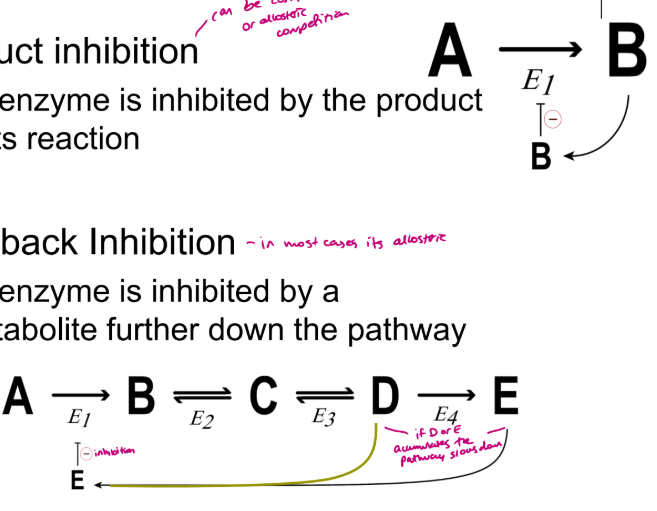
what are 2 types of inhibition
Product inhibition - An enzyme is inhibited by the product of its reaction, can be allosteric competition or competition
Feedback Inhibition - An enzyme is inhibited by a metabolite further down the pathway, in most cases its allosteric
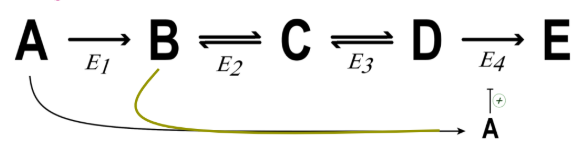
what is activation
An enzyme may be activated by a metabolite “upstream” - to smth before
Ensures that the pathway is functioning in concert (otherwise intermediates may accumulate)
“Feed-forward Activation”
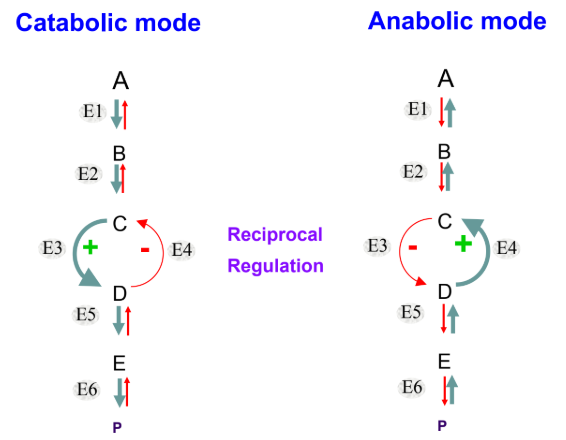
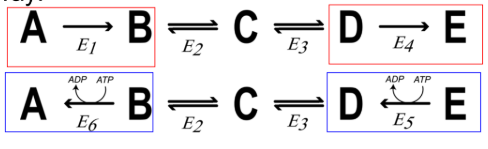
what is reciprocal regulation
Opposing pathways catalyze the “reverse” of another pathway
The irreversible reactions must be replaced or bypassed.
Reciprocal Regulation - Pathways are regulated to ensure that both do not operate at same rate simultaneously.
Example: E6 and E1 will not operate at the same rate simultaneously, nor will E4 and E5.
what are the different modes for metabolic pathways
Metabolic pathways: conversion of matter through a series of enzymatic steps
catabolic and anabolic mode, both can be on at the same time