AVIT 414 Summer Session Block 1 Exam
 Call Kai
 Learn
Learn Practice Test
 Spaced Repetition
 Match
Match Flashcards
 Knowt Play
1/105

There's no tags or description
Looks like no tags are added yet.
Name | Mastery | Learn | Test | Matching | Spaced | Call with Kai |
|---|
No analytics yet
Send a link to your students to track their progress
106 Terms
What is the Definition of Learning?
A change in behavior due to an experience.
What are the Characteristics of Learning?
Purposeful
Result of Experience
Multifaceted
Active Process
What is Purposeful Learning?
To be effective, aviation instructors need to find ways to relate new learning to the learner's goals. There needs to be a purpose behind it based on each individuals' goals.
What is Result of Experience Learning?
Learning can only come from the person and that experience. Therefore, in order to learn something new, a person must have their experiences changed.
What is Multifaceted Learning?
While learning the subject at hand, one may be learning other things as well.
What is Active Process Learning?
Learning takes more than just sitting in a classroom. It takes understanding and applying that knowledge.
What are the Defense mechanisms?
Repression
Denial
Compensation
Projection
Rationalization
Reaction Formation
Fantasy
Displacement
What is Repression?
Place uncomfortable thoughts into an inaccessible area of the unconscious mind.
What is denial?
Rejection on Truth
What is Compensation?
Disguise undesirable quality by emphasizing a more positive one.
What is Projection?
An individual places his or her own unacceptable impulses onto someone else.
What is rationalization?
Justify unacceptable behavoir
What is reaction formation?
Individual develops behaviors/attitudes that are opposite of what is desired.
What is Fantasy?
Student engages in daydreaming about how things should be than reality.
What is Displacement?
Unconscious shift of emotion, affect or desire from the original object to a more acceptable, less threatening substitute.
What are the 2 learning theories?
Behaviorism
Cognitive theory
What is the difference between Behaviorism and Cognitive Theory?
Behaviorism looks at how we act, while cognitive theory examines how we think.
What is Behaviorism?
All human behavior was learned. This is learning as a result of influences from past experiences.
What is Cognitive Theory
Cognitive theory focuses on what is going on inside the mind. It is more concerned with cognition (the process of thinking and learning)—knowing, perceiving, problem-solving, decision-making, awareness, and related intellectual activities.
Factors that affect perception
GSTEP
Goals and values
Self-concept
Time and opportunity
Element of threat
Physical organism
Laws of Learning
REEPIR
Readiness
Exercise
Effect
Primacy
Intensity
Recency
Law of Readiness
associated with the belief that students learn easier when they want to learn (homework, quizzes)
Law of Exercise
the more an act or response is used in a given situation, the more strongly the act becomes associated with that situation (practice makes perfect/repition)
Law of Effect
The principle that behaviors are selected by their consequences (Recognize students hard work paying off)
Law of Primacy
The state of being first, often creates a strong, almost unshakeable impression. Was added to Thorndike's S-R theory of Connectionism.
Law of Intensity
The more intense the material taught, the more it is likely learned
Law of Recency
Things most recently learned are best remembered
What are the domains of learning?
1. Cognitive
2. Affective
3. Psychomotor
What is the Cognitive domain?
The cognitive domain refers to the mental skills and knowledge acquisition aspects of learning, including processes such as remembering, understanding, applying, analyzing, evaluating, and creating. It encompasses the intellectual capabilities and thinking skills that enable individuals to process information, solve problems, and make decisions.
What is the affective domain?
This describes the emotional behaviors, beliefs, and attitudes of the participant. These all shape a person's feelings about exercise, and can be positively affected by the CFI.
What is the psychomotor domain?
learning of a new procedure or skill; often called the doing domain
What are the basic levels of learning?
Rote
Understanding
Application
Correlation
What is rote?
Ability to repeat something but not know the meaning
What is understanding?
Comprehend the meaning of something
What is application?
Act of putting something together that has been learned and understood
What is correlation?
Using what you have learned and applying to other parts of your learning
Real world example of correlation
Recognizing how changes in factors like aircraft weight, temperature, or pressure altitude affect the optimal Vy speed, and adjusting climb procedures accordingly to maintain optimal climb performance.
What is a learning plateau?
A phenomenon where progress slows or stops before increasing
How can a learning plateau be solved?
Introduce variations in training exercises
seek feedback from instructors to identify areas for improvement
set new goals
explore alternative learning approaches to stimulate further skill development.
What is Scenario-Based Training (SBT)?
Method that uses a highly structured script of real world experiences to address aviation training objectives in an operational environment.
What is transfer of learning?
Influence of previous experience on learning a new skill and performing a skill in a new context
What is positive transfer?
the beneficial effect of prior learning on the learning of a new skill or the performance of a skill in a new context
What is negative transfer?
When the learning and performance of one skill hinders the learning and performance of another skill
Basic elements of Communication
Source
Symbols
Receiver
What is source?
Sender, speaker, writer, encoder, transmitter, or instructor
What is symbols?
Words, signs, pictures, or props to convey the sources message
What is Receiver?
listener, reader, decoder, or learner
What are barriers to effective communication?
(COIL)
Confusion between symbol and symbolized object
Overuse of abstractions
Interference
Lack of common experience
Lack of common experience
The lack of common experience among flight crew members from different cultural backgrounds can lead to miscommunication and misunderstandings during critical phases of flight.
Tools from Instructors toolbox (Only need to know 4 for test 1)
Do not interrupt
Do not judge
Think before answering
Be close enough to them
Why is W&B important?
Safety
Stability
Controllability
Adequate Performance
Efficiency
Common Errors of W&B
Finding and using proper empty weight information
Unable to determine CG location
Mathematical errors
Unable to bring CG back into limits if outside
Can only do problem through one method
Why do you need to know Aircraft Performance?
Safety
Operational Limitations
Required by Law
Factors that Affect Performance
Air Density
Temperature
Aircraft Design
Propeller Blade Angle
Pilot Technique
Aircraft Configuration
Aircraft Weight
Wind
Runway Conditions
Turbulence
How does Forward C.G. affect performance?
Slower
Lower Range
Longer Takeoff Distance
Increased Stability
Lower Stall Speed
How does AFT C.G. affect performance?
Faster Cruise speeds
Increased climb rates
Greater Range
Short Takeoff distance
Less tail down force
Decreased stability
Higher Stall Speed
Four Forces of Flight
Weight
lift
thrust
drag
Factors affecting Stall Speed
Weight
CG location
Flaps
Power
Ice
Axis of Rotation
Rudder - Yaw - Vertical
Elevator - Pitch - Lateral
Aileron - Roll - Longitudinal
What is a Spin?
The result of an aggravated stall condition
Stages of a Spin
Entry - Where the aircraft is stalled and yaw
Incipient - Period where the aircraft begins spinning to where the forces of a spin are complete equilibrium to where control inputs are made to recover from spin
Developed - period of where forces are in equilibrium
Recovery - Period of corrective control input to return to normal flight
Spin Recovery Procedure
Rudder - Full Opposite direction of Spin
Control Wheel - Full forward and ailerons neutral
Throttle - Idle
Rudder - Neutral
Ailerons - Full Back Pressure
Throttle - As required
Forces in a Turn
Be able to draw it!
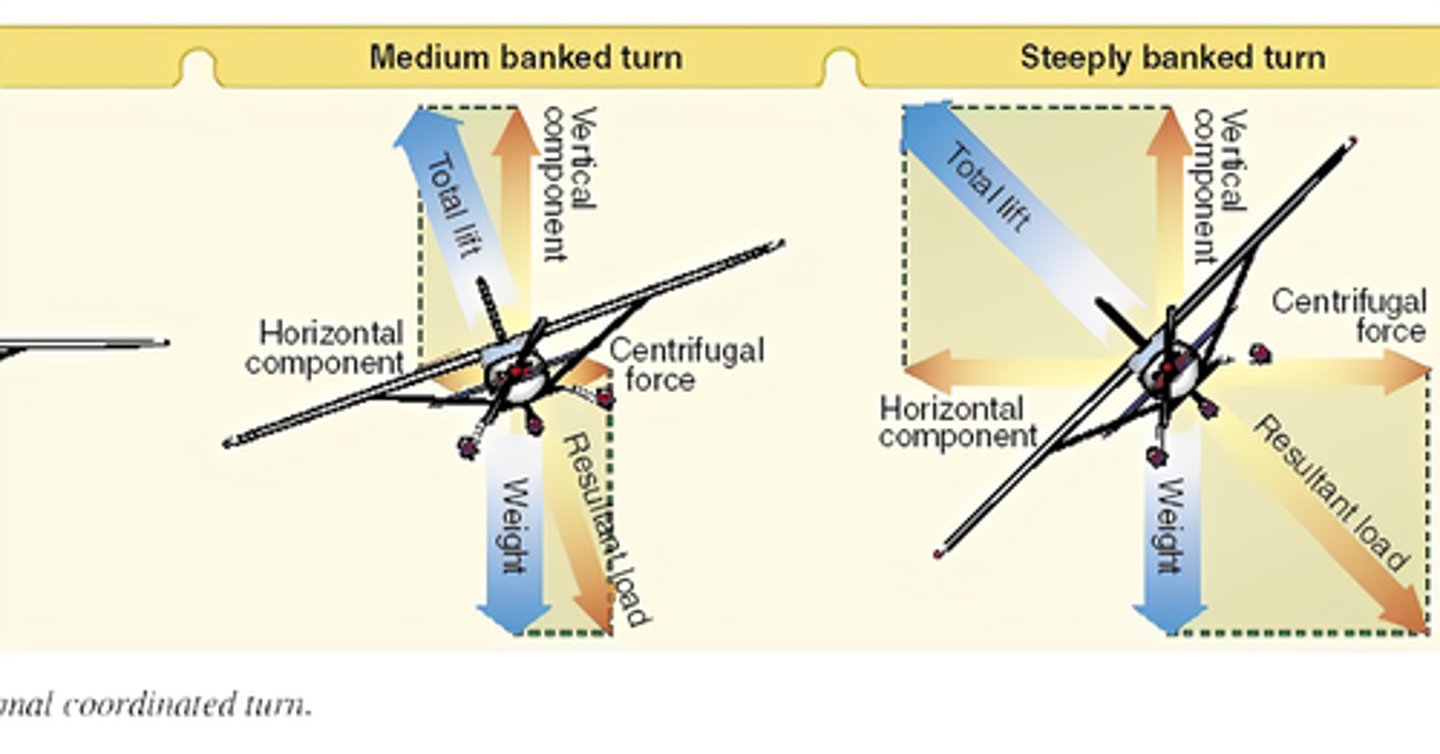
Slip vs Skid Forces
A slipping turn occurs when the horizontal lift component is greater than the centrifugal force of the aircraft.
A skidding turn occurs when the centrifugal force is greater than the horizontal lift component of the aircraft.
What is the point called when all axis meet?
Center of Gravity
What is the difference between the Induced Drag and Parasite Drag?
Induced = byproduct of lift
How does age affect learning
With age, humans move from dependency to self-direction
Motivation
The reason one acts or behaves in a certain way and lies at the heart of goals.
Negative Reinforcement
Less effective but sometimes necessary
Positive Reinforcement
Most beneficial
Instructor actions for learning plateau
1. Ask new learners about their aviation training goals.
2. Reward incremental successes in learning.
3. Present new challenges.
4. Occasionally remind learners about their own stated goals for aviation training
5. Assure learners that learning plateaus are normal and that improvement will resume with continued effort.
Biological/Physcological Defense Mechaisms
Adrenaline, heart rate
Anxiety, brain fog
Normal Reaction to Stress
Fight/flight, rapid reaction based on level of experience, check ride nerves
Abnormal reaction to stress
Over cooperation, laughing/singing, anger, mood swings
Barriers to communication
Interference
Overuse of abstractions
Confusion between symbol and object
Lack of common experience (most important)
Higher Order Thinking
ADM
Insight
Group perceptions together
Teaching Adults
Goal oriented, self driven
Types of Practice
Deliberate: Get good at specific thing
Blocked: Repetition (good short-term but not long)
Random: Throw everything at the student to mess up their flow (SBT)
Types of errors
Slips: Trying to do right thing but messing up
Mistake: Intending to do the wrong thing (isn’t aware) but succeeded accidentally
Memeory
Encoding
Storing
Retrieving
Types of Memory
Sensory
Working
Short
Long
Recall
Fading
Forgetting things when you don’t use them
Interference
Similar experiences overlap and you can’t distinguish what really happened
Retrieval Failure
Failure to put something in long-term memory and then retrieve it (You know you know something, but…),
Repression
An individual doesn’t want to remember something
Factors Affecting Aircraft Performance
Air Density
Pressure
Temp
Humidity
Wind
Pilot Technique
Flaps
Increase camber of wing
More lift at same airspeed
Airport Environment Factors
Sloped
Contaminated
Grass
Weight Effects
Higher weight=need more lift=Higher AOA
Higher stall speed
More stable
Forward CG
More longitudinal stability
Less fuel efficient
Higher stall speed
Good recovery characteristics
Aft CG
Less longitudinal stability
More fuel efficent
Lower stall speed
Bad recovery
Weight Shift Formula
Weight Shifted / total weight = Change of CG / Distance arm moves
Weight addition Formula
Weight added or removed / Total Weight = Change of CG / Distance between new weight arm and old CG
3 - 6 Rule
3 times altitude to lose = miles out to start descent
6 times GS = Rate of Descent
Flip for jets
Human Needs
Physiological, Safety, Belonging, Esteem, Self-Actualization
Lift Equation
L=Cl 1/2p v^2 Surface area of wing
AoA Definition
where RW meets the chord line
Angle of incidence
Chord line and longitudinal axis
T/F Pitch attitude on the attitude indicator is the AoA
FALSE