Gastrointestinal Block 3: Gut Communication with its Environment - nutrient sensing and uptake
 Call Kai
 Learn
Learn Practice Test
 Spaced Repetition
 Match
Match Flashcards
 Knowt Play
1/34

There's no tags or description
Looks like no tags are added yet.
Name | Mastery | Learn | Test | Matching | Spaced | Call with Kai |
|---|
No analytics yet
Send a link to your students to track their progress
35 Terms
Give an Overview of the Cephalic response:
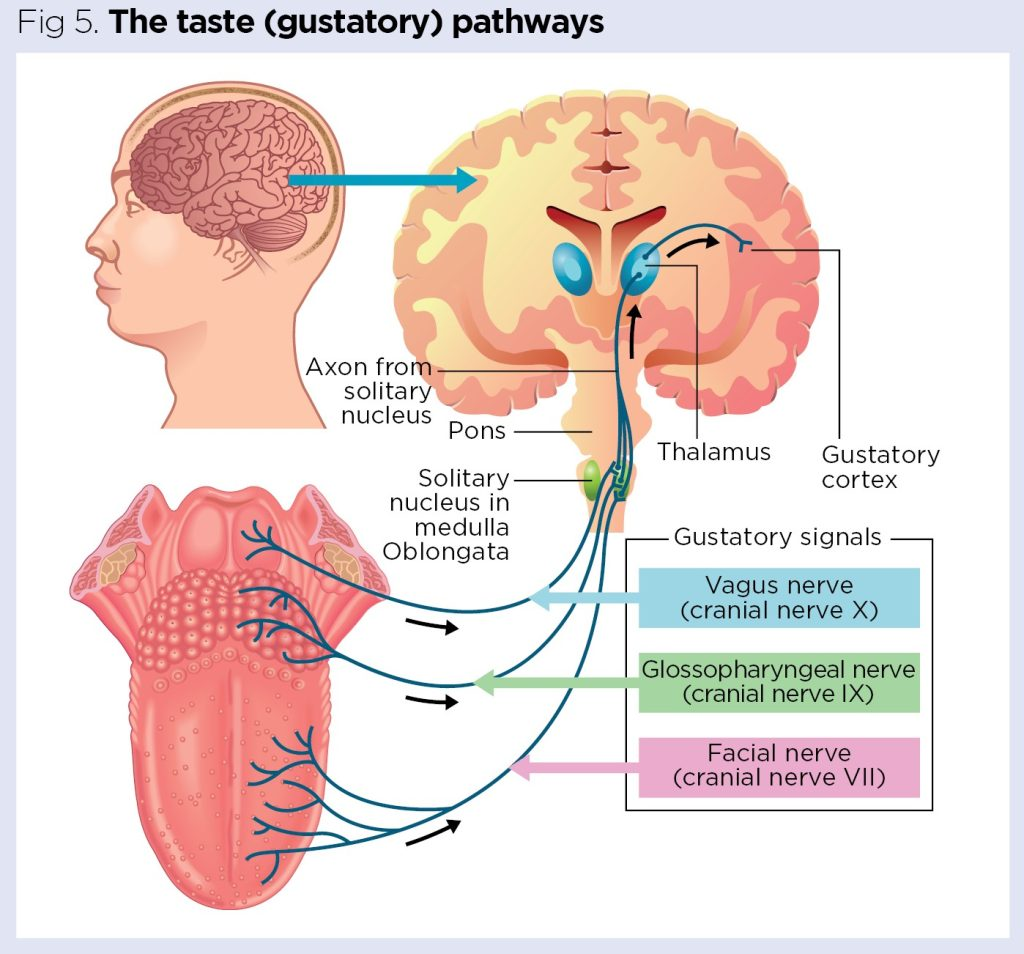
taste receptors in the tongue send information via CNVII (facial) and CNIX (glossopharyngeal) nerves to reach the nucleus of the solitary tract in the brain stem
stimulation of these afferent neurons initiate visceral reflexes to the gut to prepare for an incoming meal
What role does the Vagus nerve play in the cephalic response?
the vagus nerve is stimulated by sensory factors: smell. visual, taste etc
efferent fibers of the vagus nerve travel to the gut; cause acid secretion, pancreatic secretion, gall bladder secretion
Describe the innervation of the tongue
anterior 2/3s is innervated by the facial nerve
posterior 1/3 is innervated by the glossopharyngeal nerve
Efferent fibres from which cranial nerve travel from the brainstem to the gut and salivary glands?
facial nerve VII
Efferent fibres from which cranial nerve travel from the brainstem to salivary glands and oropharynx?
glossopharyngeal nerve (IX)
What is the role of the hypoglossal (CNXI) nerve in the tongue?
conscious control of the tongue
the hypoglossal nerve controls intrinsic and extrinsic plexei to the muscles of the tongue
What role does the trigeminal nerve play in the mouth?
involved in chewing and in sensation of pain from toothache
How do we taste?
much of our taste comes from olfactory signals (sense of smell)
the NTS (nucleus of the solitary tract) projects to specific gustatory nuclei within the thalamus of the brain → then to insular cortex = taste
Give the path of the Main Olfactory Pathway:
runs from the olfactory bulb → primary olfactory cortex → underside of temporal lobe
List 4 visceral responses (caused by cephalic response):
salivary secretion
gastric juice secretion
pancreatic secretion
gallbladder secretion
Describe the distribution of taste receptors on the tongue:
receptors are evenly distributed
bitter, salty, sweet, umami and sour are all over the tongue and not in specific regions
Give 3 reasons why taste/taste perception can deteriorate?
ageing; salty taste goes away particularly
infection
smoking
List the 3 members of the lingual epithelium taste receptors:
TR1
TR2
TR3
What taste receptor combination tastes umami?
T1R1 + T1R3
→ picks up MSG particularly well
What taste receptor combination tastes sweet?
T1R2 + T1R3
What taste receptor tastes bitter?
T2Rs
What taste receptor tastes sour?
TR3s
What type of receptor are taste receptors?
GPCRs
What is the name for G-proteins which couple taste receptors?
Gustducin - belonging to the transducin family of GPCRs
Which specific channel plays an important role in saltiness perception?
Epithelium sodium channel or ENaC
Apart from on the tongue, where else are taste receptors found and what is their purpose?
taste receptors are found throughout the body, along the digestive tract and in bile ducts
purpose is probably food related
What are Gut enteroendocrine cells?
EECs are nutrient sensors
they are central to the chemo-sensing pathway of the intestinal tract
at least 12 different EEC populations
Give the function of EECs:
sense different nutrients in the gut lumen and produce over 20 hormones in response
What transport protein is found on the luminal membrane of EECs?
nutrient sensing GPCRs
→ they control the release of hormones in response to nutrients
Give 2 other gut endocrine cells in the STOMACH and their function:
G cells → gastrin release → regulates acid and pepsinogen secretion
P/D1 cells → release ghrelin → causes hunger
What stimulates G cells to release gastrin?
G cell receptors are stimulated by GPR92
What stimulates P/D1 cells to release ghrelin?
sugar and bitter tastes
Give 2 gut endocrine cells found in the intestines:
I cells → CCK → controls satiation and gut motility
L cells → GLP-1 + PPY release
What stimulates L cells to release GLp-1?
sugars and bitter tastes
What triggers I-cells to release CCK?
bitter tastes
fatty acids
amino acids
Where are I cells predominantly found?
proximal small intestine (duodenum and jejunum)
Where are L cells predominantly found?
throughout the intestine
How do intestinal sugars enter enterocytes from the intestinal lumen?
by SGLT1 → couples the transport of 2 Na + with 1 glucose or galactose molecule
this transport is driven by a sodium electrochemical gradient which is maintained by Na+/K+ ATPase pump (which pumps Na+ OUT of cell)
What is the role of Intrinsic Factor in the stomach and what cell secretes it?
The intrinsic factor (IF) is a glycoprotein produced by the parietal cells (oxyntic cells) located at the gastric body and fundus.
It plays a crucial role in the transportation and absorption of the vital micronutrient vitamin B12 (cobalamin, Cbl) by the terminal ileum.
How could modifying the way we taste help treat obesity?
taste receptor targeting to prevent and treat obesity and diabetes
compounds that block activation of the gut’s taste receptors might serve as appetite suppressants e.g. bitter agonists.
Diabetes might be treated by activating the taste receptors on gut L cells so that they release GLP-1 to augment insulin release.