VCE PE Unit 1 EXAM
 Call Kai
 Learn
Learn Practice Test
 Spaced Repetition
 Match
Match Flashcards
 Knowt Play
1/116

There's no tags or description
Looks like no tags are added yet.
Name | Mastery | Learn | Test | Matching | Spaced | Call with Kai |
|---|
No analytics yet
Send a link to your students to track their progress
117 Terms
Define physical activity
Physical activity - any bodily movement produced by skeletal muscles that requires energy expenditure.
Define sport
Sport - Activity with a primary focus on physical exertion and skill, with elements of competition and social participation. E.g formal/informal
Define Exercise
Exercise - Activity that is planned, structured, and repetitive to improve or maintain health and/or fitness. ( including training).
Define Incidental PA
Incidental PA - Any activity that builds up in small amounts during the day. E.g housework, walking to school. (Accumulated PA is not the primary goal)
Define Structured PA
Structured PA - Planned, organised activity, requires physical effort to sustain or improve health & fitness. E.g organised sport, planned gym and workouts.
Define Sedentary behaviour
Sedentary behaviour - Time spent sitting or lying down, other than sleeping. Being sedentary means staying in the same place and expending low amounts of energy.
Define Physical Inactivity
Physical inactivity - Not engaging in regular PA beyond daily activities. Physical inactivity occurs when people undertake insufficient activity over a period of time to achieve health benefits.
Domains of PA
o Leisure
Leisure Time PA - PA over and above that which occurs within the workplace. Freedom to choose an enjoyable activity or pastime.
● For example, golf, tennis, walking the dog, basketball, karate.
Domains of PA
o Household/gardening
Gardening/ Household - Household tasks that you carry out around the house and garden, provide an important source of physical activity.
Includes tidying up, making your bed, scrubbing, sweeping, vacuuming, washing windows, raking leaves or grass clippings, digging, taking the bins out, mowing and painting.
How can gardening and household PA help older people?
Is an essential source of PA as it provides:strength, flexibility, balance and muscular endurance. It can help older people avoid a loss of basic functioning and avoid osteoporosis.
Domains of PA
o Occupational / Work
This is the physical activity that a person performs regularly as part of their work or occupation.
Some people, such as labourers, gardeners, cleaners, personal trainers and physical education
teachers, have highly active jobs, while others, such as those who have desk jobs, are highly
Sedentary. Office workers and students can be very inactive at work.
Occupational activities: walking long distances, sweeping, lifting, packing boxes, digging, carrying bricks or wood and tending to animals.
Domains of PA
o Active transport
Human-powered transportation used to get to and from specific destinations such as to the shops or school, usually across a reasonable distance, by walking, skating, cycling or the use of public transport.
Active transport usually involves the goal of travelling to a specific destination, rather than walking or cycling for exercise.
What are the benefits of active transport on the Earth?
Active transport such as riding a bike can bring many health benefits, but also reduces traffic congestion and greenhouse gas emissions which is beneficial for the environment.
7.3 Dimensions of PA
Dimensions of Physical activity (FITT) What does it stand for?
Dimensions of Physical activity - FITT, frequency, intensity, time and type.
o Frequency
Frequency - how often you exercise e.g 3x per week
The number of times a person engages in physical activity within a given time frame is referred to as frequency.
E.g adults can meet the recommended 30 minutes per day by doing three 10-minute bouts of moderate-intensity activity.
How can intensity be classified?
Intensity can be classified as sedentary, light, moderate, vigorous and high, depending on how much energy is expended during the activity.
o Intensity (Low, Mod, Vig) and ways to measure (talk test, RPE, %HR, METs)
Intensity - refers to how hard your heart, lungs and muscles are working. ( measured in several ways) e.g % of max heart rate, talk test, MET's, RPE.
What % of maxHR is all the intensities and the related MET's expended?
Sedentary
<40 & of maxHR
Met's <1.6
Low intensity
40-54% of maxHR
Met's 1.7-2.9
Moderate intensity
55-69% of maxHR
Met's
3-6
Vigorous intensity
70+ % of maxHR
Met's
7+
What is one way to measure intensity and what is it beneficial?
One way to measure intensity is through the percentage of maximum heart rate test as there is a direct linear relationship between heart rate and activity intensity. It also is objective and does not have any subjective bias.
To work at a moderate to vigorous intensity you should be working at 50-70% of max heart rate
Max heart rate = 220 - age
Also, it is easy to measure. Is an accurate indicator of effort and it is also individualised, meaning it accounts for differences in age and fitness levels, making exercise energy intensity comparison fairer between individuals.
What is another way to measure intensity and why is it beneficial?
The talk test is another way to measure intensity as it is simple. If you talk comfortably, while being active, you are working at light or moderate intensity. If you cannot talk comfortably, you are likely to be preforming at a vigorous intensity.
o Time
Time - how long the exercise session goes for? E.g 40 min run.
Duration refers to how long a person is active for within a given time period.
o Type ·
Type - there are many types of exercise e.g aerobic exercise, strength training, flexibility activities & sport.
7.4 Benefits of PA
Benefits of Physical activity
Regular participation in PA can have many benefits in the following areas of life:
● Physical
● Social
● Mental
● Emotional
● Spiritual
Physical benefits of PA include:
Increased cardiovascular function:
A stronger heart can work more efficiently, pump more blood with each beat, so that more oxygen is delivered to the brain, and muscles can contract for longer, therefore delaying fatigue.
Improved strength and endurance
● Strong muscles means reduced risk of injury/back issues.
● Enhances mobility and slows the rate of functional decline (struggle to open jars or to get up from chairs).
Greater lean body mass and less body fat
•A high level of PA is associated with an increase in lean body mass (made up of muscles, tendons and ligaments) and decreased body fat.
Social benefits of Physical activity include:
- Decreased social isolation
- Improved self- concept
- Improved quality of life and wellbeing
- Enhances engagement through team sports and walking groups
- Increase sense of belonging and attachment
- Increased enjoyment of PA, seen through going to the gym with mates and benign active and socializing with friends, family and personal trainers.
Emotional benefits of Physical activity include:
- you can remain calm under pressure
- You have positive self-esteem
- You show patience with yourself and others
- The feeling of emotional wellness fluctuates but is helped by being physically active.
Mental Health benefits of Physical activity include:
- reduces symptoms of both depression and anxiety.
- PA is often prescribed as a means of treating depression and anxiety, along with other methods.
- Aerobic exercise can also improve sleep.
- Physical activity facilitates the neuroplasticity of certain brain structures and related cognitive functions, which means better thinking!
Spiritual Benefits of Physical activity include:
- People find stillness and quieten their mind through activities such as yoga, meditation and walking in nature.
- - PA like walking, swimming, canoeing, surfing, yoga increases the production and release of endorphins.
8.1 Sociocultural factors enabling PA
o Enablers, definition
ENABLERS are factors that support and facilitate implementation, increase access to resources, and encourage and support a person to participate in a sport or physical activity. Enablers make it easier for a person to participate in PA.
At each of the levels what are some examples for enablers to PA and sport.
Individual level: Gender, SES, self efficacy.
Individual level
- Enjoyment in PE-
- Self efficacy
- High motivation and goal setting
- Positive attitude towards PA
Define self efficacy
Self-efficacy is a person’s confidence in their ability to be active within a certain circumstance.
– for example, even when you have no one to be active with.
o Social level: family, peers ( do we need to know supportive behaviours?)
Family
Family support:
- Providing opportunities to be active.
- Playing.
- Being a role model.
- Supervising.
- Encouraging them to be active.
- Transporting them to activities, parks, training sessions and competitions.
- Paying for fees, uniforms, equipment and memberships.
Social level: family, peers
Peer support
Peer support: Being active with someone can increase:
● motivation
● enjoyment
● commitment
● access and engagement.
o Culture level: CALD, ‘culture’
Define culture
The beliefs, behaviours, objects and other characteristics common to the members of a particular group or society. Through culture, people and groups define themselves, conform to society's shared values and contribute to society.
Define cultural norms/group culture
Cultural norms are shared standards of what is considered acceptable behaviour by groups.
These are contextually driven, so something that might be acceptable within the culture of your family might not be considered acceptable within your workplace environment.
CALD
Research has shown that culturally and linguistically diverse population groups are less likely to participate in sufficient physical activity to provide health benefits.
People from non-English speaking backgrounds are at a higher risk of being inactive.
Certain cultural expectations, obligations and religious beliefs can also restrict opportunities to be physically active.
Environmental / policy level: natural vs built environment, weather, supportive policy
Natural Environmental level factors which influence PA
Include:
● water (eg beaches, rivers, lakes)
● trees
● grasslands
● bushlands
Other environmental factors that influence participation:
● where you live (eg rural, suburb)
● location (eg safe, close to walking paths)
● Terrain (eg paths, hilly area, unmade roads
● Infrastructure (eg lighting, bikepaths)
Built Environmental level
Built (human-made) or constructed environments include:
● buildings and surrounding grounds
● layout of communities
● Transportation ( public transport)
● infrastructure
● parks
● playgrounds
● Trails
● Connectivity to facilities
Design and land use can also influence levels of PA.
Supportive policy
● People are even more likely to access environmental enablers when there is supportive policy.
● For example, funding from the government to build well-lit walking tracks in parks, safe bike paths etc.
8.2: Sociocultural barriers to PA
o Barriers, definition
BARRIERS are factors that impede implementation, use or access to sport or physical activity. Barriers make it harder for a person to participate in PA.
o Individual level
- Lack of time
- Stress
- Injury
o Social level
- Lack of social support
- Feeling isolated due to age, location, or cultural or linguistic differences.
- Affects all ages.
- Inactive friends
- Difficulties getting to physical activity
o Culture level: First Nations
● Higher risk of being inactive than non-Indigenous Australians.
● Traditional activities seen as more important.
● Barrier: importance of family/friends.
● lack of programs led by community leaders and elders
● scarcity of sports facilities and healthcare providers in remote areas for injuries
● low incomes means less money to spend on sport
● limited public transport due to remote areas
Environmental level
Physical environment level
- Limited community facilities
- Inadequate footpaths and cycle lanes
- Poor street connectivity
Inference
- Is an interpretation or observation made using our senses ( e.g smoke in a room = inference of fire).
Pattern
Patterns are observable, repeated sequences or relationships in groups represented by data. (e.g two groups increasing in a factor at the same rate).
Trends
Trends are different patterns. They are overall or 'big picture' patterns ( e.g. trends increase, decrease or stay constant).
Outliers
Are values that are significantly different from others in the whole data body for a given individual, variable or group. ( help us understand the behaviors or other factors which may affect data).
Variables
- Variables are factors or elements in a study that could change.
Independent variable
Independent variable - Are factors that are changed on purpose in a study.
Dependent variable
Are changes that are observed in the study (factors that change in response to the IV).
Prevalence
Refers to how common or how uncommon a particular behaviour may be in a population or given subset of the population.
Bias
A source of untruthful data
Social desirability bias
Social desirability bias occurs when people provide and describe what they believe is the desired response, rather than their actual behaviour.
Infer
To conclude from evidence and reasoning
When are trends most apparent?
Trends are much more apparent in population-level studies.
In data, we can not only see the overall trends, but also draw conclusions about the prevalence of certain behaviours over time.
What is the most significant trend for people in regards to PA
The most significant trend is as age increases people are more likely not to meet the physical activity guidelines.
9.4: Physical inactivity and sedentary behaviours: health risks and outcomes:
Significant risks to health and well-being being physical inactive and or sedentary for long periods of time. Links between being inactive and:
● Heart disease and vascular disease
● Type 2 diabetes
● Overweight and obesity
● Neurological and musculoskeletal disorders.
Heart disease and vascular disease
The body deposits fatty substances along the walls of blood vessels.
If the body is unable to remove the fatty substances plaque forms:
Blocked vessels = less oxygen circulating around the body and to your brain which leads to a heart attack.
Also reduces the area of blood vessels, impeding blood flow and increasing blood pressure.
Type 2 diabetes
Stress on the pancreas through sustained high levels of glucose in the blood.
Results in insufficient insulin production and insufficient response of cells to insulin. High glucose in the blood can cause:
● tissue damage, contributing to heart and vascular disease
● damaging nerves, suppressed immune system, harms the function of the kidney due to changes in blood volume and pressure.
Overweight and Obesity
Energy in must equal energy expended in order to maintain weight – this is the basic principle of energy balance.
● Mismatch between energy intake/output.
● Overweight and obesity lead to a number of health conditions:
● high blood pressure, heart disease, type 2 diabetes, cancers, neurological and psychiatric disorders.
Neurological and Musculoskeletal disorders
Just as smoking does not produce illnesses that are immediately obvious, the same is true of sedentary behaviour, sitting in particular.
‘Sitting is the new smoking’ puts pressure on nerves and muscles.
Lack of ergonomics, increased body mass irritates nerves and muscles and can cause sciatica.May contribute or increase the chances of dementia or Alzheimer’s disease.
Ch 10 Assessment of Physical Activity & Sedentary Behaviours
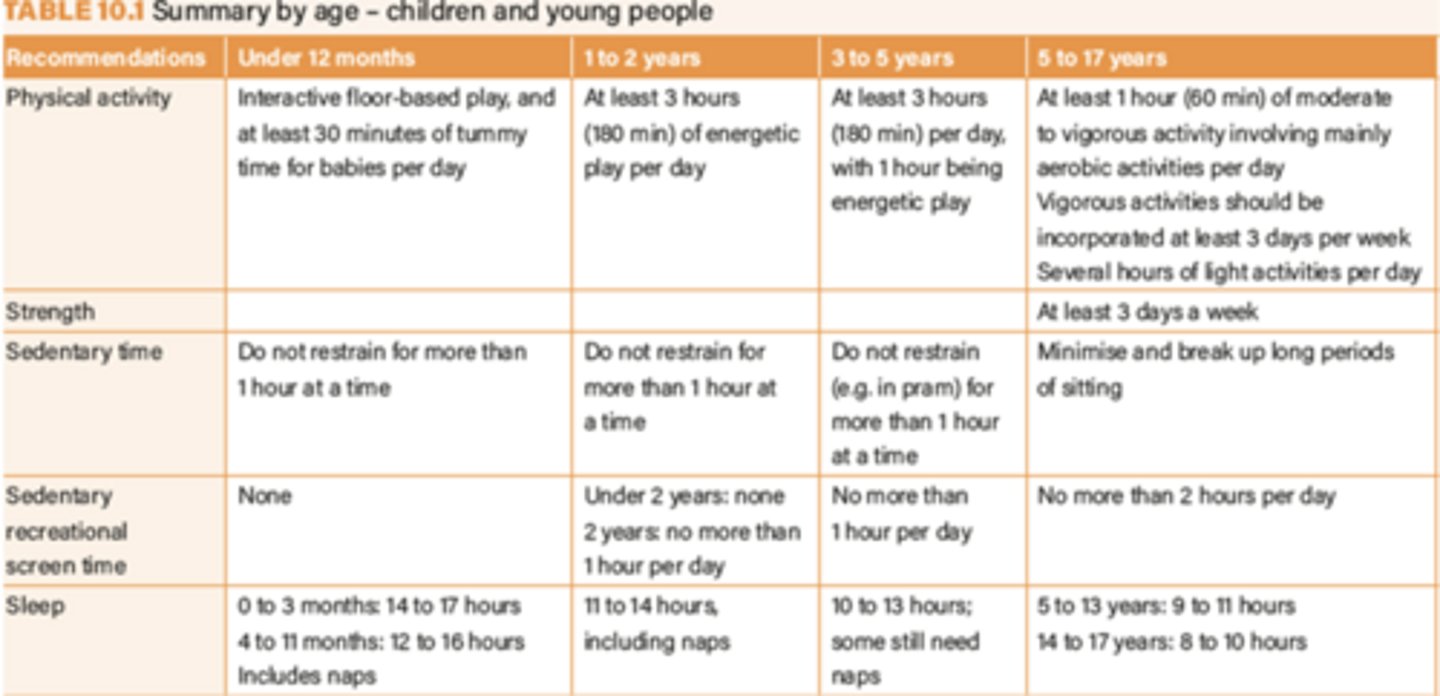
· 10.1: Physical activity and sedentary behaviour guidelines for 5 – 17 years
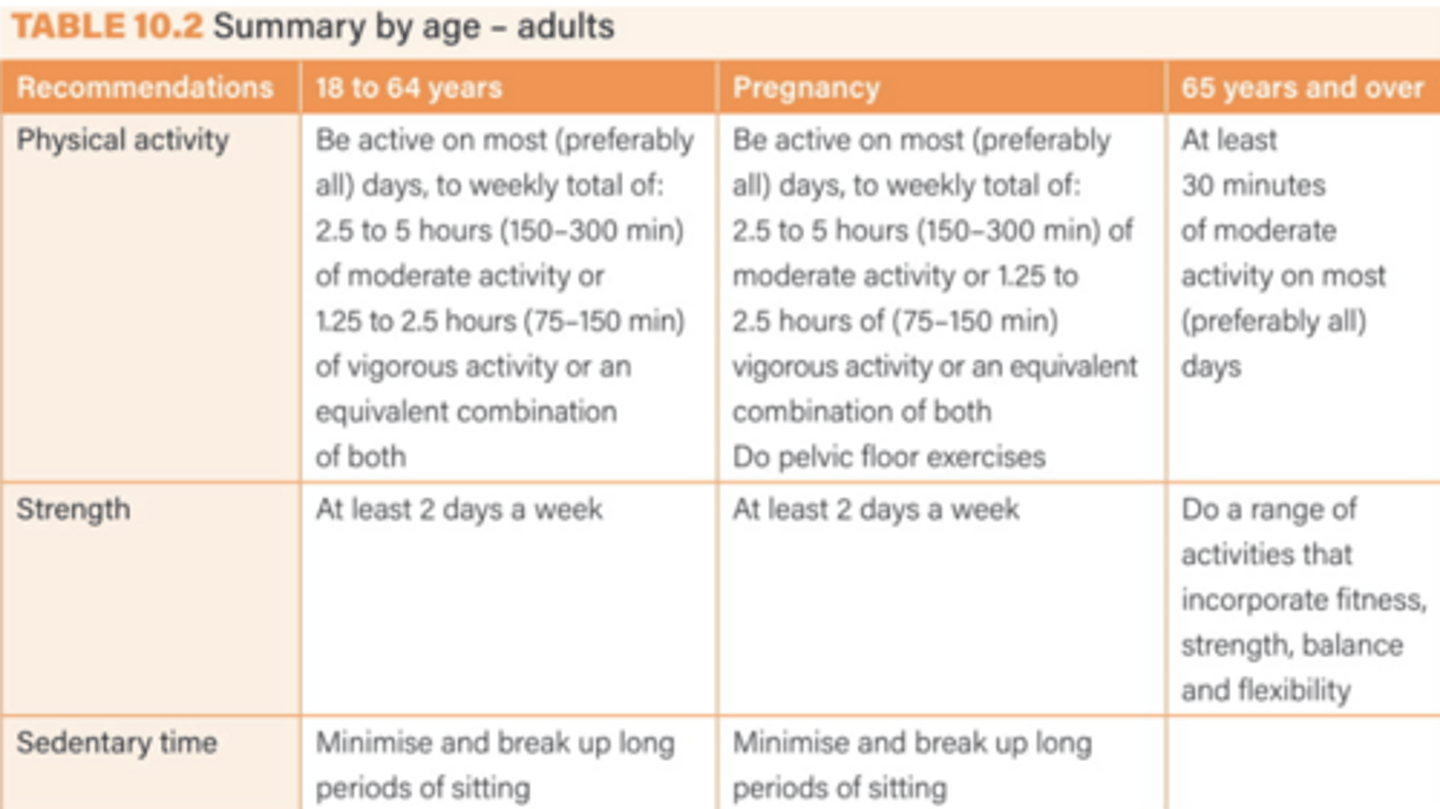
o PA and SB guidelines 65+ years
· 10.2: Measuring PA and SB among individuals and populations
o Objective + pros/cons (wearable technology, pedometers, direct observation)
What does objective mean?
(someone else or something else inputs the data)
Objective methods of assessing PA and SB
wearable technology, pedomoeters, direct observation, digital tools
Advantages of wearable technology
- Can measure heart rate, skin temperature, ECGs and EEGs. Instant feedback can be motivational. Allow tracking of personal goals.
Disadvantages of wearable technology
- Physical activity indicator can be affected by the activity type. High-speed networks are not available everywhere. The cost of the device and data costs can be high.
Advantages of pedometers
- Inexpensive, small, lightweight and noninvasive. Easy to administer to large groups.
Disadvantages of pedometers
- cannot record and store data in real time and provides no information about frequency, intensity or duration of activity.
Advantages of direct observation
- provides rich, detailed and accurate information about several dimensions of PA. Allows for collection of both quantitative and qualitative data.
Disadvantages of direct observation
- Needs trained observers and is highly time intensive.
Subjective + pros/cons (self report, proxy report, recall, diary) ( pros and cons of each measurement
What does subjective mean?
(the subject has input)
Subjective methods of assessing PA and SB
- self reports, proxy reports, recall instruments, diaries.
Advantages of subjective methods
● Capture both quantitative and qualitative information.
● Administered quickly and easily.
● Cost-effective for large-scale studies.
● Low burden on participants.
Disadvantages of subjective methods
● Social desirability bias - describing what you believe is the desired response rather than the actual result
● Not suitable for everyone.
● Reliability and validity problems.
● Interviewer may be needed to obtain accurate data.
Main purposes of measuring PA
o Population level
To determine the amount or dose of physical activity required to influence specific health parameters.
To evaluate the effectiveness of large-scale physical activity intervention programs
Main purposes of measuring PA
o Individual level
To detect change in an individual's health and/or
behaviour.
To determine the effect of any change in physical activity
behaviour
Main purposes of measuring PA
o Direct v Indirect
PA can be:
measured indirectly: eg number of times per week you walk/cycle and
measured directly: eg number of people per week using a walking/cycling path.
Ch 11 Promotion of physical activity
· 11.1: PA behaviour change (SEM)
Individual factors/influences
Knowledge
Education
Attitudes
Beliefs
Perceived barriers
Motivation
Enjoyment
Motor skills
Age
Gender
Self efficacy (a person’s belief that they can achieve success in a certain activity)
Injuries
Disabilities
§ Social environmental: family, peers, networks
Family
Partner/Spouse
Peers
Institutions/Organisations
Social support
Healthcare professionals
Educators
Community norms
Cultural background
SES (Socioeconomic status) of a community
§ Physical environment: natural, built, facilities
Natural factors (eg weather)
Availability and access to sport and recreation facilities
Aesthetics (look and feel of the environment)
Safety eg crime rates, traffic, terrain
Community design eg lighting, bike paths etc
Public transport
§ Policy & organisation: rules, incentives, resources, infrastructure
Urban planning policies
eg Green areas, provision of safe workout areas, bike paths
Education policies
eg compulsory PE/sport class time, wearing of PE uniforms to school
Workplace policies
eg encouragement of walk and talk meetings, provision of stand up desks
Funding policies
eg money put aside for health promotion initiatives and advertising eg Walk, to School Day, Steptember, This Girl Can
Opening sentence of the SEM model
"Physical activity behavior is more likely to be changed if the intervention or program targets all four levels of the social-ecological model."
Closing sentence of the SEM model
“ The campaign addressed all four levels of the social-ecological model, therefore increasing the likelihood of physical activity behaviour change occurring”.
OR
“ The campaign did not address all four levels of the social- ecological model, and therefore physical activity behavior change is unlikely to occur”.
Aerobic power
is the rate of energy production from the aerobic energy system.
is the ability of the body systems to take in, transport and utilise oxygen to produce energy.
Used for? Functional movement examples
What is aerobic power used for?
- Very beneficial for high endurance sports
- But at an optimal level is important for daily functioning such as:
Functional movement examples: jogging, walking or taking the stairs.
Associated training methods to improve aerobic power-
Moderate or vigorous movement activity can improve aerobic power
- Continuous training
- Fartlek training
- interval training (long or HIIT).
Factors affecting aerobic power includes:
- Sex ( men have a greater blood volume/lung capacity = greater aerobic power
- Age ( peaks at 25-28)
- Muscle fiber types ( slow twitch fibres = greater energy aerobically)
Fitness test for aerobic power
- Coopers 12 minute run
- Beep test
o Muscular Strength
Muscular strength - is the peak force a muscle can produce in one contraction.
Used for/ functional movement examples
Used for:
Physical activities such as rowing to grip the oar, yoga to hold an arm balance.
Functional movement examples - carrying shopping bags, opening doors, gripping a broom or rake and movements that require balance.
Associated training methods to improve muscular strength
- resistance training, where a heavy load is used to build muscle. functional strength training, which targets multiple muscle groups over multiple joint actions .
Factors affecting Muscular strength
- Sex ( males have generally have greater cross sectional area, thus = able to produce more force
- Muscle fiber type ( A greater percentage of fast- twitch fibers leads to more force production).
- Age ( peaks at 20-30 years of age) - declines after due to change in muscle size and mass.
Fitness tests for muscular strength
- Leg press
- Hand grip dynamometer test
o Muscular Endurance
Muscular endurance - is the ability of a muscle or muscle group to sustain repeated contractions against a resistance for an extended period of time.
Used for/ Functional movement examples
Used for:
Functional movement examples: full body, such as hiking and localized muscle group, for example, quadriceps riding a bike.
Associated training methods to improve muscular endurance -
- continuous training,
- - fartlek training
- resistance training
Factors affecting muscular endurance
- Age ( peaks at 25-30 years then declines)
- Muscular strength ( a high level of muscular strength positively influences the ability to contract muscles repeatedly).
- Sex ( more aerobic power and strength in males = more muscular endurance
Fitness tests:
Repeated actions of
- Push up test
- Sit up test