Macroecon comprehensive test
 Call Kai
 Learn
Learn Practice Test
 Spaced Repetition
 Match
Match Flashcards
 Knowt Play
1/83

Earn XP
Description and Tags
Name | Mastery | Learn | Test | Matching | Spaced | Call with Kai |
|---|
No analytics yet
Send a link to your students to track their progress
84 Terms
Unemployment that results because it takes time for workers to search for the jobs that best suit their tastes and skills is called
structural unemployment.
cyclical unemployment.
the natural rate of unemployment.
frictional unemployment.
frictional unemployment.
The discount rate is
the interest rate that banks charge on overnight loans to other banks.
one divided by the difference between one and the reserve ratio.
the interest rate the Fed charges banks.
the interest rate banks receive on reserve deposits with the Fed.
the interest rate the Fed charges banks.
Octavia is a retired teacher who has not worked for the past five years. Alex has been laid off but is waiting to be recalled to a job. Who does the Bureau of Labor Statistics count as "not in the labor force"?
Octavia but not Alex
Alex but not Octavia
Neither Alex nor Octavia
Both Alex and Octavia
Octavia but not Alex
Which of the following policies can the Fed follow to increase the money supply?
Sell government bonds
Reduce the quantity of funds available through the Term Auction Facility
Increase reserve requirements for banks
Reduce the interest rate on reserves
Reduce the interest rate on reserves
Which of the following is included in M2?
Money market mutual funds
Large time deposits
Corporate bonds
Credit cards
Money market mutual funds
In the long run, the unemployment rate equals
the difference between the cyclical and natural rate of unemployment.
the sum of frictional and structural unemployment.
the cyclical rate of unemployment.
the natural rate of unemployment.
the natural rate of unemployment.
To be counted as "employed" in the U.S. labor force statistics, a person
does not have to be working for pay if they are working for a family business but must be employed full time.
must be working for pay but does not have to be working full time.
must be working for pay and be working full time.
does not have to be working for pay if they are working for a family business and does not have to be working full time.
does not have to be working for pay if they are working for a family business and does not have to be working full time.
Which of the following is not included in M1?
Currency
Small time deposits
Traveler's checks
Demand deposits
Small time deposits
The money supply increases when the Fed
raises the discount rate. The increase will be larger the smaller the reserve ratio is.
lowers the discount rate. The increase will be larger the smaller the reserve ratio is.
lowers the discount rate. The increase will be larger the larger the reserve ratio is.
raises the discount rate. The increase will be larger the larger the reserve ratio is.
lowers the discount rate. The increase will be larger the smaller the reserve ratio is.
Cyclical unemployment refers to
short-run fluctuations around the natural rate of unemployment.
the relationship between the probability of unemployment and a worker's experience level.
the difference between the structural and frictional unemployment rates.
the portion of unemployment created by wages set above the equilibrium level.
short-run fluctuations around the natural rate of unemployment.
Frictional unemployment is thought to explain relatively
short spells of unemployment, while structural unemployment is thought to explain relatively long spells of unemployment.
short spells of unemployment, as is structural unemployment.
long spells of unemployment, as is structural unemployment.
long spells of unemployment, while structural unemployment is thought to explain relatively short spells of unemployment.
short spells of unemployment, while structural unemployment is thought to explain relatively long spells of unemployment.
Which of the following is an example of barter?
A doctor performs surgery on a patient whose insurance pays 100% of the bill.
A barber gives a plumber a haircut in exchange for the plumber fixing the barber's leaky faucet.
A parent gives a teenager a $10 bill in exchange for their babysitting services.
A homeowner gives an exterminator a check for $50 in exchange for extermination services.
A barber gives a plumber a haircut in exchange for the plumber fixing the barber's leaky faucet.
The labor force equals the
number of people employed.
number of people employed plus the number of people unemployed plus teenagers between ages 14 and 16 who work at least 10 hours a week.
number of people employed plus the number of people unemployed.
adult population.
number of people employed plus the number of people unemployed.
When the Fed decreases the discount rate, banks will
borrow less from the Fed and lend less to the public. The money supply decreases.
borrow less from the Fed and lend more to the public. The money supply increases.
borrow more from the Fed and lend more to the public. The money supply increases.
borrow more from the Fed and lend less to the public. The money supply decreases.
borrow more from the Fed and lend more to the public. The money supply increases.
Consider two people who are currently out of work. Tim is not looking for work because there have been many job cuts where he lives, and he doesn't think it likely that he will find work. Bev is not currently looking for work, but she would like a job, and she has looked for work in the past. The Bureau of Labor Statistics considers
only Tim to be a marginally attached worker.
neither Tim nor Bev to be marginally attached workers.
only Bev to be a marginally attached worker.
both Tim and Bev to be marginally attached workers.
both Tim and Bev to be marginally attached workers.
The existence of money leads to
neither greater specialization nor to a higher standard of living.
greater specialization and to a higher standard of living.
greater specialization in production, but not to a higher standard of living.
a higher standard of living, but not to greater specialization.
greater specialization and to a higher standard of living.
Who of the following is not included in the Bureau of Labor Statistics' "employed" category?
Those waiting to be recalled to a job from which they had been laid off
Those who were temporarily absent from work because of vacation
Those who worked in their own business
Those who worked as unpaid workers in a family member's business
Those waiting to be recalled to a job from which they had been laid off
Jack is a full-time college student who is not working or looking for a job. The Bureau of Labor Statistics counts Jack as
employed
not in the labor force.
unemployed.
marginally attached worker.
not in the labor force.
The Federal Reserve
was created in 1896.
is part of the executive branch of government.
is the central bank of the United States.
is only responsible for controlling the money supply.
is the central bank of the United States.
Which of the following both increase the money supply?
A decrease in the discount rate and an increase in the interest rate on reserves
An increase in the discount rate and a decrease in the interest rate on reserves
An increase in the discount rate and an increase in the interest rate on reserves
A decrease in the discount rate and a decrease in the interest rate on reserves
A decrease in the discount rate and a decrease in the interest rate on reserves
What is the primary aim of the Federal Reserve's contractionary monetary policy?
To lower interest rates
To stimulate the economy
To slow down the economy and curb inflation
To increase consumer spending
To slow down the economy and curb inflation
The Federal Reserve, commonly called the FED, has two primary responsibilities. What are they?
Regulating commercial banks and conducting monetary policy
Regulating commercial banks and setting interest rates
Printing money and setting inflation targets
Overseeing the stock market and managing the national debt
Regulating commercial banks and conducting monetary policy
When there is an excess supply of money,
people will try to get rid of money causing interest rates to fall. Investment increases.
people will try to get rid of money causing interest rates to rise. Investment increases.
people will try to get rid of money causing interest rates to rise. Investment decreases.
people will try to get rid of money causing interest rates to fall. Investment decreases.
people will try to get rid of money causing interest rates to fall. Investment increases.
Banks are not lending, and there is widespread fear in financial markets. What is the most appropriate Federal Reserve response?
Sell government bonds to reduce the money supply
Raise interest rates to control inflation
Increase reserve requirements to stabilize banks
Aggressively buy bonds to increase liquidity
Aggressively buy bonds to increase liquidity
Fiscal policy affects the economy
in neither the short nor the long run.
only in the short run.
only in the long run.
in both the short and long run.
in both the short and long run.
The Federal Reserve, commonly called the FED, is the central bank of the United States. Who is the current Chair of the Federal Reserve?
Janet Yellen
Jerome Powell
Ben Bernanke
Alan Greenspan
Jerome Powell
Prices across the economy are rising quickly, and consumers are spending heavily. What is the most appropriate action for the Federal Reserve?
Buy government bonds to increase the money supply
Sell government bonds to decrease the money supply
Lower the discount rate to encourage borrowing
Lower reserve requirements to increase lending
Sell government bonds to decrease the money supply
Fiscal policy refers to the idea that aggregate demand is affected by changes in
government spending and taxes.
trade policy.
the money supply.
interest rates.
government spending and taxes.
What is the main purpose of the Federal Reserve's use of expansionary and contractionary monetary policy tools?
To maximize employment and wages
To manipulate the federal budget deficit
To influence the level of economic activity and inflation
To directly control interest rates
To influence the level of economic activity and inflation
If the Fed increases the money supply,
the interest rate decreases, which tends to raise stock prices.
the interest rate decreases, which tends to reduce stock prices.
the interest rate increases, which tends to raise stock prices.
the interest rate increases, which tends to reduce stock prices.
the interest rate decreases, which tends to raise stock prices.
The Federal Reserve has a dual mandate that guides its policies. What are the two parts of this dual mandate?
Promoting maximum employment and price stability
Ensuring economic growth and full employment
Regulating commercial banks and managing the federal budget
Maintaining a stable exchange rate and low inflation
Promoting maximum employment and price stability
The Federal Reserve uses various tools to implement its monetary policy. What is the Federal Reserve's main tool for implementing monetary policy?
Increasing reserve requirements
Buying and selling government securities
Adjusting the federal funds rate
Adjusting the federal funds rate
Printing more money
Buying and selling government securities
A goal of monetary policy and fiscal policy is to
enhance the shifts in aggregate demand and thereby increase economic growth.
enhance the shifts in aggregate demand and thereby create fluctuations in output and employment.
offset the shifts in aggregate demand and thereby stabilize the economy.
offset the shifts in aggregate demand and thereby eliminate unemployment.
offset the shifts in aggregate demand and thereby stabilize the economy.
The Federal Open Market Committee (FOMC) plays an important role in the Federal Reserve's operations. What is the FOMC's main role?
Overseeing the regulation of commercial banks
Making monetary policy decisions
Appointing the Chair of the Federal Reserve
Determining the Federal Reserve's budget
Making monetary policy decisions
Monetary policy
can be described either in terms of the money supply or in terms of the interest rate.
must be described in terms of money-supply targets.
must be described in terms of interest-rate targets.
cannot be accurately described in terms of the interest rate or in terms of the money supply.
can be described either in terms of the money supply or in terms of the interest rate.
The relationship between the price of a six-pack and the quantity of Pepsi demanded is called _____
the law of supply.
the fact that consumers like Pepsi.
demand.
supply.
the law of demand.
the law of demand.
If we say that the demand for a good has increased, we mean there has been _____
a downward movement along the demand curve.
an upward movement along the demand curve.
a rightward shift of the demand curve.
a leftward shift of the demand curve.
an increase in the slope of the demand curve.
a rightward shift of the demand curve.
If the price of vanilla ice cream increases, everything else remaining constant, it is likely that ___
the demand for vanilla ice cream will decrease.
the quantity demanded of vanilla ice cream will increase.
the demand for vanilla ice cream will increase.
the demand for chocolate ice cream, a substitute, will increase.
the demand for chocolate ice cream, a substitute, will decrease
the demand for chocolate ice cream, a substitute, will increase.
The demand for an inferior good decreases as consumer income increases.
True
False
True
_____ indicate(s) how much producers are willing and able to offer for sale per period at each possible price, other things constant.
Demand
Supply
Scarce resources
Unlimited wants
Markets
Supply
Miguel buys 1 pizza per week when the price is $10, and buys 2 when the price is $7. Miguel is demonstrating _____
supply
the law of demand
demand.
the law of supply.
that he likes pizza.
the law of demand
Which of the following statements about a demand curve is true?
If price increases, the demand curve will shift to the right.
If a demand curve shifts, the supply curve will shift as well irrespective of whether price changes.
The demand curve for a good will not shift when price changes.
The demand curve for a good will not shift when the money income of consumers increases.
If a supply curve shifts, thereby changing price, the demand curve will shift as well.
If a demand curve shifts, the supply curve will shift as well irrespective of whether price changes.
The demand for a product is the amount of the product that _____
buyers are willing to purchase over different time periods.
buyers are willing to consume at a constant price.
sellers are willing and able to sell at different prices.
buyers are willing and able to purchase at different prices.
sellers are willing to sell at a particular price.
buyers are willing and able to purchase at different prices.
As the price of milk increases, producers are generally willing to sell a larger quantity of milk in the market, other things constant. This represents the law of _____
decreasing opportunity costs.
diminishing marginal utility.
variable proportions.
supply.
demand
supply.
Which of the following will not shift the supply curve?
the prices of resources
producer expectations
the prices of other goods
a change in price
the state of technology and know-how
a change in price
The slope of the demand curve for a normal good must be positive.
False
True
False
The law of demand states that _____
quantity demanded varies inversely with price, other things constant.
rms create a demand for a product by producing it.
the demand curve shifts whenever the price of a good changes, other things constant.
price is the only factor that influences the quantity that people are willing and able to buy.
price and quantity demanded are positively related, other things constant.
quantity demanded varies inversely with price, other things constant.
The explanation for the law of demand begins with _____
prices acting as signals to existing and potential suppliers.
unlimited wants confronting scarce resources.
finite wants satisfied by infinite resources.
a small number of wants satisfied by scarce resources.
unlimited wants matching up with unlimited resources.
unlimited wants confronting scarce resources.
_____ is the amount offered for sale per period at a particular price, as reflected by a point on a supply curve.
Market supply
Supply
Law of supply
Quantity supplied
Individual supply
Quantity supplied
Two goods are considered substitutes only if a(n) _____
increase in the demand for one good leads to a decrease in the supply of the other.
decrease in the demand for one good leads to a decrease in the supply of the other.
decrease in the price of one good leads to an increase in the demand for the other.
decrease in the supply of one good causes producers to switch to the production of the other.
increase in the price of one good leads to an increase in the demand for the other.
increase in the price of one good leads to an increase in the demand for the other.
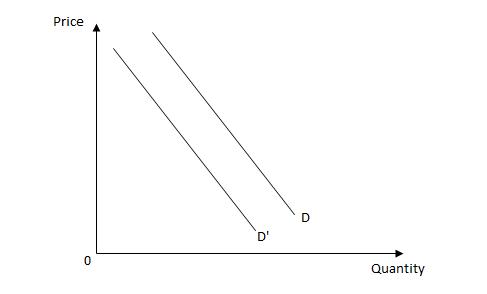
Refer to Exhibit 4.2 of the demand curves for a good. A shift from the demand curve D to the demand curve D' would be caused by a(n) _____
decrease in the price of the good under consideration.
increase in the price of an important resource used to produce the good.
decrease in the number of producers of the good.
significant increase in population because of immigration.
decrease in consumer income.
decrease in consumer income.
If demand decreases, then quantity supplied will increase.
False
True
False
The law of supply implies that _____
price and quantity supplied are positively related.
price and quantity demanded are inversely related.
price and quantity supplied are inversely related.
price and quantity demanded are not related.
price and quantity demanded are positively related.
price and quantity supplied are positively related.
The law of supply indicates that _____
when prices rise, the quantity demanded falls.
when prices fall, the quantity supplied falls.
when prices rise, the quantity demanded rises.
when prices fall, the quantity supplied rises.
when prices rise, the quantity demanded stays the same.
when prices fall, the quantity supplied falls.
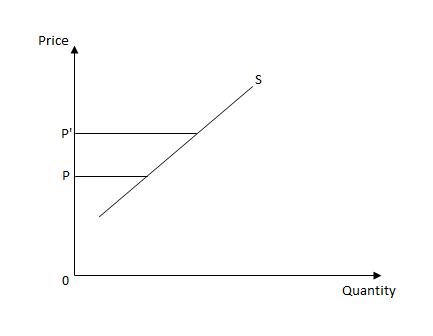
Refer to Exhibit 4.4, which shows the supply curve of a good. Which outcome will result when price increases from P to P'?
Quantity supplied will decrease.
Supply will decrease.
Supply will remain unchanged.
Supply will increase.
Quantity supplied will increase.
Quantity supplied will increase.
Which of the following will lead to an increase in the quantity supplied of a given good?
a technological improvement
an increase in the population
an increase in resource prices
an increase in the price of an alternative good
an increase in the price of the good
an increase in the price of the good
As the price of ballpoint pens increases, the demand for felt-tip pens can be expected to decrease.
True
False
False
A decrease in the price of peanut butter will cause a leftward shift of the supply curve of peanut butter.
True
False
False
Jennifer expects the price of chewing gum to go up by 10 percent next week. Which of the following is the most likely result of such an expectation?
Jennifer’s demand for chewing gum will decrease during this week.
Jennifer’s demand for chewing gum will increase during this week.
Jennifer’s demand for chewing gum will decrease during this week.
Jennifer’s demand for chewing gum will increase during the following week.
Jennifer’s demand for chewing gum will increase during the following week.
Jennifer’s demand for chewing gum will increase during this week.
When a country has a comparative advantage in producing a certain good,
the country’s opportunity cost of that good is high relative to other countries’ opportunity costs of that same good.
then specializing in the production of that good and trading for other goods could allow that country to consume at a point beyond its production possibilities frontier.
the country should produce just enough of that good for its own consumption.
the country should import that good.
then specializing in the production of that good and trading for other goods could allow that country to consume at a point beyond its production possibilities frontier.
Points inside the production possibilities frontier represent feasible levels of production.
True
False
False
The principle of comparative advantage does not provide answers to certain questions. One of those questions is
Is it possible for specialization and trade to increase total output of traded goods?
Is it absolute advantage or comparative advantage that really matters?
Do specialization and trade benefit more than one party to a trade?
How are the gains from trade shared among the parties to a trade?
How are the gains from trade shared among the parties to a trade?
The production possibilities frontier illustrates
the combinations of output that an economy should produce.
the combinations of output that an economy wants to produce.
the combinations of output that an economy should consume.
the combinations of output that an economy can produce.
the combinations of output that an economy can produce.
Points on the production possibilities frontier represent efficient levels of production.
True
False
True
The production possibilities frontier is a graph that shows the various combinations of outputs that the economy can possibly produce given the available factors of production and the available production technology.
True
False
True
The opportunity cost of an item is
usually less than the dollar value of the item.
what you give up to get that item.
the dollar value of the item.
the number of hours needed to earn money to buy the item.
what you give up to get that item.
Absolute advantage is found by comparing different producers'
locational and logistical circumstances.
payments to land, labor, and capital.
input requirements per unit of output.
opportunity costs.
input requirements per unit of output.
The circular-flow diagram explains, in general terms, how the economy is organized and how participants in the economy interact with one another.
True
False
True
Where can an economy not produce?
On its production possibilities frontier
Outside its production possibilities frontier
At the endpoints of its production possibilities frontier
Inside its production possibilities frontier
Outside its production possibilities frontier
The business cycle is the
positive relationship between the quantity of money in an economy and inflation.
predictable changes in economic activity due to changes in government spending and taxes.
irregular fluctuations in economic activity.
relationship between unemployment and inflation.
irregular fluctuations in economic activity.
A production possibilities frontier is bowed outward when
the rate of trade-off between the two goods being produced is constant.
the rate of trade-off between the two goods being produced depends on how much of each good is being produced.
the more resources the economy uses to produce one good, the fewer resources it has available to produce the other good.
an economy is self-sufficient instead of interdependent and engaged in trade.
the rate of trade-off between the two goods being produced depends on how much of each good is being produced.
In the circular-flow diagram, which of the following is not a factor of production?
Capital
Output
Labor
Land
Output
An economy's production of two goods is efficient if
the economy is producing at a point inside the production possibilities frontier.
it is possible to produce more of both goods without increasing the quantities of inputs that are being used.
the economy is producing at a point on the production possibilities frontier.
all members of society consume equal portions of the goods.
the economy is producing at a point on the production possibilities frontier.
Points outside the production possibilities frontier represent infeasible levels of production.
True
False
True
Natural gas is considered to be a nonrenewable energy source. Which of the following statements is correct?
Natural gas is a nonscarce resource.
Natural gas is an unlimited resource.
Natural gas is a scarce resource.
Natural gas is not a resource.
Natural gas is a scarce resource.
A circular-flow diagram is a model that
incorporates all aspects of the real economy.
helps to explain how consumers and the government interact with one another.
explains how countries trade with each other.
helps to explain how the economy is organized.
helps to explain how the economy is organized.
Economics is the study of how society manages its
limited wants and unlimited resources.
limited wants and limited resources.
unlimited wants and limited resources.
unlimited wants and unlimited resources.
unlimited wants and limited resources.
Resources are
plentiful for households and plentiful for economies.
plentiful for households but scarce for economies.
scarce for households and scarce for economies.
scarce for households but plentiful for economies.
scarce for households and scarce for economies.
Trade
reduces specialization, which increases costs.
allows specialization, which increases costs.
reduces specialization, which reduces costs.
allows specialization, which reduces costs.
allows specialization, which reduces costs.
The production possibilities frontier provides an illustration of the principle that
trade can make everyone better off.
people respond to incentives.
governments can sometimes improve market outcomes.
people face trade-offs.
people face trade-offs.
The overriding reason why households and societies face many decisions is that
goods and services are not scarce.
people, by nature, tend to disagree.
resources are scarce.
incomes fluctuate with business cycles.
resources are scarce.
A circular-flow diagram is a visual model of the economy.
True
False
True
The "invisible hand" refers to
how central planners made economic decisions.
the control that large firms have over the economy.
government regulations without which the economy would be less efficient.
how the decisions of households and firms lead to desirable market outcomes.
how the decisions of households and firms lead to desirable market outcomes.
Microeconomics is the study of
how government affects the economy.
how the economy as a whole works.
how money affects the economy.
how individual households and firms make decisions.
how individual households and firms make decisions.