4.1.8 - The market mechanism, market failure and government intervention in markets
 Call Kai
 Learn
Learn Practice Test
 Spaced Repetition
 Match
Match Flashcards
 Knowt Play
1/161

There's no tags or description
Looks like no tags are added yet.
Name | Mastery | Learn | Test | Matching | Spaced | Call with Kai |
|---|
No analytics yet
Send a link to your students to track their progress
162 Terms
Price Mechanism =
The interaction of supply and demand in a market economy that allocates scarce resources amongst competing needs and wants (to resolve the basic economic problem of unlimited wants but scarce resources)
4 Functions of the Price Mechanism
- Rationing
- Incentive
- Signalling
- Allocative
RATIONING Function of Prices
Increasing prices rations demand for a product. Helps establish equilibrium.
When there is a shortage of a good, the price will rise to deter consumers who cannot afford it from buying it.
When there is a surplus of a good, the price will fall to allow more consumers to afford it.
INCENTIVE Function of Prices
Prices create incentives for people to alter their economic behaviour.
Encourages firms to increase or decrease output to increase profits.
For example, a higher price creates an incentive for firms to supply more of a good/service to increase profits.
SIGNALLING Function of Prices
Prices provide information to buyers and sellers about where resources are wanted (markets with increasing prices) and where they are not (markets with decreasing prices).
For example, a sudden rise in a competitor's prices might indicate a rise in demand for similar products.
High prices signal to a producer to produce more of that good/service, and would signal to other producers to enter the market
ALLOCATIVE Function of Prices
Changing relative prices allocate scarce resources away from markets exhibiting excess supply and into markets in which there is excess demand --> allocative efficiency.
Prices are useful because they allocate resources to different markets based on market conditions. When prices are set above equilibrium in markets and there is therefore excess supply, resources are allocated away from these markets and towards markets with excess demand. This pushes prices towards equilibrium in both markets.
Advantages of Price Mechanism
More efficient allocation of resources - resources are allocated to their most valued use for production and consumption (where they are most needed)
Greater productive efficiency - firms need to have efficient production to maximise their output from their given resources and max profits, Consumers have to be efficient in choices to max their utility from limited income
Freedom of choice - Consumers choose goods and services based on tastes, preferences, and income that producers then allocate resources towards the needs & wants of consumers.
Lower Prices & Higher Quality - Competition of firms keeps down prices and drives up the quality of goods and services & also leads to innovation to retain customers in order to max profits
Disadvantages of Price Mechanism
Inequality - People with higher income have more buying power (effective demand), whilst lower income people may end up deprived of necessities.
Market Failure of Externalities - Over-provision of goods that have negative externalities, Under-provision of goods that have positive externalities
Market Failure of Missing Markets - Under-provision of public goods (gov intervention therefore necessary)
Information Failure - If left to free market, consumers may be exploited by assymetric info --> market failure
The use of the price mechanism in some markets could be undesirable or distort incentives
e.g. Using price mechanism for markets for life saving treatments such as blood or organ donations would incentivise high prices and create inequalities in access
Government Failure =
= When government intervention leads to a misallocation of resources that is worse than the free-market outcome, and a net welfare loss.
would have been better off if the gov did not intervene
Reasons for Government Failure:
Inadequate Information
Conflicting Objectives
Costs of Intervention (admin costs)
Market Distortions
Unintended Consequences
Inadequate Information Gov Failure
Governments and regulators do not have perfect information / have poor-quality information
Government is subject to the same information gaps and cognitive biases that consumers face
This could lead to the government intervening in the wrong way, or by the wrong amount --> resulting in a worsening of the market failure
Conflicting Objectives Gov Failure
The implementation of government intervention in one market to maximise social welfare causes a loss in social welfare in another market.
or
Government policy will raise social welfare in the LONG-RUN, but may be unpopular in the SHORT-RUN
Therefore, governments have to make a trade-off that it believes will maximise social welfare, at the expense of another objective.
Conflicting Objectives Gov Failure Example
e.g.
The imposition of tax on sugary drinks decreases the overconsumption of sugary drinks, improving the social welfare in that market.
However, it may shift consumption towards drinks low in sugar but higher in artificial sweeteners. This substitute good are also demerit goods as they also have adverse private effects of consumption, so the gov may have worsened market failure.
Costs of Intervention Gov Failure (Administrative Costs)
- Administrative or enforcement costs of government intervention can be expensive.
- These costs may end up outweighing the benefits of improved social welfare of gov intervention, leading to a worsening of resource allocation.
Market Distortions Gov Failure
Price intervention may help solve one problem, but can create others by DISTORTING PRICE SIGNALS
The SIGNALLING FUNCTION of the PRICE MECHANISM is artificially altered
This causes changes to QUANTITIES traded for goods and services
This can lead to an inefficient allocation of resources - surpluses and shorages
Unintended Consequences =
Government intervention policies can lead to unpredictable, unintended consequences which worsen the allocation of resources and net welfare
Minimum Price Unintended Consequences
Loss of international competitiveness
Minimum price must be placed above free market equilibrium
Therefore, market price of factor inputs (labour, energy) rises, meaning firms prefer to produce goods abroad rather than in the UK.
Bans/Tax/Regulation Unintended Consequences
Formation of Informal Black Markets with worse social outcomes
When products are sold legally, governments are able to regulate them through quantity, packaging, ingredients, production methods, who they are sold to.
However when banned, people may turn to sell them in informal black markets which are UNREGULATED.
Suppliers are able to exploit customers, use dangerous ingredients, sell to minors
Therefore, damaging social welfare
Subsidies Unintended Consequences
Inefficiency among Producers
Producers may rely on subsidies to survive, rather than cost-cutting and innovation
They devote less resources to improving their production process to keep costs of production down
It also protects inefficient firms from competition and create barriers to entry for new firms because prices are kept 'artificially' low.
Leads to moral hazard
Market Failure =
When the market mechanism results in a misallocation of resources and social welfare is not maximised
Complete Market Failure =
When there is no market / the market does not supply products at all.
- there are "missing markets"
Partial Market Failure =
When the market produces either the wrong quantity of a product or at the wrong price
Public Good Market Failures
- Complete Failure / Missing Market
- Public Good
- Quasi-public Good
Externality Market Failures
- Partial Failure / Incomplete Markets
- Positive Externality
- Negative Externality
- Consumption Externality
- Production Externality
- Absence of Property Rights
Merit/Demerit Good Market Failure
- Partial Failure / Incomplete Markets
- Merit Good
- Demerit Good
Information Market Failure
- Partial Failure / Incomplete Markets
- Imperfect Information
- Asymmetric Information
Public Good =
Goods that are not provided in a market because it is non-excludable and non-rivalrous
[define non-excludable & non-rivalrous in exam definition]
2 Main Characteristics of Public Goods
- Non-Excludable
- Non-Rivalry
Private Good =
Goods that are excludable, rivalrous and rejectable
Non-excludable =
Consumers cannot be excluded from consuming the product even if they didn't pay for it.
If provided for one person, anyone can accesss them.
(free rider problem)
Non-rivalry =
One person's consumption of a product does not reduce the amount available for other people to consume
Rejectability =
Private goods and services can be rejected as a person may not wish to buy them (have a choice whether to consume)
Quasi-Public Good =
A good which is partly rivalrous and partly excludable.
- exhibits some but not all the characteristics of a public good.
Why do Public Goods lead to Market Failure?
The FREE RIDER PROBLEM - When people can enjoy the benefits of consumption without paying anything for it.
If you cannot exclude the non-payers, profit-motivated businesses may decide not to supply these products.
This is as there is a loss of the incentive function to provide these goods, therefore the good becomes under-provided, resulting in a missing market - complete market failure.
Public Goods Market Failure Free Rider Problem Chain of Analysis
- Public goods are subject to the free rider problem, where people can enjoy the benefits of consumption without paying anything for it.
- This is due to the public goods being 'non-excludable' meaning non-payers cannot be excluded from consuming the product.
- This means individuals have no incentive to pay for the good.
- If individuals aren't willing to pay for it, firms cannot make money from producing the good.
- Therefore, profit-motivated firms would decide not to supply these products.
- As a result, the public goods become under-provided if left to the free market, resulting in a MISSING MARKET.
- There is under allocation of scarce resources to this particular market, in fact none are allocated at all.
- Therefore, the free market mechanism has caused allocative inefficiency and a loss in welfare, resulting in complete market failure.
How can the Government solve the Market Failure of Public Goods?
- State Provision
- Subsidies
- Charge Consumers for public goods (e.g. tolls on roads)
- Regulation
Technological Change/Advancements (& its implication for public goods) =
The process of innovation, invention and the widespread use of technology in society. This means that public goods can become private goods over time.
How has Technological Change impacted the nature of Public Goods? (chain of analysis)
- Technological advancements have made pure public goods more excludable, thus transforming them into more of a private good, or a quasi-public good.
- For example, encryption has allowed TV broadcasting to only stream to paying subscribers, thus making the service excludable to non-payers.
- This, in turn, means that firms can now make money from producing this service, encouraging firms to enter the market.
- So it reduces the under-provision and solves the problem of missing markets.
- Therefore, solving the market failure and reduces the need for government intervention.
The Tragedy of the Commons =
A situation where individuals acting independently and rationally in their own self-interest behave contrary to the best interests of society by depleting a common resource.
Common Resource =
A natural resource with no private ownership, which is non-excludable, but is rivalrous in consumption.
Why does the Tragedy of the Commons occur?
- There is an absence of property rights on the common resource as it has no private ownership.
- It is unregulated as there is no market in place to manage the allocation of these common resources
- As no one owns the resource and it is non-excludable, no one personally suffers the consequences of depleting it.
- As people will act in their self-interest (+ moral hazard), people have no incentive to look after the good
- This can lead to exploitation and overuse of the resource, leading to its depletion if used unsustainably. (tragedy of the commons)
- Leads to negative externalities in consumption, hence market failure
How can the Government solve the Market Failure of the Tragedy of the Commons?
Extend Property Rights to create a market/private good
Examples of the Tragedy of the Commons:
- Overfishing - As fishers have an incentive to maximise profits of selling fish, they attempt to catch as many as possible --> Decline in fish population --> Depletes population of fish to unsustainable levels --> Habitat degradation & less available resource of fish in the long-run
- Deforestation
- Litter
- Tasty Animals
Externality =
A 'spillover' effect from production or consumption that affects third parties either positively or negatively
Positive Externality =
A spillover effect from production or consumption that affects third parties positively
Negative Externality =
A spillover effect from production or consumption that affects third parties negatively
Production Externality =
A positive or negative externality arising from the production of a good or service
- Divergence between private & social costs (MSC & MPC curves)
Consumption Externality =
A positive or negative externality arising from the consumptionof a good or service
- Divergence between private & social benefits (MSB & MPB curves)
Social Cost =
Private Cost + External Cost
Social Benefit =
Private Benefit + External Benefit
Positive Production Externality Analysis (9 marker)
In free market --> producers consider own actions --> so equilibrium is at point A where MPC=MPB
Positive Production Externality occurs where the production of a good benefits third parties [insert application]
This means at Point A --> private cost [insert application] is greater social cost (shown by MPC>MSC) --> so an external benefit exists of A-B.
Socially optimal point is at C where MSC=MSB at Ps, Qs.
Therefore, the good is underproduced at Qm and overpriced at Pm compared to what is best for society.
There is under allocation of scarce resources, resulting in Deadweight Welfare Loss shown by area ABC
Therefore, allocative inefficiency occurs, resulting in partial market failure
![<ul><li><p>In free market --> producers <strong><mark data-color="purple" style="background-color: purple; color: inherit;">consider own actions</mark></strong> --> so equilibrium is at point A where MPC=MPB</p></li><li><p>Positive Production Externality occurs where the production of a good benefits third parties <strong><mark data-color="yellow" style="background-color: yellow; color: inherit;">[insert application]</mark></strong></p></li><li><p>This means at Point A --> private cost <strong><mark data-color="yellow" style="background-color: yellow; color: inherit;">[insert application]</mark> </strong>is greater social cost (shown by MPC>MSC) --> so an external benefit exists of A-B.</p></li><li><p>Socially optimal point is at C where MSC=MSB at Ps, Qs.</p></li><li><p>Therefore, the good is underproduced at Qm and overpriced at Pm <strong><mark data-color="purple" style="background-color: purple; color: inherit;">compared to what is best for society</mark></strong>.</p></li><li><p>There is <strong><mark data-color="purple" style="background-color: purple; color: inherit;">under allocation of scarce resources</mark></strong>, resulting in <strong><mark data-color="purple" style="background-color: purple; color: inherit;">Deadweight Welfare Loss</mark></strong> shown by area ABC</p></li><li><p>Therefore, <strong><mark data-color="purple" style="background-color: purple; color: inherit;">allocative inefficiency</mark></strong> occurs, resulting in <strong><mark data-color="purple" style="background-color: purple; color: inherit;">partial market failure</mark></strong></p></li></ul><p></p>](https://knowt-user-attachments.s3.amazonaws.com/323f5fe0-e8a0-478a-addf-f740a2a5d690.png)
Negative Production Externality Analysis (9 marker)
In free market, producers consider own actions --> so equilibrium is at point A where MPC=MPB
Negative production externality occurs where the production of a good costs to third parties. [insert application]
This means that at point A --> social cost [insert application] is greater than private cost (shown by MSC>MPC) --> so an external cost exists of A-B
Socially optimum point is at C where MSC=MSB at Ps, Qs
Therefore, the good is overproduced at Qm and underpriced at Pm compared to what is best for society
There is over allocation of scarce resources, resulting in Deadweight Welfare Loss shown by area ABC
Therefore, allocative inefficiency occurs, resulting in partial market failure
![<ul><li><p>In free market, <strong><mark data-color="purple" style="background-color: purple; color: inherit;">producers consider own actions</mark></strong> --> so equilibrium is at point A where MPC=MPB</p></li><li><p>Negative production externality occurs where the production of a good costs to third parties. <strong><mark data-color="yellow" style="background-color: yellow; color: inherit;">[insert application]</mark></strong></p></li><li><p>This means that at point A --> social cost <strong><mark data-color="yellow" style="background-color: yellow; color: inherit;">[insert application] </mark></strong>is greater than private cost (shown by MSC>MPC) --> so an external cost exists of A-B</p></li><li><p>Socially optimum point is at C where MSC=MSB at Ps, Qs</p></li><li><p>Therefore, the good is overproduced at Qm and underpriced at Pm <strong><mark data-color="purple" style="background-color: purple; color: inherit;">compared to what is best for society</mark></strong></p></li><li><p>There is <strong><mark data-color="purple" style="background-color: purple; color: inherit;">over allocation of scarce resources</mark></strong>, resulting in <strong><mark data-color="purple" style="background-color: purple; color: inherit;">Deadweight Welfare Loss</mark></strong> shown by area ABC</p></li><li><p>Therefore, <strong><mark data-color="purple" style="background-color: purple; color: inherit;">allocative inefficiency</mark></strong> occurs, resulting in <strong><mark data-color="purple" style="background-color: purple; color: inherit;">partial market failure</mark></strong></p></li></ul><p></p>](https://knowt-user-attachments.s3.amazonaws.com/448b2561-0ab1-431c-9173-cd108bdfcd2b.png)
Positive Consumption Externality Analysis (9 marker)
In free market, producers consider own actions --> so equilibrium at point A where MPB=MPC
Positive consumption externality occurs where the consumption of a good benefits to third parties. [insert application]
Therefore at point A, social benefit [insert application] is greater than private benefit (shown by MSB>MPB) --> external benefit exists of A-B
Socially optimum point at C where MSB=MSC at Ps, Qs
Therefore, the goods are under consumed at Qm compared to what is best for society
There is under allocation of scarce resources, resulting in Deadweight Welfare Loss shown by area ABC
Therefore, allocative inefficiency occurs, resulting in partial market failure
![<ul><li><p>In free market, <strong><mark data-color="purple" style="background-color: purple; color: inherit;">producers consider own actions</mark></strong> --> so equilibrium at point A where MPB=MPC</p></li><li><p>Positive consumption externality occurs where the consumption of a good benefits to third parties. <strong><mark data-color="yellow" style="background-color: yellow; color: inherit;">[insert application]</mark></strong></p></li><li><p>Therefore at point A, social benefit <strong><mark data-color="yellow" style="background-color: yellow; color: inherit;">[insert application]</mark></strong> is greater than private benefit (shown by MSB>MPB) --> external benefit exists of A-B</p></li><li><p>Socially optimum point at C where MSB=MSC at Ps, Qs</p></li><li><p>Therefore, the goods are under consumed at Qm <strong><mark data-color="purple" style="background-color: purple; color: inherit;">compared to what is best for society</mark></strong></p></li><li><p>There is under allocation of scarce resources, resulting in <strong><mark data-color="purple" style="background-color: purple; color: inherit;">Deadweight Welfare Loss </mark></strong>shown by area ABC</p></li><li><p>Therefore, <strong><mark data-color="purple" style="background-color: purple; color: inherit;">allocative inefficiency</mark></strong> occurs, resulting in <strong><mark data-color="purple" style="background-color: purple; color: inherit;">partial market failure</mark></strong></p></li></ul><p></p>](https://knowt-user-attachments.s3.amazonaws.com/e7cd0a6c-2e30-420c-9530-857a5fab4180.png)
Negative Consumption Externality Analysis (9 marker)
In free market, producers consider own actions --> so equilibrium is at point A where MPC=MPC
Negative consumption externality occurs where the consumption of a good costs to third parties. [insert application]
This means that at point A --> private benefit [insert application] is greater than social benefit (shown by MPB>MSB) --> so an external cost exists of A-B
Socially optimum point is at C where MSC=MSB at Ps, Qs
Therefore, the goods are over consumed at Qm compared to what is best for society
There is over allocation of scarce resources, resulting in The Deadweight Welfare Loss shown by area ABC
Therefore, allocative inefficiency occurs, resulting in partial market failure
![<ul><li><p>In free market, <strong><mark data-color="purple" style="background-color: purple; color: inherit;">producers consider own actions</mark></strong> --> so equilibrium is at point A where MPC=MPC</p></li><li><p>Negative consumption externality occurs where the consumption of a good costs to third parties. <strong><mark data-color="yellow" style="background-color: yellow; color: inherit;">[insert application]</mark></strong></p></li><li><p>This means that at point A --> private benefit <strong><mark data-color="yellow" style="background-color: yellow; color: inherit;">[insert application] </mark></strong>is greater than social benefit (shown by MPB>MSB) --> so an external cost exists of A-B</p></li><li><p>Socially optimum point is at C where MSC=MSB at Ps, Qs</p></li><li><p>Therefore, the goods are over consumed at Qm <strong><mark data-color="purple" style="background-color: purple; color: inherit;">compared to what is best for society</mark></strong></p></li><li><p>There is <strong><mark data-color="purple" style="background-color: purple; color: inherit;">over allocation of scarce resources</mark></strong>, resulting in The <strong><mark data-color="purple" style="background-color: purple; color: inherit;">Deadweight Welfare Loss</mark></strong> shown by area ABC</p></li><li><p>Therefore, <strong><mark data-color="purple" style="background-color: purple; color: inherit;">allocative inefficiency</mark></strong> occurs, resulting in <strong><mark data-color="purple" style="background-color: purple; color: inherit;">partial market failure</mark></strong></p></li></ul><p></p>](https://knowt-user-attachments.s3.amazonaws.com/be889200-637a-46e8-b885-4df8f851d646.png)
Property Rights =
The authority to determine how an economic resource is used - who gets it, who is excluded from it, what it's used for etc.
Why do Lack of Property Rights lead to the Tragedy of the Commons
Non-excludable resources tend not to be looked after, or are overused, because the lack of clear property rights means it's not worth any one person taking responbility for them.
Moral Hazard =
Risk that people will behave antisocially/recklessly when they won't bear the costs of their own behaviour
Why can lack of property rights lead to externalities, hence market failure
The LACK of property rights means no one owns the good so no one is responsible and can be held accountable for their actions.
As people will act in their self-interest (+ moral hazard), people have no incentive to look after the good
Leads to tragedy of the commons → negative consumption externalities therefore market failure
Merit Good =
A good that is underconsumed because consumers underestimate the benefits to themselves of consuming it (imperfect information)
Imperfect Information
Positive Externalities
Demerit Good =
A good that is overconsumed because consumers underestimate the costs to themselves of consuming it (imperfect information)
Imperfect Information
Negative Externalities
What does the classificiation of merit & demerit goods depend on?
Value judgements
Imperfect Information =
Occurs when people have inaccurate, incomplete, misleading, or misunderstood information which leads them to make wrong/suboptimal choices
Merit Good Chain of Analysis
In a free market, said good may lead to market failure due to it being a merit good.
This is because imperfect information arises when consumers don't know the full benefits to themselves of consumption.
For example, [application] vegetables improve immune system
As a result, consumers underestimate the private benefits of consuming the merit good. This often occurs as a result of short-term bias in decision-making.
This causes consumers' actual demand to be determined by information that is only partial (shown by D (partial)), so the free-market equilibrium occurs at point A at Pm,Qm
However, with full information about the good the demand would be higher at D (full), which results in the social optimum being at point C at Ps,Qs
Therefore, information failure results in consumers underestimating the benefits of consuming the good so causes underconsumption
There is under allocation of scarce resources to the good, resulting in deadweight welfare loss shown by area ABC
Therefore, the free market mechanism has caused allocative inefficiency, resulting in partial market failure.
![<ul><li><p>In a free market, said good may lead to market failure due to it being a merit good.</p></li><li><p>This is because <strong><mark data-color="purple" style="background-color: purple; color: inherit;">imperfect information</mark></strong> arises when consumers don't know the full benefits to themselves of consumption.</p></li><li><p>For example,<em> </em><strong><em><mark data-color="yellow" style="background-color: yellow; color: inherit;">[application]</mark></em><mark data-color="yellow" style="background-color: yellow; color: inherit;"> vegetables improve immune system</mark></strong></p></li><li><p>As a result, consumers <strong><mark data-color="purple" style="background-color: purple; color: inherit;">underestimate the private benefits</mark></strong> of consuming the merit good. This often occurs as a result of short-term bias in decision-making.</p></li><li><p>This causes consumers' actual demand to be determined by information that is only partial (shown by D (partial)), so the free-market equilibrium occurs at point A at Pm,Qm</p></li><li><p>However, with full information about the good the demand would be higher at D (full), which results in the social optimum being at point C at Ps,Qs</p></li><li><p>Therefore, <strong><mark data-color="purple" style="background-color: purple; color: inherit;">information failure</mark></strong> results in consumers underestimating the benefits of consuming the good so causes underconsumption</p></li><li><p>There is under allocation of scarce resources to the good, resulting in deadweight welfare loss shown by area ABC</p></li><li><p>Therefore, the free market mechanism has caused allocative inefficiency, resulting in partial market failure.</p></li></ul><p></p>](https://assets.knowt.com/user-attachments/24279bc3-c86b-494a-a3e7-10ea3e3c33cf.png)
Demerit Good Chain of Analysis
In a free market, said good may lead to market failure due to it being a demerit good.
Imperfect information arises when consumers attribute goods with benefits that are not true or fail to take account of long-term costs of consumption.
For example, [application] sugary drinks can lead to obesity, diabetes, cancer.
As a result, consumers overestimate the private benefits & underestimate the private costs of consuming the demerit good. This often occurs as a result of short-term bias in decision-making.
This causes consumers' actual demand to be determined by information that is only partial (shown by D (partial)), so the free-market equilibrium occurs at point A at Pm,Qm
However, with full information about the good the demand would be lower at D (full), which results in the social optimum being at point C at Ps,Qs.
Therefore, information failure results in consumers overestimating the benefits of consuming the good so causes overconsumption of the good.
There is over allocation of scarce resources to the good, resulting in deadweight welfare loss shown by area ABC
Therefore, the free market mechanism has caused allocative inefficiency, resulting in partial market failure.
![<ul><li><p>In a free market, said good may lead to market failure due to it being a demerit good.</p></li></ul><ul><li><p><strong><mark data-color="purple" style="background-color: purple; color: inherit;">Imperfect information</mark></strong> arises when consumers attribute goods with benefits that are not true or fail to take account of long-term costs of consumption.</p></li><li><p>For example, <strong><mark data-color="yellow" style="background-color: yellow; color: inherit;">[application] sugary drinks can lead to obesity, diabetes, cancer.</mark></strong></p></li><li><p>As a result, consumers <strong><mark data-color="purple" style="background-color: purple; color: inherit;">overestimate the private benefits & underestimate the private costs</mark></strong> of consuming the demerit good. This often occurs as a result of short-term bias in decision-making.</p></li><li><p>This causes consumers' actual demand to be determined by information that is only partial (shown by D (partial)), so the free-market equilibrium occurs at point A at Pm,Qm</p></li><li><p>However, with full information about the good the demand would be lower at D (full), which results in the social optimum being at point C at Ps,Qs.</p></li><li><p>Therefore, <strong><mark data-color="purple" style="background-color: purple; color: inherit;">information failure</mark></strong> results in consumers overestimating the benefits of consuming the good so causes overconsumption of the good.</p></li><li><p>There is over allocation of scarce resources to the good, resulting in deadweight welfare loss shown by area ABC</p></li><li><p>Therefore, the free market mechanism has caused allocative inefficiency, resulting in partial market failure.</p></li></ul><p></p>](https://assets.knowt.com/user-attachments/f057df36-233c-4470-bb2c-0dbc564d2003.png)
Assymetric Information Application
15-30% of household food waste stems from the premature disposal of products based on misunderstanding the best before date.
Imperfect Information =
When individuals don't have the full information available to them, which leads them to make suboptimal choices
Asymmetric Information =
When one party to a transaction has access to more information about the good than the other party —> leads to adverse selection or moral hazard
Immobility of Labour =
Frictions in markets that make it difficult for workers to move between jobs
Geographical
Occupational
Geographical Immobility =
Frictions that prevent workers from moving from one area to another where the jobs are
How Geographical Immobility leads to Market Failure (chain of analysis)
Geographical barriers (like costs of moving, leaving family...) prevent FoP from moving from one area to another
Surplus of resources in one area not able to be used in other areas where there is a shortage of resources
Therefore, scarce resources will not be allocated in the way that maximises welfare
Therefore, there is allocative inefficiency, thus market failure
Reasons for Geographical Immobility (Geographical Barriers)
Costs of moving
Cost of rent/property/ living costs
Leaving family & friends
Restrictions to move (visa issues)
Occupational Immobility =
When workers are unable to move from one type of job to another because different skills are needed that these workers lack.
How Occupational Immobility leads to Market Failure (chain of analysis)
Structural changes in economy causes certain sectors to decline so reducing derived demand for labour
Rise in structural unemployment of workers in these declining sectors
Unemployed workers lack the different skills that other jobs require
Workers unable to gain employment
Therefore, scarce resources will not be allocated in the way that maximises welfare
Therefore, there is allocative inefficiency, thus market failure
Ways to Solve Occupational Immobility
Provide education
Provide training
Improve job centres and job information
Competition Policy =
Government policy which seeks to promote competition and efficiency in different markets and industries.
Government Agency for UK Competition Policy
Competition and Markets Authority (CMA)
Independent deparment responsble for advising on and implementing competition policy in monopolistic markets and regulated industries.
Anti-Competitive Behaviour =
Strategies by firms designed to limit the degree of competition inside a market and reinforce the monopoly power of established businesses.
3 Focuses of the CMA
Abuse of Monopoly Power
Merger Policy - concerned with takeovers or mergers that might create a new monopoly
Restrictive Trading Practice - price-fixing, market-sharing, cartel activities
3 Ways that Competition Policy promotes competition
Change the market stsructure
Prevent the abuse of monopoly power
Prevent monopolies arising in the first place
Types of Competition Policy (& real world examples)
Compulsory Break-up of Monopolies - CMA has power to order the breakup of a monopoly
e.g. In 2011, airport operator BAA were forced to sell London Stansted, and either Glasgow or Edinburgh airport.
Price Controls - Max prices to limit monopoly profits
Taxing Monopoly Profits
Nationalisation - Government takes private monopoly into state ownership
Privatisation of Monopolies - Selling state-owned industries to private sector to improve efficiency and performance
Deregulation - Deregulatory policies to remove barriers to entry
e.g. UK ‘Big Bang’ - deregulation of financial markets
Introducing a Regulatory Body for a specific industry
e.g. Ofcom, Ofgem
Prevent Merger or Takeover - CMA has power to block mergers/takeovers if it believes it will act against the public’s interest
Fines
Prosecute Directors
Benefits of Competition Policy
If competition policy is effective, it should boost competition & decrease monopoly powers/cartel activity, which leads to the following benefits:
Productive Efficiency
↑Competition → ↑Price competition → Firms need to minimise costs so they can offer similar prices → ↑Productive efficiency
Reduce X-Inefficiency:
↑Competition → Firms have to reduce unnecessary costs and cut organisational slack to survive → Reduces X-Inefficiency
Allocative Efficiency:
↑Competition → Price competition - firms undercut each other’s prices → Price falls closer to P=MC → More allocatively efficient
Improves consumer choice:
More alternative firms to buy from
Costs of Competition Policy
Reduces possible benefits of Monopolies:
Reducing supernormal profits may eliminate R&D opportunities → ↓Dynamic efficiency
Costly:
Regulation requires lengthy investigations → large cost to taxpayers
May lack power:
Government may reject CMA’s recommendations
Risk of Gov Failure:
Regulatory capture - regulatory agencies, meant to protect the public, instead promote the commercial interests of the industry they regulate → makes misallocation of resources worse
Free market argument:
Process of creative destruction will remove monopoly power in LR
Public Ownership =
State control of firms, industries or other assets
Nationalisation =
The transfer of assets from the private sector to public ownership
Examples of Nationalisation in UK
Network Rail in 2014
Bank of England in 1946
Arguments FOR Public Ownership / Nationalisation
Ability to Control Natural Monopolies
Natural monopoly is when the most efficient number of firms in an industry is one because of high entry costs meaning always achieving EOS
Therefore, if no nationalisation and controlled by private sector, it would create a private monopoly which might seek to set higher prices which exploit consumers → reduced allocative efficiency
Therefore, better to nationalise to have a public monopoly
Maximise Social Welfare
Gov will focus more on maximising social welfare rather than just maximising profits for shareholders. Can therefore:
Minimise negative externalities in production
Provide non-profit goods/services
Provide socially optimum level of g&s
Ensure prices are low and fair for consumers
Greater Control of Economy
Control of key strategic industries (coal, steel, rail, utilities) can be seen as best way to control an unstable market economy
Also, a single integrated system run by gov may be more efficient than multiple businesses operating simultaneously (e.g. one rail network, one road system)
Arguments AGAINST Public Ownership / Nationalisation
X-Inefficieny & Lack of Dynamic Efficiency:
Lack of competitive pressure & subsidies from gov leads to:
Organisational slack & average costs rise → X-inefficiency
Less pressure on managers to drive down unit costs → ↓Productive efficiency
Less incentive to reinvest in innovation & R&D + Less supernormal profit → ↓Dynamic efficiency
Lack of Expertise:
Often better managers & leaders are found in the private sector where the financial rewards are greater
Worsen Gov Finance:
Gov responsible for funding all the required costs of the industry → Large opportunity cost
Funding all capital investment
+ Gov will not collect any corporation tax revenue
Privatisation =
Sale of government owned (public owned) assets to the private sector
Examples of Privatisation in UK
Royal Mail in 2013
British Gas in 1986
British Airways in 1987
Arguments FOR Privatisation
Monopoly vs PC diagram
Increased Competition Improves Efficiency
Competition & profit motive → firms incentivised to cut average costs → ↑Productive efficiency
To be competitive and survive, must cut unnecessary costs → ↓X-inefficiency
↑Price competition → firms undercut each other’s prices → Lower prices → ↑Allocative efficiency
↑Supernormal profits → ↑Dynamic efficiency
Improves Gov Finances
In SR, Sale of assets increases revenue
In LR, reducues public spending & borrowing + increases corporation tax rev
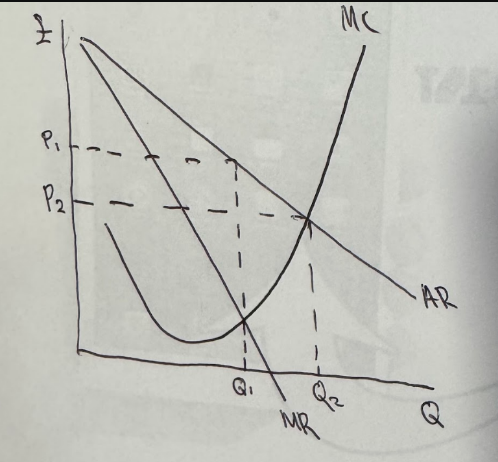
Arguments AGAINST Privatisation
Cannot Control Natural Monopolies
Natural monopoly is when the most efficient number of firms in an industry is one because of high entry costs meaning always achieving EOS
Therefore, if privatisation, it could create a private monopoly which might seek to set higher prices which exploit consumers → reduced allocative efficiency
If do attempt to split natural monopoly when privatising, loss of a lot of economies of scale → Less productive efficient
Loss of Social Welfare
Private firms focus on profit maximising rather than improving social welfare. Could lead to:
Increased negative externalities in production
Under-provide merit goods
High and unfair prices for consumers → ↓Allocative efficiency
Evaluating Privatisation (IDO’s)
The type of industry - industries that produce public goods should not be privatised as introducing profit motive does not make sense
Effectiveness of regulators - Need regulators to prevent abuse of monopoly power
Degree of contestability or competition - If low barriers to entry, competition likely to be healthy
Regulation =
Setting rules and controls that restrict market freedom
Example of Regulation in UK
2012 Financial Services Act in response to GFC, introduced the FCA, PRA & FPC to regulate financial services.
Arguments FOR Regulation
Allocative Efficiency
Max prices → ↑allocative efficinecy
Reduces Monopoly Power
Block mergers, break up monopolies
Max prices to limit monopoly profits
Health & Safety at work
Price Discrimination & Consumer Rights
Reduces Neg Externalities
Arguments AGAINST Regulation
Reduces possible benefits of Monopolies:
Reducing supernormal profits may eliminate R&D opportunities → ↓Dynamic efficiency
Costly:
Regulation requires lengthy investigations → large cost to taxpayers
Risk of Gov Failure:
Regulatory capture - regulatory agencies, meant to protect the public, instead promote the commercial interests of the industry they regulate → makes misallocation of resources worse
Free market argument:
Process of creative destruction will remove monopoly power in LR
Regulatory Capture =
A form of government failure where regulatory agencies, meant to protect the public, instead promote the commercial interests of the industry they regulate.
i.e. operating in favour of producers rather than consumers
Deregulation =
Removal of rules and controls that restrict market freedom in order to increase the efficiency of markets
Supply-side policy which removes barriers to entry
Deregulation Chain of Analysis
Deregulation is the removal of rules & controls that restrict market freedom.
This is a supply-side policy, which removes barriers to entry and thus facilitates contestability
This should increase both actual & potential competition
As a result, monopoly firms convert to monopolistic competition
Therefore, in LR, supernormal profits are eroded away.
Market price should become lower, closer to that of allocative efficiency
Example of Deregulation in UK
‘Big Bang’ - Deregulation of financial markets