Lab 3b: Lactate Threshold (LT)
 Call Kai
 Learn
Learn Practice Test
 Spaced Repetition
 Match
Match Flashcards
 Knowt Play
1/9

There's no tags or description
Looks like no tags are added yet.
Name | Mastery | Learn | Test | Matching | Spaced | Call with Kai |
|---|
No analytics yet
Send a link to your students to track their progress
10 Terms
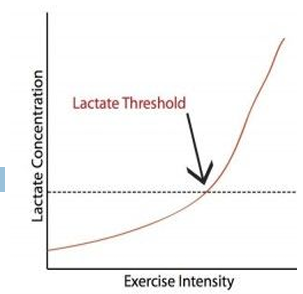
What is lactate threshold?
Point at which blood lactate begins to increase substantially above resting
Sometimes termed “anaerobic threshold”
Glycolysis produces pyruvate
Insufficient O₂ present to use pyruvic acid in oxidative phosphorylation
Pyruvate fermented into lactate
Lactic acid = lactate with a hydrogen ion (H+)
What are the negatives Lactic Acid Accumulation?
Lactic acid dissociates into H+ and Lactate
We measure lactate as a proxy for lactic acid production
Accumulation of H+ causes acidosis
Lowers pH of cells
Acidic pH- limiting factors of exercise
Inhibits PFK (enzyme required for glycolysis)-
Can displace calcium in muscle fibers (needed for muscle contractions
How can we combat H+ Accumulation?
Buffering controls levels of H+
Bicarbonate (HCO₃)
Bicarbonate uses H+ to create 2 things
H₂O and CO₂
Helps control pH and limit negative influence of H+-
Short term - breathed off in the lungs to lower pH -
Does NOT remove lactate
How do we remove lactic acid?
Removal methods
70% of lactate is oxidized (turned into pyruvate to enter Krebs cycle)
Used as an energy substrate by heart and skeletal muscle (type 1 fibers)
20% converted to glucose (gluconeogenesis)
10% converted to amino acids
Blood lactate concentration depends on:
Production, Diffusion, Oxidation, & Clearance
Typical Lactate Levels at rest and max?
At rest
1-2 mmol/kg of muscle
0.5-2 mmol/L of blood*
Maximum levels
20-25 mmol/kg of muscle
30 mmol/L of blood*
what is the Lactate Threshold differences between a Trained vs. Untrained person?
Aerobically Trained
Higher lactate threshold (~70-80% VO2 max) (lactate produced “later”)
Clearance of lactate is faster
Untrained
Lower lactate threshold (~50-60% VO2 max)-
Clearance is slower
Estimating LT Using Ventilatory Equivalents
Ventilatory equivalent of oxygen: Ve /VO2
Ventilatory equivalent of carbon dioxide: Ve /VCO2
Why is there an increase in the Ve /VO2 , but not Ve /VCO2
Ventilation to remove CO2 (in order to buffer changes in blood pH due to H+ accumulation from anaerobic metabolism) becomes disproportionate to the body’s need to provide O2 to the active muscles
Therefore:
Ventilatory equivalents can provide reasonably close estimates of lactate threshold
Does Lactic Acid cause DOMS?
No, lactate returns to resting about 2 hours after exercise cessation. DOMS (delayed onset muscle soreness) is caused by microscopic injury to muscle fibers leading to inflammation.
How do we measure blood lactate?
Finger Stick: Cleanse the skin with an alcohol pad. Let finger dry or the alcohol will influence results. Use the lancet to pierce the skin (towards side of fingertip)
Sample Collection: Insert test strip into analyzer. Wipe away first blood droplet with gauze (alcohol residue contaminated sample). Once new droplet has formed, hold test strip to droplet. Test strip should pull blood sample on its own
Results: Analyzer will reveal measure after brief countdown
Documentation: Record results in the shared class data sheet
What are the bicycle testing procedures?
Fitness testing on cycle ergometer
Record resting blood lactate
Complete the cycling protocol
Begin at 1 kp and increase resistance by 0.5 kp each stage until exhaustion
2-minute stages-Pedal rate 50-60 RPM
Record HR, RPE, and lactate within the last 30 seconds of each stage, at the point of exhaustion, and 1 min post exercise