Cognitive Approach

0.0(0)
Studied by 0 people
call kaiCall Kai
learnLearn
examPractice Test
spaced repetitionSpaced Repetition
heart puzzleMatch
flashcardsFlashcards
GameKnowt Play
Card Sorting

1/23

encourage image

There's no tags or description

Looks like no tags are added yet.

Last updated 4:49 AM on 4/24/26
Name
Mastery
Learn
Test
Matching
Spaced
Call with Kai

No analytics yet

Send a link to your students to track their progress

24 Terms

1
New cards

Schema theory

Bartlett

  • Aim: investigate how the role of cultural schema on memory

  • Procedure:

    • Told British participants a Native American legend (War of the Ghosts)

    • One group used repeated reproduction (participants repeatedly reproduced the story)

    • One group used serial reproduction (repeat the story to another person)

  • Results:

    • No significant difference between groups

    • Story became shorter

    • Details about story were assimilated to their cultural schemas (ex: canoe to boat)

    • Order of the story was changed to make it more familiar

    • Overall theme remained, just details changed

  • Evaluation: (L) other researchers tried to replicate the findings but were not successful, so low reliability; (L) did not standardize the time before recall, so not very scientific

Brewer and Treyens

  • Aim: study the role of schema in encoding and retrieval of memory

  • Procedure: 

    • Participants asked to wait in an office room with various objects that are congruent and incongruent before going into another room and asked what they remembered

    • Recall condition: participants asked to write a description of what they remembered and then given a list of objects and asked how confident they were that it was in the room

    • Drawing condition: given an outline of the room and asked to draw objects

    • Verbal recognition condition: read a list of objects and asked if they were in the room

  • Results:

    • Incongruent objects less likely recalled

    • More likely to recall congruent objects when writing/drawing

    • More likely to recall incongruent and wrong congruent objects when in a list

    • Objects were changed to fit schema

  • Evaluation: (L) very small sample; (L) ethical concerns with deception

2
New cards

Multi-store model

Miller

  • Aim: test for capacity of STM

  • Procedure: participants asked to memorize a string of numbers, each time increasing by one digit

  • Results: found that participants were able to memories 7±2 digits

  • Evaluation: (L) processing strategies employed by participants because they expected how many numbers needed to memorize

Cowan

  • Aim: test Miller’s magic number 7

  • Procedure: participants asked to memorize numbers, but did not know in advance how many digits there would be

  • Results: found that participants could only remember 3-5 digits, could be because Miller’s experiment allowed participants to employ processing strategies

  • Evaluation: (S) supported by biological research, as fMRIs show that parietal cortex activity correlates with 4 digits

3
New cards

Working memory model

Evans and Wason

  • Aim: test for matching bias (abstract task)

  • Procedure: Wason selection task

    • Shown four cards, two turned up (with 3 and 8) and two turned down (red and orange)

    • Asked participants which card must be turned over to test the idea that if a card shows an even number on one face, then its opposite face is red

  • Results: most participants picked 8 or the red card simply because they were mentioned in the question, even if this is untrue, showing System 1 thinking

  • Evaluation: (L) low ecological validity; (S) has been replicated and so is reliable

Goel et al.

  • Aim: investigate biological support for DPM

  • Procedure: replicated Wason selection task with abstract and non-abstract tasks while under fMRI

  • Results: when the task was abstract, the parietal lobe was activated (spatial processing), and when the task was concrete, the left hemisphere temporal lobe was active

  • Evaluation: (L) does not directly explain why or how dual processing model works

4
New cards

Thinking and decision-making

Evans and Wason

  • Aim: test for matching bias (abstract task)

  • Procedure: Wason selection task

    • Shown four cards, two turned up (with 3 and 8) and two turned down (red and orange)

    • Asked participants which card must be turned over to test the idea that if a card shows an even number on one face, then its opposite face is red

  • Results: most participants picked 8 or the red card simply because they were mentioned in the question, even if this is untrue, showing System 1 thinking

  • Evaluation: (L) low ecological validity; (S) has been replicated and so is reliable

Goel et al.

  • Aim: investigate biological support for DPM

  • Procedure: replicated Wason selection task with abstract and non-abstract tasks while under fMRI

  • Results: when the task was abstract, the parietal lobe was activated (spatial processing), and when the task was concrete, the left hemisphere temporal lobe was active

  • Evaluation: (L) does not directly explain why or how dual processing model works

5
New cards

Reconstructive memory

Loftus and Palmer

  • Aim: test whether the use of leading questions would affect estimation of speed

  • Procedure: participants shown driver’s education films of cars crashing and then asked to fill out a questionnaire with one critical question (how fast were the cars going when they ___ each other, with the blank being hit, collided, bumped, smashed, or contacted).

  • Results: there was a significant difference between speed estimations, with smashed having the highest and contacted the lowest

  • Evaluation: (L) low ecological validity as participants did not feel the same emotions as they would in a real car crash

Yuille and Cutshall

  • Aim: test whether leading questions affect the memory of eyewitness at real crime scene

  • Procedure: eyewitnesses of a crime (thief entering gun shop and stealing money and guns, with thief shooting shop owner) interviewed with two leading questions about getaway car and asked to rate stress

  • Results: eyewitnesses were actually very reliable and did not make errors, with higher stress leading to more accuracy

  • Evaluation: (L) not replicable and not generalizable; (L) could be a case of FBM and so not comparable to Loftus and Palmer

6
New cards

Emotion and memory

Brown and Kulik

  • Aim: test for FBM

  • Procedure: participants given nine events (ex: JFK assassination) and asked to write an account fo their memory and rate on scale of personal importance

  • Results: very clear descriptions, high FBM rate, lower FBM rate in white respondents compared to black respondents for MLK assassination

  • Evaluation: (L) cannot establish cause-effect relationship; (L) potential for social desirability effect

Kulkofsky et al.

  • Aim: test the role of individualism vs collectivism in flashbulb memories

  • Procedure: participants from five countries (including China and USA), asked to recall as many memories of public events from their lifetime and asked about this memory (where they learned of it, what time, what they were doing, how personally important)

  • Results: in collectivistic cultures like China, personal importance and intensity of emotion played less of a role in predicting flashbulb memories

  • Evaluation: (L) ecological fallacy (just because a participant comes from a culture does not mean that they necessarily share the traits of the culture’s predominant dimensions)

7
New cards

Biases in thinking and decision-making

Strack and Mussweiler

  • Aim: test the influence of anchoring bias on decision-making

  • Procedure: participants first asked a comparative question with a high or low implausible anchor, and then an absolute judgement question

  • Results: with high anchor, absolute judgement questions were significantly greater and the opposite was true

  • Evaluation: (L) sampling bias as participants were all university students

Tversky and Kahnemann

  • Aim: test framing effect on decisions

  • Procedure:

    • Given a scenario about a disease expected to kill 600 people and asked about which programs should be adopted

    • Positive frame condition:

      • A: 200 people will be saved

      • B: ⅓ probability that each of the 600 people will be saved

    • Negative frame condition:

      • A: 400 people will die

      • B: ⅔ probability that each of the 600 people will die

  • Results: certain outcome (A) preferred for positive frame and uncertain outcome (B) preferred for negative frame, even though they have the same result

  • Evaluation: (L) low mundane realism as there is no actual threat; (S) highly standardized and therefore reliable

8
New cards

Emotion and decision-making

Bechara et al.

  • Aim: test SMH

  • Procedure: Iowa Gambling Task (for each turn out of 100 turns, participant picks a card from four labeled decks which indicates how much money gained or lost, with level of rewards changing throughout the progression of the game) performed by healthy participants and participants with vmPFC damage

  • Results: healthy participants were able to identify strategy quickly, while vmPFC damage participants did much worse

  • Evaluation: (L) low ecological validity and so may not be an accurate representation of decision-making; (L) low mundane realism as no actual money lost or gained

De Martino et al.

  • Aim: test SMH

  • Procedure:

    • Participants asked to complete a financial decision-making task while under fMRI

    • Positive frame: you can gamble $50 for more or keep $20

    • Negative frame: you can gamble $50 for more or lose $30

  • Results: more gambling in negative frame and greater activation of amygdala when selecting safe option in both frames

  • Evaluation: (L) low mundane realism as no actual money used; (L) unsure whether amygdala activation guides decision-making or if it is a consequence

9
New cards

Schema

Mental representations that are derived from prior experience and knowledge.

10
New cards

Scripts

Patterns of behavior that are learned through our interaction with the environment.

11
New cards

Types of memory

  • Declarative memory: conscious memory of facts and events (knowing what)

    • Episodic memory: memory of events

    • Semantic memory: general knowledge of facts and people not linked to time/place

  • Procedural memory: unconscious memory of skills and how to do things (knowing how)

12
New cards

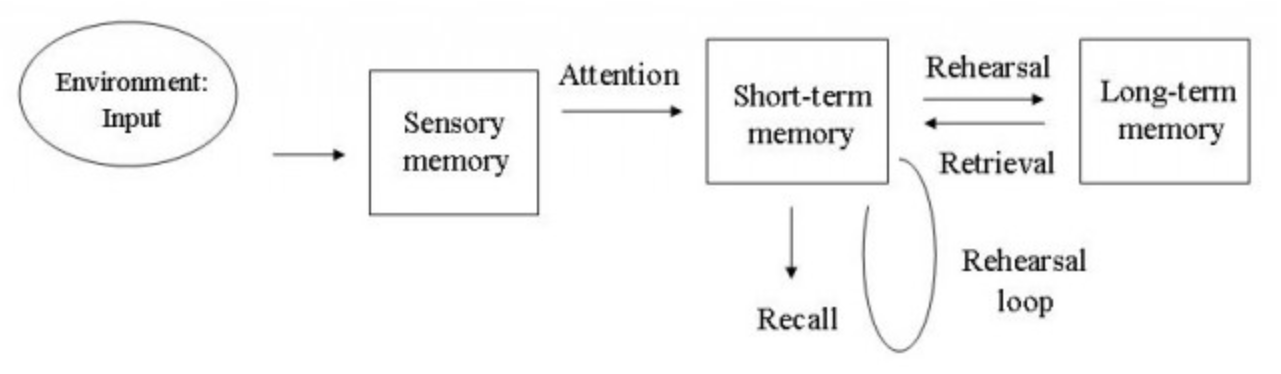
Multi-store model

Argues that short-term memory is limited in both capacity and duration.

<table style="min-width: 25px;"><colgroup><col style="min-width: 25px;"></colgroup><tbody><tr><td colspan="1" rowspan="1" style="border-width: 1pt; border-style: solid; border-color: rgb(0, 0, 0); vertical-align: top; padding: 5pt; overflow: hidden; overflow-wrap: break-word;"><p><span style="background-color: transparent; font-family: &quot;Times New Roman&quot;, serif;"><span>Argues that short-term memory is limited in both capacity and duration.</span></span></p></td></tr></tbody></table><p></p>
13
New cards

Sensory memory

Modality-specific memory (related to the different senses) including the visual and auditory store; information only stays for a few seconds.

14
New cards

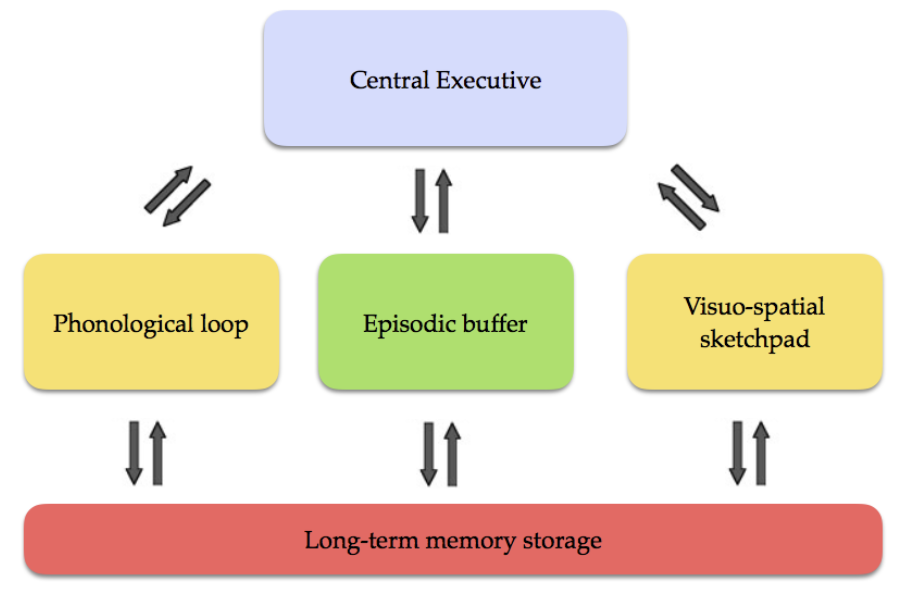
Working memory model

Suggests that STM is not a single store, but rather consists of a number of different stores.

  • Central executive: an attention control system that monitors and coordinates the operations of the sub-systems (including attention control)

  • Phonological loop: auditory component of STM

    • Articulatory control system: inner voice

    • Phonological store: inner ear, which needs to be rehearsed by the articulatory control system

  • Visuospatial sketchpad: visual component of STM

  • Episodic buffer: temporarily holds several sources of information active at the same time as a display (responsible for conscious awareness)

<table style="min-width: 25px;"><colgroup><col style="min-width: 25px;"></colgroup><tbody><tr><td colspan="1" rowspan="1" style="border-width: 1pt; border-style: solid; border-color: rgb(0, 0, 0); vertical-align: top; padding: 5pt; overflow: hidden; overflow-wrap: break-word;"><p><span style="background-color: transparent; font-family: &quot;Times New Roman&quot;, serif;"><span>Suggests that STM is not a single store, but rather consists of a number of different stores.</span></span></p><ul><li><p><span style="background-color: transparent; font-family: &quot;Times New Roman&quot;, serif;"><u><span>Central executive</span></u><span>: an attention control system that monitors and coordinates the operations of the sub-systems (including attention control)</span></span></p></li><li><p><span style="background-color: transparent; font-family: &quot;Times New Roman&quot;, serif;"><u><span>Phonological loop</span></u><span>: auditory component of STM</span></span></p><ul><li><p><span style="background-color: transparent; font-family: &quot;Times New Roman&quot;, serif;"><u><span>Articulatory control system</span></u><span>: inner voice</span></span></p></li><li><p><span style="background-color: transparent; font-family: &quot;Times New Roman&quot;, serif;"><u><span>Phonological store</span></u><span>: inner ear, which needs to be rehearsed by the articulatory control system</span></span></p></li></ul></li><li><p><span style="background-color: transparent; font-family: &quot;Times New Roman&quot;, serif;"><u><span>Visuospatial sketchpad</span></u><span>: visual component of STM</span></span></p></li><li><p><span style="background-color: transparent; font-family: &quot;Times New Roman&quot;, serif;"><u><span>Episodic buffer</span></u><span>: temporarily holds several sources of information active at the same time as a display (responsible for conscious awareness)</span></span></p></li></ul></td></tr></tbody></table><p></p>
15
New cards

Articulatory suppression

Participants are asked to repeat a word while trying to memorize a list (leads to impairment of the WMM).

16
New cards

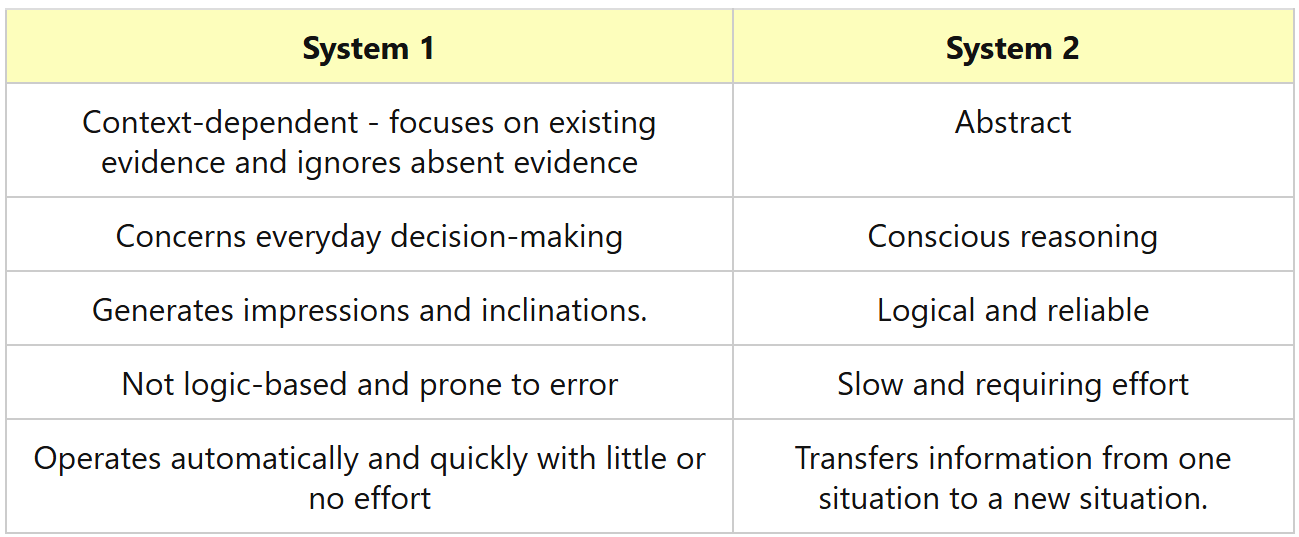
Dual process theory

Argues that there are two basic modes of thinking.

<table style="min-width: 25px;"><colgroup><col style="min-width: 25px;"></colgroup><tbody><tr><td colspan="1" rowspan="1" style="border-width: 1pt; border-style: solid; border-color: rgb(0, 0, 0); vertical-align: top; padding: 5pt; overflow: hidden; overflow-wrap: break-word;"><p><span style="background-color: transparent; font-family: &quot;Times New Roman&quot;, serif;"><span>Argues that there are two basic modes of thinking.</span></span></p></td></tr></tbody></table><p></p>
17
New cards

Matching bias

In an abstract problem, we tend to be overly influenced by the wording and context of the question.

18
New cards

Misinformation effect

Leading questions and post-event information facilitate schema processing and may influence the accuracy of recall.

19
New cards

Flashbulb memory

A highly detailed, exceptionally vivid ‘snapshot’ of the moment when a surprising and emotionally-arousing event happened. Explained by the Special-Mechanism Hypothesis.

20
New cards

Special-mechanism hypothesis

Argues for the existence of a special biological memory mechanism that, when triggered by an event with critical levels of surprise, creates a permanent record of the details of the event.

21
New cards

Anchoring bias

The tendency to rely too heavily on the first piece of information offered (the anchor) when making decisions.

22
New cards

Framing effect

A heuristic from prospect theory (describes the way people choose between alternatives that involve risk) in which people react to choices depending on how they are framed.

23
New cards

Somatic markers

Feelings in the body that are associated with emotions (e.g. rapid heartbeat with anxiety or nausea with disgust). Related to the ventromedial prefrontal cortex (vmPFC).

24
New cards

Somatic marker hypothesis

Somatic markers play an important role in linking emotions with decision-making, allowing us to make better decisions.