Cog Neuro [Language]
 Call Kai
 Learn
Learn Practice Test
 Spaced Repetition
 Match
Match Flashcards
 Knowt Play
1/29

There's no tags or description
Looks like no tags are added yet.
Name | Mastery | Learn | Test | Matching | Spaced | Call with Kai |
|---|
No analytics yet
Send a link to your students to track their progress
30 Terms
What is phonology
the sounds that make up words
what is syntax
how sentences are structured
what is semantics
what words mean
what is pragmatics
what might be implied by how the person chooses to use their words
what are impairments in language broadly referred to as?
aphasias
aphasias are generally impairments of both written and verbal speech
What is anomia
a fluent form of aphasia
impaired
characterized by a difficulty naming and finding words
know what the word is but cannot retrieve it → dissociates object knowledge from retrieval of linguistic label)
intact:
affected patients still have fluent language and excellent comprehension/semantics
What is Broca’s Aphasia?
a non-fluent/expressive aphasia
can understand language though if you give them even moderately complex sentence structures sometimes they have more subtle comprehension deficits
agrammatic aphasia → trouble understanding grammatically complex sentences
rhythm of their speech is very natural
but they do not express actual content when they talk
extreme cases → patients just repeat the same nonsense word over an over but with the intonation and rhythm of normal speech
less extreme cases → telegraphic speech: speech is focused on key content words
e.g. “son…university…smart…boy…good…good”
oftentimes involves damage beyond the Broca’s area (esp. the insula)
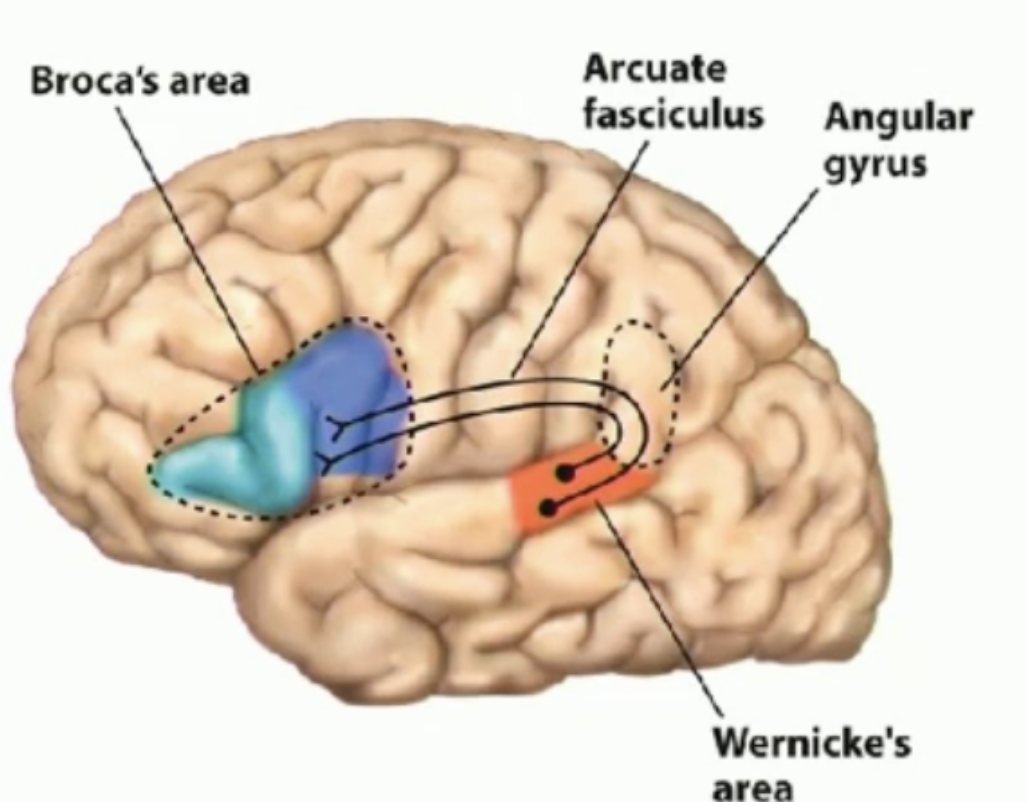
Where is Broca’s Area
near the motor strip at the back of the frontal lobe; at the inferior part of the frontal lobe, close to the temporal lobe
What is Wernicke’s Aphasia
the inverse of Broca’s apahsia
patients have trouble comprehending spoken or written language
speech production is fluent + follows a natural rhythm but is nonsensical
word choice is not entirely random, sometimes words are semantically related to intended ones (semantic paraphasia)
Doesn’t require damage to Wernicke’s area!
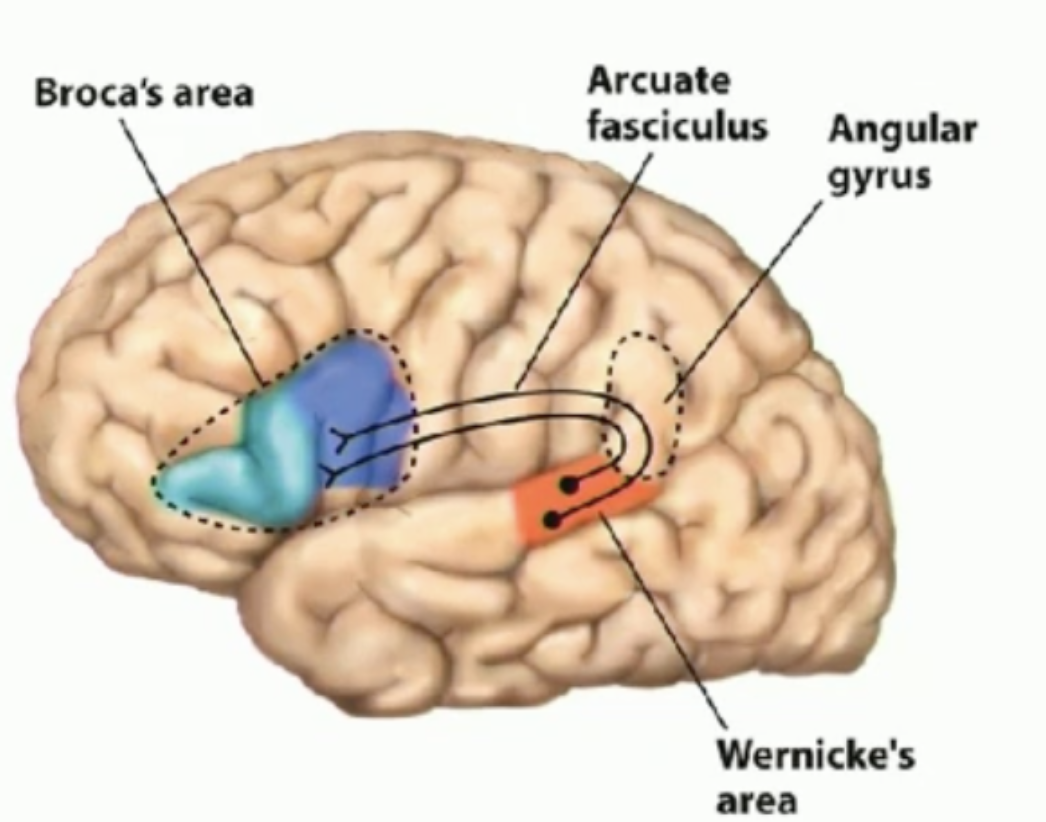
typically involves surrounding posterior temporal lobe or underlying white matter (arcuate fasciculus)
Where is Wernicke’s Area Located
in the superior temporal lobe, near where the auditory stuff is
What is conduction aphasia?
patients have difficulty repeating back words/sentences
they hear their errors but can’t correct them → thought to be a disruption between understanding and production
motor production is reasonably well intact
understanding is intact
have specific impairment in repeating words back
What are some other language production deficits?
speech apraxia → difficulty generating articulator motor plan
dysarthria → trouble controlling articulatory muscles in their mouth and tongue (lower level motor deficit)
What are some other language comprehension deficits`
pure word deafness → inability to recognize speech presented auditorily
alexia → inability to recognize words presented visually
What are the key stages of word processing
General Overview:
starts with two streams of input
spoken word
written word
do some type of acoustic or visual analysis
Access the word concepts
Three Main Stages:
Lexical Access → assumes that you got the output of perceptual analysis and now a word representation is being activated in your mental lexicon (your mind’s dictionary) and the semantic (related words) and syntactic (grammar) attributes go with that word.
Lexical Selection → finding the best match in your lexicon
Lexical Integration → integrating words into the rest of a sentence or some type of broader context, in order to understand what the overall message of the speech is
leads to speech production → actually getting your motor system to say the word
What is a mental lexicon?
a collective store of not just the word itself but:
its semantics → what it means
its syntax → how it fits in with other words structurally (grammar)
its orthography → how it’s written
its phonology → the sounds that make up the word
We match percepts and language to our mental
What are phonemes
the smallest unit of speech sound that a listener can distinguished
e.g. /f/
what are morphemes?
the smallest unit that signifies meaning; consist of multiple phonemes
e.g. ‘frost’, ‘de-’
What are the organizing principles of the mental lexicon
semantically related lexical representations are located nearby to one another
phonemes that have similar sounds also share connections (e.g. meat, beat, seat)
activation of a given unit spreads to nearby units
this means that both phonemic and semantic priming effects can occur
not a theory about the brain → theory about the mind
Describe the early models of semantic networds
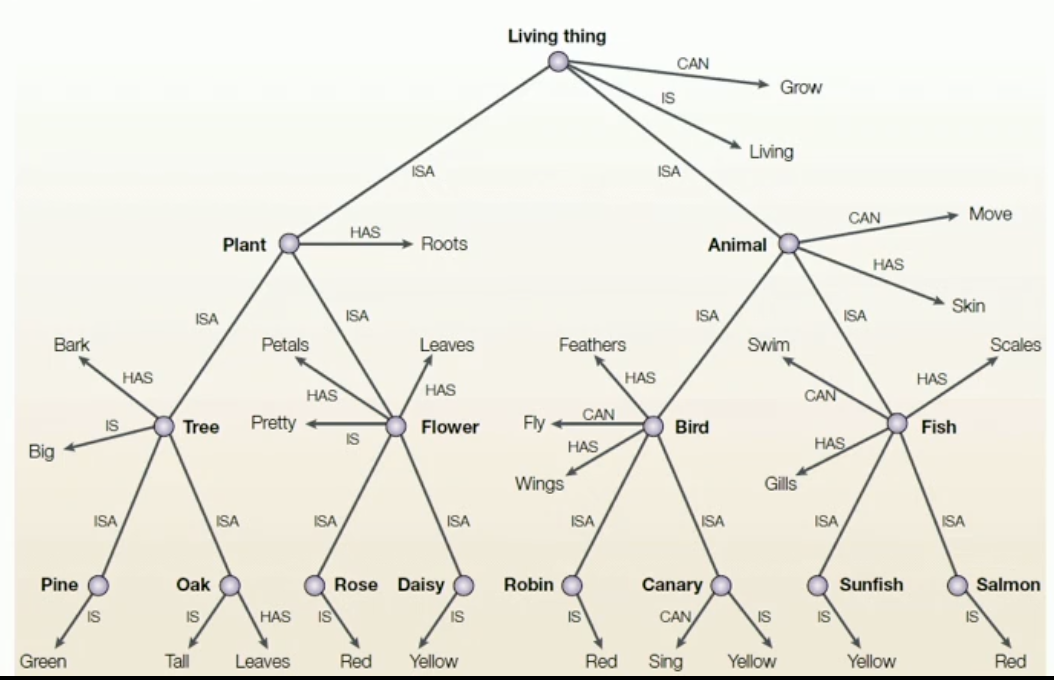
nodes → represent concepts based on discrete categories, relate to each other via hierarchical ordering
nodes are connected logically through propositions like ‘has’ or ‘can’
e.g. “ a living thing can grow)
propositions get inherited down the hierarchy
if a living thing can grow, that also mean an animal=[ can grow, a fish can grow, and a salmon can grow
new attributes get added along the way
What are the strengths of the early semantic networks models?
it is efficient to store things this way because of the inheritance property
just need to know that a salmon is a fish and a fish is an animal to know a lot about what a salmon can and can’t do
can generalize to new concepts → can easily add in new pieces of information and have existing information apply to them
What are the problems of the early semantic network's models?
they don’t account for exceptions
e.g. birds that can’t fly
in practice, people don’t have equal access to all of these features → some properties are easier to retrieve than others
e.g. “oak is tal” vs. “oak has bark”
model does not account for the fact that people don’t remember all items the same → some items are more canonical representations than others
What is the connectionist approach to semantic networks
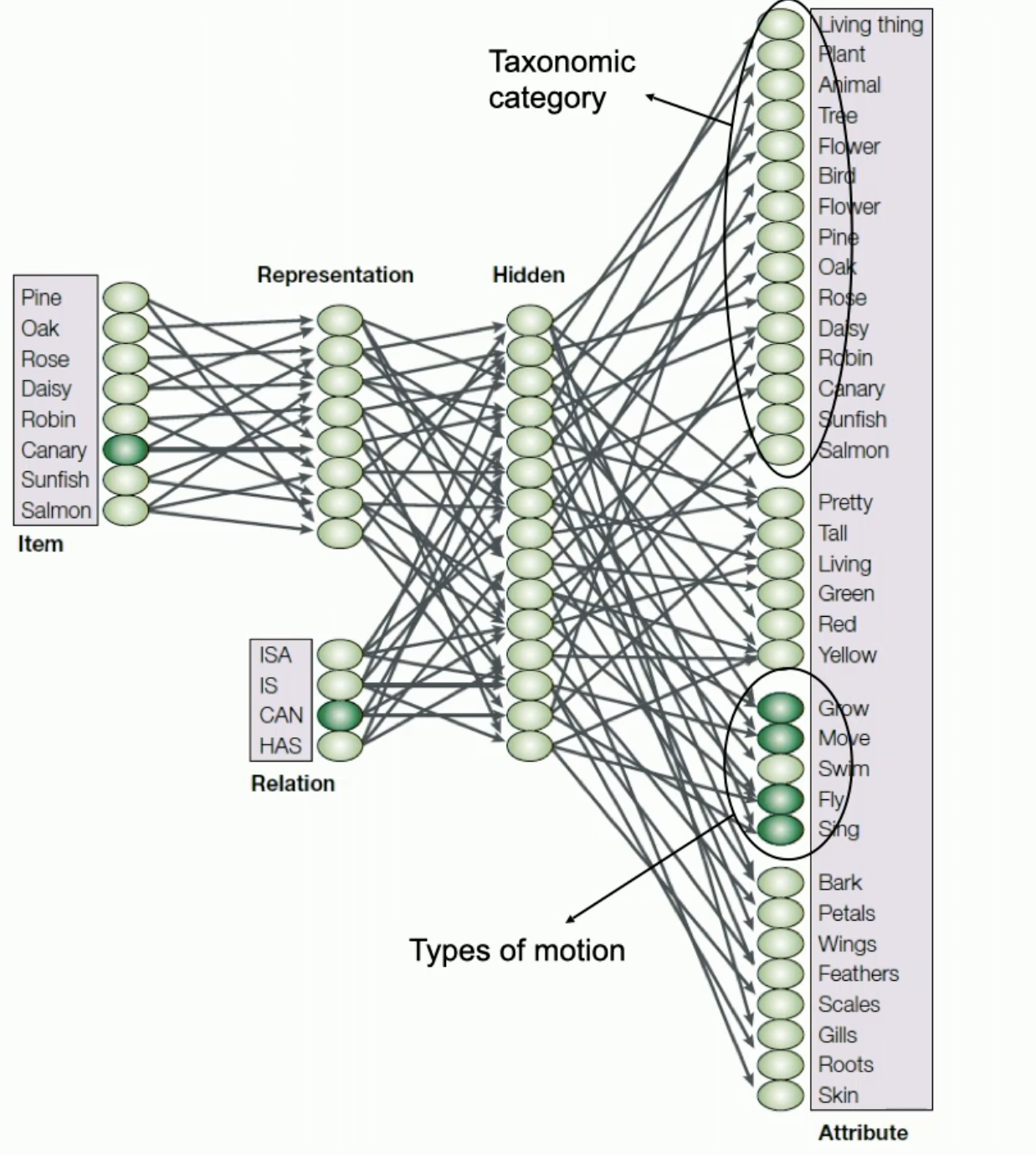
there is no strict hierarchy that is organized, instead there is a way to learn everything from scratch
whats learned is distributed across the model
the model will learn based on the natural co-occurrence of words in natural language and semantic features (e.g things that have 4 legs often run)
learns things from experience such that after it learns it can activate correctly associated words
relies on the idea that we have these different attributes that are stored seperately from these individual concepts → through learning we learn the link between the attributes and the concepts
this allows properties to be associated probabilistically → allows for different strengths of associations (and that there are more typical examples of certain concepts)
captures generalization through pattern association
What is the classical model of semantic networks in the brain
things like attributes, properties, and features are going to be represented in the part of the brain that processes those attributes, properties, and features
e.g. v4 is going to activate when we think about things like color
What is the evidence for the classic model of the semantic network
if you show people words of colors → activates ventral, posterior color regions like v4
if you show people action words like swim → activates more dorsal, posterior temporal regions that code more for actions
if you read action words involving a body party, you’re going to get activation in the motor strip that corresponds to movement of that body part
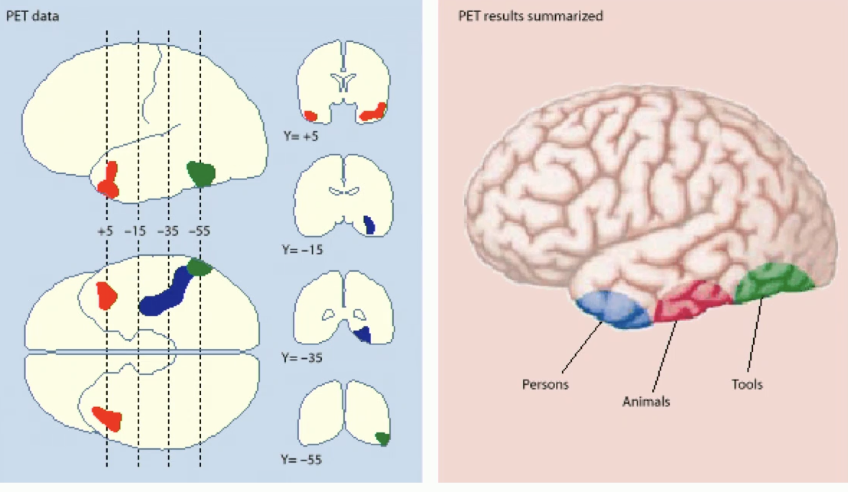
people noticed early on from lesion patients that sometimes people present with categorical anomias
categorical anomia → inability to name objects in specific categories
deficits naming tools, animals, and people go from posterior to anterior temporal cortex
people → most anterior
animals → in the middle
tools → most posterior
similar type of topography observed with PET scanning of healthy subjects
this suggests that there is some type of segregation of this information in the ventral temporal cortex
What is the alternate view of semantic networks
Instead of segregating information by living/non-living distinctions, maybe the anterior temporal love is critical for specific-level naming
because
Non living things are distinguished by fewer features than living things
and specific naming requires more retrieval and integration, moreso for living
study
give participants a set of the same images but ask them to classify them at different levels of specificity
e.g. is it a car or a dog (more specific) versus is it an animal or a vehicle (less specific)
results
more posterior regions of the temporal cortex are activated by both specific and general naming
as you move anterior it is only the specific level naming that causes activation
the most anterior part of the temporal lobe may be necessary for representing these very specific exemplars and linking them to the relevant features and attributes
What is semantic dementia
degenerative atrophy that starts in the temporal pole and the progresses posteriorly and medially
leads to impairments in finding the appropriate word and in comprehension
in early stages it looks like anomia but then it progresses to become much more severe where they can’t even access the categories (impairment goes from impairing exemplars to impairing categories)
additional support for the alternate view of semantic networks
What are the impairments of someone with another variant of frontal temporal dementia that more aggressively affects the frontal lobe?
see a lot of personality and mood changes with some control changes
how do we understand spoken language?
go from acoustic processing to speech → mediated through the auditory processing system
hierarchy of selectivity to acoustics vs. speech
primary auditory cortex → responds to all sounds, non-selective for speech
superior temporal sulcus (STS) → selective for speech sounds (words, non-words that sound like words, and reversed speech)
impairment to STS leads to pure word deafness → trouble recognizing speech sounds but not other sounds, otherwise intact reading and other types of language abilities
how do we understand written language
people have not been writing for very long so we likely do not have dedicated brain circuits that have been evolved for reading
parts of the object recognition streams that are generally good at recognizing objects have been co-opted to specifically recognize letters
orthographic input gets process through the visual system (V4) the same as anything else → then lands in an area called the visual word form area (VWFA)
VWFA us sensitive to things that look like words and semantic content
keyboard mashes do not activate the VWFA
selectivity emerges as you go further in to the visual processing system
What are the cultural differences in learning to read?
English: complex mapping of orthography to phonology → so learning to read is hard → increased developmental dyslexia rates
1120 letter/ letter combinations to 40 sounds
Italian: simple mapping - 33 letters to 25 sounds → all children lear to read in about 6 months → developmental dyslexia rate is half that of English
people who speak different languages have different reliances on orthography vs. phonology
English > Italian → VWFA: greater reliance on orthography (spelling of word)
Italian > English → Second auditory: greater reliance on phonology (how the word sounds)