PSYCH 4630 - Exam 3
 Call Kai
 Learn
Learn Practice Test
 Spaced Repetition
 Match
Match Flashcards
 Knowt Play
1/79

Earn XP
Description and Tags
Name | Mastery | Learn | Test | Matching | Spaced | Call with Kai |
|---|
No analytics yet
Send a link to your students to track their progress
80 Terms
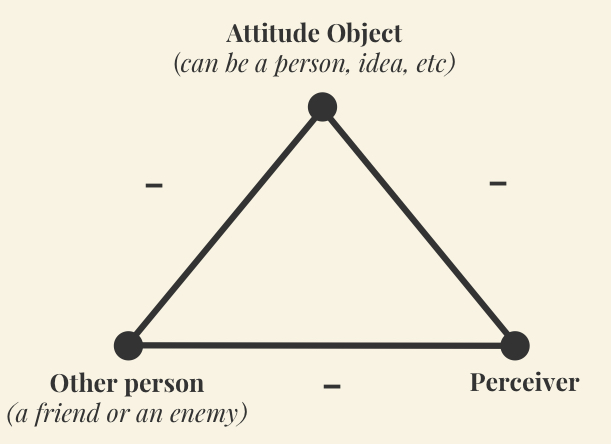
balance theory
a state of balance if the product the signs is positive
a state of imbalance if the product is negative
balance occurs when…people agree with someone they like, people disagree with someone they dislike
balance theory (political application)
we tend to assume our friends share our politics and that our enemies have opposing political views
we tend to change our political views to agree with our partners and close friends (or, we simply break up with them)
vicarious dissonance
others’ hypocrisy makes us feel similar levels of dissonance
vicarious dissonance (experiment)
procedure: tape was a counter-attitudinal argument about raising tuition
manipulations: the speaker was
ingroup (same dorm)
outgroup (differnt dorm)
who was believed to have:
high choice (decided to speak on this topic)
low choice (forced to speak on t opic)
findings: attitudes toward tuition became most positive for ingroup, high choice
persuading the powerful
who was MOST affected by argument quality?
low power (employee) or high power (manager)
answer: low power
why? managers have action orientation (not deliberating about high quality arguments)
public conformity
openly agreeing with groups even when we privately disagree
attitudes (or in this case, beliefs) do not change
informational social influence
using others to disambiguate our environment
private acceptance
conforming to others’ beliefs and believing in it
informational influence
occurs in ambiguous situations
does not involve arousal or discomfort
results in belie or attitude change
normative influence
occurs in unambiguous situations
involves some arousal or discomfort
does NOT result in belief of attitude change
polarization
a growing division between social groups, leading to intensification of opposing attitudes
why does polarization happen?
persuasive arguments
social comparison
outgroup derogation
persuasive arguments
group members develop arguments to convince the others within their group
social comparison
adopting the majority opinion and becoming more extreme to maintain a sense of uniqueness/individuality
outgroup derogation
dreaming/looking down on other groups too feel justified in one’s own position
types of polarization
political attitudes
attitudes within religious organizations
lifestyle polarization
gender polarization
believing in conspiracy theory
conspiratorial beliefs are driven, in part, by a desire to
belong balanced with a desire to be unique (optimal distinctiveness theory)
optimal distinctiveness theory
we are motivated to balance belonging and uniqueness
majority influence
the numerical majority opinion can influence attitudes
“if everyone says so, it must be true”
minority influence
the numerical minority opinion can influence attitudes
“what is that person saying? Maybe they have a point”
majority v. minority influence
when not elaborating, people mostly ignored argument quality
instead they used consensus as a cue
when elaborating, people used argument quality
but they also used majority or minority opinion
what happens with “moderate” relevance
when the attitude object was of moderate personal relevance, it’s unclear which path people will take
if the message is surprising, engaging, or challenging, then this will put them down the central path
but if the message is expected then this will put them down the peripheral path
main effects
the influence of an independent variable on the DV, when controlling for others IV’s
main effect (argument quality)
when the argument was highly relevant, those in the strong argument condition were more persuaded compared to those in the weak argument condition, regardless of majority v. minority
message repetition
effective until a point…
message repetition can trigger counter arguments, which is motivated by a threat to one’s autonomy
sleeper effect
initially rejecting an argument due to a flaw, but being persuaded after the flaw is forgotten
requires specific conditions:
enough time to forget the flaw
but still remember the argument
other than the flaw, the argument must be otherwise persuasive
truisms
belief so widely accepted that they are rarely challenged. as a result, we are rarely exposed to counterarguments.
despite being highly endorsed, these beliefs are relatively weak and easy to change
low attitude strength
compared to many other attitudes of equal valence and extremity, truisms tend to be easily changed.
because truisms often have ___ ____ ____
although truisms are generally easy to change, it’s possible to build up a defense against counter-messages
inoculations
building a resistance to counterarguments
supportive defenses
strong, pro-attitudinal argument
“helping others is important because…”
it’s the right thing to do
they’re more likely to help you in return
it improves your own wellbeing
refutational defenses
learning to reject the other argument
“some will claim being selfish is important but” actually selfishness harms you in the long run
narrative transportation
immersion in a narrative can change attitudes
mechanism: when transported, people may be unlikely to conterargue with story ideas or claims, as is often the case with direct experience itself
the greater the suspension of disbelief - accepting the premise of a narrative - the more likely to be transported
suspension of disbelief
the greater the ______ ___ _____ - accepting the premise of a narrative - the more likely to be transported
“murder at the mall” (narrative transportation)
participants read a story about a murder in an Ohio mall
IV: this is a work of fiction v. true story
in which condition do you think people were more transported? fiction, suspend disbelief
DV:
beliefs in a just world
beliefs about psychiatric patients
increasing narrative transportation
high quality story (v. factual report)
hedonic (v. critical) mindset = more likely to suspend disbelief
valence weighting bias (vWB)
the tendency to evaluate novel or ambiguous objects as positive or negative
it involves weighting positive or negative features more heavily
those with a positive vWB make more friends during their first year at OSU!
learning asymmetry
in attitudes
positives are less well-learned than negatives
approaching an object leads to gaining accurate information in the long run
avoiding an object leads to maintenance of the negative attitude, regardless of accuracy
life stage hypothesis
U shape with age on openness to cahnge
reason 1: power (in middle age)
reason 2: cognitive differences
attitudes and memory
alzheimer’s dementia causes cognitive decline including memory loss
question: do they tend to retain their attitudes or lose them along with their explicit memory?
study: presented with a variety of objects and asked attitudes, repeated 1 week later, they didn’t remember having seen those objects
results: the attitude was consistent with evaluation one week prior
attitudes influence self-knowledge
attitudes influence memory
attitudes influence intentions and behavior
attitudes are related to group identity
self-defining attitudes
attitudes that help us define who we are
who one is
who one strives to be
what one values
tend to be
extreme, unambivalent
characterized by likes (v. dislikes)
strong
prior work: self-defining attitudes…
can be measured
relate to, but are distinct from, other attitude properties
correlates with advocacy
grocery store research summary (dr. jessie)
self-definition biases memory
influences behavior
other findings: increases the degree to which a person feels they are a “prototypical” organic food person
body-specificity hypothesis
the way we physically interact with environments shapes our attitudes
ie: left handers associate left side with “good”, right handers associate right side
hand grip (left/right political attitudes)
gripped something with left or right hand
to what degree do you agree with Democrats/Republicans on political issues
had surprising small effect
physical lean (left/right political attitudes)
democrats sat in a chair leaning left or right
to what degree do you agree with Democrats on political issues
the effect is tiny, replicability may be limited
motor movements & attitudes
our physical movements can affect our emotions
these emotions can, in turn, influence attitudes
nodding head while listening to counter attitudinal info, more likely to agree
flexation
the action of bending a limb or joint
visceral fit
match between physical state and argument increases perceived plausibility of related events
reported greater belief in global warming on warm v. cold days
ambivalence study
university students read article about abolishing minimum wages for young adults while on balance board
those who read the ambivalent text moved from side-to-side
subjective ambivalence and side-to-side movement correlated at r=.38
also research showing in the reverse
metacognition
thinking about one’s thoughts, and in this case, it means “thinking about one’s own attitudes”
can alter attitude properties such as…
valence
extremity
strength
self-definition
metacognition (name swap)
students at a Spanish University learned about Juan and Jose
oops! there was a transcription error! reverse the names
DVS: explicit measure of attitude favorability and extremity: “to what extent do you like or dislike Jose/Juan?”
implicit measure of ambivalence
IAT associating Juan and Jose with ambivalence v. certainty
results: more ambivalence when told to reverse the names
reshape an attitude
metacognition can involve attempt to ___ ___ ____
attitudes that might benefit from metacognition:
when based on incorrect information
when prejudiced toward marginalized social groups
but the original (incorrect or biased) information may influence our evaluations despite metacognition
mitigating misinformation
all of these interventions work, but mostly only immediately during/after the intervention
“this is false” before misinformation with no details
“misleading” during misinformation with details
“this is false” during headline with details
media literacy tips
source credibility
learn misinformation techniques
accuracy nudge rated accuracy of nine neutral headlines
descriptive norms
“thinking mood” asked to explain how they knew each was true or false
illusory truth effect
the more familiar we are with a concept, the truer we believe it to be
how to avoid illusory truth effect
deliberate thought and counterarguments
fact checking
replication
testing the reliability of a scientific finding with different data (ie running the study again)
direct replications
as close as possible to the original procedure and sample
conceptual replications
using different operationalizations of variables
robustness
reliability of the prior finding using the same data, but a different statistical analysis strategy
p-hacking
running a variety of statistical procedures until you find one that “works”
reproducibility
reliability of a finding using the same data, and the same statistical analysis strategies
open science replication effect
100 replications by 270 scientists
selected at random articles from our top journals
then conducted direct replications where possible, conceptual when not
only ~36-40% of replications succeeded
the replication crisis
a period in the 2010’s in which psychologists discovered that many prominent findings were less replicable than the literature implied
causes of failures to replicate
low statistical power
researcher degrees of freedom
questionable research practices
publication bias
poorly conducted replications
statistical power
the ability of a study to detect an effect if one actually exists
high power means that if your hypothesis is correct, you’ll find out!
statistical power & replication
power is important because:
when power is low, false positives made up a larger share of the literature
that’s because the true positives are “hidden”: they aren’t being reported
but the false positives are “visible”: they are being reported
summary: have a high enough sample size and try to find a powerful effect
research degree of freedom
the many, often small ways, researchers can “massage” their data. usually no deceitful intent
freedom in cleaning such as outlier removal
freedom in analysis plans
flexible stopping rules
this can result in p-hacking: tweaking data until things “work”
publication bias
prestigious journals want positive (not null) findings
exception: when the null findings discredit another finding
file drawer problem
null results disappear from view
low power causes a higher rate of false positives
the file drawer problem also causes a higher rate of false positives
poorly conducted replications
conducting high quality science is TOUGH
researchers who attempt to replicate sometimes produce low quality work, compared to the original researchers
example: a direct replication when a conceptual replication would be more appropriate
solutions to replication crisis
open science: share data, analytic procedure
preregistration: share analytic procedure and hypothesis before launching the study
high powered studies
publication reform: more publishing of null results (assuming the study was of a high quality)
conspiracy theories
explanations of important events that center on secret plots by powerful actors
conspiratorial ideation
a general tendency to believe in conspiracy theories
those who tend to believe in one conspiracy theory are also more likely to believe others
illusory pattern perceiption
the cognitive tendency to perceive meaningful connections within random, unrelated, or ambiguous data
epistemic needs
a desire for explanation, certainty, and “meaning”
people dislike randomness and ambiguity. we want to make sense of the world
(illusory) pattern perception
when understanding of our world is threatened, we may turn to systems of belief
existential needs
a need for safety and control
people like having control over their environment
“control threats” include
terrorist strike, natural disaster, war, job loss
such threat lead to endorsement of conspiracy theory and similar belief systems because they help make people feel they can take back control
social motives
include a need to belong, social identity, and status
conspiracy theories can mark and protect identity
there are communities of people who share beliefs
gateway hypothesis
believing in one conspiracy theory may “open the door” toward belief in later ones
our attitudes shape our lives
attitudes mater
attitudes are construction
attitudes can be examined and changed