The Urinary System CH.26
 Call Kai
 Learn
Learn Practice Test
 Spaced Repetition
 Match
Match Flashcards
 Knowt Play
1/29

There's no tags or description
Looks like no tags are added yet.
Name | Mastery | Learn | Test | Matching | Spaced | Call with Kai |
|---|
No analytics yet
Send a link to your students to track their progress
30 Terms
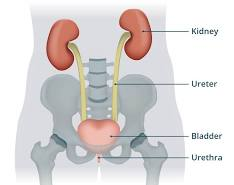
_____ activates vitamin D.
Kidney
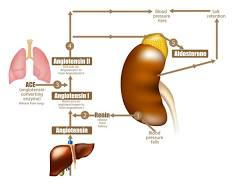
According to the Renin-Angiotensin-Aldosterone system (RAAS), Angiotensinogen is produced in the _____.
Liver
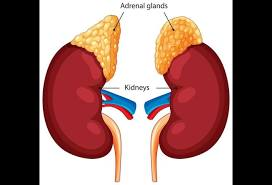
According to the Renin-Angiotensin-Aldosterone system (RAAS), Aldosterone is produced by the _____.
Adrenal gland
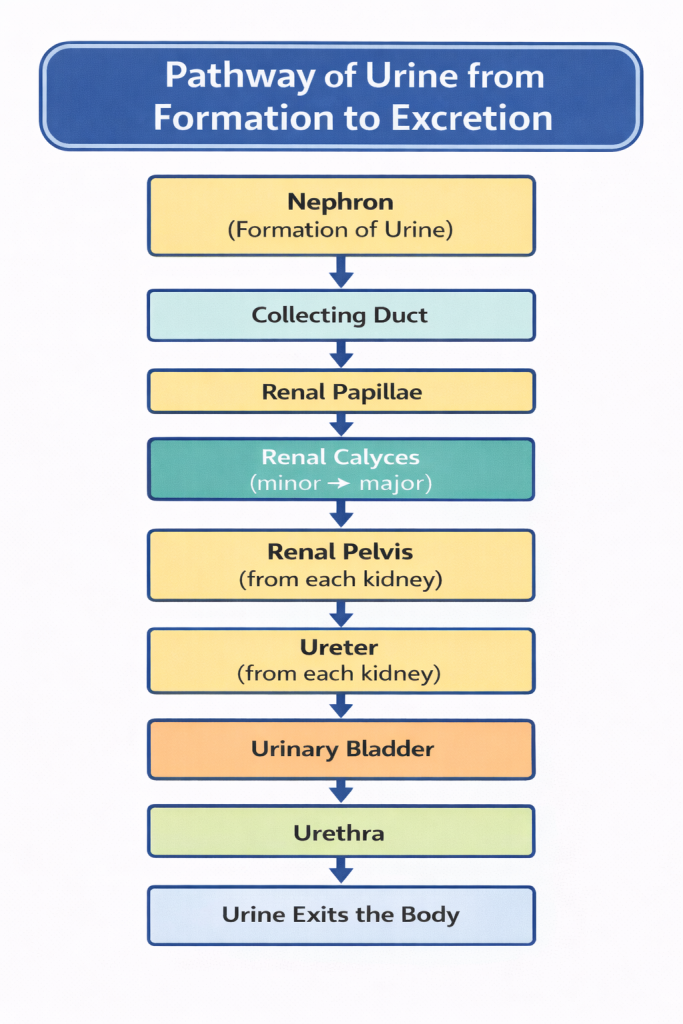
What is the order in which urine flows through as it moves out of the body from the kidney?
Renal pyramid
Minor calyx
Major calyx
Renal pelvis
Ureter
Urinary bladder
Urethra
Locate the different parts of the nephron in the kidney.
Renal Cortex
Distal convoluted tubule
Proximal convoluted tubule
Renal corpuscle
Renal medulla
Majority of the loop of Henle
Majority of the Collecting duct
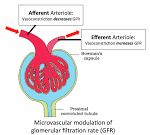
The Juxtaglomerular cells are located around the _____ of the nephron
Afferent arteriole
According to the Renin-Angiotensin-Aldosterone system (RAAS), Angiotensin converting enzyme (ACE) is produced by the _____.
Liver
A _____ is the extension of the renal cortex into the renal medulla found in between the renal pyramids.
Renal column
According to the Renin-Angiotensin-Aldosterone system (RAAS), Renin is produced in the _____.
Liver
Antidiuretic hormone and Aldosterone will act in the _____ of the nephron to retain water.
Collecting duct (as well as the late DCT)
T/F: As the filtrate descends toward the bottom of the loop of Henle, osmolatity decreases.
False.
As the filtrate descends toward the bottom of the loop of Henle, the osmolality increases
T/F: As circulating antidiuretic hormone increases, the individual is likely to produce a concentrated type of urine
True
As circulating antidiuretic hormone (ADH) increases, the body is likely to produce a concentrated type of urin
(It is without that it becomes diluted)
T/F: The outer region of the kidney, immediately deep to the renal capsule, is called the renal medulla.
False
It is the renal cortex
Place the structures with their functions
Kidney
Produces urine
Ureter
Transports urine to urinary bladder
Urinary bladder
stores urine
Urethra
Transports urine out of the body
The _____ produces renin.
Juxtaglomerular cell
T/F: The female urethra is used in both urinary and reproductive purposes.
False
-the female urethra is only used in the urinary system
T/F: The urinary bladder is line with Ciliated pseudostratified columnar epithelium with Goblet cells.
False
lined with transitional epithelium
The _____ detects osmolatity (concentration of solutes) in the filtrate.
Macula densa cell
The _____ is located at the superior pole of the kidney.
Adrenal gland
Indicate whether the following structures will 'enter' or 'exit' the renal hilum (indentation) of the kidney
Ureter - Exit
Renal artery - Enter
Renal nerve - Enter
Renal vein - Exit
Order in which blood flows into the kidney
Renal arterty
Interlobar artery
Arcuate artery
Cordical radiate artery
Afferent artery
Glomerulus
Efferent artery
Peritubular capillaries
Vasa Recta
Cortical radiate vein
Microscopic processes of the nephron
Tubular reabsorption: Fluid and solutes movement from the renal tubular strutures to the peritubular capillaries
Tubular secretion: Fluid and solutes movement from the peritubular capillaries to the renal tubular strutures
Filtration: Fluid and solutes movements from the Glomerulus and the Bowman's capsule
The nephron in order in which filtrate flows through.
1st: Renal corpuscle
2nd: Proximal convoluted tubule
3rd: Descending loop of Henle (Thick)
4th: Descending loop of Henle (Thin)
5th: Ascending loop of Henle (Thin)
6th: Ascending loop of Henle (Thick)
7th: Distal convoluted tubule
8th: Collecting duct