Exam 1 (Ch. 1-6)
 Call Kai
 Learn
Learn Practice Test
 Spaced Repetition
 Match
Match Flashcards
 Knowt Play
1/117

There's no tags or description
Looks like no tags are added yet.
Name | Mastery | Learn | Test | Matching | Spaced | Call with Kai |
|---|
No analytics yet
Send a link to your students to track their progress
118 Terms
Avery, MacLeod, and McCarty Experiment
Found that only DNA was able to transform the strains
DNA was transforming principle → suggested DNA may act as genetic material
Hershey and Chase “Blender Experiment”
Concluded DNA was genetic material
Schleiden & Schwann
Described cells in plants & animals
proposed cell theory: all life is composed of cells; cells = basic building blocks of organisms
Rudolph Virchow
Expanded on cell theory → “every cell stems from another cell”
gave cell theory an evolutionary basis
Germ plasm theory
Posits reproductive organs carry full sets of genetic information and that the sperm & egg cells they produce carry the genetic information brought together in fertilization
Proposed by August Weismann
The 4 Phases of Modern Genetics
Identification of cellular and chromosomal basis of heredity
Identification of DNA as hereditary material
Description of the informational and regulatory processes of heredity (the encoding of information in genes and processes of transcription and translation)
Genomic era: completion of first genome sequences → complete human genome produced
Eukaryote vs. Prokaryote
Eukaryote
Multiple chromosomes organized by proteins
Membrane-bound nucleus, and intracellular membranes
Unicellular and multicellular
Larger genomes
Prokaryote
lack nuclear membrane & typically no membrane bound organelles
Bacteria and archaea
Single large chromosome (some also contain plasmids)
No membrane-bound nucleus or intracellular membranes
Unicellular
Smaller genomes
What is the hereditary material of certain viruses?
RNA
Mitosis
Cell-division process where a complete set of nuclear chromosomes are transmitted to produce genetically identical daughter cells
Meiosis
Cell-division process that produces reproductive or sex cells (gametes)
how sexual reproduction to produce offspring occurs
Haploid vs. Diploid
Haploid: one copy of each gene in genome
Diploid: twice the haploid number of chromosomes found in genome
How are zygotes produced?
Through the union of haploid gametes at fertilization producing a diploid fertilized egg that begins mitotic division to produce it
Genes
Composed of defined DNA sequences that collectively control gene transcription + contain info to produce RNA (mRNA used to produce proteins through translation)
Fundamental unit of heredity
come in multiple forms called alleles
give phenotypes
physical units of heredity (originally posited by Mendel)
Chromosomes
Long molecules of double-stranded DNA and protein, which contain genes
Sexually reproducing organisms usually have …
Homologous pairs (or homologs) of chromosomes, which carry genes for the same traits
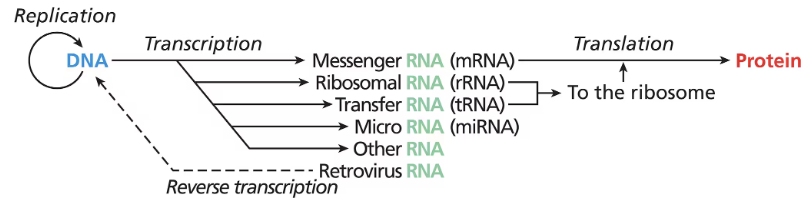
Central dogma
Describes the flow of hereditary information
DNA is transcribed to RNA which is translated to PROTEIN
reverse transcription: turn RNA to DNA
Transcription: one strand of DNA (aka the template strand) is used by RNA polymerase to direct synthesis of a single strand of RNA (can produce various forms of RNA, like mRNA)
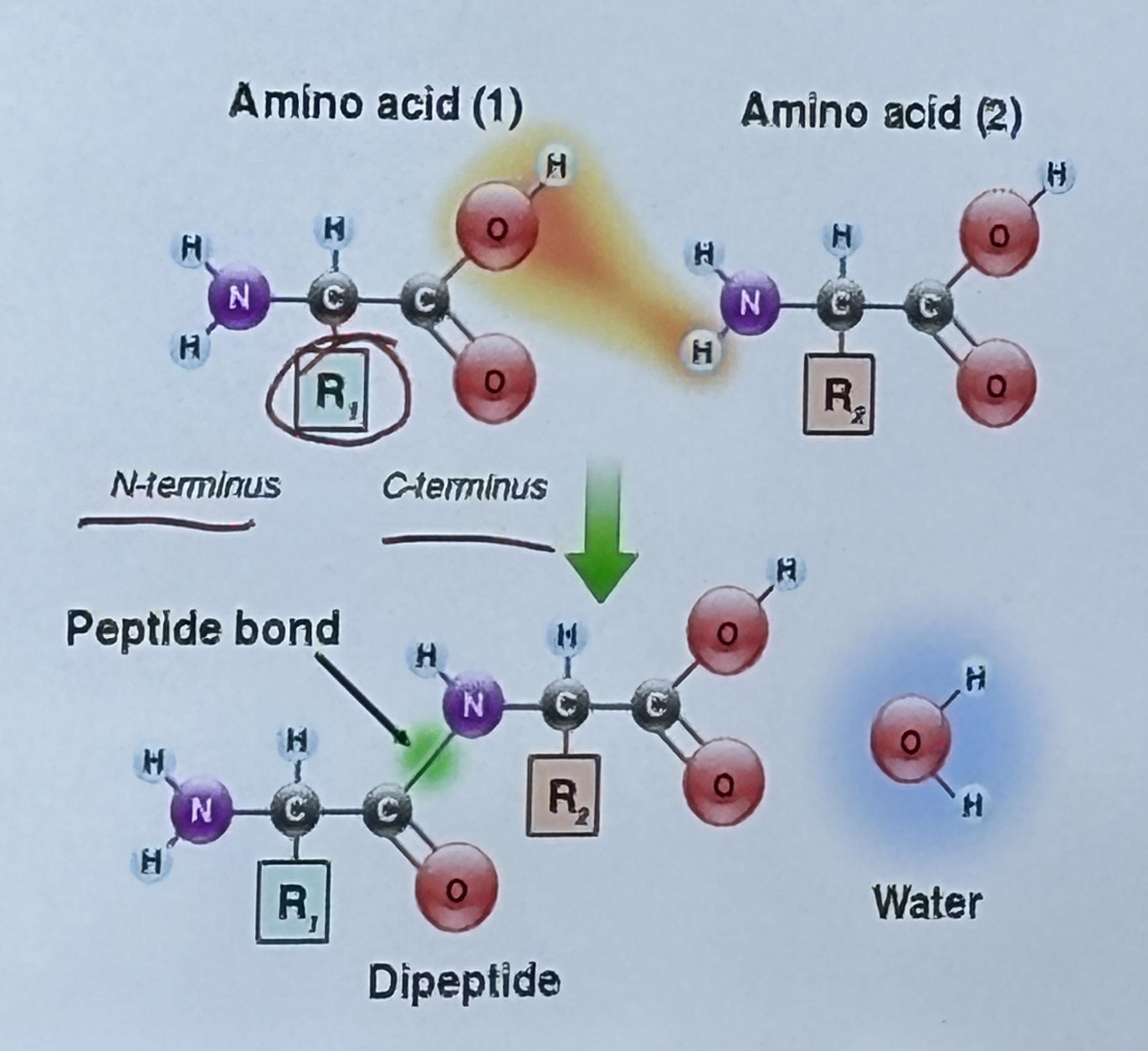
Translation: RNA is translated to sequences of amino acids (held together by peptide bonds) using the genetic code → resulting string of amino acids upon folding makes up protein at ribosomes
rRNA: forms part of the ribosome (aka where protein assembly takes place)
tRNA: carries amino acids (building blocks of proteins) to ribosomes
How to begin transcription?
RNA polymerase must locate a gene and gain access to the template DNA strand by interacting w/ DNA sequences that control transcription
once coding sequence of gene has been transcribed, RNA polymerase must stop transcription and release the transcript
To transcribe
Identify the template strand
Read it in 3’ to 5’ direction and then pair complementary nucleotides
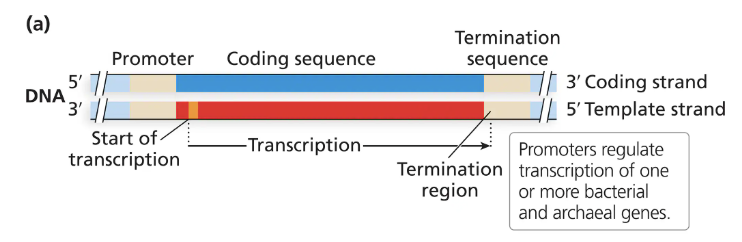
Promoters
The most common type of DNA sequences controlling transcription; are regulatory sequences- not transcribed
are recognized by RNA polymerase and directs it to a nearby gene
Where transcription of a gene starts and ends
Starts near the promoter at the start of transcription, the DNA location where transcription of a sequence begins
Ends at the termination sequence, where another DNA sequence facilitates the stopping of transcription
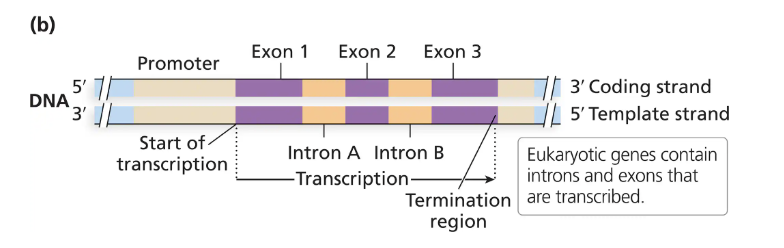
Exons and Introns
Are what eukaryotic genes are subdivided into
Exons: contain the coding information that will be used in translation
Introns: intervene between exons and are removed from the transcript before translation (which occurs in nucleus)
are not in bacterial genes, some in archaeal
What’s the backbone of DNA?
Phosphate and sugar
Nucleic acid structure
a) Phosphate
b) Sugar (ribose or deoxyribose)
c) Nitrogenous base
Purines
Adenine and Guanine
Pyrimidines
Cytosine and Thymine/Uracil
How are nucleotides forming a strand linked together?
By a covalent phosphodiester bond between the 5’ phosphate group of one nucleotide and the 3’ hydroxyl (OH) group of the adjacent nucleotide
it leads to alternation of deoxyribose sugars & phosphate groups along the strand + gives molecule a sugar-phosphate backbone
Molecular Structure of DNA
Discovered by Watson, Crick, Franklin
A double helix composed of two strands of DNA, with an invariant sugar-phosphate backbone on the outside and nucleotide bases (ATCG) forming complementary base pairs within the center of the molecule
hydrogen bonds hold complementary base pairs in DNA together
2 between A-T
3 between G-C
Chargaff’s Rule
Percentages of adenine and thymine are equal
A = T
Percentages of guanine and cytosine are equal
G = C
Note:
A + T doesn’t equal to G + C
suggested that nucleotides are arranged in complementary base pairs to Watson and Crick
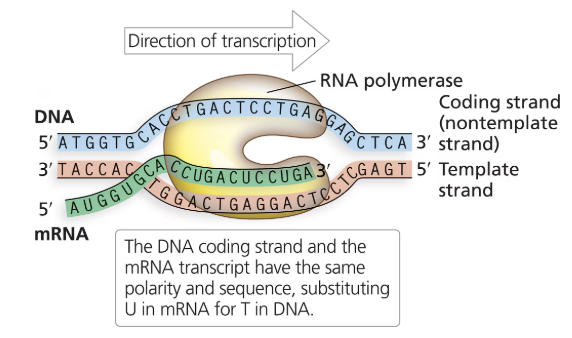
Direction of transcription
From 5’ to 3’ (Coding strand; non-template strand)
Template strand
The DNA strand from which the mRNA transcript is synthesized from
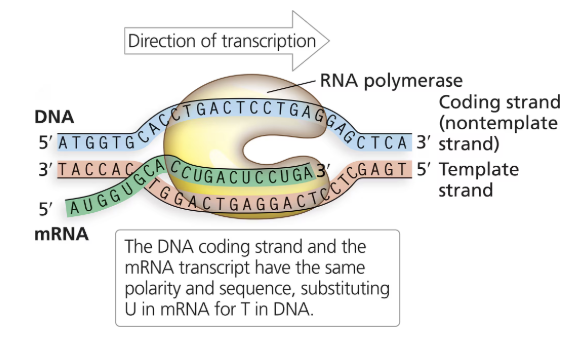
Coding strand
The complementary partner of the DNA template strand
aka is complementary and antiparallel to it (so has same 5’→ 3’ polarity as RNA transcript made from template strand)
Complementary strand
Is antiparallel (one strand is 5’ to 3’, the other is 3’ to 5’)
A pairs w/ T, C pairs w/ G
mRNA transcript
Is antiparallel to the DNA template strand
DNA Coding strand vs mRNA transcript
Both have same polarity and sequence, substituting U in mRNA for T in DNA
aka same direction (i.e. both 5’ to 3’) and same sequence except in mRNA, T is replaced w/ U
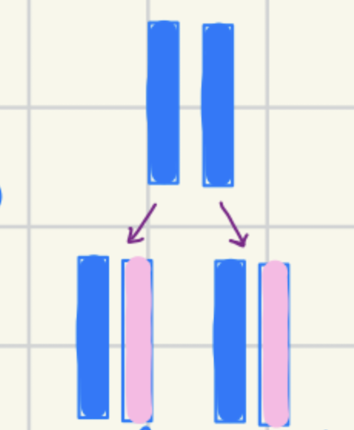
DNA replicates by …
Semiconservative replication
Both parental DNA are templates for new DNA
Each double stranded DNA has one parental (old) and one “new” daughter strand
RNA Structure
Mostly similar to DNA except:
Uracil replaces thymine
2’ hydroxyl on all bases
Usually single stranded
Protein Structure
Composed of amino acids linked together in a chain
Each of the 20 amino acids have a unique R-group
Have N-terminus and C-terminus
Mendelian/Transmission genetics
The study of transmission of traits and characteristics in successive generations
Evolutionary genetics
The study of the origins of and genetic relationships between organisms and examines the evolution of genes and genomes
Molecular genetics
The study of inheritance and variation in nucleic acids (DNA and RNA), proteins, and genomes and tries to connect them to inherited variation and evolution in organisms
Evolutionary principles developed by Darwin
Variation exists in populations
Hereditary transmission allows that variation to be passed along to subsequent generations
Variants survive differentially due to environmental pressures
Variants that lead to increased survivorship increase in frequency in the population
Class definition of evolution
Change over time
doesn’t have to take a long long long time
i..e antibiotic resistance
Phylogenetics
The study of evolutionary relationships
uses multiple markers, but DNA is one of the most robust
General principle: the most closely related species will have the smallest number of differences between shared genes
the same principle as determining relatedness within human populations, just extended to other species
Mendel’s Experiment
Goal: to determine the pattern by which inheritable characteristics were transmitted to the offspring
Conclusions
characteristics were governed by distinct units of inheritance (genes)
each organism has/inherits two copies of each gene, one from each parent
the two genes may be identical to one another or non-identical (alleles)
Gametes (reproductive cells) must therefore carry only one copy of the gene for each trait
Monohybrid cross → parents differ by a single trait
Principle of Independent Segregation
An organism’s alleles separate from one another during gamete formation and are independently transmitted to offspring
Principle of Independent Assortment
Each pair of alleles segregates independently from other pairs during gamete formation
Concepts for Mendelian Inheritance
Aka looking at 2+ traits simultaneously
Alleles for each trait segregate independently and don’t influence the inheritance (independent assortment) of the second trait
Results in definite ratios for progeny phenotypes based on initial frequencies
Monohybrid cross
Follows 1 homo: 2 hetero: 2 homo ratio
Equation for total number of gametes each parent produces
2n where n = # of heterozygous alleles in parent
True breeding
Homozygous (TT or tt)
Test cross
Homozygous recessive (known) x heterozygous dominant
Getting 4 phenotypes of equal frequencies
Forked line method
Consider only one allele at a time and cross them; do this for each trait
Then cross all of the results making sure to multiply the fractions
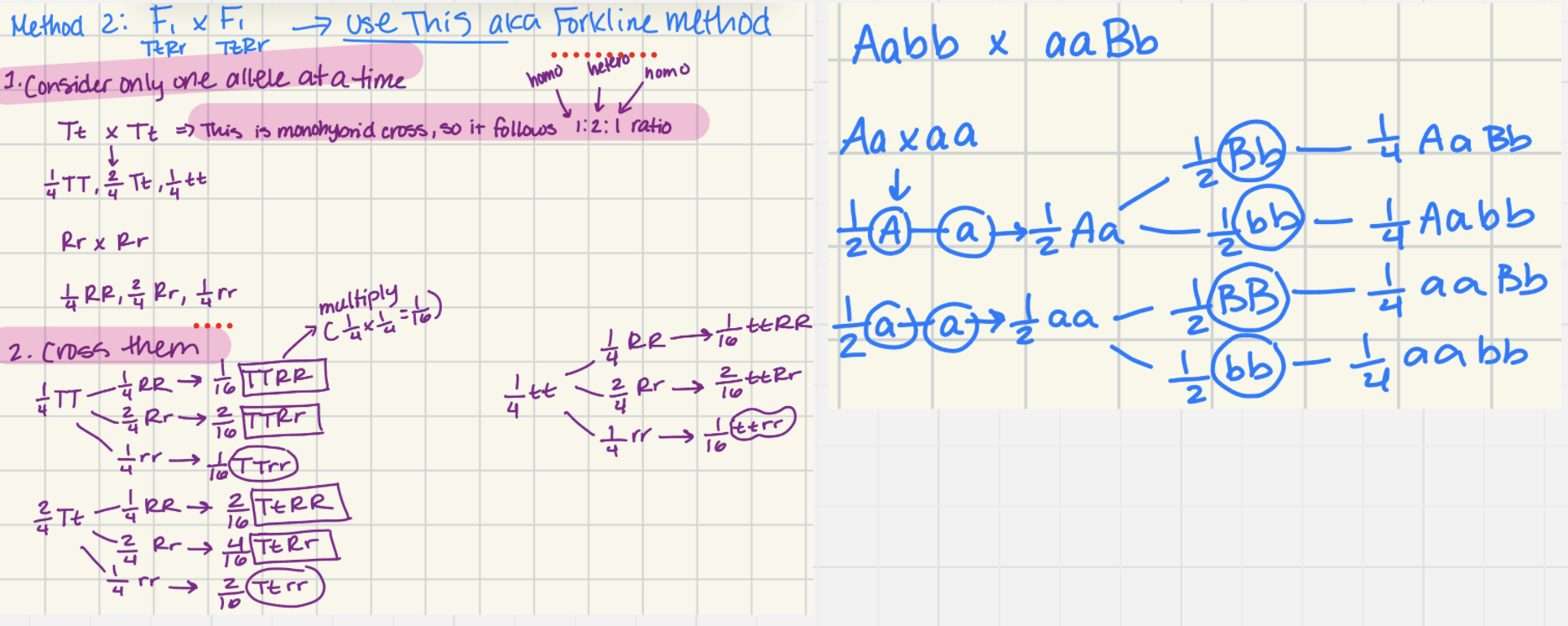
In a dihybrid test cross, the phenotypic ratio is always …
1:1:1:1
In monohybrid test crosses, the phenotypic ratio is always …
1:1
Product rule (or multiplication rule)
Use if two or more events are independent of one another → their joint probability is the product of the individual probabilities
Chances of g AND g happening (multiply both the probability of both by each other)
P(g) = 1/2 , P(g) = ½
P(gg) = ½ x ½ = ¼
Sum rule (or addition rule)
Use if finding joint probability of two or more mutually exclusive events (not independent)
Events is the sum of probabilities of each event
Probability of obtaining any heterozygote is equal to the sum of the probabilities of each possible heterozygote
The chances of Gg OR other Gg happening: add probabilities of each event together
P(one Gg) = ¼ , P(other Gg) = ¼
P(any Gg) = ¼ + ¼ = ½
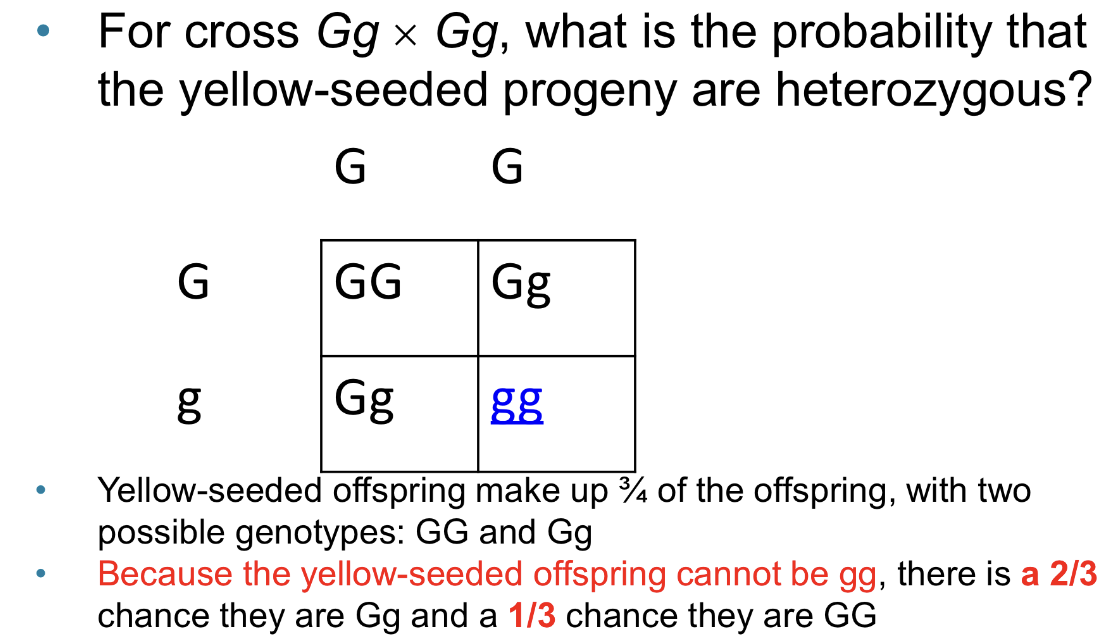
Conditional Probability (prior probability)
The probability of an event (A), given that another (B) has already occurred
Is asked after the cross has been made, is applied when information about the outcome modifies the probability calculation
Note: the product and sum rules are used before a cross is made, in order to predict the likelihood of certain outcomes
Binomial Expansion and Probability
The probability that a binomial experiment results in EXACTLY X successes
predicting the likelihood of a series of events
Two variables, each representing the frequency of one of two alternative outcomes
P(outcome 1) = p ; P(outcome 2) = q
If p and q are the only possible outcomes → p+q = 1
In examining probable outcomes (i.e. coin flips), we expand the expression by n events → (p+q)n = 1
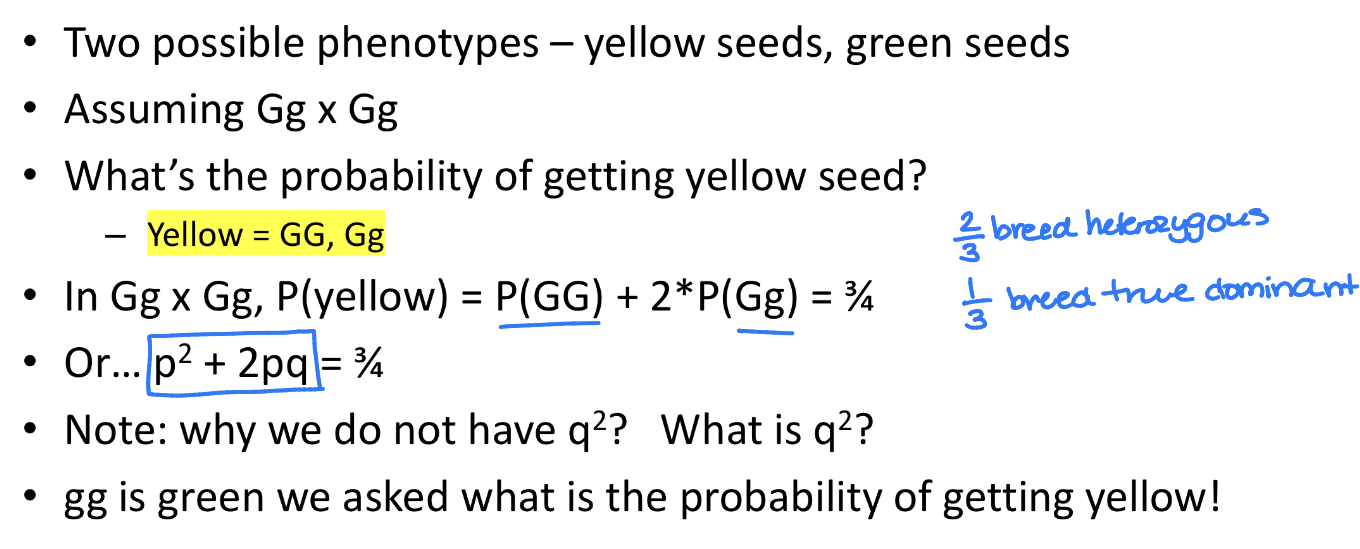
Method to solve problems w/ binomial expansion: Pascal’s Triangle
Binomial coefficient
(p+q)n where …
n = # of events
Each line is total # of outcomes
i.e. (p+q)2 , n=2, so can expand to: 1p2 + 2 (p1q1) + 1q2 = 1
Normal distribution
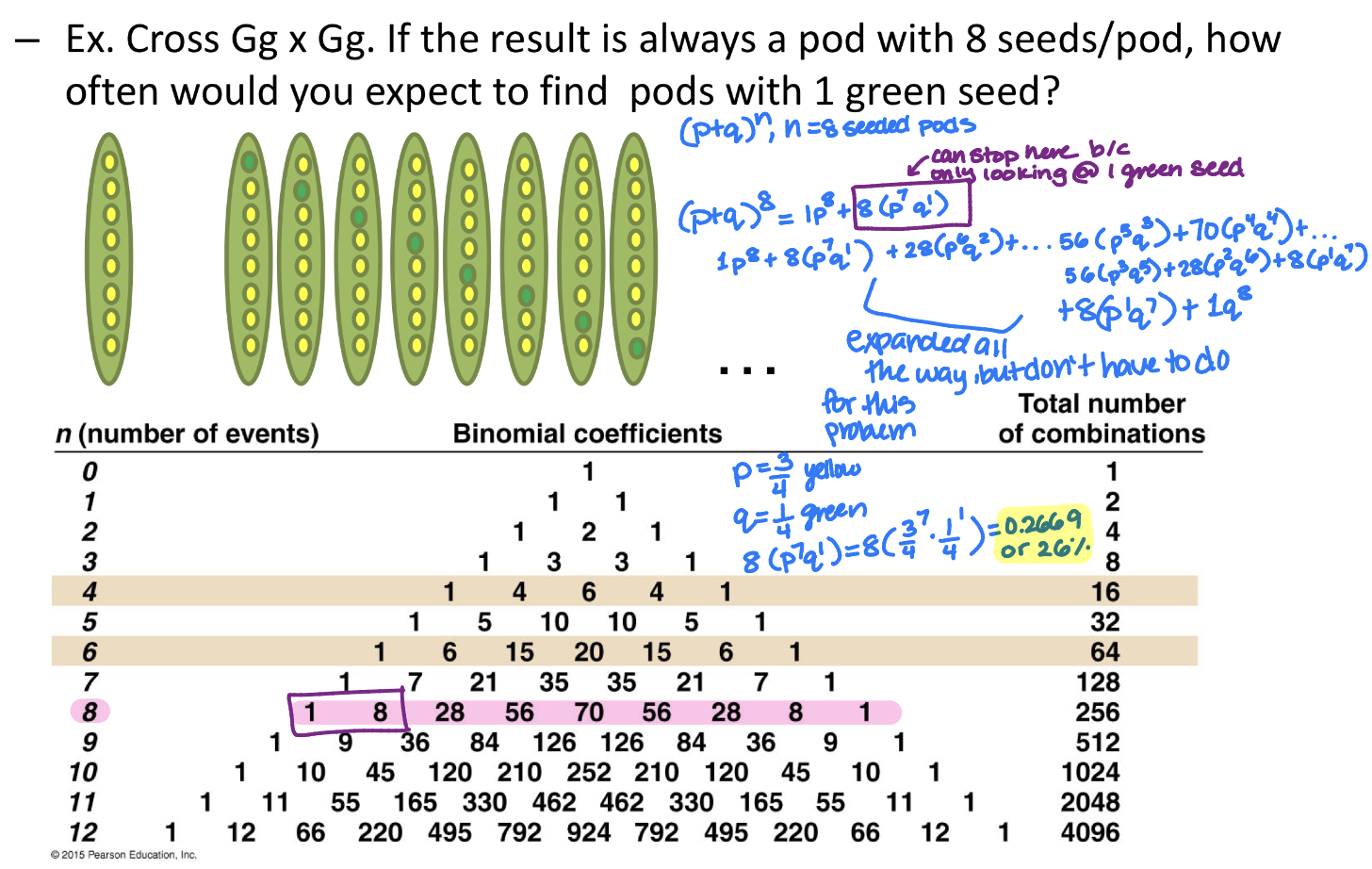
A binomial distribution depicting all of the experimental outcomes
μ = the average outcome
σ = one standard deviation
A result is considered statistically significant if it falls more than ~2σ away from μ
It has a probability (p-value) of < 0.05
The p-value is the probability of a result deviating by at least that much by chance
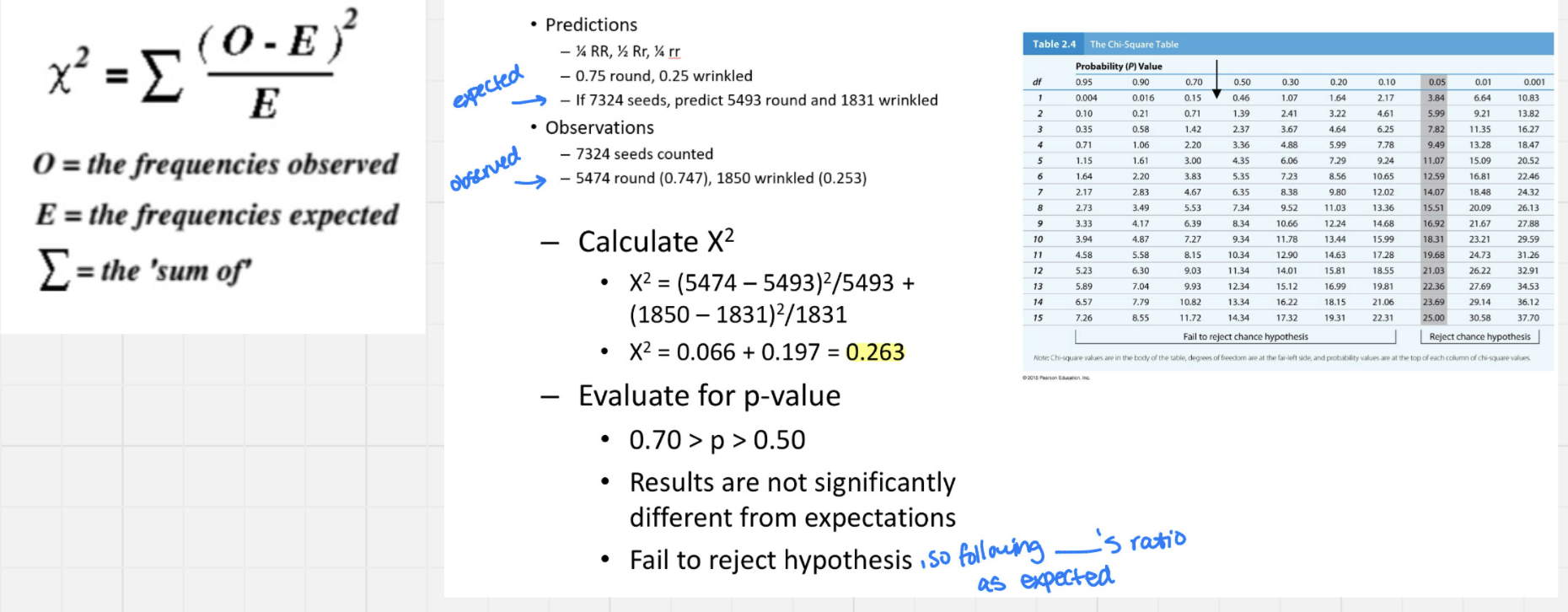
Chi-square (X2) analysis
A method to statistically evaluate the relationship between observed and expected values; are the results statistically significant?
Dependent on sample size, # of outcome classes, # of observations in each class
Larger # of outcome classes or more observations = larger X2 values
So can’t compare experiments that have diff #s of outcome classes or observations
Steps to calculate X2 value for Chi-square analysi
1. Calculate the difference between the observed (O) and expected (E), then square it and divide by E
2. Sum for each outcome class
Then, find where X2 falls on a normal distribution to determine p-value
Need to also know degrees of freedom (df = n-1)
If fail to reject = they assort independently
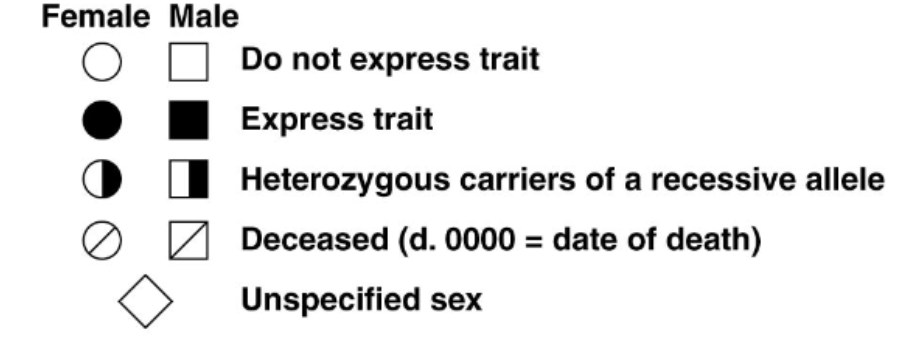
Pedigree symbol meanings
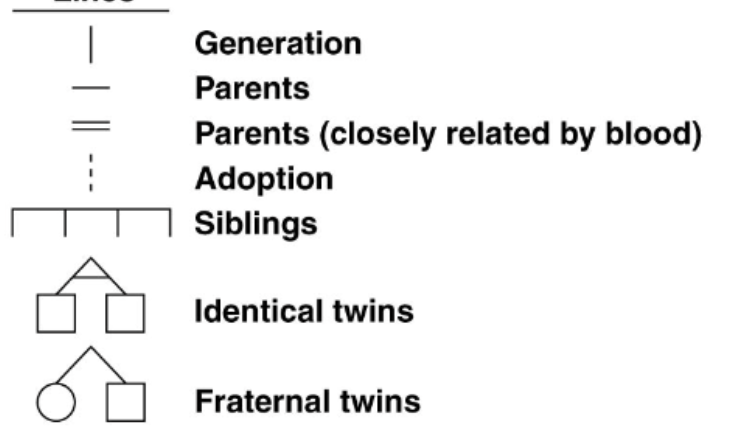
Pedigree line meanings
Autosomal inheritance
The transmission of genes that are carried on autosomes (non-sex chromosomes)
found in pairs
Split up during gamete formation (segregation)
Individual chromosomes are distributed in gametes w/out regard to other chromosomes (independent assortment)
Autosomal dominant
The trait isn’t controlled by sex chromosomes; allele can be shown/transmit in either male or female
Males and females are impacted equally
If offspring are affected, at least one parent should be affected
In crosses where one parent is affected but the other isn’t, ~half of offspring should be affected
Gg x gg → ½ Gg & ½ gg
Two affected parent may produce unaffected offspring
Gg x Gg → ¼ GG + ½ Gg + ¼ gg
Autosomal recessive
The trait is controlled by recessive gene and the affected can often be born to parents that are both unaffected
If one parent is affected, risk to the child is dependent on the other parent
If both parents are affected, all offspring will be affected
The trait may not show up in every generation
If allele is rare, unaffected parents of affected children are likely to be closely related
Chromatin
The material of which eukaryotic chromosomes are composed; protein, RNA, and DNA
Euchromatin
Chromosomal material that isn’t densely compacted during normal cell operation; comprises many functional (genes) parts of the genome
Heterochromatin
Chromosomal material more densely packed and containing few expressed genes
Chromosome
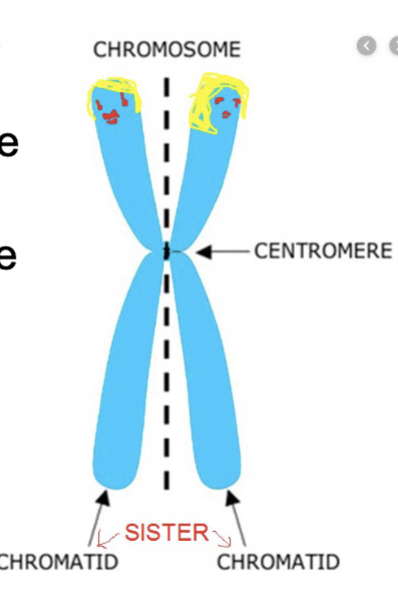
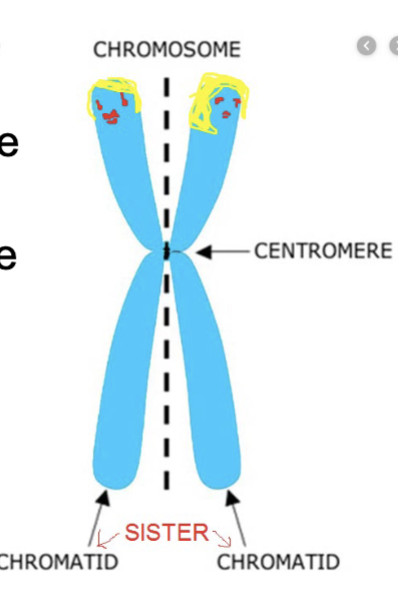
A DNA-containing structure that has a centromere
at end of S-phase, consists of two replicated structures, joined at the centromere
Homologous
Having the same structural features and patterns of genes
Chromatid
One of the replicated structures
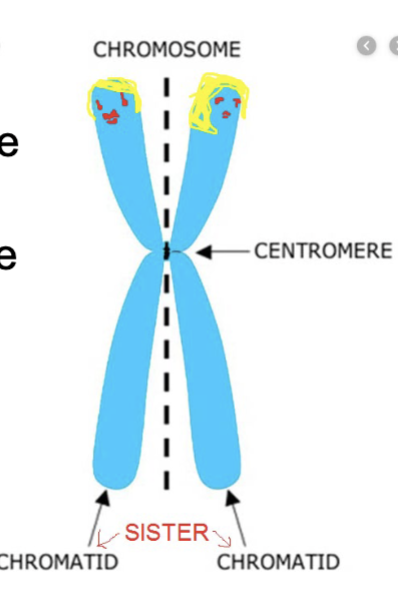
Sister chromatids
The two replicated chromosomes as a unit
Diploid
2n chromosomes present in pairs
Haploid
1n
only 1 chromosome pair
Somatic cells
Non-reproductive cells, usually diploid “body cells”
produced through mitosis
Gametes
Reproductive cells, germ-line cells (sex cells)
contain haploid (n) chromosome number
produced through meiosis
Meiosis
Produces gametes that have half the number of chromosomes as the original cell (reduction type division)
the gametes aren’t genetically identical to one another
2 Major Cell Cycle Phases
M phase
includes mitosis (duplicated chromosomes are separated into 2 nuclei (karyokinesis) AND cytokinesis (entire cell & its cytoplasm divide into 2 daughter cells
Interphase
divided into G1 (first gap), S (synthesis), & G2 (second gap)
Interphase → occupies bulk of cycle
Days, weeks, or longer, depending on cell type
Most DNA is unpacked and distributed throughout the nucleus; i.e. euchromatin
Cells prepare for mitosis, replicate DNA, perform normal metabolic functions (glucose oxidation, replication, transcription, translation)
M phase
Activities necessary for cell division; usually lasts ~ 1 hour
Only a small percentage of cells in a tissue are in mitosis at any given time
DNA is tightly packed (heterochromatic) and inaccessible
Usual processes of protein synthesis are largely shut down
Mitosis
Process of nuclear division (karyokinesis) / cell division that produces two genetically identical daughter cells from one original parental cell
Is precisely controlled to prevent either an excess of an insufficient # of cells
Replicated DNA molecules of each chromosome are faithfully partitioned into 2 nuclei
Usually accompanied by cytokinesis → dividing cell splits into 2
Maintains chromosome number & is necessary to generate new cells for organism growth, maintenance, and repair
Happens in diploid OR haploid cells
Usually divided into 5 distinct stages
Sex chromosomes do go through this
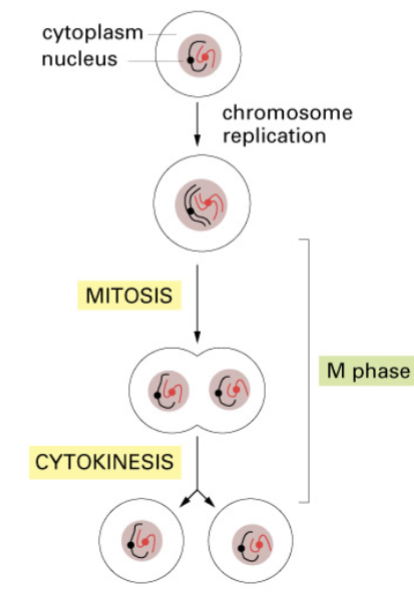
Mitosis Start and End
Start: one cell w/ a diploid number of chromosomes
diploid: 2 copies of each chromosome
End with: two cells w/ diploid complements of each chromosome
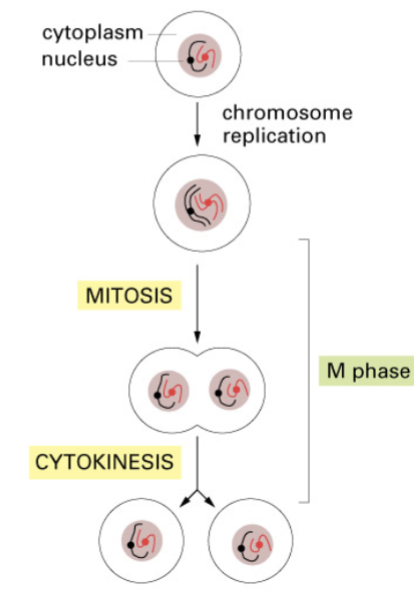
5 Phases of Mitosis? (in order)
Prophase
Prometaphase
Metaphase
Anaphase
Telophase
What happens in the Prophase?
Mitotic chromosomes condense to appear as distinct, rodlike structures
Two mirror-image sister chromatids formed during replication
1. Held together along its length with a multi-protein complex called cohesion
Holds the 2 sister chromatids together through G2 and into mitosis
Microtubules appear in sunburst arrangement (aster) around each centrosome during early prophase
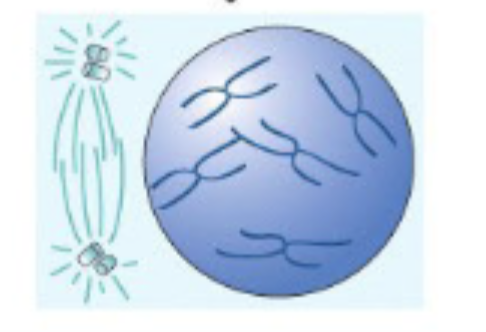
What happens in Prometaphase?
Starts w/ dissolution of nuclear envelope
A) Mitotic spindle assembly is completed
B) Chromosomes are moved into position at center of cell
When it starts, compacted chromosomes are scattered throughout space that was nuclear region
microtubules penetrate central cell region
free ends grow & shrink as if searching for chromosome
those that contact a kinetochore are captured & stabilized
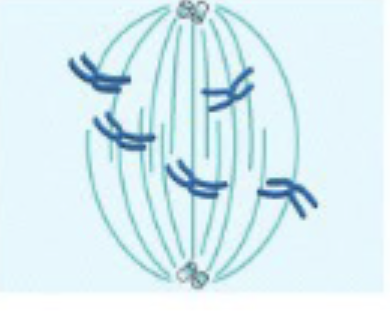
What happens in Metaphase?
Starts with chromosomes aligned at spindle equator in a plane (metaphase plate)
One chromatid attached by its kinetochore to spindle fiber from one pole, other from opposite pole
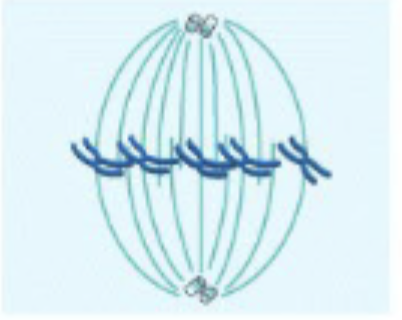
What happens in Anaphase?
All metaphase plate chromosomes split synchronously
The chromosomes (formerly sister chromatids) begin to migrate poleward
accompanied by shortening of microtubules attached to kinetochore
Chromosomes move at ~1 μm/min
2 types of movement: movement of chromosomes toward poles and the 2 spindle poles move farther apart
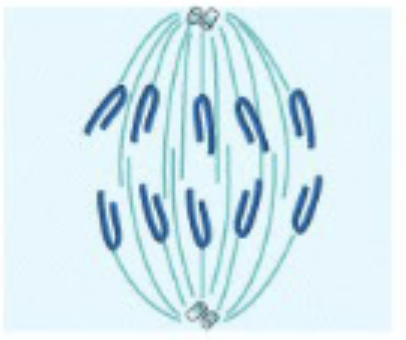
What happens in Telophase?
Chromosomes collecting as they near their respective poles
Daughter cells return to their interphase condition
A) Nuclear envelope reforms
B) Chromosomes disperse until they disappear from view under microscope
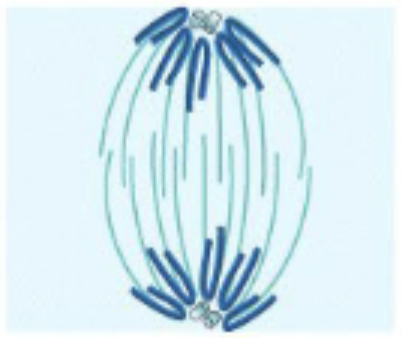
What happens in Cytokinesis?
Is a process which the cell is divided into 2 daughter cells, usually coordinated with mitosis
First evidence of cytokinesis occurs in late anaphase w/ cell surface indentation in narrow band around cell
as time progresses, indentation deepens & forms furrow completely encircling cell
Meiosis
Produced haploid gametes for sexual reproduction
Union of haploid gametes produces diploid progeny
Distinguished from mitosis by different products and different meiotic M phase
Meiotic interphase is followed by two divisions with no DNA replication between them:
1) meiosis I
2) meiosis II
Characterized by recombination or crossing over aka exchange of material between homologous pairs of chromosomes
Where is Meiosis happening?
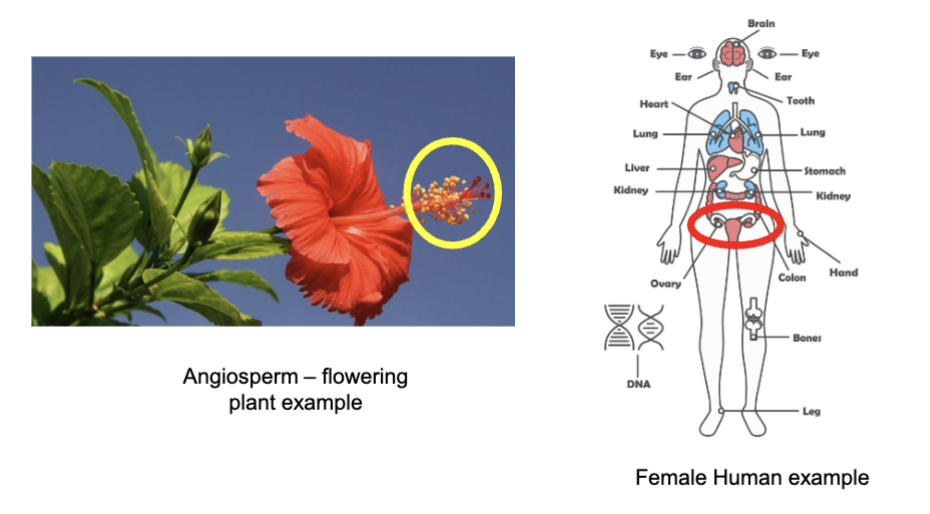
Where is Mitosis happening?
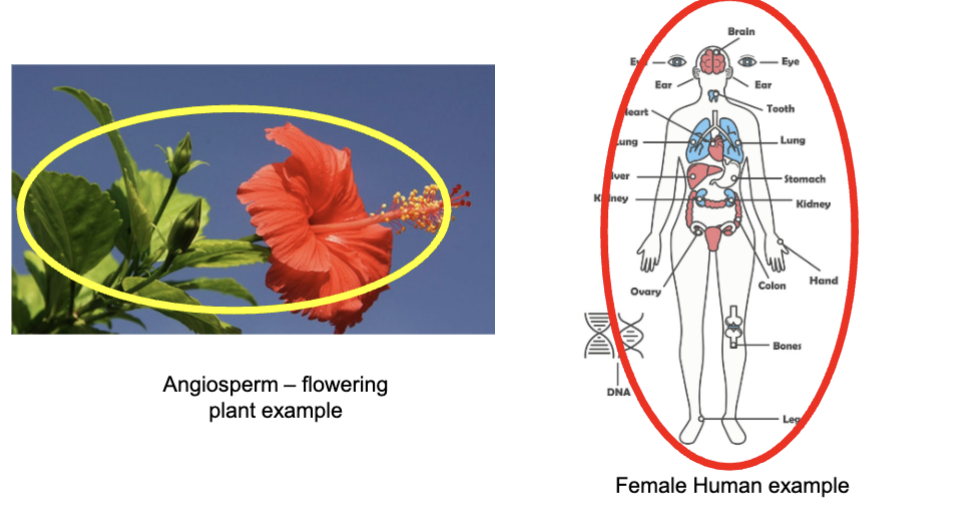
What happens in Meiosis I?
Separation of homologous pairs of chromosomes
3 hallmarks:
Homologous chromosomes pair (synapsis)
synapsis: pairing of homologous chromosomes
Crossing over (recombination) occurs at chiasmata
Segregation of homologous chromosomes occur to make haploid complements
Subdivided into prophase I, metaphase I …. with similar (but different) events to mitosis happening in each
Chromosome theory of heredity & experimental evidence: Mendel
Pea plants
Chromosome theory of heredity & experimental evidence: Thomas Morgan
Fruit flies
Chromosome theory of heredity & experimental evidence: Sutton and Boveri
Sea urchin eggs
Chromosome theory of heredity & experimental evidence: Nettie Stevens
Beetles
Model organism
A non-human species that is extensively studied to understand particular biological phenomena, w/ expectation that discoveries made in organism model will provide insight into workings of other organisms
For chromosomes, the earliest productive model was Drosophilia melanogaster
Thomas Hunt Morgan tested the chromosome theory of inheritance in D. melanogaster
only four chromosome pairs, easy to identify phenotypes
Nettie Stevens
Most work to that time was focused on autosomes
Nettie Stevens noticed that there were differences between male and female chromosomes in many (but not all) species
heterogametic
In Tenebrio molitor (a beetle)
Stevens concluded that sex-dependent hereditary differences are due to the presence of two X chromosomes in females and an X and a smaller Y chromosome in males
Not always true and are variations but works as a general rule