biochem 2 final
 Call Kai
 Learn
Learn Practice Test
 Spaced Repetition
 Match
Match Flashcards
 Knowt Play
1/77

There's no tags or description
Looks like no tags are added yet.
Name | Mastery | Learn | Test | Matching | Spaced | Call with Kai |
|---|
No analytics yet
Send a link to your students to track their progress
78 Terms
Glucose 6-phosphate dehydrogenase
catalyzes the first step in the pentose phosphate pathway (glucose 6-phosphate to 6-phospho-glucono-δ-lactone
Glycogen phosphorylase
catalyzes the removal of glucose residues from glycogen to yield glucose 1-phosphate
Transferase
is necessary for the remodeling of a-1,6 branch points in glycogen
Adenylate cyclase
catalyzes the synthesis of cyclic AMP from ATP and is important for the activation of protein kinase A.
Protein phosphatase I (PPI)
PPI is a phosphatase that is activated in response to elevated glucose levels. PPI is heavily regulated in both muscle and liver.
Acylcarnitine transferases (I and II)
these enzymes mediate the transfer of fatty acyl CoA into the mitochondrial matrix. Acylcarnitine transferase I is inhibited by malonyl CoA.
Acyl CoA dehydrogenase
catalyzes the first oxidation step in fatty acid b-oxidation
Acetyl CoA carboxylase (ACC)
catalyzes the synthesis of malonyl CoA from acetyl CoA. This is the major control point in fatty acid synthesis.
Aminotransferases/transaminases
catalyze the transfer of an amine group from an amino acid to a carbon skeleton to make a new amino acid
The nitrogenase (dinitrogenase) complex
catalyzes the fixation of nitrogen
Carbamoyl phosphate synthetase
catalyzes the conversion of ammonia and bicarbonate into carbamoyl phosphate in the urea cycle
Glutamate dehydrogenase
catalyzes the direct deamination of glutamate and the reverse reaction, the addition of an amine group to a-ketoglutarate to make glutamate.
Calvin cycle
Carbon fixation
Reduction
Regeneration
Converts CO₂ into carbohydrate precursors using ATP and NADPH from light reactions.
Carbon fixation (calvin cycle)
rubisco catalyzes
ribulose-1,5-bisphosphate (RuBP) + CO₂ + H₂O
→ 2 molecules of 3-phosphoglycerate (3-PGA)
reduction (calvin cycle)
3-phosphoglycerate is reduced by NADPH to form hexoses
regeneration (calvin cycle)
Ribulose 5-phosphate is regenerated and reenters to the Calvin cycle to fix more CO2
Pentose phosphate pathway
NADPH production
Ribose-5-phosphate production
NADPH production (Pentose phosphate pathway)
Fatty acid synthesis
Cholesterol synthesis
Neurotransmitter synthesis
Protection against oxidative stress via glutathione
Ribose-5-phosphate production (pentose phosphate pathway)
Used for nucleotide synthesis.
Oxidative phase (The pentose phosphate pathway)
Rate-limiting enzyme:
Glucose-6-phosphate dehydrogenase (G6PD)
G6P
→ 6-phosphoglucono-δ-lactone + NADPH
Nonoxidative phase (The pentose phosphate pathway)
Uses:
Transketolase
Transaldolase
Produces:
Fructose-6-phosphate
Glyceraldehyde-3-phosphate
Glycogen breakdown
Main enzyme
Glycogen phosphorylase
Glycogen + Pi
→ Glucose-1-phosphate
Breaks α-1,4 glycosidic bonds using phosphorolysis.
Branch removal
Transferase
Moves glucose residues near branch points.
α-1,6-glucosidase
Removes branch-point glucose.
liver
Has glucose-6-phosphatase
Releases glucose into blood
muscle
Lacks glucose-6-phosphatase
Uses glucose internally via glycolysis
Glycogen synthesis
Activated donor
UDP-glucose
G1P + UTP
→ UDP-glucose
UDP-glucose is used by glycogen synthase.
Glycogen Synthase
Active form:
Glycogen synthase a
Dephosphorylated
Inactive form:
Glycogen synthase b
Phosphorylated
Fatty acid oxidation (β-Oxidation)
oxidation (FADH2)
hydration
oxidation (NADH)
Thiolysis
oxidation (Fatty acid oxidation)
Acyl-CoA dehydrogenase
Produces:
trans-Δ²-enoyl CoA
FADH₂
hydration (fatty acid oxidation)
Adds water across double bond.
oxidation 2 (fatty acid oxidation)
Produces:
β-ketoacyl CoA
NADH
thiolysis (fatty acid oxidation)
Produces:
Acetyl-CoA
Fatty acyl CoA shortened by 2 carbons
Fatty acid synthesis
condensation
Acetyl + malonyl units join
reduction
uses NADPH
dehydration
reduction
uses NADPH again
repeated until palmitate forms
Ubiquitin
Small protein attached to lysine residues of target proteins.
Polyubiquitination signals degradation.
Proteasome
Structure:
α₇β₇β₇α₇
β subunits contain protease activity.
Ubiquitin mediated protein degradation
Products
Protein
→ peptides
→ amino acids
Amino acids can be used for:
glucose synthesis
fatty acid synthesis
cellular respiration
Amino acid degradation
Step 1: Transamination
Amino acid + α-ketoglutarate
→ α-keto acid + glutamate
Catalyzed by aminotransferases.
Step 2: Deamination
Glutamate
→ α-ketoglutarate + NH₄⁺
Catalyzed by glutamate dehydrogenase.
Step 3
Ammonium enters urea cycle.
The urea cycle
Purpose
Detoxifies NH₄⁺ by converting it to urea.
Steps
Carbamoyl phosphate synthetase
Ornithine transcarbamoylase
Argininosuccinate synthetase
Argininosuccinase
Arginase
Produces urea and regenerates ornithine.
First amino acids formed
Glutamate
Glutamine
These serve as nitrogen donors for synthesis of other amino acids.
Rubisco
catalyzes carbon fixation and the formation of 3-phosphoglycerate from ribulose 1,5-bisphosphate and CO2. most abundant enzyme in the biosphere
rubisco reaction and mechanism
Ribulose-1,5-bisphosphate (RuBP) + CO₂ + H₂O
→ 2 molecules of 3-phosphoglycerate (3-PGA)
Lys201 is carbamylated
Mg²⁺ binds active site
RuBP forms an enediol intermediate
CO₂ added to substrate
Unstable 6-carbon intermediate forms
Cleavage produces two 3-PGA molecules
Urea Cycle Defects
Hyperammonemia
Excess NH₄⁺ accumulates.
→ glutamine synthesis
Glutamine accumulates in neurons.
→ osmotic stress
→ brain swelling
→ neurological damage
Mutant Argininosuccinase
Argininosuccinate
❌→ Arginine + fumarate
Treatment:
excess arginine
reduced protein diet
Excess argininosuccinate is excreted and removes nitrogen from body.
Mutant Carbamoyl Phosphate Synthetase
Cannot form carbamoyl phosphate.
Treatment:
benzoate
phenylacetate
These remove nitrogen through alternative excretion pathways.
Toxic drug-induced necrosis
Cells rupture.
→ mitochondria released
→ GLDH elevated in blood
Used to distinguish types of liver injury.
Diagnostic enzyme for liver diseases
Glutamate dehydrogenase (GLDH)
Viral hepatitis
Mitochondria remain intact.
→ little GLDH released
Starvation and how this condition affects the urea cycle
Glucose-Alanine Cycle
During starvation:
Muscle protein
→ amino acids
Branched-chain amino acids degraded in muscle.
Amino groups transferred to pyruvate.
Pyruvate + NH₂
→ alanine
Alanine transported to liver.
In liver:
amino group enters urea cycle
carbon skeleton used for gluconeogenesis
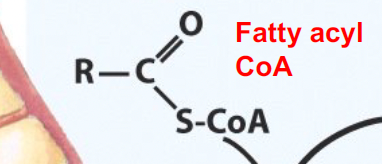
Fatty acyl CoA
Long hydrocarbon chain
Thioester linkage
Attached to coenzyme A
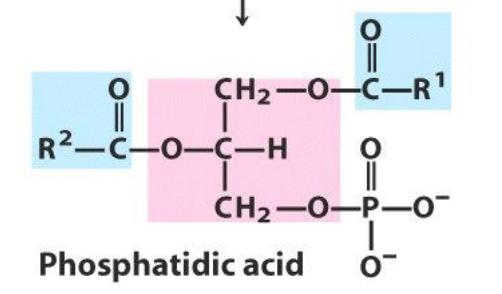
Phosphatidic acid
Glycerol backbone
Two fatty acids
One phosphate group
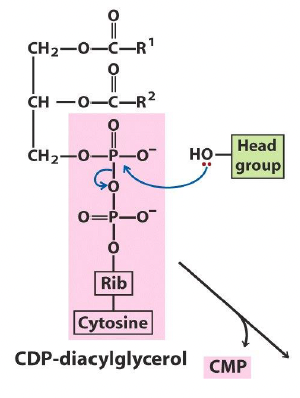
Cytidine diphosphate choline
Cytidine nucleotide
Diphosphate
Choline head group
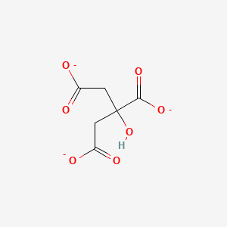
Citrate
6-carbon TCA intermediate
Three carboxyl groups
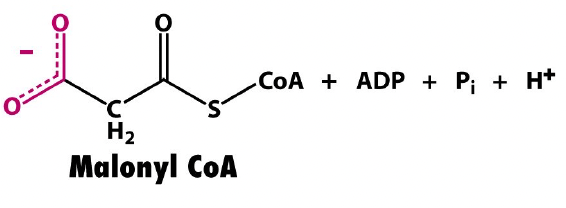
Malonyl CoA
CoA attached
Three-carbon dicarboxylic acid
Cells heavily dependent on PPP
Red blood cells
RBCs require NADPH to maintain reduced glutathione and protect against oxidative stress.
Evidence comes from G6PD deficiency causing RBC hemolysis.
Cells using large amounts of NADPH
Adipose tissue
Lipid-synthesizing tissues
PPP mode 3 is specifically for high NADPH demand.
Cells that rely less heavily on PPP
Cells primarily interested in ATP production rather than NADPH generally rely more on glycolysis than PPP.
Glucagon
Released during fasting.
Effects:
glycogen breakdown ↑
glycogen synthesis ↓
Epinephrine
Released during stress/exercise.
Effects:
glycogen breakdown ↑
lipolysis ↑
Insulin
Released in fed state.
Effects:
glycogen synthesis ↑
glycogen breakdown ↓
PKA
Glucagon/Epinephrine
→ Adenylate cyclase
→ cAMP
→ PKA
PKA
Activates
Phosphorylase kinase
→ Glycogen phosphorylase
Inhibits
Glycogen synthase
PP1
Opposite of PKA.
PP1 dephosphorylates:
glycogen synthase
phosphorylase kinase
glycogen phosphorylase
Result:
glycogen synthesis ON
glycogen breakdown OFF
Muscle phosphorylase
Activated:
AMP
Inhibited:
ATP
G6P
Liver phosphorylase
Inhibited:
glucose
PLP (Pyridoxal Phosphate)
Active form of vitamin B6.
Used by:
aminotransferases
glycogen phosphorylase
Functions in amino acid metabolism.
ACP (Acyl Carrier Protein)
Used by:
Fatty acid synthase.
Function:
Carries growing fatty acid chain during synthesis.
FeMo Cofactor
Used by:
Nitrogenase.
Function:
Nitrogen fixation.
N₂ → NH₄⁺
Regulatory steps in Fatty acid oxidation
Rate-limiting control:
CPT-I
Inhibited by:
Malonyl-CoA
Prevents newly synthesized fatty acids from being degraded.
Regulatory steps in Fatty acid synthesis
Rate-limiting enzyme:
ACC
Acetyl-CoA
→ Malonyl-CoA
Activated by
citrate
Inhibited by
palmitoyl-CoA
AMPK phosphorylation
ketone bodies
Water-soluble fuels produced in liver mitochondria from excess acetyl-CoA.
acetoacetate, acetone, D-3-Hydroxybutyrate
Extrahepatic tissues convert ____ back into acetyl-CoA for energy production.
When are ketone bodies produced?
Starvation
Fasting
Type 1 diabetes
When OAA is diverted toward gluconeogenesis and acetyl-CoA accumulates.
Carbamoyl Phosphate Synthetase (CPS I)
Reaction
NH₄⁺ + HCO₃⁻ + 2 ATP
→ Carbamoyl phosphate
Location
Mitochondrial matrix
Important
First step
First nitrogen enters cycle
Ornithine Transcarbamoylase (OTC)
Reaction
Ornithine + Carbamoyl phosphate
→ Citrulline
Location
Mitochondria
Important
Citrulline leaves mitochondria and enters cytoplasm.
Argininosuccinate Synthetase
Reaction
Citrulline + Aspartate
→ Argininosuccinate
Important
Aspartate contributes the second nitrogen of urea.
Argininosuccinase
Reaction
Argininosuccinate
→ Arginine + Fumarate
Fumarate
→ Malate
→ Oxaloacetate
Links urea cycle to central metabolism.
Arginase
Reaction
Arginine
→ Ornithine + Urea
Products:
Urea:
excreted
Ornithine:
reenters cycle
Ketogenic amino acids
Produce:
Acetyl-CoA
Acetoacetyl-CoA
Examples:
Leucine
Lysine
glucogenic amino acids
Produce:
Pyruvate
OAA
α-ketoglutarate
Succinyl-CoA
Fumarate
Can contribute to gluconeogenesis.
Nitrogen fixation
Conversion of atmospheric nitrogen:
N₂
→ NH₄⁺
cyanobacteria
soil bacteria
also lightning (extreme heat)
can perform it.
Glutamine synthetase
Heavily regulated.
Inhibited by:
Glycine
Alanine
Multiple nitrogen-containing end products synthesized from glutamine
Covalent regulation (glutamine)
When glutamine is abundant:
Glutamine synthetase becomes adenylylated
→ activity decreases