Crime, Power and Media
 Call Kai
 Learn
Learn Practice Test
 Spaced Repetition
 Match
Match Flashcards
 Knowt Play
1/52

Earn XP
Description and Tags
Lectures 1-8 and chapters + readings
Name | Mastery | Learn | Test | Matching | Spaced | Call with Kai |
|---|
No analytics yet
Send a link to your students to track their progress
53 Terms
Criminology in the 18th century:
Criminology becomes its own discipline
Era of the classical school → crime is the result of free will
people start understanding to act on rational choices
there is a lot of judgment because “there cannot be only one judgement”
still happening in the 21st century
part of modernity.
Criminology in the 19th century:
area of positivism → individual fender
a government within criminological thought → offender as criminological
experiment to see if a person was dangerous or not (Cesare Lombroso) through facial characteristics
individual pathologies
part of modernity.
Criminology in the 20th century:
first half: optimism and development
focus of criminology shifts to understanding where society was wrong → era of social positivism
“is it all positive? “ and “can we trust it?” → societal processes
crime and urban space
part of modernity
second half: more changes
shift from modernity to post-modernity → relation between power inequalities and crime
critical criminology → what is a crime? who is a criminal?
internet → importance of image
cultural criminology → what makes a criminal a criminal? what interests to study criminals?
true crime and its popularity
product → it sells and has value.
What are the three tenets?
Crime, power and media.
Explain what is meant by crime.
mapping approaches of understanding or conceptualising crime.
Explain what is meant by (crime and) power.
Power of states, institutions, and corporations in creating or responding to crime.
Explain what is meant by (crime, power, and) media.
representations of crime → “a world in which the street scripts the screen, and the screen scripts the street.“
What is an example of when crime and criminal got mixed up or questioned?
1964 Ohio: legal case → film “The Lovers“ → basecally p0rn
contingency of what crime would be – but it was constructive information
how to further argue?
What is crime from the legal approach?
A crime is a legally defined act or omission that violates public law, causing harm to society or individuals, and is punishable by the state through fines, penalties, or imprisonment.
needs guilty act (actus reus) and a guilty mind (mens rea) → separating it from civil wrongs.
What is crime from the sociological approach?
A violation of formal, written laws and social norms, creating harmful acts that attract state-sanctioned punishment.
it is a social construct that changes based on culture, time, and the power structures that determine which actions are legally or socially prohibited.
What is crime from the social constructivist approach?
A flexible concept created through societal, cultural, and political processes. It argues that actions are labelled "criminal" based on shared societal meanings, power dynamics, and reactions.
What is crime from the zemiological (harm) approach?
The study of social harm offers a critical alternative to traditional criminology by focusing on harmful actions (legal or illegal) that damage individuals or society. It investigates harms often ignored by the justice system, such as poverty, environmental destruction, and corporate wrongdoing.
late 20th century
What are the mainstream and traditional views of crime?
individuals or groups → biological determinism (positivism) → not present in human relations
What is criminal law?
The behavioral components that are prerequisite to define a criminal → individualistic
humans as rational actors.
What is an example of a criminology type that goes beyond the law?
cultural/feminist criminology → subjective experiences and contexts.
Mass Society Theory I:
Behaviour is a response to external stimuli, which can be predicted and conditioned
late 19th and early 20th century
scientism => principles of natural sciences in criminology
causes and effects
focuses on individuals
Mass Society Theory II:
mass media influences society
cause and effect
Hypodermic syringe model: Mass media injects society with values, morals, and information that affects behaviour and thought.
Strain and Anomie Theory I:
Strain (eg. stress): Robert Merton (1938)
appetites aren’t human characteristics → created by cultural influences
culturally defined goals (success, money, beauty) while lacking the means to do so (class/financial privilege)
= strain → criminal behaviour
Anomie (eg. normlessness): Emile Durkheim (1897)
breakdown of the moral authority of collective consciousness, where society cannot regulate the appetites of individual conscience → mass non-conformity and crime
Strain and Anomie Theory II:
anomie and strain are fueled by the mass media
builds on the “hypodermic syringe model” → values and images of success are injected into society (= mass media feed us the cultural goals)
those that cannot achieve these goals → strain → criminal behaviour.
Dominant Ideology Approach:
mid-20th century → critique of capitalism
Karl Marx - society is controlled by the elites → exploit the lower classes
Antonio Gramsci - control is relinquished to the upper classes → hegemonic cultures (common sense)
=> the propagation of the values and norms that uphold the status quo, consent over violence
Radical and Critical criminology: crime and criminal are labels attached to people or behaviour by powerful classes
people or behaviour by powerful classes (top-down) – labelling theory
radical, critical, new criminology – importance of structural inequalities in determining crime and criminality.
Pluralism:
1980s - 1990s
The counterargument for the dominant ideology approach
free market → tokenism: the contemporary ruling class is more diverse than ever
sensationalism: information overload.
Criminalisation — late 50s onwards:
critical criminological school → not necessarily within strategies (injury, harm) and interactionism (= shaping identities and future behaviour).
Criminalisation — 60s to 80s:
→ social constructionism
punishment and abolition => a radical perspective advocating for the dismantling of prisons, police, and the punitive criminal justice system, viewing them as inherently harmful, racist, and ineffective
neomarxist and postmarxist - ruling class takes advantage of the working class
Who benefits? Who’s considered criminal?
critical criminology
Constructive criminology => theories of moral panic → the different schools.
What is stigma, and what types are there?
An attribute that is deeply discrediting (Goffman, 1963): entirely dependent on social, economic, and political power
tribal stigmas: race, ethnicity, and religion
physical deformities: deafness, blindness, and leprosy
blemishes of character: homosexuality, addiction, and mental illness.
There are 2 main categories of stigma. What are they?
micro-level: psychology and macro-level: sociology/criminology.
What does stigma at the macro level consist of? (4 processes)
labelling human differences (= a result of social processes of differentiation)
stereotyping such differences (= associating differences with undesirable characteristics)
separating those labelled from “us“
status loss (downward placement in status hierarchy) and individual/structural discrimination.
Labelling (1960s): What are the 3 stages of creating deviance (labelling)?
No fixity of a criminal act → can be decided based on context
symbolic interactions
__
making the rules whose infraction constitutes deviance
applying those rules to particular people
labelling them outsiders.
What are moral panics and who created them?
Cohen, 1972 - exaggerated, disproportional societal reactions to perceived threats, usually driven by media sensationalism and targeting specific groups – "folk devils".
What is satanic panic?
Where unsubstantiated fears of organised Satanic ritual abuse (SRA) led to widespread wrongful convictions, particularly in daycare cases.
It involved mass hysteria, flawed investigative techniques, and media amplification → "folk devils" out of innocent individuals.
What are 3 types of moral panics?
The grassroots model => panics originate with the general public; a concern about a particular threat is widespread and genuinely felt (latent fears)
American elites are supplying the black community with drugs to
commit genocide against them, political elites are upper-class perverts,
drug abuse ‘taking over’ body and mind of addicts (VS. war on drugs)
The interest group model => police departments, media,
religious groups, educational organizations etc., may have a
stake in bringing to the fore an issue which is independent of
the interests of the elites - elites do not dictate the content,
direction, or timing of panic
The elite-engineered model (1978, british society) => powerful groups that dominate the media and political arena to generate and sustain fear and panic over an issue they recognize to not be terribly harmful to society → mass media is a passive actor
What are 2 approaches to panics?
processual => stages: warning, impact, inventory moment, reaction - active/passive role
attributional => stages: concern, positivity, reaching consensus, proportionality, volatility.
Do films express reality?
Movies can show the social zeitgeist (“spirit of the times”).
Anthony Gidden - “My identity is not based on anything but my capability to keep a particular narrative going. Because my identity has to do with what you (other people) see.“
Trump: trying to show the megalomaniac narrative
Ariana Grande: trying to show the pop star aesthetic
Code of Hammurabi
one of the oldest legal texts
explains how people should behave → “a tooth for a tooth” → retribution penalty “I only have the right to take your tooth if I give you mine first”
rules about slaves → now we don’t have these because they are illegal → before it was normalised
What is culture?
A narrative. Traditions are commonly accepted. It organizes us and shows habits and power relationships → shapes meaning of things
Nietzsche => the truth is the most successful lie.
How does social construct become so neutralised?
It breaks the first wall like the show "Fleabag"
Nihilism: Do fish know they’re in water?
Fight club → Brad knows he’s in a movie => the fish knows it is in water.
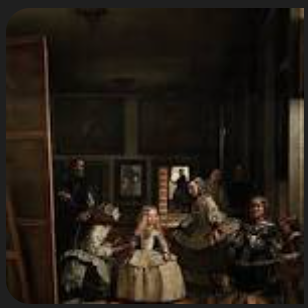
What is the main point of cultural/visual criminology?
Understanding that we live in socially constructed scenarios → we have agency.
What is Friedrich Nietzsche’s superman?
An ideal human of the future who creates their own values, affirms life without needing religious dogma (= a principle of belief), and overcomes the limitations of traditional morality.
What is the role of media in constructing culture?
Meaning. It is everything that shapes our reality – when someone asks if it is nature or nurture, it is always both.
→ it represents and shapes our reality
What does “monopoly of force” mean?"
The state is the sole authority entitled to authorise, control, or use physical coercion (police, military) within its territory, with legitimacy derived from the public.
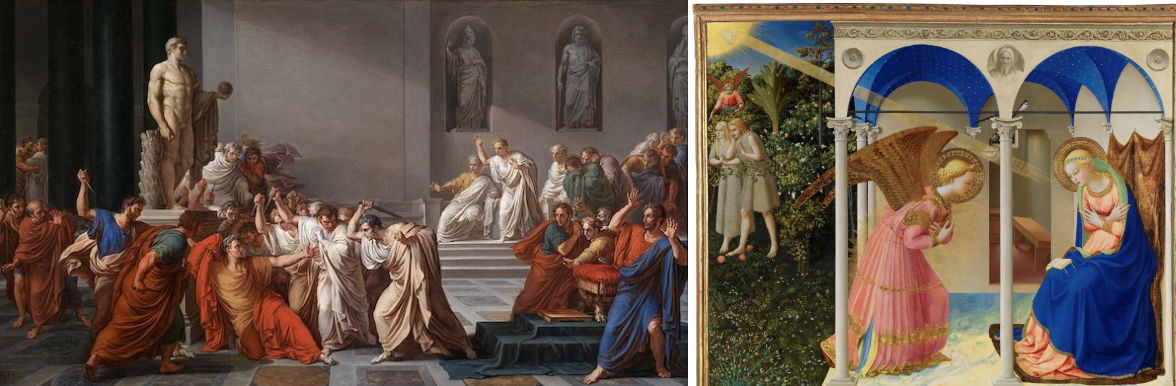
What do these images represent?
they legitimise the monopoly of force of the institutions or groups that enjoyed power and their decisions regarding the maintenance of their respective conception of oder.
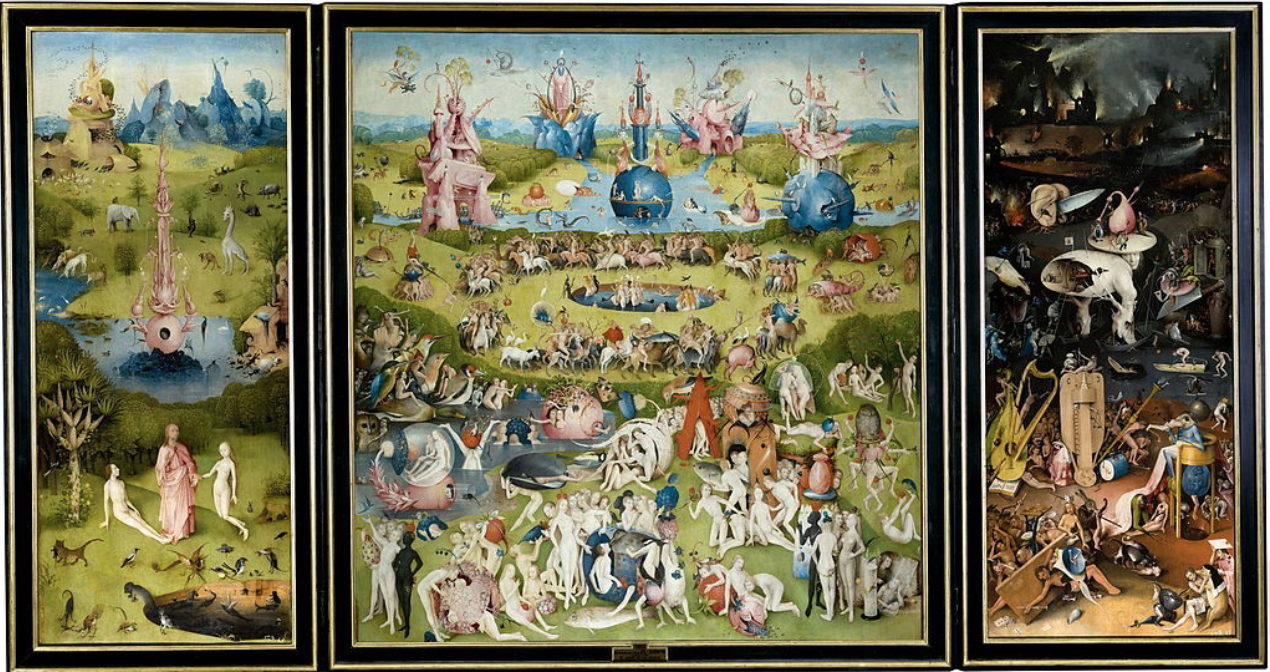
What does this Dutch painting by Bosch tell us?
It explains a scene in a movie, the garden of the lights
It talks about the beginning, when there was Eve with the dinosaurs, and when you misbehaved, you would get tortured
This shapes people through catholicism.

How is the movie “Zone of Interest” a media constructed phenomenon?
Because of football, women's football players → this tries to change the culture into accepting women doing sports as well as men → making football more equal.
What does it mean for cultural criminology to be equal to critical criminology?
How culture shapes traditions → emphasis on culture
wants to face traditions and challenges
these are not mutually exclusive
What is semiotics?
The study of symbols and signs and their use or interpretation.
signs = anything that conveys meaning (words, images, gestures, objects, etc.)
Sign systems = structured ways in which signs interact to form meaning
Interpretation = meaning is not fixed but shaped by cultural and social contexts.
What are the 2 main schools of Semiotics?
(Ferdinand de Saussure) => structuralism
analytical approach → human culture, language, and behaviour can only be understood by examining their underlying, self-contained relational structures
individual elements (words or cultural rituals) have no inherent meaning but derive significance from their relationships, oppositions, and contrasts within a larger system
language is the action of separating (creating the difference)
langue vs parole
(Charles Sanders Peirce) => The Triadic Model → post-structuralism
analytical approach → language is fluid, meaning is unstable, and knowledge is inherently intertwined with power
emphasizes deconstructs established binaries, questions objectivity, and focuses on the reader's interpretation over the author's intent.
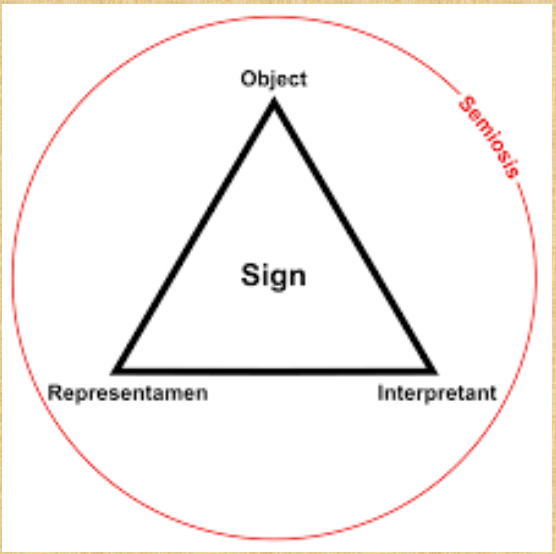
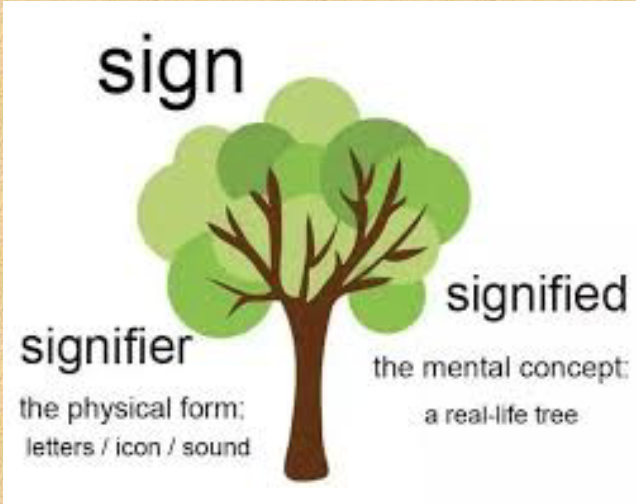
Can you go more in-depth about Saussure’s structuralism?
signifier => the physical form of a sign (eg. a word, sound, or image)
signified => the concept or meaning associated with the signifier.
the word “tree” (→ signifier) refers to the concept of a tree (→ signified)
the relationship between them is arbitrary (= no inherent connection between the sound “tree” and the object)
What does connotation mean?
Cultural emotional meaning
What is the role of an object?
What is denotation?
The literal meaning of something.
What is an example for connotation vs denotation?
When you see a rose, the denotation is a rose, and the connotation is that it could symbolise love or pain that can be caused by something pretty
This is also how they create marketing strategies.
Goffman → (gender advertisements) has 3 stages and says that every person is a combination of the 3. What are they?
Front stage: now we are behaving in one particular way
it is a cultural norm → everyone is obeying to preserve identity in one particular way → your behaviour relates to what you know
Backstage: how you present yourself to people you are close to
differently, it changes
Offstage: How you present yourself to yourself → what you do in your private, personal life, that you would not do around other people.
How are cultural norms aapplied?
They are infused by elements around you. The construction of culture connects to a personal experience.
What can we do with semiotics?
We can change the narrative that is presented by the media. We need to find these patterns and actively create counter-visual elements. We want to make others aware that behaviour is learned and a product of culture.