Midterm 2: TCA cycle and PPP
 Call Kai
 Learn
Learn Practice Test
 Spaced Repetition
 Match
Match Flashcards
 Knowt Play
1/53

There's no tags or description
Looks like no tags are added yet.
Name | Mastery | Learn | Test | Matching | Spaced | Call with Kai |
|---|
No analytics yet
Send a link to your students to track their progress
54 Terms
Name the 5 cofactors used in Pyruvate Dehydrogenase Complex(PDC). How many enzymes r involved?
CoA, NAD+, thiamine (TPP), lipoate, FAD.
3 enzymes are used
Where do the PDC and TCA cycles occur? Do they need O2?
Occurs in mitochondria, needs O2
What are the outputs of the PDC?
acetyl-CoA + CO2 + NADH
Which PDC step is the committed/regulated step?
E1: the decarboxylation step is irreversible since CO2 is lost
Thiamine deficiency leads to :
Neuromuscular deficiency like beriberi
If the body does not need energy, will E1 be turned on?
No, PDC won’t run
Which specific enzyme of the TCA cycle is located in the inner mitochondrial membrane rather than the matrix?
Succinate dehydrogenase
For every molecule of glucose, how many times does the PDC and TCA cycles occur?
twice
How do mercury and arsenite inhibit the pyruvate dehydrogenase complex?
They bind to the sulfurs of lipoic acid, inactivating the cofactor.
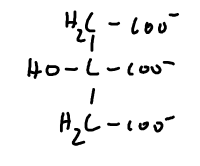
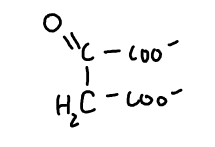
In Step 1 of the TCA cycle, which two molecules condense to form citrate? What enzyme is used?
Acetyl-CoA and oxaloacetate; citrate synthase
Draw citrate
Draw oxaloacetate
The formation of citrate is driven by the hydrolysis of what high-energy bond?
The thioester bond of acetyl-CoA.(O=C-CH3)
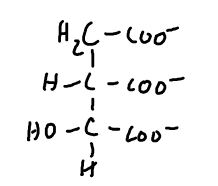
What enzyme catalyzes citrate—>isocitrate?
aconitase
Draw isocitrate
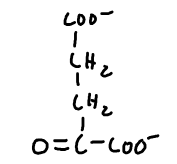
What enzyme catalyzes the oxidative decarboxylation of isocitrate to alpha-ketoglutarate?
Isocitrate dehydrogenase
What does the isocitrate dehydrogenase step produce?
1NADH, CO2
Draw alpha-ketoglutarate
What are the reactants and products in the reaction catalyzed by α-ketoglutarate dehydrogenase complex (α-KG DC)?
alpha-ketoglutarate + NAD+ + CoA—>succinyl CoA, NADH, CO2
Draw succinyl CoA
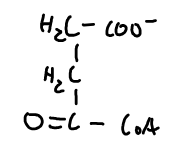
Draw succinate
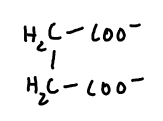
What enzyme catalyzes the reaction turning succinyl CoA to succinate
Succinyl-CoA-synthetase
What are the reactants and products of the reaction catalyzed by succinyl-CoA-synthetase?
Succinyl-CoA+GDP—>Succinate + GTP + CoA
Difference between Synthase vs. Synthetase?
Synthases catalyze synthesis without direct energy input from nucleoside triphosphates, while synthetases require energy (e.g., ATP or GTP).
Succinate is oxidized into _______ using what enzyme and what e- carrier?
Fumarate, uses succinate dehydrogenase; FAD—>FADH2
The enzyme _____ catalyzes the hydration of fumarate to malate.
Fumerase
Draw fumerate
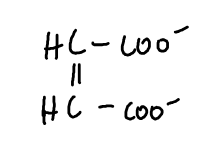
Draw malate
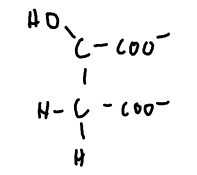
Malate is turned into oxaloacetate using which enzyme? What else is produced?
Malate dehydrogenase; NAD+—>NADH
Dehydrogenases are involved in _____ reactions.
Redox
Per turn, the TCA cycle produces ___NADH, ___FADH2, and ___GTP?
3 NADH, 1 FADH2, 1GTP
Which step(s) produce NADH(give the enzyme name)?
Isocitrate dehydrogenase. alpha KG dehydrogenase, malate dehydrogenase
Which step(s) produce FADH2(give the enzyme name)?
Succinate dehydrogenase
Which step(s) produce GTP(give the enzyme name)?
Succinyl-CoA synthetase
Identify the four steps in the PDC/TCA sequence that are highly thermodynamically favorable and irreversible.
PDC, citrate synthase, isocitrate dehydrogenase, and alpha-ketoglutarate dehydrogenase.
What two metabolic molecules act as general inhibitors for all regulated enzymes in the TCA cycle?
NADH and ATP
What two molecules generally act as activators for the regulated enzymes of the TCA cycle?
NAD+ and AMP (or ADP).
A metabolic pathway that is involved in both catabolism (oxidative breakdown) and anabolism (reductive synthesis).
Amphibolic
Which intermediate of the TCA cycle can be converted to glucose via gluconeogenesis?
Oxaloacetate
A metabolic process that "fills up" or replenishes depleted intermediates in the Citric Acid Cycle
anaplerotic reaction
Explain the reciprocal control by acetyl-CoA
High acetyl-CoA activates pyruvate carboxylase activated to make oxaloacetate—>TCA cycle
Low acetyl CoA activates PDC to generate more AcCoA
What is NADPH used for?
Biosynthesis(fatty acids, cholesterol, neurotransmitters, etc.) as well as detoxification in the liver.
What is ribose 5-phosphate(R5P) used for?
used to make nucleotides and coenzymes
What are the 2 phases of the Pentose Phosphate Pathway (PPP)? Are are reversible or irreversible?
Oxidative(irreversible) and nonoxidative(reversible)
In which part of the cell does the Pentose Phosphate Pathway occur?
The cytosol
What are the inputs and outputs of the oxidative phase?
Inputs: Glucose 6 phosphate, 2 NADP+, H2O
Outputs: NADPH + 2H, ribulose 5-phosphate, CO2
What is the net production of NADPH per one molecule of glucose 6-phosphate entering the PPP?
2 NADPH
What is the relationship between ribulose 5 phosphate and ribose 5 phosphate?
Isomers; ribulose is the ketose form while ribose is the aldose form
What enzyme interconverts ribulose and ribose 5 phosphate?
Phosphopentose isomerase
What occurs in the non oxidative phase?
Ribose 5 phosphate is carbo shuffled into F6P and G3P.
Suppose you need more ribose 5 phosphate than NADPH. What pathway will your body run?
G6P—>F6P via glycolysis
F6P—>ribose 5 phosphate via nonoxidative phase
Suppose you need BOTH ribose 5 phosphate and NADPH. What pathway will your body run?
The oxidative phase
Suppose you need more NADPH than ribose 5 phosphate. What pathway will your body run?
Oxidative phase
R5P—>F6P via nonoxidative phase
F6P—>G6P via gluconeogenesis
Repeat to produce more NADPH
Suppose you need more NADPH and ATP. What pathway will your body run?
Oxidative phase
Nonoxidative phase
F6P and G3P—>ATP via glycolysis