[ANALYSIS-LAB-FIN-03-PT2] DISSOLUTION TESTING APPARATUS
 Call Kai
 Learn
Learn Practice Test
 Spaced Repetition
 Match
Match Flashcards
 Knowt Play
1/17

Earn XP
Name | Mastery | Learn | Test | Matching | Spaced | Call with Kai |
|---|
No analytics yet
Send a link to your students to track their progress
18 Terms
Cylindrical flat bottom glass vessels
Reciprocating cylinders
Stainless steel fittings
TYPE 3 — RECIPROCATING CYLINDER:
Design: Vessel
Set of (1)____ flat bottom ___ vessels
Set of (2) reciprocating _____
(3)________ steel fittings
Reciprocating (upward & downward)
200-250 mL
Cylinder
TYPE 3 — RECIPROCATING CYLINDER:
What is the agitation type of the apparatus?
What is the volume of dissolution medium of the apparatus?
Where is the dosage form placed in the apparatus?
37 ± 0.5°C
TYPE 3 — RECIPROCATING CYLINDER:
Design: Water Bath
It maintains at what temperature (°C)?
Tablets
Beads
Controlled and extended release formulations
TYPE 3 — RECIPROCATING CYLINDER:
This is used for what dosage forms (3)?
Reservoir
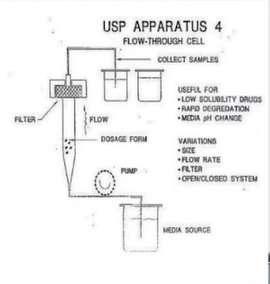
TYPE 4 — FLOW THROUGH CELL:
This is for the dissolution medium
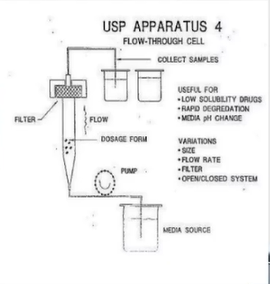
Upward
TYPE 4 — FLOW THROUGH CELL:
The pump forces dissolution medium through cell in what direction?
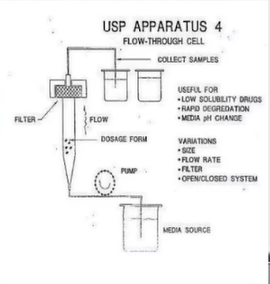
10-100 mL/min
Laminar flow
Centrifugal pumps
TYPE 4 — FLOW THROUGH CELL:
Design: Pump
What is the flow rate of the pump?
What flow is maintained by the pump?
What kind of pumps are not recommended?
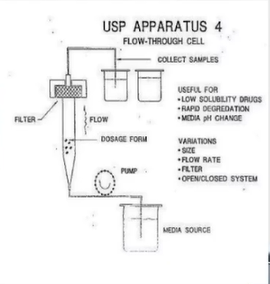
37 ± 0.5°C
TYPE 4 — FLOW THROUGH CELL:
Design: Water Bath
It is maintained at what temperature (°C)?
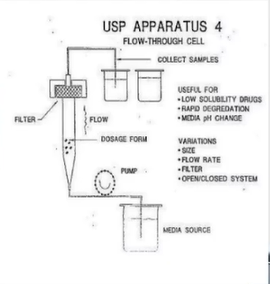
Low solubility drugs
Microparticulate
Implants
Suppositories
Controlled release formulations
TYPE 4 — FLOW THROUGH CELL:
This is used for what dosage forms (5)?
Same as paddle apparatus
25-50 rpm
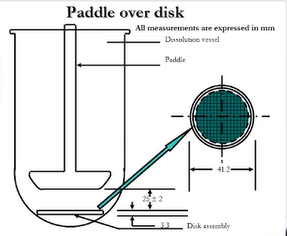
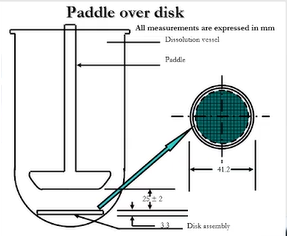
TYPE 5 — PADDLE OVER DISK:
What is the vessel & shaft of the apparatus?
What is the rotation speed of the apparatus?
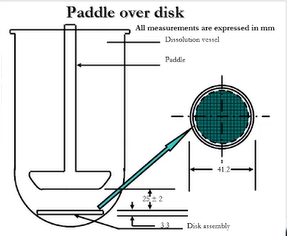
Sample Holder
TYPE 5 — PADDLE OVER DISK:
A disk assembly that holds product in such a way that release surface is parallel with paddle blade.
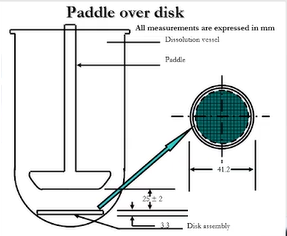
25 ± 2 MM
TYPE 5 — PADDLE OVER DISK:
What is the distance?
(Samples are drawn between surface of the medium and the top of the paddle blade)
32 ± 0.5°C
Transdermal products and emulsions
TYPE 5 — PADDLE OVER DISK:
It is maintained at what temperature (°C)?
This apparatus is used for what dosage forms (2)?
Gikapoy nako boi
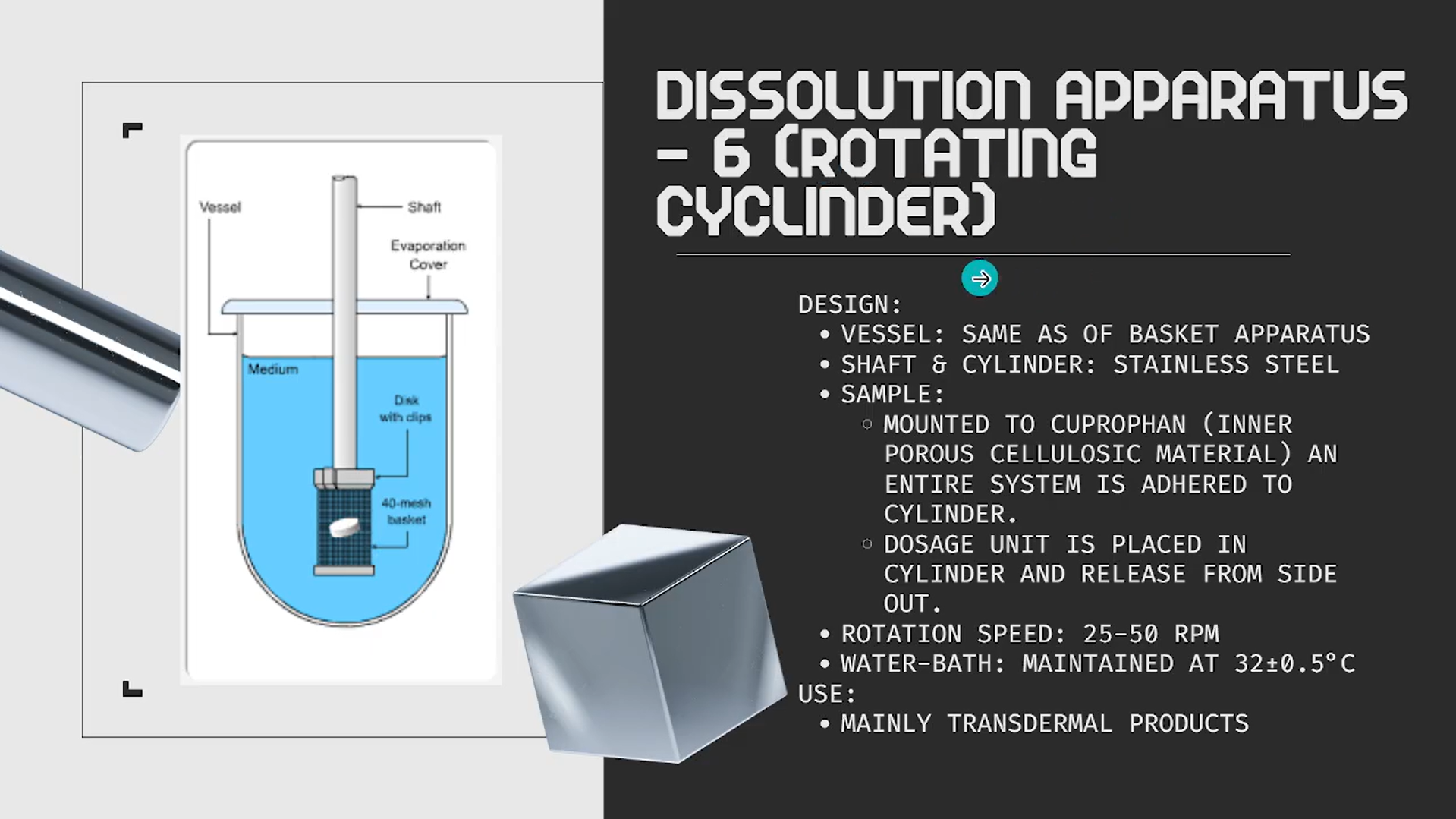
TYPE 6 — ROTATING CYLINDER:
Gikapoy nako boi
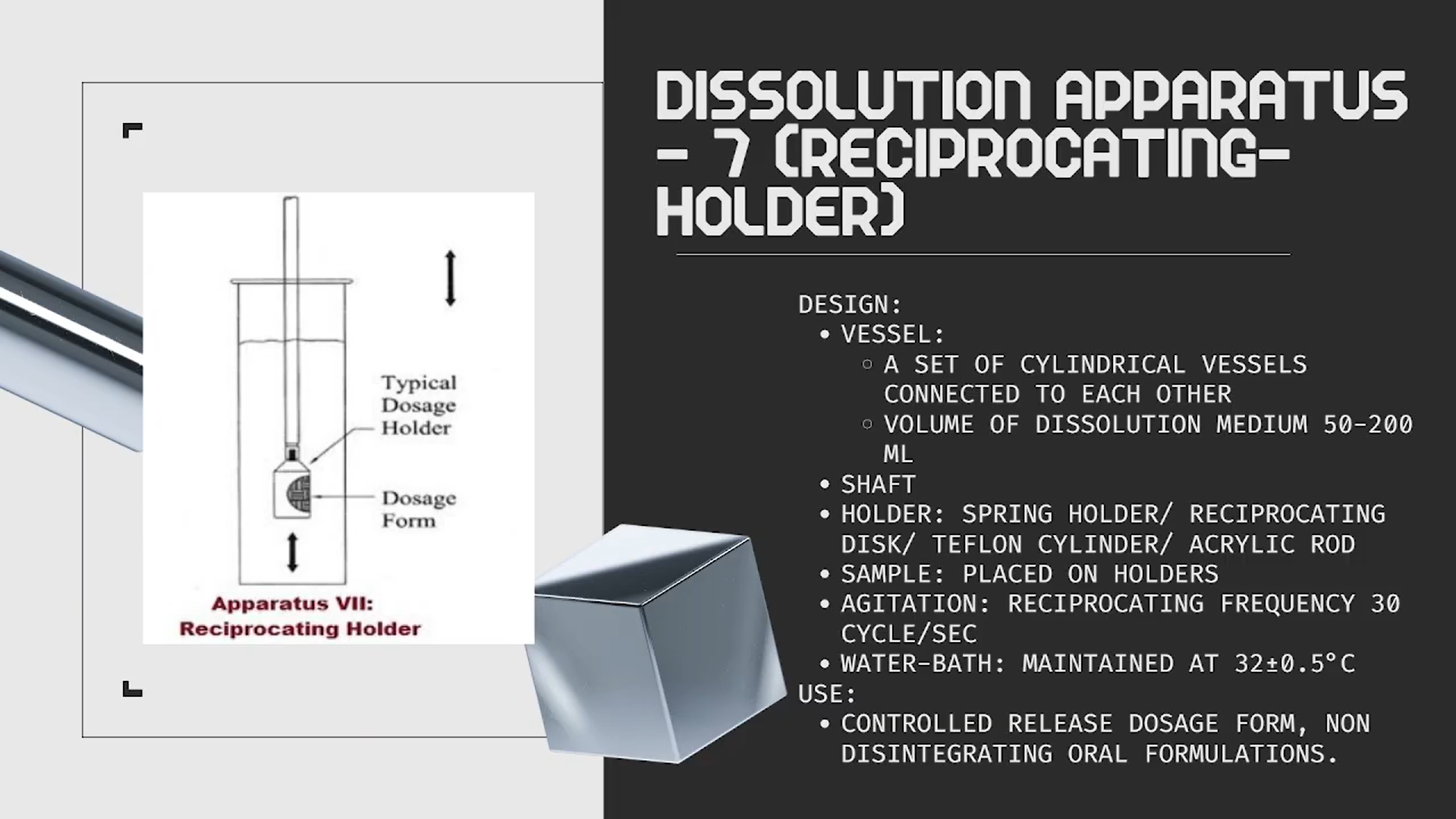
TYPE 7 — RECIPROCATING-HOLDER:
Purified water
Dilute acid
Stimulated gastric fluid (SGF)
Stimulated intestinal fluid (SIF)
Surfactants (e.g., Polysorbate, SLS)
Aqueous buffers
What are the (6) Commonly Used Dissolution Media?
Hint: PDS-SSA
1897
Noyes and Whitney
Benzoic acid
Lead chloride
Conclusion:
Dissolution research started to develop in (1)____ when (2)_____ and _____ derived their equation in the course of their dissolution studies on (3)____ acid and (4)____ chloride.
Basaha nalang brah