Biology Exam Flashcards
 Call Kai
 Learn
Learn Practice Test
 Spaced Repetition
 Match
Match Flashcards
 Knowt Play
1/132

There's no tags or description
Looks like no tags are added yet.
Name | Mastery | Learn | Test | Matching | Spaced | Call with Kai |
|---|
No analytics yet
Send a link to your students to track their progress
133 Terms
Photosynthesis Equation
6CO2+6H2O+Sunlight—>C6H12O6+6O2
Photosynthesis
Captures energy from sunlight to make sugars
Occurs in the chloroplast
Producers
Photosynthetic organisms are producers (plants make their own source of energy using photosynthesis)
Chlorophyll
Found in chloroplasts
Is a molecule that absorbs light energy—part of the thylakoid membrane
Photosynthesis takes place in two parts of chloroplasts…
Grana—stack of many thylakoids, inside each thylakoid membrane are pigments (molecules that absorb specific wavelengths of light)
Stroma—fluid outside the thylakoids
Stage 1 of Photosynthesis
Light-dependent reactions
Thylakoid
6H20+Sunlight—>6O2 (released)+ATP
Stage 2 of Photosynthesis
Light-independent reactions
Stroma
6CO2+ATP—>C6H12O6 (Calvin Cycle)
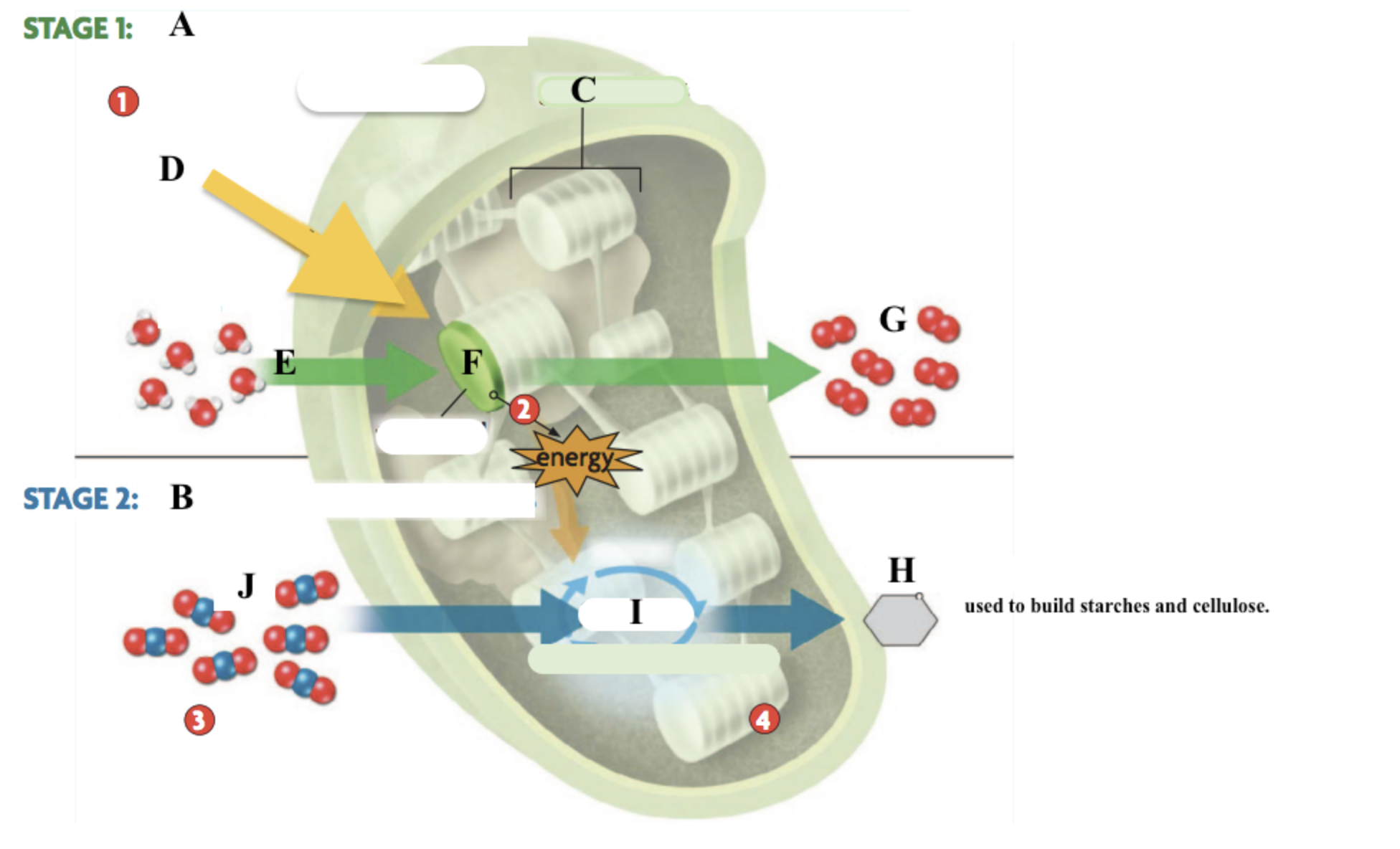
Photosynthesis Diagram
A: Light dependent reactions
B: Light independent reactions
C: Grana
D: Sunlight
E: 6H2O
F: Thylakoid
G: 6O2
H: C6H12O6
I: Calvin Cycle
J: 6CO2
Enzymes and energy in photosynthesis
Enzyme: NADPH (nicotinamide adenine dinucleotide phosphate), helps convert glucose in Calvin Cycle
Energy: ATP (adenosine triphosphate) and ADP (adenosine diphosphate)
Cellular Respiration Equation
C6H12O6+6O2—>6CO2+6H2O+ATP
Cellular respiration
Makes ATP by breaking down sugars
Cellular respiration is aerobic (requires oxygen), glycolysis is anaerobic
Aerobic stages take place in the mitochondria
Glycolysis
Must take place first, is anaerobic
Occurs in the cytoplasm
Glucose (C6H12O6)—>2 3-carbon molecules (pyruvate)
Stage 1 of Cellular Respiration
Kreb’s Cycle
Occurs in the mitochondria matrix
Pyruvate—>ATP (makes 4, uses 2)+6CO2
Stage 2 of Cellular Respiration
Electron transport chain
Occurs in the inner membrane
6O2+ATP (2)—>36-38 ATP+6H2O
Glycolysis Process
Glucose—>Glycolysis—>Pyruvate
Without oxygen: Lactic acid (animals), ethyl alcohol+CO2 (plants)
With oxygen: Kreb’s Cycle, Electron Transport Chain
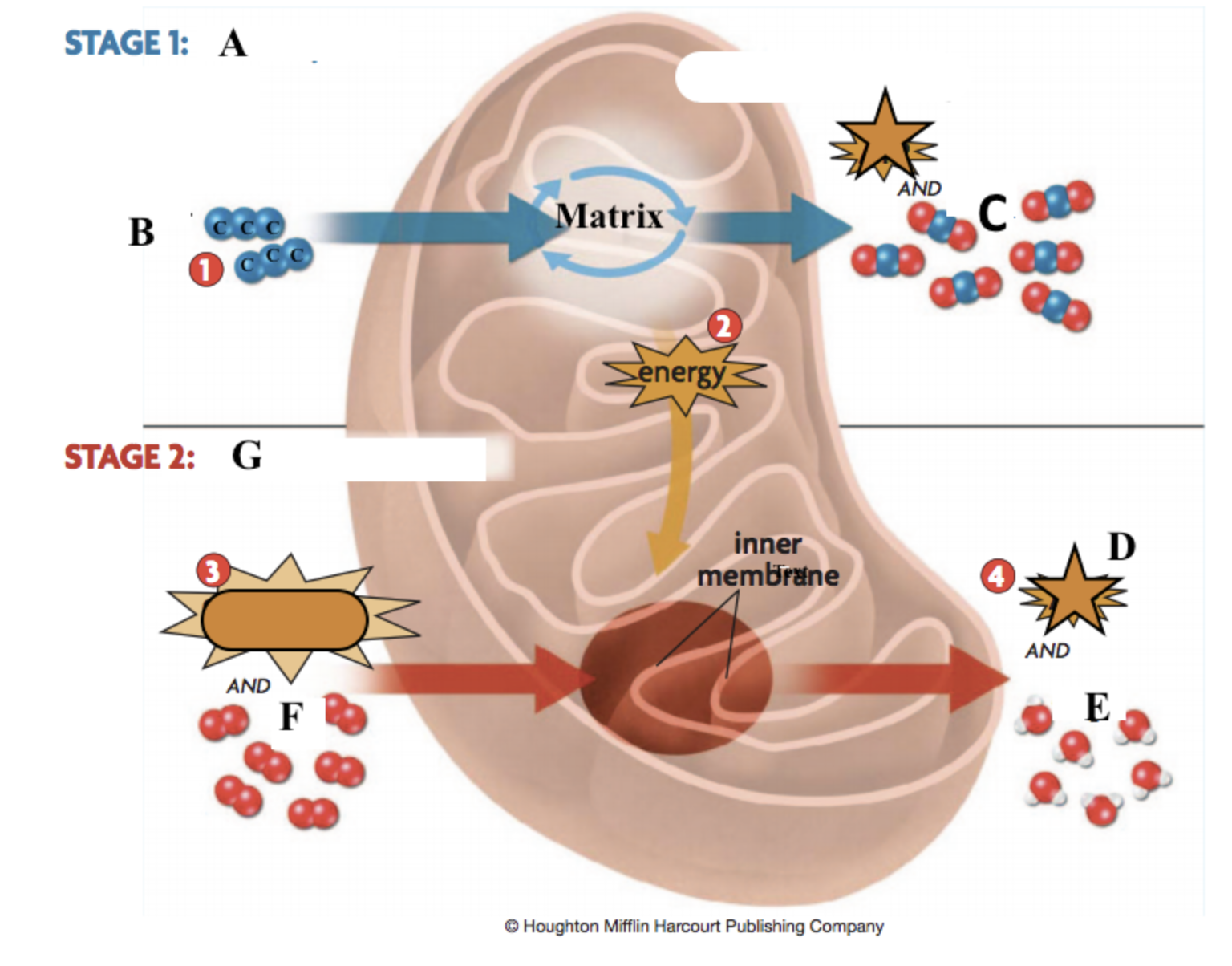
Cellular Respiration Diagram
A: Kreb’s Cycle
B: Pyruvate
C: ATP and 6CO2
D: ATP
E: 6H2O
F: energy and 6O2
G: Electron Transport Chain
Lab Notes
Cabbage juice indicator is a great pH indicator, helps us identify pH of acids and bases
In the presence of acids or carbon, CJ turns a lighter color/pink
What was added to the cabbage juice indicator that contained carbon?
Dilute acid (vinegar)
Carbonated beverage (sprite)
Breath (that contained carbon)
Wheat grass seeds (25 germinated in one, 25 dry in another)
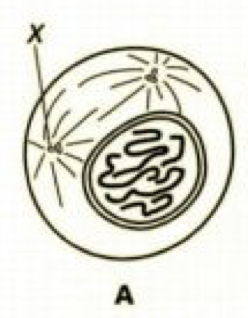
What stage of mitosis is this?
Early prophase
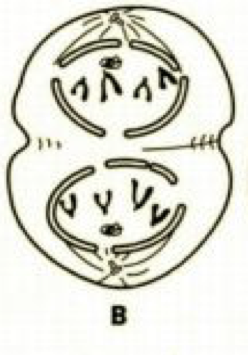
What stage of mitosis is this?
Telophase
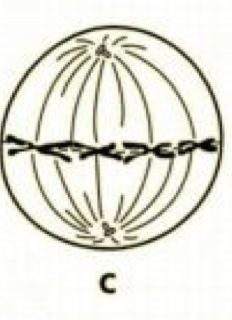
What stage of mitosis is this?
Metaphase
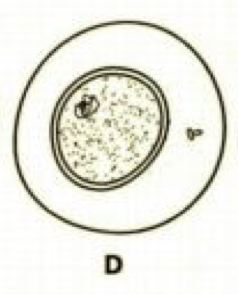
What stage of mitosis is this?
Interphase
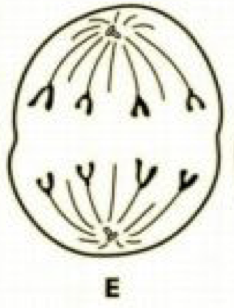
What stage of mitosis is this?
Anaphase
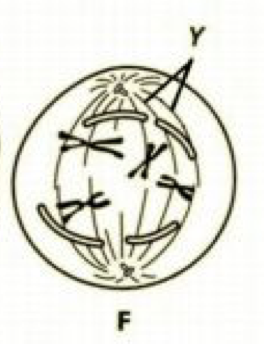
What stage of mitosis is this?
Late prophase
End product of mitosis
Two identical diploid cells
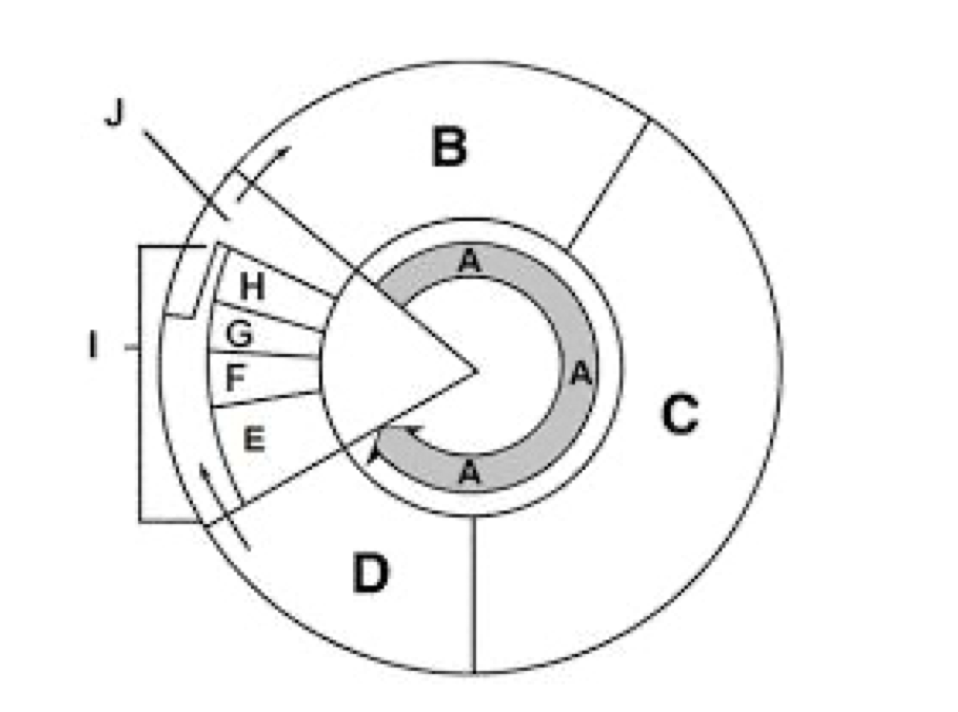
Cell Cycle
Gap 1 (G1)
Synthesis (S)
Gap 2 (G2)
Prophase
Metaphase
Anaphase
Telophase
Cytokinesis
PMAT is mitosis
Interphase
Cell is growing and preparing for division
Gap 1 (G1)
Cell growth and normal functions and replicate their organelles
DNA Synthesis (S)
DNA replication
Gap 2 (G2)
Growth and preparing for division
Mitosis
Nuclear division/growth and development—results in 2 daughter cells with the same number of chromosomes (two identical diploid cells)
Prophase
Nuclear envelope dissolves, DNA condenses, chromosomes first become visible
Metaphase
Chromosomes line up in center, centrosomes are at opposite poles
Anaphase
Sister chromatids separate and are pulled to the poles of the cell
Telophase
Nuclear membrane reforms, cleavage furrow or cell plate forms, chromosomes begin to uncoil
Cytokinesis
Cytoplasm divides and two daughter cells are created
Differs in animal and plant cells:
Animal cells: forms a cleavage furrow and membrane pinches closed
Plant cells: a cell plate forms
Each daughter cell has…
46 chromosomes because DNA is duplicated before the cell divides
Apoptosis and Necrosis
Apoptosis: programmed cell death
Necrosis: accidental cell death
Haploid cells
have half the number of chromosomes
Diploid cells
have two complete sets of chromosomes
Somatic cells
are diploid cells, body cells
Germ cells
are haploid cells, gametes (egg and sperm), cells in your reproductive organs that develop into gametes
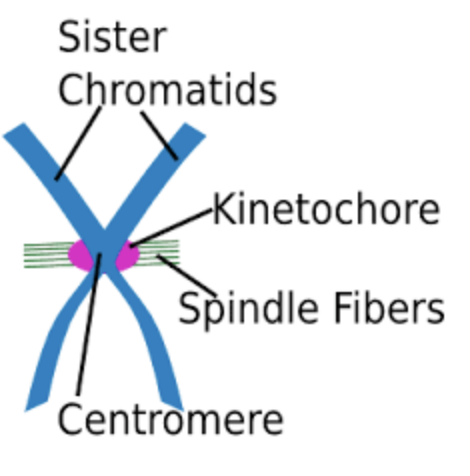
Chromosome structure
Sister chromatids
Kinetochore
Spindle fibers
Centromere
Meiosis
a type of cell division that results in four daughter cells each with half the number of chromosomes of the parent cell, as in the production of gametes
End product of meiosis
4 genetically diverse haploid daughter cells
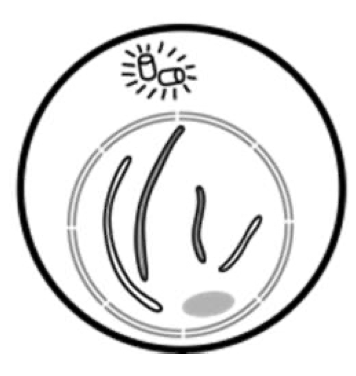
What stage of meiosis is this?
Interphase G1
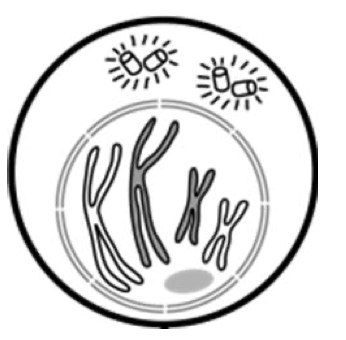
What stage of meiosis is this?
Interphase S
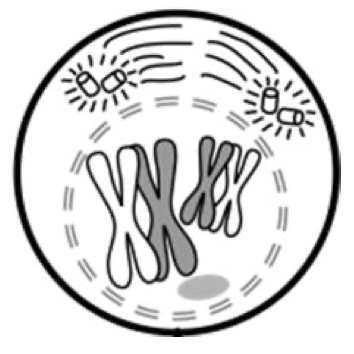
What stage of meiosis is this?
Prophase I
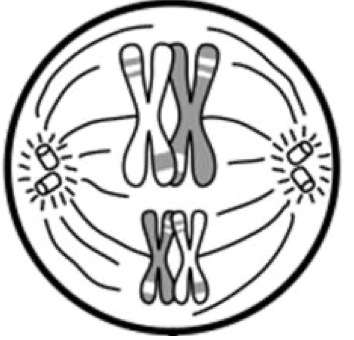
What stage of meiosis is this?
Metaphase I
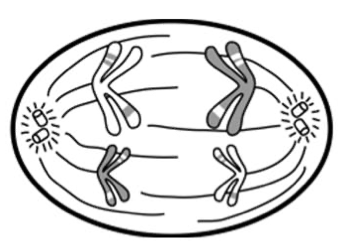
What stage of meiosis is this?
Anaphase I
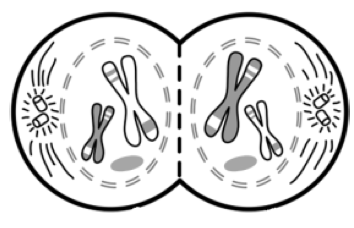
What stage of meiosis is this?
Telophase I
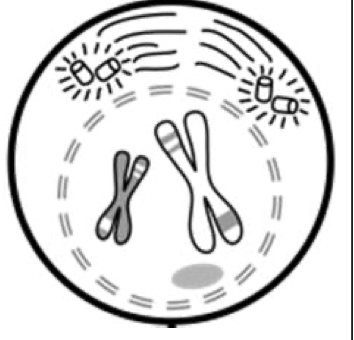
What stage of meiosis is this?
Prophase II
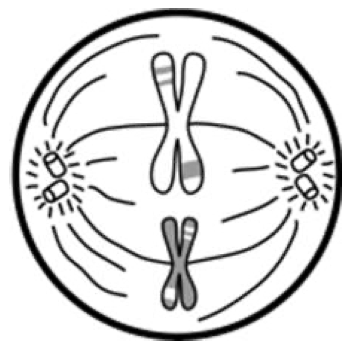
What stage of meiosis is this?
Metaphase II
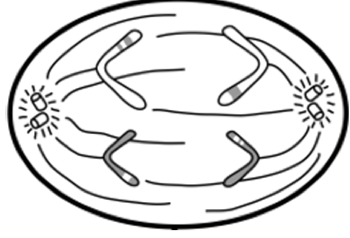
What stage of meiosis is this?
Anaphase II
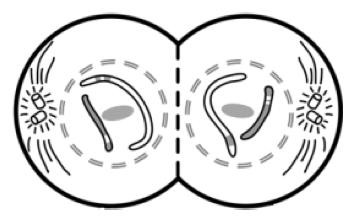
What stage of meiosis is this?
Telophase II
Interphase G1 Meiosis
Cell is increasing in size (23 chromosomes)
Interphase S Meiosis
DNA is replicated to create two copies of each chromosome (46)
Prophase I
The DNA starts to coil itself up into visible chromosomes
The copies of each chromosome (sister chromatids) are connected together by a centromere
During the end of this stage the nuclear membrane starts to dissolve, centromeres move towards the poles, and spindle fibers start to form
Crossing over occurs during this stage
Metaphase I
Spindle fibers are completely formed and attach to the centromeres of the homologous chromosomes
The chromosomes line up down the middle of the spindles along with their homologous pair
Anaphase I
At this point the spindle fibers start to pull on the chromosomes and each homologous chromosome heads to a different pole
Telophase I
Chromosomes are now at the pole, nuclear membranes start to form around the chromosomes
Cells are still diploid at this point
Cleavage furrow is forming
Prophase II
Skip interphase because there is no replication of DNA
The chromosomes reorganize and nuclear membrane starts to dissolve again
Sister chromatids again joined by a centromere
Spindles start to reform between the centrosomes
Metaphase II
Spindles are fully formed again and attach to the centromeres
The chromosomes line up down the middle of the spindles
Anaphase II
The spindles pull the sister chromatids apart. Each goes toward a different pole
Telophase II
Nuclear membranes start to form around the chromosomes again. A cleavage furrow forms. Cytokinesis begins
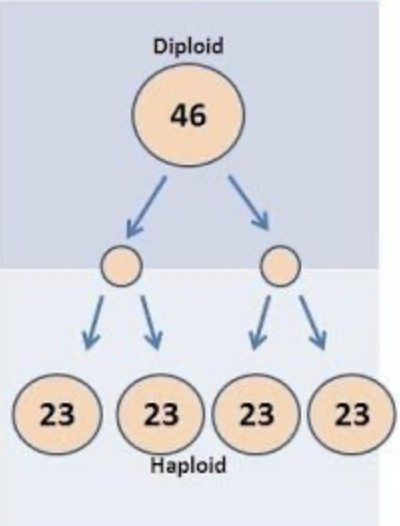
Meiosis Number of Chromosomes
Meiosis 1: pairs of homologous chromosomes separate (46 pairs of chromosomes to 23 chromosomes)
Meiosis 2: 23 sister chromatids
Gametes
egg and sperm cells
Gametogenesis
the production of gametes
Oogenesis
the production of mature egg cells (1 egg and 3 polar bodies)
Spermatogenesis
the production of sperm (4 sperm)
Egg
female gamete developed in the ovaries
Sperm
male gamete developed in the testes
Polar bodies
smaller cells that contain little more than DNA, and are eventually broken down, do not produce eggs
Chiasma (chiasmata)
the microscopically visible site where crossing over has occurred between chromatids of homologous chromosomes during prophase I of meiosis
Crossing over
exchange of genetic material between homologous chromosomes during prophase I of meiosis
Tetrad
structure containing 4 chromatids that forms during meiosis. Occurs in prophase I. Allows for crossing over to occur
46 chromosomes
number of chromosomes a human body cell has (23 pairs—22 autosome and 1 sex chromosome)
23 chromosomes
number of chromosomes a human sex cell has
Homologous chromosomes
matching chromosomes from mother and father, two chromosomes that are the same size and have copies of the same genes
Synapsis
the pairing of homologous chromosomes during meiosis (prophase I) during which crossing over may occur
Replication
chromosomes duplicate before dividing in meiosis
Independent assortment
the random sorting of homologous chromosomes during metaphase I and II
Sexual reproduction
involves two gametes (egg and sperm) joining together
Fertilization
when the egg and sperm join successfully
Autosomes
chromosomes that contain genes for all the rest of an organism’s life functions
Sex chromosomes
chromosomes that determine the sex of an organism (x and y)
Diploid (meiosis)
containing two sets of chromosomes, one from each parent
Haploid (meiosis)
an organism or cell having only one complete set of chromosomes
Monohybrid crosses
Crosses one trait
Put across top and bottom, write cross in each box
Dihybrid cross (how to do)
Crosses two traits
Write letters (genotype of each parent), FOIL, put each possible allele in front of each column/row, write cross in each box
Steps: Key, FOIL, chart, genotypes (letters, write number of each), phenotypes (physical characteristic, write number/percentage of each)
Trait
characteristics that are inherited
Genetics
study of heredity patterns and variation of organisms
Cross
the mating of two organisms in the context of genetics
DNA
deoxyribonucleic acid
Law of Segregation
the principle, originated by Gregor Mendel, stating that during the production of gametes the two copies of each hereditary factor segregate so that offspring acquire one factor from each parent
Gene
a piece of of DNA that provides a set of instructions to a cell to make a certain protein and is located at a particular on a chromosome
Allele
one of a number of different forms of a gene (round or wrinkled for pea shape)
Homozygous
alleles that are identical to each other (AA or aa)
Heterozygous
alleles that are different from each other (Aa), two heterozygous parent offspring ratio is 9-3-3-1 for a dihybrid cross
Genome
all of an organisms genetic material
Phenotype
physical characteristics of the person or organism