Biology - Gas Exchange, Breathing and Respiration
 Call Kai
 Learn
Learn Practice Test
 Spaced Repetition
 Match
Match Flashcards
 Knowt Play
1/15

Earn XP
Description and Tags
Name | Mastery | Learn | Test | Matching | Spaced | Call with Kai |
|---|
No analytics yet
Send a link to your students to track their progress
16 Terms
Aerobic respiration equation
Glucose + oxygen → carbon dioxide + water + energy (ATP). C6H12O6 → 6CO2 + 6H2O + ATP
Anaerobic respiration in animals
Glucose → lactic acid (+ energy)
Anaerobic respiration in plants and yeast
glucose → ethanol + carbon dioxide (+ energy)
Energy released from respiration is used for:
Heat generation
Muscle contraction and movement
Growth and repair
Nervous activity
It allows all other life processes to be carried out
Oxygen debt
Anaerobic respiration produces energy energy to keep the overworked muscles going for a short period time, making lactic acid build up in the blood stream causing muscle cramps. The person then has to rest to allow the body to breakdown the lactic acid using oxygen. The volume of oxygen needed to completely breakdown the lactic acid is called the oxygen debt.
Investigating the evolution of CO2 from a small animal
Two beakers both with sodium hydrogen carbonate solution in them, then a little tray and in one a dead bug and the other a live bug. The live one will respire aerobically and produce waste products of CO2 which turns the red solution yellow. The dead one will remain red due to no respiration.
Investigating the heat produced from respiring vs not respiring pea seeds
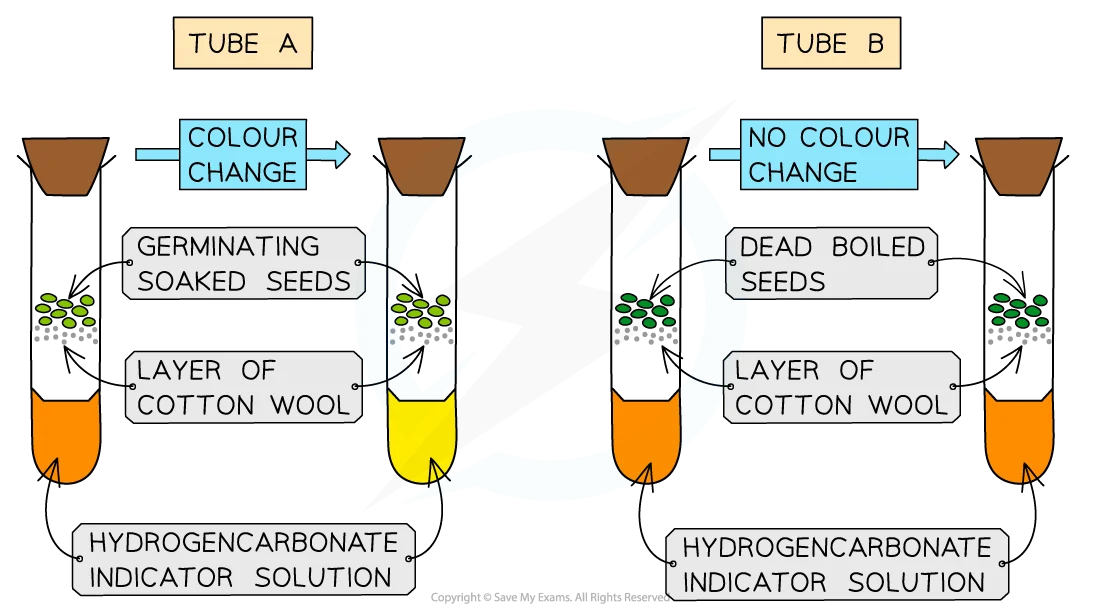
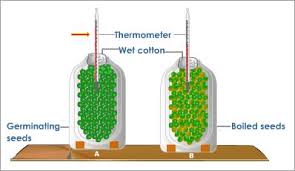
One set of pea seeds boiled so they die and wont respire, the others soaked in water so they start germinating and respiring. Waste product of respiration is heat so the respiring peas will have a higher temperature
Parts of the gas exchange system
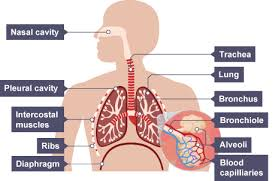
Larynx, trachea (wind pipe), C-shaped rings of cartilage, left and right lung, external and internal intercostal muscles, bronchus, bronchioles, alveoli, ribs, diaphragm, pleural membranes, pleural cavity fluid, sternum
Inhalation (breathing in)
Diaphragm contracts, becoming flatter, moving downwards. The intercostal muscles contract, moving the ribcage up and out. Increases volume of thorax, so pressure of thorax decreases. Air rushes into thorax through nose and mouth due to pressure gradient, which fills up the lungs
Exhalation (breathing out):
Diaphragm relaxes, returning to its dome shape, moving upwards. The intercostal muscles relax, moving ribcage in and down. Decreases volume of thorax, so increases pressure of thorax. Air is forced out of the nose and mouth due to pressure gradient which empties the lungs
Inhaled air percentages
CO2 = 0.04%
O2 = 21%
Exhaled air percentages
CO2 = 4%
O2 = 16%
Alveoli adaptations
Large surface area → millions of alveoli providing a large surface area for a high rate of diffusion
Thin walls → 1 cell thick walls of alveoli and capillaries that run across the alveoli so a short diffusion distance for a high rate of diffusion
Rich blood supply → a dense network of capillaries surrounding the alveoli, maintaining a steep concentration gradient for a high rate of diffusion
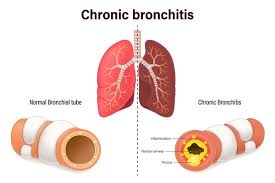
Bronchitis
Where the bronchi and bronchioles are clogged with mucus. Caused by smoking.
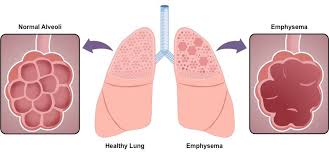
Emphysema
Where the surface area of the alveoli decreases. Caused by smoking.
Lung Cancer
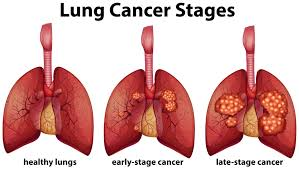
Where mutations in the DNA of cells lead to abnormal growth. Caused by smoking.