Biol005c Module 4 Learning Objectives
 Call Kai
 Learn
Learn Practice Test
 Spaced Repetition
 Match
Match Flashcards
 Knowt Play
1/28

There's no tags or description
Looks like no tags are added yet.
Name | Mastery | Learn | Test | Matching | Spaced | Call with Kai |
|---|
No analytics yet
Send a link to your students to track their progress
29 Terms
Identify and describe the biotic and abiotic components of ecosystems, and construct models that show how energy flows and matter cycles through ecosystems.
Biotic components of ecosystems include all living organisms and dead organic matter/waste, while abiotic components of ecosystems include nutrients, energy, water, and minerals.
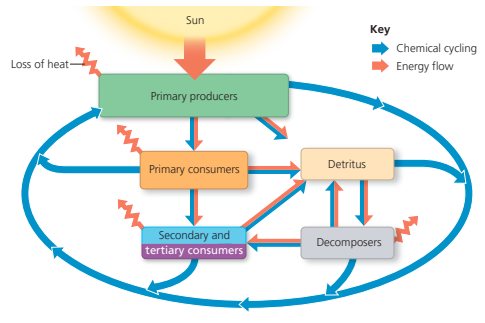
Trace the movement and transformation of water, carbon, nitrogen, and phosphorus through biotic and abiotic reservoirs, including the major processes that transfer materials between reservoirs.
Water:
think of the water cycle (evaporation, transpiration, condensation, precipitation)
reservoirs include oceans, glaciers, ice caps, lakes, and rivers
Carbon:
photosynthetic organisms convert atmospheric CO2 into glucose that can be consumed by heterotrophs, consumers breathe out CO2 via cellular respiration, volcanoes and burning of fossil fuels contribute to atmospheric CO2
reservoirs include fossil fuels, soil, and atmosphere
Nitrogen:
atmospheric nitrogen can be taken up by nitrogen-fixing bacteria (nitrogen fixation) or decomposed by decomposers (ammonification) and can be converted into nitrate and ammonium for plant use
main reservoir is the atmosphere
Phosphorus:
rock weathering releases phosphate into soil and reaches aquatic systems through leaching, phosphate is returned by decomposition or excretion by consumers
reservoirs include sedimentary rocks of marine origin, soil, and organisms
Differentiate between organic and inorganic forms of biologically important elements and explain how organisms obtain and transform these materials through processes such as photosynthesis, respiration, decomposition, nitrogen fixation, and ammonification.
Carbon:
Organic: carbohydrates, lipids, proteins
Inorganic: atmospheric gas
Photosynthesis converts CO2 (inorganic) into glucose (organic)
Consumers exhale CO2 (inorganic) and return it back to the environment via cellular respiration
Decomposition breaks down CO2
Nitrogen:
Organic: amino acids, nucleic acids
Inorganic: atmospheric gas, ammonium, nitrate
Nitrogen-fixing bacteria converts atmospheric nitrogen (inorganic) into ammonium and nitrate (inorganic) for plant use via nitrogen fixation
Decomposers break down atmospheric nitrogen (inorganic) into ammonium and nitrate (inorganic) for plant use via ammonification and decomposition
Phosphorus:
Organic: nucleic acids, phospholipids, ATP
Inorganic: phosphate
Weathering of rocks releases phosphate (inorganic) into soil and reaches aquatic systems through leaching
Decomposition breaks down phosphate
Explain how microbes, decomposers, and detritivores regulate nutrient availability and contribute to ecosystem productivity and nutrient cycling.
Microbes, decomposers, and detritivores break down dead matter, and when they die, these inorganic compounds (like nitrate and ammonium) and nutrients are returned to the soil, regulating nutrient availability and contributing to ecosystem productivity and nutrient cycling.
Analyze how nutrient availability can limit biological growth and predict how ecological interactions and environmental conditions influence rates of nutrient cycling within ecosystems.
If there is not many nutrients available, organisms are not able to grow properly and benefit from them. To prevent this, it is important for an ecosystem to maintain high productivity (more moisture, higher temperatures) and biodiversity as this allows for more nutrients to be recycled.
Evaluate how human activities, including agriculture and fertilizer use, alter biogeochemical cycles and affect nutrient movement, storage, and ecosystem function.
When humans harvest plants from a farm, they are removing nutrients from the soil. Adding fertilizer helps return those nutrients back to the soil and can even increase the amount of nutrients in the soil.