DRL Exam 2
 Call Kai
 Learn
Learn Practice Test
 Spaced Repetition
 Match
Match Flashcards
 Knowt Play
1/162

There's no tags or description
Looks like no tags are added yet.
Name | Mastery | Learn | Test | Matching | Spaced | Call with Kai |
|---|
No analytics yet
Send a link to your students to track their progress
163 Terms
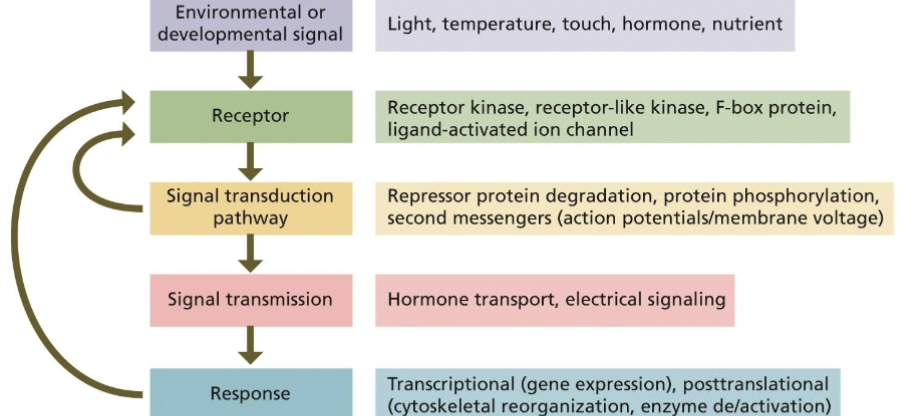
What are the steps of signal transduction
perception of stimulus
transduction
response
attenuation
Spatially, what are the two types of respionses
cell autonomous (same cell sense signal and responded)
non cell autnomous (response un distant cells/tissue/organs)
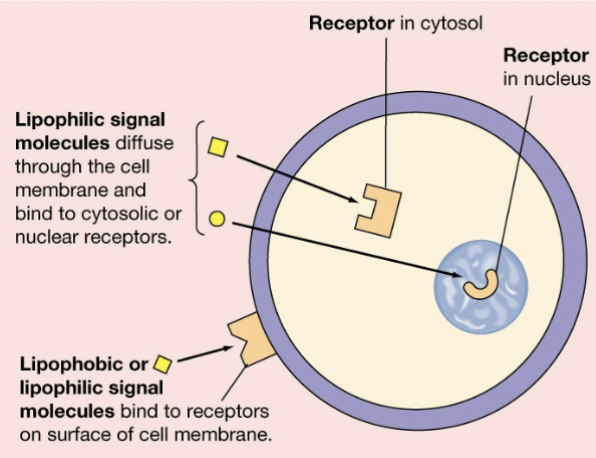
Name some protein receptors
membrane receptors: lipophobic ligands for faster responses
nuclear receptors: lipophilic ligands for slower and gene expression
name types of receptors that exist
protein kinases
F-Box proteins (TIR1 for auxin)
Mechanosensitive ion channels
Nucleotide bidning receptors (R-gene)
LRR-RK (leucine rich repeats receptor kinases for MAMPS)
What does it mean when a receptor is disrupted
loss of sensitivity
disruption of photophatse
constitutive signaling
what is the primary type of signal transduction that triggers sig amplification
phosphorylation is key!
activate enzyme activity
conformational changes
protein to protein interactions
protein kinase: transfer terminal phosphate of ATP ot hydroxyl
Protein phophatase: removes phosphate by hydrolysis & is reversible
what are the effects if phosphorylation
alter enzyme activity
conformational change
enables protein-protein interactions
transcription factors can interact with transcriptional complex
What is MAPK
mitogen-activiated protein kinase cacasdes
amplify environ & developmental signals
What do second messengers do
amplify the inital signal to trigger a potent response
Name the fast & small second messengers
Ca++ ions
action potentials (ion potentials)
ROS
H+
Nitric Oxide (NO)
Name slow second messgers
lipids
carbs
small peptides
flavonoids
sRNA
What does Ca do as an universal messenger
binds to CaM (Calmodulin) = conformational change to explose non-polar ends for CaM to target proteins and activate downstream responses
can be decoded differently for diff responses
What are action potentials similar to in terms of signaling
endocrine system
fast and long distance signaling
uses glutamate-like receptors and Ca++
CLV3-WUS is key signaling pathway for controlling meristem status in this way
What are hormones
secondary messengers that control physiological and developmental processes
Name the modes of hormone action
autocrine/intracrine: hormone acts on same cell that produces it (ABA, GA)
paracrine: act on neighboring cells (auxins)
endocrine: acts on distant cells via transport in phloem (CK, Auxin, ABA)
Primary function of auxin
organ growth
proliferation
cell specification
plar transport drives tropisms
Primary function of cytokinin
cell division/proliferation
differentiation
breaks apical dominance
Primary function of gibberellin
germination
cell elongation
reproduction
flowering time
green revolution gene
Primary function of ethylene
cell elongation
fruit ripening/senescence
stress response
triple response in dark
Primary function of brassinosteriods
cell elongation
fertility
stress response
cell wall loosening
Primary function of ABA
inhibits growth
promotes dormancy
drought stress response
stomatal closure
Primary function of strigolactones
inhibits shoot branching
mycorrhizal symbiosis
parastiic plant germination
Primary function of jasmonic acid
insect hervivory response
necrotrophic pathogen defense
trichome development
Primary function of salicylic acid
biotrophic pathogen defense
system acquired resistance
Primary function of peptide hormones
flowering
stem cell homeostasis (CLV3)
cell differenciation (systemin)
what is the result of hormone signal transduction and repressor proteins working together
proteasomal degragation
What is the general hormone pathway for auxin
auxin → membrane TIR1 (F-box) → AUX/IAA repressors degraded → ARF transcription → activate gene expression
What is the general hormone pathway for cytokinin
cytokinin → histidine kinase receptor → phospho-relay with HPt → ARR response → gene expression
What is the general hormone pathway for GA
GA → GID1 (F-box) receptor → DELLA repressors degraded → PIF and growth genes activated
What is the general hormone pathway for ABA
ABA → cytoplastmic PYR receptor → PP2C phosphatase inhibit → SnRK2 kin autophosphorylates → ABF transcription
What is the general hormone pathway for brassinosteriods
BRI1 LRR at membrane → SERK co receptor → phosphorylation cascade → BES1 active
What is the general hormone pathway for ethylene
ERS receptors (ER BOUND) → ethylene binding → inhibits receptor → CTR1 inactive → EIN2 active
What is the general hormone pathway for JA
JA → COI1 (f-box) receptor → JAZ repressors degraded → MYC2 transcription factors active
What is the general hormone pathway for SL
SL → D14 receptor → conformational change → D3 MAX Box degrade repressors → PHR active
What is the general hormone pathway for SA
SA → NPR1 receptor → TGA transcription factors interaction → Pathogenesis related gene expression
Types of plant interactions with plant and environment
Mutualism (both benefit)
Commensalism (one benefits, other unaffected)
Parasitism (one benefits, other harmed)
Predation/Herbivory
Allelopathy (competition)
What is the first line of defense for plants against pathogens and herbivores
physical and mechanical barriers
thorns, spines, prickles, trichomes, wax
How are trichomes developed
Jasmonates control (as well as secondary metabolite in trichomes like the ones with glands and chemical compounds)
Example of plant using chemical to defend itself
glucosinolates (mustard bomb) and protease inhibitors to block insect gut digestion
What is the active form of JA
JA-Ile from fatty acids
Functions of JA for defense
induction of anti-herbivory responses
production of herbivore induced volatiles (HIPVs)
response to necrotrophic pathogens
induce systemic response to herbivory (SYSTEMIN)
Components of disease triangle
susceptible host
virulent pathogen
conducitve environemnt
What must a pathogen do to be considered successful
find host
penetrate defenses
avoid defense repsinses
grow and reproduce
spread and proliferate
What are the different lifestyles of pathogens
biotrophic (steal)
necrotrophic (kill & feed)
hemibiotroph (both)
entry of wounds, haustora, degrading enzymes to get into place
What is the zig-zag mofel
model of arms race of plant and pathogen
PTI → plants learn to recognize MAMP
ETS → pathogen effectors suppress PTI
ETI → R-proteins recognize effectors and have stronger response
pathogen evolves to avoid R-protein detection
What are MAMPs
microbe associated molecular patterns
what are DAMPs
damage assocated molecular patterns
what are PRRs
pattern recognition receptors with LRR-RK proteins to recognize MAMPS
What are some PTI responses
phytoalexins
ROS release
callose deposition
stomata closure
restrict nutrient transport
programmed cell death
What is the pathway for ETI
R-proteins find effectors → RESISTOSOMES form → stronger immune response
What is HR
programmed cell death of infected cells to seal biotrophic pathogen
What is gene-for-gene resistance
interaction bt specific pathogen effector and mathcing plant R-gene
What are some hormones that are induced after pathogen recogition
SA, JA, ET
SA and JA control response types tradeoffs in defense
SA: SAR, HR to fight biotrophic
JA: phytoalexin and fights necrotrophic
SA & JA are antagonistic (suppress each other)
JA triggers ISR from symbionts to prime defenses tho
Who sense strigolactones
mycorrhizal fungi to initate symbiosis with roots
Who manipulates SL sensing in roots
parasitic plants germinate near host roots and form haustoria
what do plants perceive in terms of photoreceptors
light quality
quantity
duration
What are photoreceptors
multi-domain proteins that bind chromophores
DIMERS
What is the wavelength and function of PhyA-E
R&FR (660-730 nm)
photomorphogensis
germination
shade avoidance
flowering
What is the wavelength and function of cryptochrome
UV-A/Blue (320-500nm)
Hypocotyl elongation
circadian rhythms
flowering
What is the wavelength and function of phototropin (PHOT)
Blue (320-500nm)
phototropism
chloroplast movement
stomata open
What is the wavelength and function of UVR8
UB-B (280-315nm)
circadian thythms
flowering time
What type of photoconversion does phytochrome go through
Pr (inactive and reads R) ←> Pfr (active and reads FR)
How does phytochrome signaling move
Pfr enters nucelus → inhibits COP1 → photomorphogenesis
How does COP1 work
DARK: suppress photomorphogenesis
LIGHT: inhibited by UVR8 → photomorphogenesis
What are PIFs
phytochrome interacting factors
they are negative regulators to promote elongated FR growth
What are the fluence classes
VLFR (phyA) → LFR (phyB) → HIR (phyA)
What are CRY1 and CRY2 features
CRY1: light stable, in cytoplasm and nucelus, low fluence, hypocotyl inhibitation
CRY2: degrades in light, nucleus only, high fluence, cotyledon expansion, flowering
what is the pathway for CRY activation
blue light → phosphorylatoin → CRY2 degrades COP1 → HY5 active → photomorphogensis
What are the PHOT1 and PHOT2 responsibilities
PHOT1: receptor for low f& high blue light fluence (phototrophism)
PHOT2: receptor for high light; chloroplast avoidance
What is the phototroph (PHOT) mechanism for phototrophism
blue light → PHOT1 autophosphorylates → blocks auxin transport on light side → auxin redistrubuted to shaded side → shaded cells elongate → plant bend towards the light
PHOT2 active to move chloroplast to walls → prevent photoinihibition
What is UVR8
plant specific UV-B receptor
inactive dimer → UV-B → monomer active to go to nucleus with COP1 → HY5 active → flavonoid production
what is flavonoid
sunscreen to absorb UV to protect DNA
3 parts of seeds
embryo
food storage (endosperm w/ aleurone&scutellum or cotyledons)
seed coat
what about seed dormancy makes it not germ even in good conditions
exogenius barrier or endogenus with hormones
What changes of the ABA:GA results in what
ABA>GA = dormancy
ABA<GA = germination
how does ABA in seed accumulate
during late seed development → dormancy + desiccation tolerance
Water uptake phases in seeds
rapid imbibition → metabolic repair → translation of stored mRNAs
plateau → cell wall loosening with metabolic activation → radical emergence and germination
water uptake resumes → makor reserve mobilization with new mRNA transcription for seedling growth
In cereals, how does GA and nutrient movement pathway look like
Embryo → GA → aleurone cells → a-amylase + hydrolases → starch breakdown → scutellum absorb → embryo growth
What breaks seed dormancy in terms of hormones and light
photoblasty (phytochrome promotoes GA buildup to germ)
stratification uses cold and wet for ROS and GA buildup
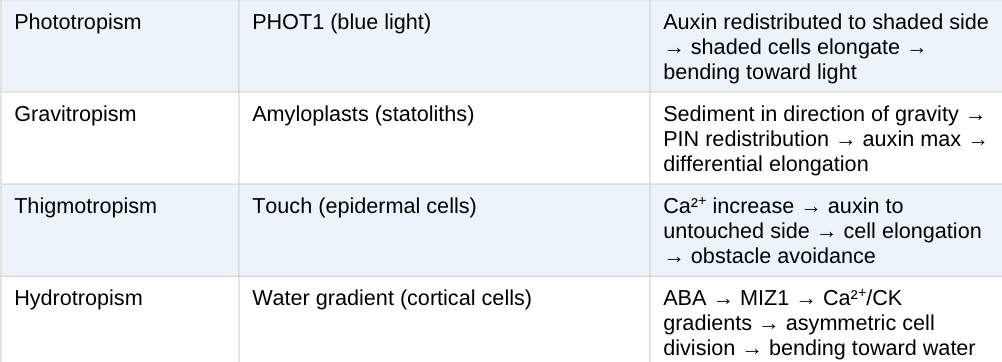
Name the 4 tropisms, their sensors, and mechanism
What is there to note for polar auxin transport
it is INDEPENDENT of gravity
directed by PIN and AUX1 and LAX influx carriers
What is the acid growth hypothesis
Auxin → H+ ATPase → apoplast acidification → expansin activation → cell wall loosening → cell elongation
What is the ethylene tripe response
hook + hypocotyl thicken + reduced elongation
ethylene reorients the microtubles in walls to transverse to longitudinal
How do plants develop organs post embro phase
maintaining stem cell populations in meristems
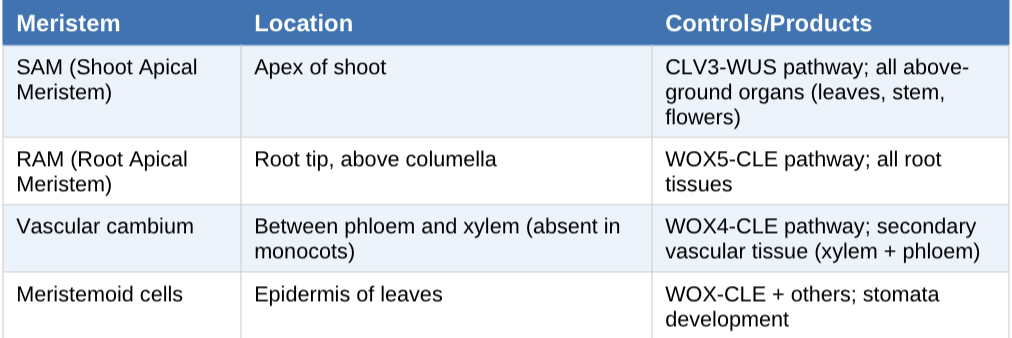
Name all meristems, their location in the plant, and the control/products of each
What are the root zones (from tip to base)
root cap → meristematic zone (QC + inital cells) → elongation zone → maturation zone
What is the quiescent center
only a few cells near root cap
low division rate, but maintain RAM with WOX5 and PLETHORA gradients
What is the pathway for QC vs in the elongation zone
QC: AUXIN + cytokinin → WOX5 + PLETHORA expression = meristemic
Elongation: CYTOKININ + ARR + less PLETHORA = elongation and differenciation
WOX5 movement between cell is important in meristem activity regulation
what are the SAM regions
Central zone (slow division)
Peripheral zone (fast division for leaf primoridia)
Rib Zone (generate stem tissue)
What are the SAM cell layers
L1 - epidermis, single cell thick (anticlinal growth)
L2 - internal tissue (anticlinal growth)
L3 - internal tissue and flowers
What is the CLV3-WUS feedback loop
WUS promotes stem cell activity in QC cells
CLV3: peptides from QC cells bind to CLV1 receptor → repress WUS → limit meristem size
more QC cells → more CLV3 → less QC cells created → less CLV3 → more WUS → more QC cells
In SAM, what are needed for meristem identity
SHOOTMERTISTEMLESS and cytokinins
What are the SAM hormone domains
HIGH CK + low auxin → meristem
HIGH AUXIN + low ck → organ differentiation
HIGH AUXIN → more GA + BR → organ development
Where does leaf initation occue in SAM
sites of localized AUXIN concentration in peripheral zone of sam (BOUNDARY)
What defines leaf polarity in the SAM/development?
adaxial: HD-ZIP II genes
abaxial: YABBY genes
What defines somata development in leavs
meristemoid cells
make asymmetric division → meristemoid → guard mother cell → symmetric division → guard cell pair
EPF1 peptides force stomatal spacing
What regulates the vein formation in stems
AUXIN and PIN1 that is directed with auxin flow from tip down
define a phytomer
basic module of shoot organization
What makes up a phytomer
internode + node + leaf + axillary bud