Ch. 17 from gene to protein
 Call Kai
 Learn
Learn Practice Test
 Spaced Repetition
 Match
Match Flashcards
 Knowt Play
1/75

There's no tags or description
Looks like no tags are added yet.
Name | Mastery | Learn | Test | Matching | Spaced | Call with Kai |
|---|
No analytics yet
Send a link to your students to track their progress
76 Terms
eukaryote have a RNA processing step
whats the difference between making of a trait in a eukaryotic cell vs a bacterial cell
transcription
the making of RNA from DNA
RNA polymerase
enzyme that makes an RNA copy of a gene by reading the complementary DNA strand
false
RNA polymerase require a primer to make RNA
tells RNA polymerase where to start and which direction
what is the purpose of the promoter
true
the promoter does not get translated into RNA
exon
RNA that is spliced together and exits the nucleus
introns
RNA that stays in the nucleus
upstream
what direction from the promoter is RNA going to replicate?
template strand
strand that RNA polymerase reads
coding stranding (nontemplate)
looks like mRNA except for when T turn into U
3'-5’
what direction does RNA polymerase read?
5’-3’
what direction does RNA polymerase write?
transcription initiation
RNA polymerase and transcription factors binds to promoter; first step of transcription
TATA box
beginning of promoter, made up of TATAAAA
TATA binding protein (TBP)
binds TATA box first, then other transcription factors form a complex around
transcription initiation complex
transcription factors interact with RNA polymerase to create a complex that unwinds DNA and RNA poly begins transcription
elongation
RNA polymerase begins synthesizing RNA
termination
RNA transcript is released from RNA polymerase
polyadenylation
what sequence signals termination?
this sequence is coded into RNA
endonuclease
binds to AAUAAA signal to RNA
cuts RNA 10-35 nucelotdies downstream of polyadenylation signal
release RNA from DNA and the RNA polymerase
5’ cap
consists of modified GTP (guanosine triphosphate)
put on while RNA is still being made
50-200 adenines
what is the 3’ cap of RNA made up of?
this is NOT encoded by the gene
protects the 5’ and 3’ end from degradation, aids in export of mRNA from nucleus, helps biding of mRNA to ribosomes in cytoplasm
what is the function of the 5’ and 3’ cap?
less expression of the gene because it’s degraded, not exported from nucleus, and not assisted with ribosome binding
what would happen if you don’t have 5’ or 3’ cap?
RNA splicing
the process of removing introns and splicing together exons
spliceosome complex
what is RNA splicing catalyzed by?
alternative splicing
the purpose of introns that allows production of multiple protein produce from a single gene is called?
translation
the process of making proteins from RNA
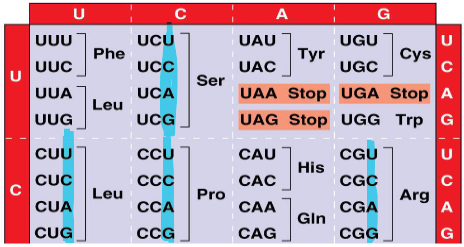
codons
3 nucleotides that makes up one amino acids
n^c = a
what’s the equation to find possible amino acids give the # of nucleotides and codon size? n = nucleotides, c = codon size, a = amino acids possible
universal, redundant, unambiguous, and nonoverlapping
what are the features of genetic code?
universal
genetic code is the same in all organisms, making it what?
redundant
some amino acids are encoded by several codons (ex: there are 3 codons that code for Leu)
unambiguous
one codon never encodes multiple amino acids
nonoverlapping
each base is part of only one codon
methionine
start codon name where translation starts
5’ untranslated region (5’ UTR)
what is the name of the section that occurs before the start codon?
stop codon
where is mRNA no longer read?
start gets translated to methionine while stop codon is NOT translated
does the start codon get translated? does the stop codon get translated?
3’ UTR
untranslated region after the stop codon
tRNA
read language of mRNA codon through anticodons and bind a specific amino acid through 3’ end
anticodons
what does tRNA use to read mRNA codons?
3’ end of tRNA
the amino acid is attached to where of the tRNA?
aminoacyl-tRNA synthetase
enzyme that binds amino acid to a tRNA; there’s 20 different type, one per amino acid
specific to amino acids
is aminoacyl-tRNA synthetase specific to the number of tRNA or specific to number of animno acids?
last base of anticodon binds weakly to codon; wobble pairing
there are 64 codons but only 45 tRNA, how can it cover all 64 codons?
2/3 RNA & 1/3 protein
what is ribosome consists of?
mRNA, A site, P site, E site
what are the 4 binding sites in a ribosome?
once bound to mRNA
when do the two subunits come together?
A site (aminoacyl-tRNA site)
accepts incoming tRNA
P site (peptidyl-tRNA site)
holds tRNA with growing polypeptide chain
E site (exit site)
site from which empty tRNA exits
initiation, elongation, termination
what are the stages of translation
translation initiation
small subunit binds to 5’ end of mRNA, scans for first AUG
anticodon of intiator tRNA base pairs with start codon (carry methionine)
large ribosomal subunit then binds (dependent on GTP)
initiator tRNA sits in P site
initiator tRNA
anticodon of mRNA start codon that carries methionine and sits at P site
codon recognition
anticodon of incoming tRNA binds to A site
anticodon of tRNA H-bonds with codon of mRNA
P-site contains growing polypeptide chain
peptide bond formation
peptide bond forms between polypeptide and new amino acid
catalyzed by rRNA in large subunit of ribosome
results in transfer of polypeptide to incoming tRNA
translocation
ribosome translocate on the mRNA
P-site now contains tRNA with growing polypeptide
E-site allows the ‘empty’ tRNA to leave
cycle continues as next tRNA binds to empty A site
requires GTP
translation termination
occurs at stop codon
no tRNAs but codon are bound by release factors
hydrolyze bond linking polypeptide and tRNA
ribosome, mRNA, and polypeptide dissociate
polysomes
a string of ribosomes on a single mRNA simultaneously synthesizing polypeptide
increase speed of polypeptide production
what’s the purpose of having multiple ribosomes on one mRNA?
transcription and translation are coupled
what happens in prokaryotes that doesn’t happen in eukaryotes ?
while RNA is bring made from a strand of DNA, that RNA is also being translated to polypeptide
what does it mean that transcription and translation is coupled?
bacterial components to transcribe/translate are slightly different from human ribosomes
how come antibiotics affect bacteria and not human cells?
point mutation
a single nucleotide change (ex: sickle cell disease
nucleotide pair substitution
replacement of one nucleotide with another
silence, missense, nonsense
what ate 3 types of nucleotide pair substitution?
silent substitution
no change in amino acid, synonymous substitution, no impact
missense substitution
change in amino acid, nonsynonymous
nonsense substitution
early stop codon (truncated protein)
insertion and deletion
insertion or deletion of nucleotides
frameshift
occurs in a deletion/insertion when the following base pairs are shifted over
extensive missense and nonsense, not in multiple of 3
what type of insertion / deletion leads to a frame shift? and how many nucleotides are deleted?
multiples of 3 result in missing or extra amino acids
how many nucleotide must be inserted/deleted to have no frameshift? this results in what?
cause drastic change to protein
why is frameshift harmful?