Chem - Section bank 1
 Call Kai
 Learn
Learn Practice Test
 Spaced Repetition
 Match
Match Flashcards
 Knowt Play
1/116

There's no tags or description
Looks like no tags are added yet.
Name | Mastery | Learn | Test | Matching | Spaced | Call with Kai |
|---|
No analytics yet
Send a link to your students to track their progress
117 Terms
proteolytic cleavage is a type of
hydrolysis reaction
what equation would you use for the magnitude of the electric field
E = V/d
what equation would you use for electromagnetic energy
energy equation. E = P x t
phenols, thiophenols, and alkylbenzenes all share
aromatic rings
what must happen in order to break a bond
photon energy must be larger than the bond energy; high frequency
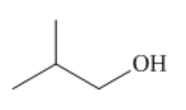
primary alcohol
Amine+Anhydride→
Amide+Carboxylic acid
anhydrides produce _____ (during nucleophilic acyl substitution reactions)
carboxylic acid byproducts
amides are ____ so they go into the _____
neutral, ether layer/organic layer
Charged molecules go to
aqueous layer
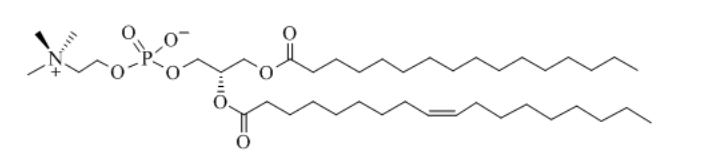
phosphatid (lipid)
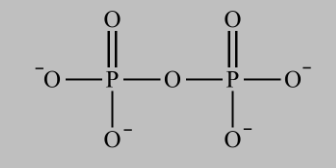
pyrophosphate
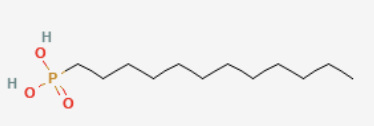
phosphonic acid
how could liposomes be able to fluoresce during size-exclusion chromatography?
fluorescent dye could be trapped inside
Liposomes can be difficult to detect during experiments like size-exclusion chromatography since they
do not absorb visible light
If products do NOT rearrange after forming, what should you think?; ie stable to mixing
Kinetic control.
If products CAN rearrange into more stable forms, what should you think?; ie form new products after mixture
Thermodynamic control.
what equation would you use for this:
Assume the hydrolysis of ATP proceeds with ΔG′° = –30 kJ/mol.
ATP + H2O → ADP + Pi Which expression gives the ratio of ADP to ATP at equilibrium, if the [Pi] = 1.0 M? (Note: Use RT = 2.5 kJ/mol.)
ΔG′° = -RT ln(k)
mol=
M x V or grams/molar mass
1.0 mL=
1.0×10⁻³L
Which cation is most likely to be found in place of Fe(II) in the square planar binding domain of hemoglobin?
Co 2+
_______ catalyze the transfer phosphate groups from ATP to target proteins and are classified as _______
kinases, transferase
KM is the concentration of substrate at which the kinetics experiment reaches
half maximum velocity
What happens when a larger amino acid is replaced by a smaller amino acid?
steric hinderance decreases
Why is alanine commonly used in mutation studies?
Because it is small and minimally disruptive.
What kind of side chains increase steric hindrance?
Large bulky side chains,
Ex. tryptophan, phenylalanine, isoleucine
What kind of side chains decrease steric hindrance?
small amino acids, like glycine and alanine
Deprotonation of the reacting water will make it
more nucelophilic (more acidic)
what would be a good reason to use alanine as the replacement residue for each of the single site variants used in a study?
reduces the interaction of the side chain with other active site components.
kcat is related to
catalysis
what type of mutation is E147D
a conservative mutation - both amino acids have similar properties and charges
what type of bond is broken by this enzyme:
“Lysozyme is an enzyme that kills gram-positive bacteria by cleaving N-acetylglucosamine oligosaccharides”
glycosidic - oligosaccharides are chains of sugars, glycosidic bonds link sugars

this is expressed as y = mx + b
When performing experiments to measure the kcat of an enzyme, the substrate concentration should be:
saturating
Why do enzymes sometimes protonate substrates during catalysis?
To improve leaving group ability or stabilize intermediates.
“enzyme was prepared by diluting 0.100 mL of the commercial preparation to 25.0 mL in the buffer solution”
buffer equation - 25.0/.100
Dnmt3a is active as a homotetramer - it showed a single band at 35 kDa what is its molecular weight
140
After substrate exposure, the reactions were initiated by addition of 3H-labeled methyl-donating substrate, which undergoes β– decay with a half life of 4500 days
What fraction of the starting amount of tritium remains after 13,500 days?
A. 1/8
B. 1/3
C. 1/2
D. 3/4
A. 1/8
purified with nickel-nitrilotriacetic acid-agarose chromatography and histine tagging is an example of
affinity chromatography
Avidin: strongly binds biotin
So what happens? Biotinylated substrate (has biotin attached) binds tightly to: avidin plate
So during washing:
it stays attached
if a protein as no disulfide bonds what happens in Nonreducing SDS-PAGE
things run as monomers
if a protein has disulfide bonds what Happens in Nonreducing SDS-PAGE
everything stays linked together
on an SDS page what has the highest electrophoretic mobility
the smallest molecular weight (kDa)
in a mixture of 2:1 hexane/water what layer would steroid hormone, estrogen be in
the hexane layer
in a mixture of 2:1 hexane/water what layer would the peptide hormone, insulin be in
the aqueous layer
a protein with a low pI would be _______ at pH 7
negatively charged
Which amino acid in the substrate binding pocket is most likely to interact with the substrate through its backbone as opposed to its side chain?
glycine
What is the most likely reason for the decreased KM values observed in the D45G variant compared to the other two versions of GalK with respect to each substrate?
The substrate binding pocket is a better fit.
Which of the four DNA bases contains the largest number of hydrogen bond acceptors when involved in a Watson–Crick base pair?
C
Which of the four DNA bases contains the largest number of hydrogen bond donors when involved in a Watson–Crick base pair?
G
The side chain of which amino acid can form a bond that is similar to a peptide bond?
lysine
Substituting residues in a peptide with which type of amino acida will most likely result in a peptide with an increased pI?
basic amino acids
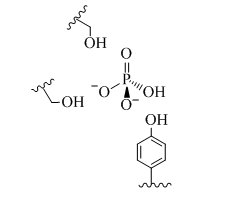
What is the primary means of stabilization of phosphate bound to MP based on the binding site depiction shown in Figure 1?
hydrogen bonds
Which statement accurately describes the properties of maltose?
A. It is a reducing disaccharide in which only one anomeric carbon is involved in the glycosidic bond.
B. It is a reducing disaccharide in which both anomeric carbons are involved in the glycosidic bond.
C. It is a nonreducing disaccharide in which only one anomeric carbon is involved in the glycosidic bond.
D. It is a nonreducing disaccharide in which both anomeric carbons are involved in the glycosidic bond.
A. It is a reducing disaccharide in which only one anomeric carbon is involved in the glycosidic bond.
Both anomeric carbons bonded is this reducing
no
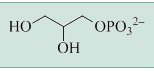
glycerol - 3 - phosphate
if something is a homodimer, then the disruption of the quaternary structure during SDS would result in a
single gel band
if something is a heterodimer, then the disruption of the quaternary structure during SDS would result in
two bands
the passage states that both ATP and glycerol occupy the catalytic cleft, which means that a
ternary complex was formed.
ATP and glycerol both occupy the catalytic cleft prior to catalysis, and it has been determined that glycerol binds first. Glycerol is stabilized in the cleft through interactions with Arg18, Arg84, Glu85, and Asp246.
What is the best description of the catalytic mechanism of GK? Catalysis occurs through:
A. an ordered mechanism in which a ternary complex is formed.
B. an ordered mechanism in which no ternary complex is formed.
C. a random order mechanism in which a ternary complex is formed.
D. a random order mechanism in which no ternary complex is formed.
A. an ordered mechanism in which a ternary complex is formed.
To determine a protein’s thermodynamic stability, chemical denaturation studies can be performed. Assuming that only the native and unfolded states can be observed under experimentally available conditions, what is the most likely shape of the curve for the dependence of the fraction of folded protein upon denaturant concentration?
sigmoidal
Purpose:
Turn large biomolecules into ions without breaking them apart.
Examples:
Proteins
Peptides
Lipids
Carbohydrates
All ions are accelerated by the same voltage, so they have the same kinetic energy
maldi - tof
Why use a matrix in maldi tof
To absorb laser energy and prevent fragmentation of the analyte.
Conjugation and electron delocalization =
greater stability = easier detection = absorption at longer wavelengths.
Resonance
Conjugation
Delocalization
Aromatic stabilization
Extended π system
Lower transition energy
Longer wavelength absorption
"This molecule is probably more stable and more likely to be observed experimentally."
More conjugation → smaller
HOMO-LUMO gap → longer λ absorbed
The energy of the photon must equal the
energy gap
Requires:
High-energy light
Short wavelength
Examples:
Molecules with little conjugation
Large HOMO-LUMO gap
Requires:
Low-energy light
Long wavelength
Examples:
Molecules with lots of conjugation
Small HOMO-LUMO gap
allows electrons to spread out (delocalize).
conjugation
Why does Compound 2b absorb at a longer wavelength?
Compound 2b has greater conjugation, resulting in a smaller HOMO-LUMO energy gap.
A molecule has extensive electron delocalization. What is expected?
Smaller HOMO-LUMO gap
Lower transition energy
Longer wavelength absorption
Which ion arrives first? in maldi tof?
Ion A:
m/z = 50
Ion B:
m/z = 100
ion A
Why is MALDI useful?
Because it ionizes large biomolecules without extensive fragmentation.
The instructor prepared a solution of NaOH(aq) by dissolving 8 g of NaOH(s) (MM = 40.00) in 2 L of H2O, as shown in Equation 1. The temperature of the solution rose during the mixing process.:
Enthalpy decreased, entropy increased
in ester hydrolysis what bond is broken:
RCOOR′+H2O
Acyl-oxygen bond
CH3Br + OH− → CH33 OH+Br−
How many bonds are broken and formed?
Broken: C-Br (1)
Formed: C-O (1)
1 broken, 1 formed
Peptide hydrolysis
RCONHR
Broken: C-N bond
Formed: C-O bond
Which Carbon is the Reacting Carbon?
C=O because it is electrophilic
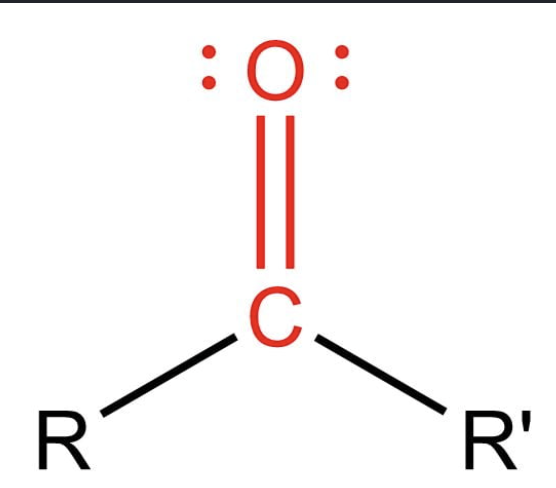
carbonyl carbon - most electrophilic
What geometry change occurs when a nucleophile attacks a carbonyl?
Trigonal planar → tetrahedral
add more substrate to overcome
competitive inhibition
hydrolyzed
broken bond wih water
A glutamate residue (Glu-1) in the active site donates a proton to an oxygen atom. Another glutamate on the opposite axial side (Glu-2) acts as a nucleophile to liberate D-glucose and generate an α-D-galactopyranosyl-modified enzyme intermediate. Then, Glu-1 deprotonates water, and the resulting hydroxide ion acts as a nucleophile to liberate β-D-galactose and regenerate the enzyme.
Based on the description provided, if lactose was hydrolyzed under the action of lactase in O-18 labeled water, in which location(s) would the label appear?
A. Neither the galactose nor the glucose products
B. The glucose product only
C. The galactose product only
D. Both the galactose and the glucose products
C. The galactose product only
A glutamate residue (Glu-1) in the active site donates a proton to an oxygen atom. Another glutamate on the opposite axial side (Glu-2) acts as a nucleophile to liberate D-glucose and generate an α-D-galactopyranosyl-modified enzyme intermediate. Then, Glu-1 deprotonates water, and the resulting hydroxide ion acts as a nucleophile to liberate β-D-galactose and regenerate the enzyme.
For what mechanistic reason does G1 of lactase first act as a Brønsted acid during catalysis?
A. G1 becomes a better nucleophile.
B. G2 becomes a better nucleophile.
C. Glucose becomes a better leaving group.
D. Galactose becomes a better leaving group.
C. Glucose becomes a better leaving group.
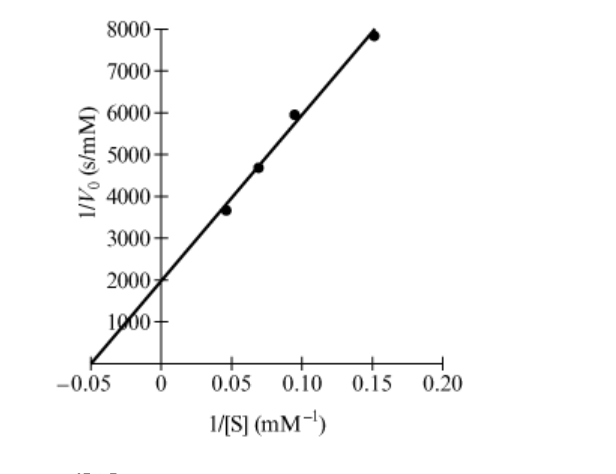
What is the KM of Compound 1 with respect to lactase?
A. 0.05 mM
B. 0.10 mM
C. 5 mM
D. 20 mM
D. 20 mM
![<p><span>The initial rates </span><em>V</em><sub>o</sub><span> were measured for each trial. The students then plotted 1/<em>V</em><sub>o</sub> versus 1/[S] (Figure 1) to determine </span><em>K</em><sub>M</sub><span>, </span><em>V</em><sub>max</sub><span>, and [E]</span><sub>T</sub><span> for the four trials.</span></p><p>What method did the students use to calculate <span style="line-height: inherit; font-size: inherit;"><em>V</em><sub>max</sub></span>?</p><p>A. <em>V</em><sub>max</sub> was calculated as <em>K</em><sub>M</sub> × <em>k</em><sub>cat</sub>.</p><p>B. <em>V</em><sub>max</sub> was determined as the inverse of the <em>y</em>-intercept of the graph shown in Figure 1.</p><p>C. <em>V</em><sub>max</sub> was calculated as [S] × <em>k</em><sub>cat</sub> for the trial with the highest substrate concentration.</p><p>D. <em>V</em><sub>max</sub> was determined as the fastest initial rate of Compound 2 formation obtained during the kinetics experiments from the passage.</p>](https://assets.knowt.com/user-attachments/a0a13d79-9cdc-4c6a-aa37-037754d2438d.png)
The initial rates Vo were measured for each trial. The students then plotted 1/Vo versus 1/[S] (Figure 1) to determine KM, Vmax, and [E]T for the four trials.
What method did the students use to calculate Vmax?
A. Vmax was calculated as KM × kcat.
B. Vmax was determined as the inverse of the y-intercept of the graph shown in Figure 1.
C. Vmax was calculated as [S] × kcat for the trial with the highest substrate concentration.
D. Vmax was determined as the fastest initial rate of Compound 2 formation obtained during the kinetics experiments from the passage.
B. Vmax was determined as the inverse of the y-intercept of the graph shown in Figure 1.
The students prepared stock solutions of Compound 1 in four different concentrations in pH 7 buffer. A stock solution of the enzyme was prepared by diluting 0.100 mL of the commercial preparation to 25.0 mL in the buffer solution. Experiments were initiated by mixing 1.0 mL of each substrate solution with 1.0 mL of the enzyme solution
If [E]T was the concentration of lactase in the kinetics trials, what expression gives the concentration of lactase in the commercial preparation of this enzyme?
A. [E]T × 500
B. [E]T × 50
C. [E]T × 200
D. [E]T × 25
A. [E]T × 500
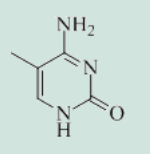
cytosine modified at C-5 position
is something migrates further in the gel.
that means it is more compacts
Lane 1 = control
Lane 2 = mutant
Band appears only in Lane 1.
Question:
What happened?
Mutant lacks detectable protein.
Lane 1 band is darker than Lane 2.
Question:
Interpretation?
Lane 1 has more protein.; band intensity = amount of proteins
After siRNA treatment, band nearly disappears.
Protein expression decreased.
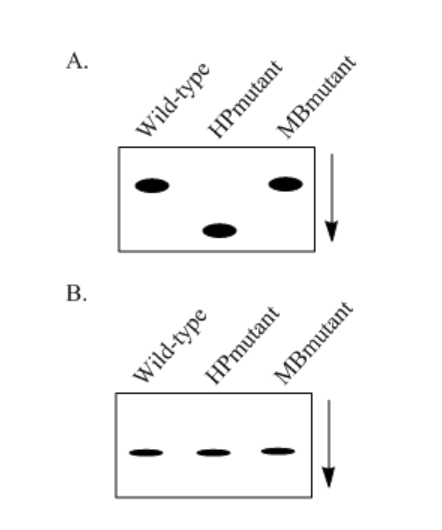
Based on the results shown in Figure 2, what effect does mutation have on M1 mRNA?
A. The folded structures of wild-type and MBmutant M1 mRNA are similar, but the structure of HPmutant M1 mRNA is less compact.
B. The folded structures of wild-type and MBmutant M1 mRNA are similar, but the structure of HPmutant M1 mRNA is more compact.
C. Wild-type and MBmutant M1 mRNA have the same number of base pairs, but HPmutant M1 mRNA has fewer base pairs.
D. Wild-type and MBmutant M1 mRNA have the same number of base pairs, but HPmutant M1 mRNA has more base pairs
B. The folded structures of wild-type and MBmutant M1 mRNA are similar, but the structure of HPmutant M1 mRNA is more compact.
Example
Normal protein: 100 kDa
Mutant: 70 kDa
truncated protein
Researchers use:
Anti-phosphotyrosine antibody
Question:
What is detected?
Only phosphorylated proteins
Example
Protein X total amount unchanged.
Phosphorylated Protein X increases.
increased activation
Protein band doubles.
Actin band doubles too.
Interpretation?
More total sample loaded - Need normalization.
Example
Protein:
50 kDa monomer
100 kDa dimer
Reducing gel:
50 kDa
Nonreducing gel:
100 kDa
aubunits were linked by disulfide bonds - reducing agent breaks S-S bonds.
Example
SDS-PAGE shows: 25 kDa
Protein known to be homodimer.
Question:
Native protein size?
25×2=50 kDa