Mistakes in topic questions
 Call Kai
 Learn
Learn Practice Test
 Spaced Repetition
 Match
Match Flashcards
 Knowt Play
1/13

There's no tags or description
Looks like no tags are added yet.
Name | Mastery | Learn | Test | Matching | Spaced | Call with Kai |
|---|
No analytics yet
Send a link to your students to track their progress
14 Terms
Errors in the precise location of splicing in the DNA molecule an lead to mutations
Explain why
Deletion of bases
Changes in base sequence of exons
May result in a shortened (truncated) and non functional polypeptide produced
Describe the role of haemoglobin (Hb) in the loading, transport and unloading of oxygen
Haemoglobin has a high affinity for oxygen where PO2 is high
Therefore it binds to oxygen in the lungs to form oxyhaemoglobin (oxygen is loaded)
Haemoglobin has a low affinity for oxygen when the pO2 of oxygen is low
Therefore it releases oxygen at muscle tissues (oxygen is unloaded).
Haemoglobin binds by cooperative binding, where the binding of one oxygen molecule changes the tertiary structure of haemoglobin , making it easier for the second and third oxygen molecules to bind rapidly.
Haemoglobin also contains four polypeptide chains, each with a heme group, which contains an Fe2+, which can bind reversibly to oxygen to form oxyhaemoglobin
This allows it to transport oxygen around the body and release or pick up oxygen
Describe how a polypeptide is produced from the translation of mRNA
mRNA binds to a free ribosome in the cytoplasm or in the rough endoplasmic reticulum
The tRNA binds to mRNA with a codon complementary to its anticodon
tRNA carries an amino acid corresponding to the anticodon
A second tRNA brings a specific amino acid to an adjacent codon
A peptide bond is formed in a condensation reaction, where energy is released from the hydrolysis of a phosphate bond in ATP
tRNA then detaches and goes and collects another amino acid
The ribosome moves along the mRNA sequence one codon at a time, causing a polypeptide chain to grow one one amino acid at a time
The polypeptide is released and translation stops when stop codon is reached
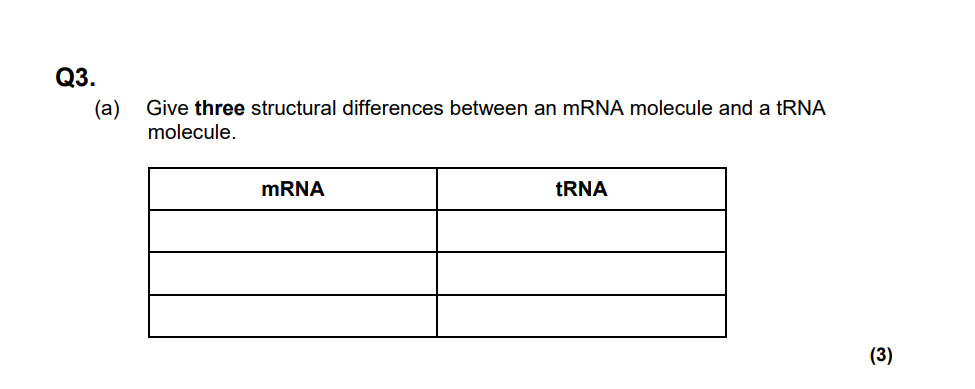
Give three structural differences between an mRNA molecule and a tRNA molecule
mRNA contains codons, whereas tRNA contains anticodons
mRNA is longer than tRNA
mRNA does not contain an amino aicd binding site whereas tRNA does
Extra points
mRNA doesn’t contain hydrogen bonds whereas tRNA does
mRNA is a linear single helix whereas tRNA is a folded clover leaf shape
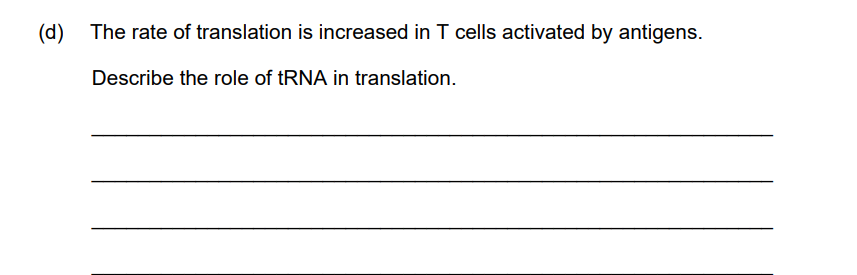
The rate of translation is increased in T cells activated by antigens
Describe the role of tRNA in translation
tRNA binds to an mRNA molecule in the ribosome with a codon complementary to its anticodon
tRNA carries an amino acid to the ribosome
Condensation reaction occurs between adjacent amino acids using energy released from hydrolysis of ATP to form a peptide bond
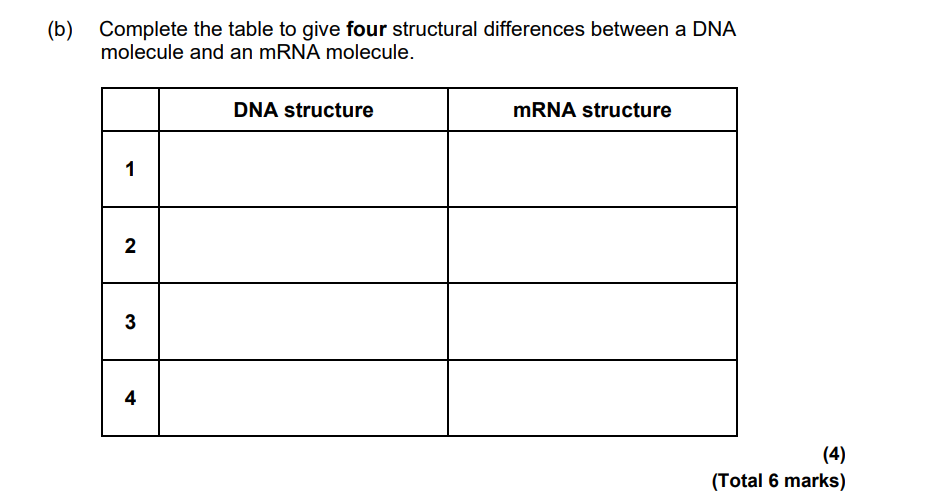
Give 4 structural differences between mRNA and DNA
DNA contains thymine, whereas mRNA contains uracil
DNA is longer than mRNA
DNA is double-stranded (double helix), whereas mRNA is single stranded (single helix)
DNA contains hydrogen bonds, whereas mRNA does not
Extra points
DNA contains deoxyribose sugar, whereas mRNA contains ribose sugar.
What is a gene?
A sequence of DNA nucleotide bases which result in the production of a specific functional polypeptide
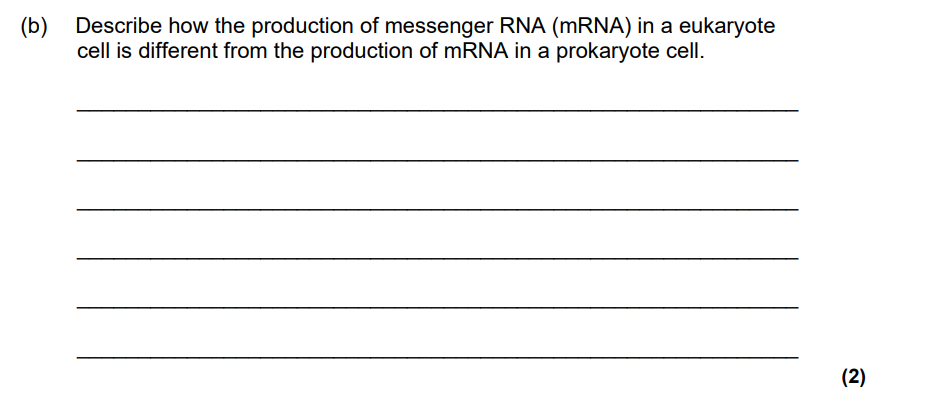
Describe how the production of messenger RNA (mRNA) in a eukaryotic cell is different from the production of mRNA in a prokaryotic cell
In eukaryotic cells only, pre-mRNA is produced
This is because eukaryotic cells only contain introns and prokaryotic cells do not.
Therefore, in eukaryotic cells, splicing must occur to remove these introns
Describe the role of ATP in the process of translation of protein synthesis
Energy is released from the hydrolysis of ATP (phosphate bonds)
This provides energy for the formation of a peptide bond in a condensation reaction between amino acids