PIC W9 L1 technologies, identities and exclusion
 Call Kai
 Learn
Learn Practice Test
 Spaced Repetition
 Match
Match Flashcards
 Knowt Play
1/43

Earn XP
Description and Tags
identity and exclusion
Name | Mastery | Learn | Test | Matching | Spaced | Call with Kai |
|---|
No analytics yet
Send a link to your students to track their progress
44 Terms
What is technology:
- A broad, complicated, and encompassing term
- Idea of tech is often tied to contemporary moment in which the question is being proposed – i.e. different ideas about technology at different points in time
- Often think about it temporally – bound into a present
o But there’s a lot longer lineage
- It’s also a question of what is the human – what does it mean to be human/ manipulate the world around us
Kline (1985) – four stages of the world ‘technology’:
- Artifacts (hardware)
- System of manufacture
- Know-how (technique)
- System of use
Hardware: quote
- “the devices and techniques employed by society to sustain its existence and improve its quality of life […] [t]echnology most often refers to tangible, practical objects” (Wilbanks, 2004: 3).
Hardware:
- Stuff we use to manipulate the world around us – with our bodies (hands/ feet etc)
- E.g. we want to cut – use a knife
- Manipulate world around us for fuel, shelter – fundamental needs
o i.e. how we answer our basic needs
Process of manufacture:
- we live in sophisticated world
- how do we end up with our products
- systems of technologies to reproduce more technologies/ hardware
- process of manufactures – been around for a long time
- greater efficiency and refinement over time
- multiple forms of manufacturing process
- fewer humans involved nowadays – lees likely to get injured
Know-how – savoir -fare:
- How do we know how to do this stuff
- E.g. Light a fire
- ways in which we are able to use these technologies is dependent. On us knowing how to do it - e.g. manipulating fire bodies
- when baby born- certain things are tracked – height, weight, fine motor skills
o learn to manipulate items – learn to write/ hold a pen etc.
- society is structure din a way to constantly train the next generation in this form of know-how
- we draw on understandings of existing technologies to learn how to use new ones
- process/ system of. Hardware and know how come together
Personal technologies: quote
- “The body is [a human’s] first and most natural instrument. Or more accurately, not to speak of instruments, [a human’s] first and most natural technical object, and at the same time technical means, is his [or her] body.” (Mauss, 1973: 75)
Personal technologies:
- … ‘disciplinary’ actions that have become taken for granted.
- We discipline ourselves through institutions – e.g. schools, factories – subject to these forms of disciplines
System of use:
- Easy to overlook ‘the mundane’ – technologies we don’t think about can have significant impact
- Things in the world we take for granted – don’t always thinking about it
Black boxes: quote
- “…technology is often treated as a ‘black box’ whose contents and behaviour may be assumed to be common knowledge”
o (Layton 1977: 198)
Black boxes:
- Technology is treated as black boxes – don’t necessarily understand what’s in them but have a set of common tacit knowledge of how it works
o E.g. put a plug in a wall then the light bulb will turn on
Health and technology:
- Health technologies can help lead to better treatment
- Health technologies are becoming more common, more advanced, and less restricted to medical settings.
- Health technologies help lay people engage with medical practitioners in a way that can be positive and lead to better treatment.
o Access medics more easily – rural areas and internationally
- Help us benchmark society – what a develop society looks like, progress (often configured in relation to technology)
- Reliant on the fact these are designed tools that we expect to work
- BUT:
o poorly implemented or designed health technologies can exacerbate existing inequalities.
o Assumptions that sit behind them matter
Models of disability:
medical and social
- Prosthesis – add things to body to do things that otherwise couldn’t – medical techniques to deal with impairement
medical
o disability is the result of individual impairment/ injury/ difference
o common in medicine.
social
o disability as a shortcoming of society failing to adapt
o sees disability not as a direct result of an impairment/injury/difference
o Clearest example of this is when comparing disabilities that are common and unobtrusively ‘remedied’ than those that require more prominent adaptations.
Normative understandings of the body:
- Normative ideas of the body assume a ‘standard’ or ‘correct’ body that all others deviate from.
o Often male – many technologies created without taken into account that a women’s body differs from a man
§ E.g. periods/ menstruation – not even looked at
The results in multiple dimensions of exclusion including
o Difference is defined in terms of absence, inability, and other negative framings.
o Assumptions are made about the accessibility, impact, and suitability of product/process etc. because they are designed around a singular theoretical ‘norm’.
- Upon which hardware, systems of use are predicated
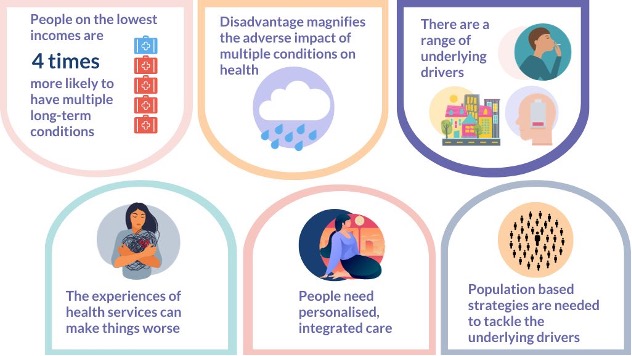
Example 1: normative health technologies:
- Most health technologies – including medicines – are tested on men/ male orientated biological model (male mouse/ male test animal) resulting in women being significantly more likely to experience adverse drug reactions and when they do these are also more likely to result in hospitalisation.
o Often abstract things out seen as too complicated e.g. menstruation
- Technologies that function by shining light on skin and measuring reflections work better and more accurately on lighter skin tones – including pulse oximeters.
- Artificial limb skin tones are very limited and matches are more likely to be available for white men. Poorer matches result in higher rejection rates.
Technologies of the self:
- Beyond ‘biology as destiny’
o (Rose, 2001)
o Rose, N. 2001 “The Politics of Life Itself”, Theory, Culture & Society 18(6): pp. 1-30.
- “Prosthesis” is a translation of the Ancient Greek meaning ‘addition’, so a ‘prosthetic’ technology is one that is seen to ‘add’ to the body
- This can include anything that reshapes how the body works, but describing non-medical technologies as prostheses has been critiqued (e.g., De Preester and Tsakiris, 2009)
- A ‘biomedical prosthesis’ is one that serves a specifically biomedical purpose (e.g., an artificial limb)
- For a prosthetic limb to be ‘accepted’ it needs to fit into someone’s ‘body schemata’ – their sense of the form of their body
- Technologies of the self – grant a movement of our body beyond ‘our destiny’

Innovating on health technologies beyond the body:
- These technologies are being improved quite rapidly
- Rapid growth in the capacity of these technologies to provide a more fulfilling life
o But only comparatively recently
o Taken a long time to have investment
o Often tied up to wide political/ economic issues in society
Example 2: ‘assistants’:
- Assistants being sold to use elderly, housebound, additional needs
- Especially those who would’ve needed home visits regularly for medical issues – the home assistants are marketed as a solution
- Also helping to do everyday things even if don’t need that form of care
- “Consistently representing digital assistants as female…hard-codes a connection between a woman’s voice and subservience.”
o Jessica Nordell, New Republic (2016)
- Idea of a female assistant as subservient
- Who makes them? Rich white men – in a narrow social dynamic
- Lots of the assumptions being the technologies that are sold to us as helpful and advancing our lives aren’t neutral – carry with them a lot of politics of who counts in society, why they count – sometimes implying/ directly who does not
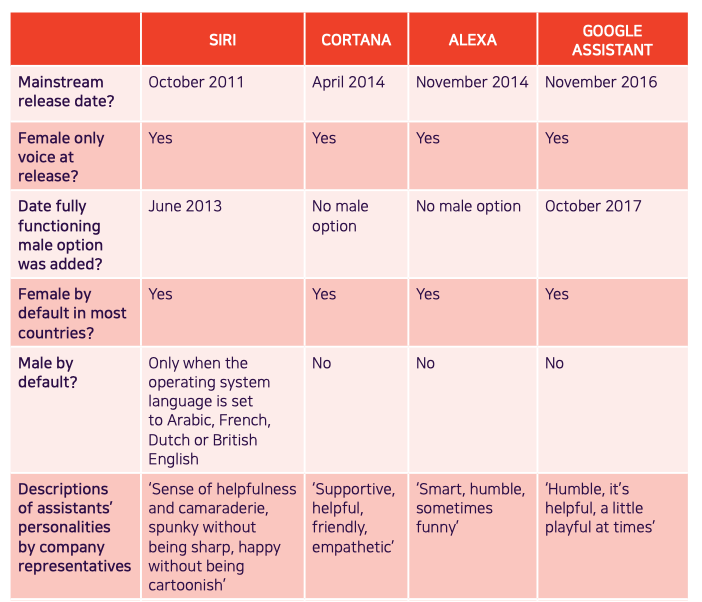
- Why is it an assistant in the home being figured as a female
- Descriptions of the personalities
- Why are they gendered
Example 3: health and AI:
- AI has the ability to process huge volumes of data (very quickly), but this means errors can be replicated in ways humans wouldn’t do.
- AI can introduce biases to data analysis, especially where biases already exist in data sets.
- High risk application with restricted use in EU but fewer restrictions elsewhere.
o EU – over where can and should be used
o Can be used for screening cancers but not other forms of diagnoses
o Very patchy across the world
o AI far less regulated in some countries than other s- particularly in USA
- AI is still poorly regulated and understood by many consumers and users.
- Doesn’t work everywhere so well – the biases can make a material, real difference – can’t be blanketly applied
- The medicine were being asked to take isn’t just decide don a human doctor’s knowledge
- Subject to that black box of AI technology – don’t necessarily know how those inferences is being applied
Power:
- Sweden said this was medically ok – 37 got pregnant even though followed it
- “Nowhere do issues of privacy and technology intertwine more than at the interface of the health of the individual and the health of a community.” (Rosenberg and Waldbrook, 2017: 454)
- Many reproductive tracking apps don’t treat data on menstrual cycles as sensitive (Shipp and Blasco, 2020) which has caused alarm following the overturning of Roe v. Wade
- If sold or leaked, medical data can be used to target vulnerable people, e.g., denying insurance claims.
- All the big data companies want access to our health data – have it in USA and are getting it in the UK.
o NHS ideal access point – centralised set of data over whole population over a long set of time
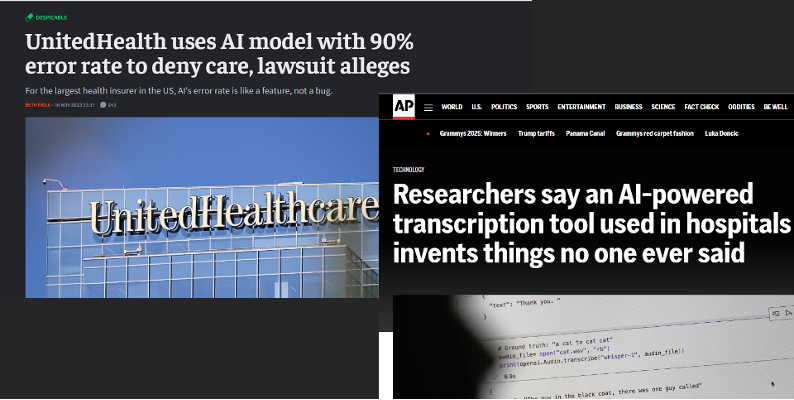
- Error rate of about 90% to deny care
- When access to healthcare has a direct relationship with what you can afford, it become existential
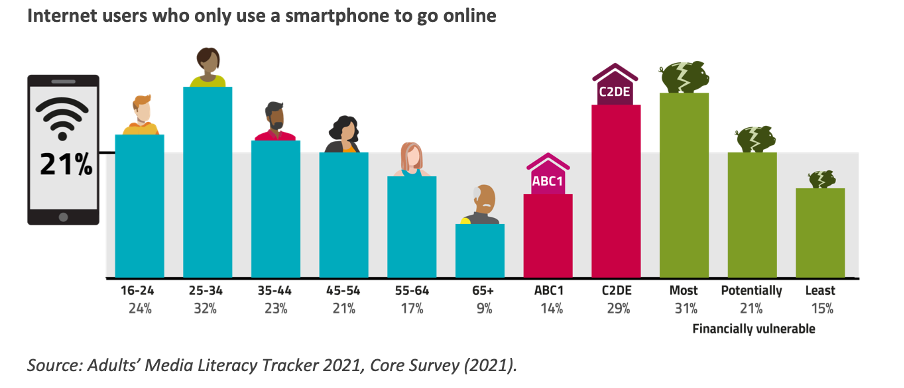
The digital divide:
- Who has access and who doesnt
- Long-running discussion of a digital divide. Yet, the proportion of adults identified as ‘non internet users’ has dropped continuously over the years.
- However, this compounds issues – the more common internet use is, the more likely it is to be assumed as a given.
- Distribution of access to technologies. Ownership varies on age and socio-economic profiles
- Also about norms of use. Some people grow up with technology being very accessible.
o Norms change over time
o Generational differences – not just economic differences
- Remains to be active sets of concerns
- 3% of adults don’t have a smartphone, tablet, or laptop (c1.5m) (CDI)
- 8% of households struggle to afford broadband (c1.9m households) (Ofcom)
- 9% of households struggle to afford mobile (c2.6m households) (Ofcom)
- 15% of 8-25 year olds are without home broadband (c2.1m) (DYI)
- 14% of 8-25 year olds lack access to a larger screen device for learning (c2m) (DYI)
- 4% of 8-25 year olds lack both a learning device and home internet (c570k) (DYI)
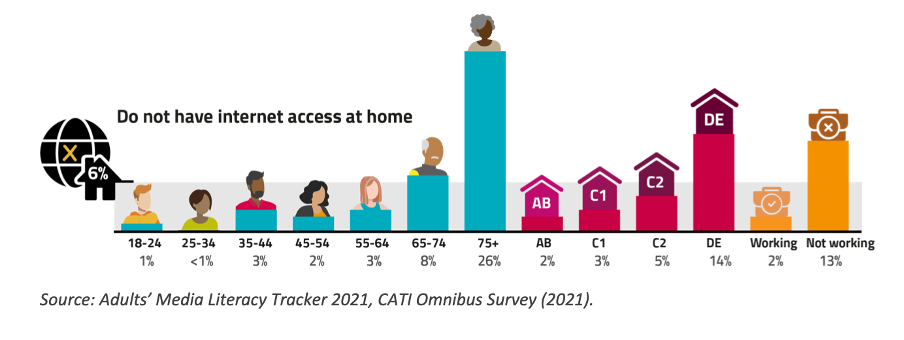
o Theres a generation of people who just don’t have internet connection at home and probably never will
o An issue as gov tried to implement things over the internet
- Differences over who can afford access to the internet – some have unlimited 4G/5G/ broadband.
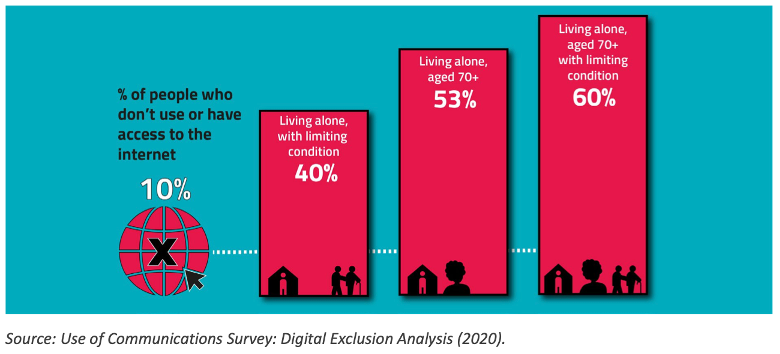
- Vulnerable people
- Becomes a difficult political problem – for how gov implements their systems if no interne
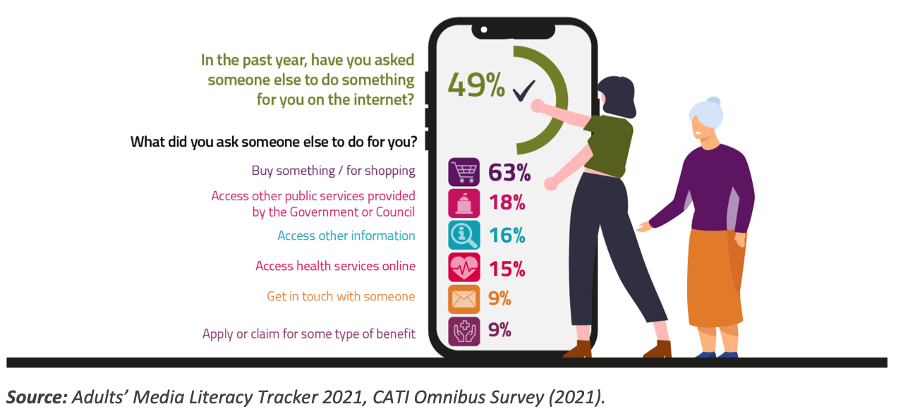
- How many people ask others to do things for them online
- Family members asking others for help
- Very common
- For fundamental things
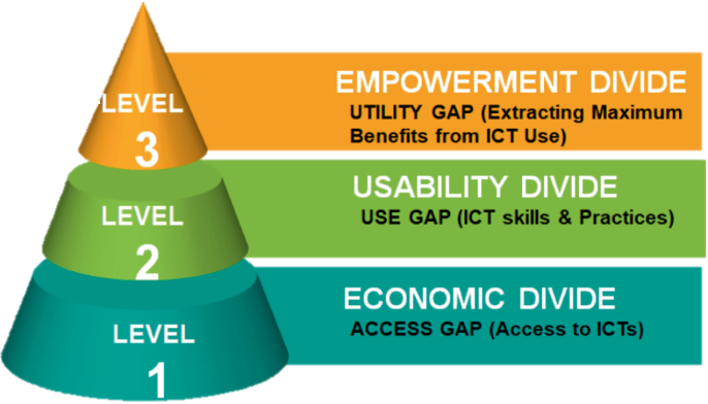
Three levels of digital divide:
- These divides are amplified by assumptions and norms.
- Level 1: Access –
o does a person have access to IT/internet (e.g., enabled technology, internet infrastructure, ability to pay).
o Access gap
- Level 2: Skills and Uses –
does a person have the skills to use IT/internet (e.g., do they have training, familiarity, or access to learning
- Level 3: Outcomes –
o does a person’s use of IT/internet lead to different outcomes (e.g., better learning, productivity, health)
o Does a use of these technologies lead to different outcomes
Digital exclusion:
- Many resources and services are now only available through online portal and websites,
- BUT: also loss of public access (e.g. libraries)
- This has been coupled with the loss of public access to computers (e.g., in libraries) meaning that individuals without access to a private computer can be excluded from accessing vital services.
o Computers in libraries was a central part of state/ gov heping people access these services
o But now not open as long/ as much
- This produces a ‘catch-22’ scenario (Holmes and Burgess, 2022)
o If don’t have access can’t ask for help to get access
- Not simply about lack of internet enabled device – can be lack of understanding, knowledge, income to pay for subscriptions etc.
- “Digital inclusion should always be seen as embedded in a person’s offline circumstance” (Helsper, 2012: 405)
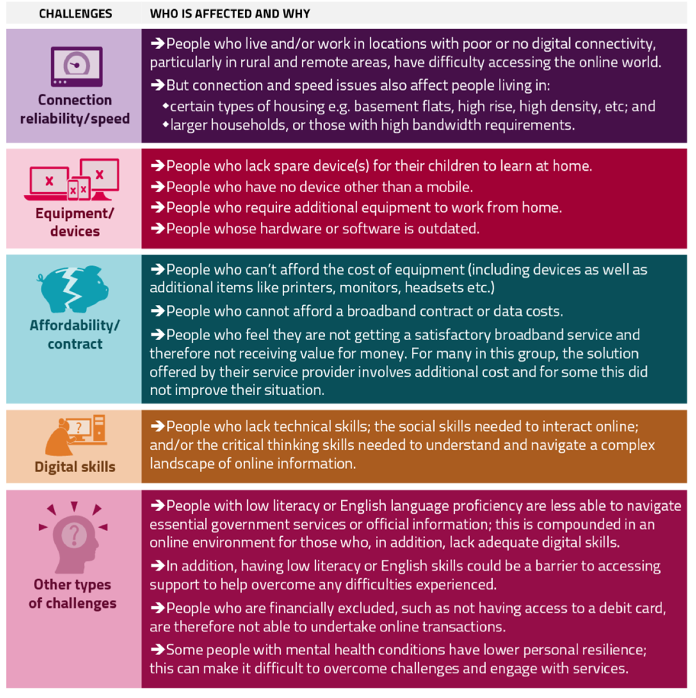
Impacts of digital exclusion:
- Limited access to vital services, reduced career opportunities, and increased exposure to risks.
- Reduction in training and familiarity may increase vulnerability when online.
- Intersects with other issues, such as poverty, amplifying their consequences.
- Detrimental to career progression and independent living.
- Severe and broad impacts
- Challenges created by and exacerbated by digital exclusion
- Access to internet is just as fundamental as other needs
Summary:
- Technology is more than just ‘digital’
o ‘Mundane’ technologies shape our everyday lives too but can be overlooked.
- Technologies are both sites and subjects of exclusion but can also be an avenue to inclusion
- Inequality is changing – the digital divide is become starker even if fewer people are affected.