1.4 Depictions and Portrayals: Mythical Barbarians OCR A Level Classical Civilisation
 Call Kai
 Learn
Learn Practice Test
 Spaced Repetition
 Match
Match Flashcards
 Knowt Play
1/24

There's no tags or description
Looks like no tags are added yet.
Name | Mastery | Learn | Test | Matching | Spaced | Call with Kai |
|---|
No analytics yet
Send a link to your students to track their progress
25 Terms
Amazons standard appearance
Pointed caps, patterned tunic and trousers (horse riding), bow and arrow, half-moon shield; Sometimes with leopard skin, tattoos, other weapons like battle axe
Homer on Amazons
They are "the equals of men"
Girdle of Hippolyte
One of Herakles' labours to take the girdle of the Amazon queen, mission where Theseus also took her sister Antiope who the Amazons attacked Athens to try to recover but accidentally killed her attacking Athens
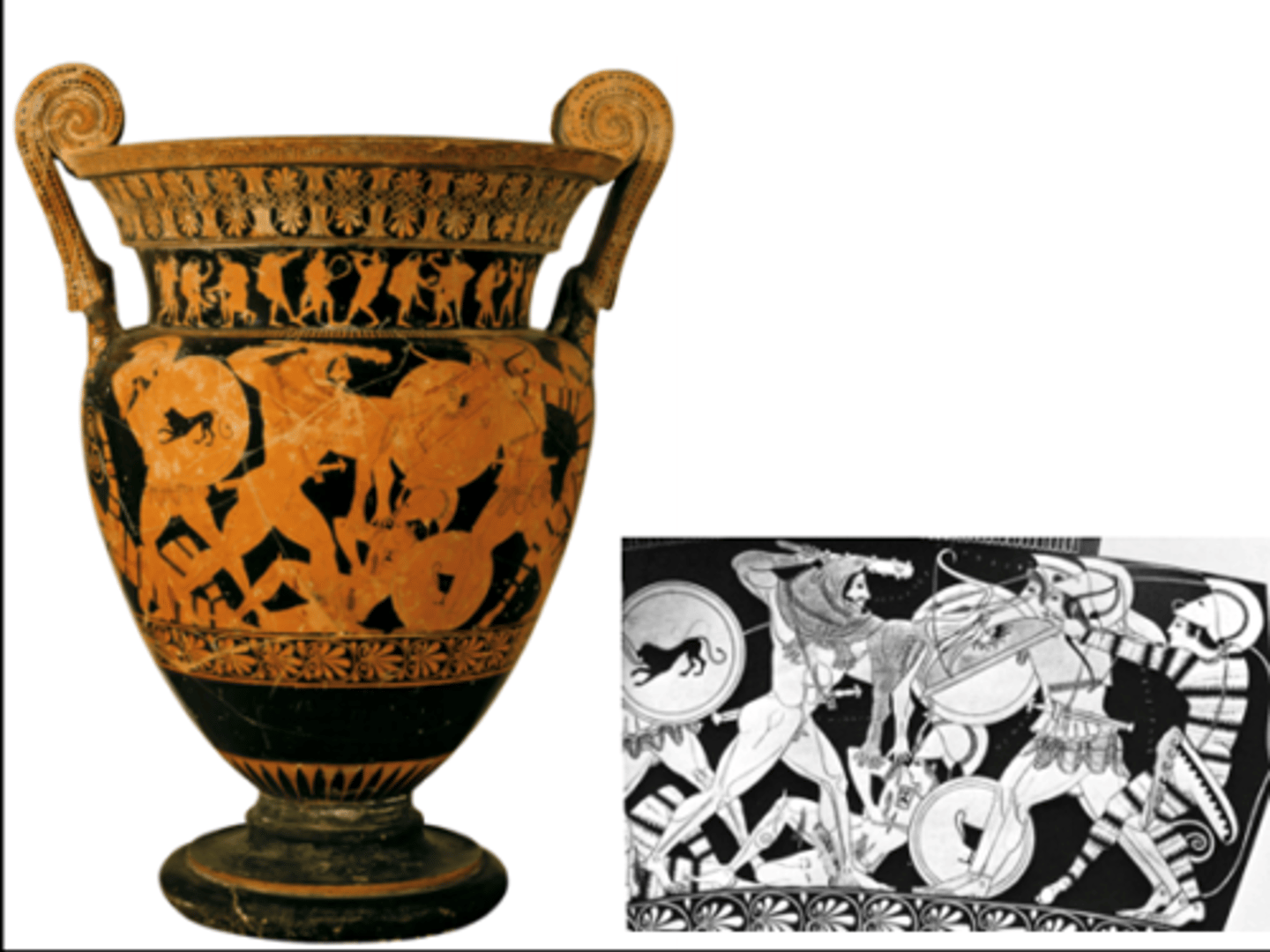
Red-figure krater of Herakles and the Amazons
6th century BCE; bow and arrow fighting (Herakles with both a club and a bow); an Amazon on the floor being defeated; Herakles mostly naked while they are clothed
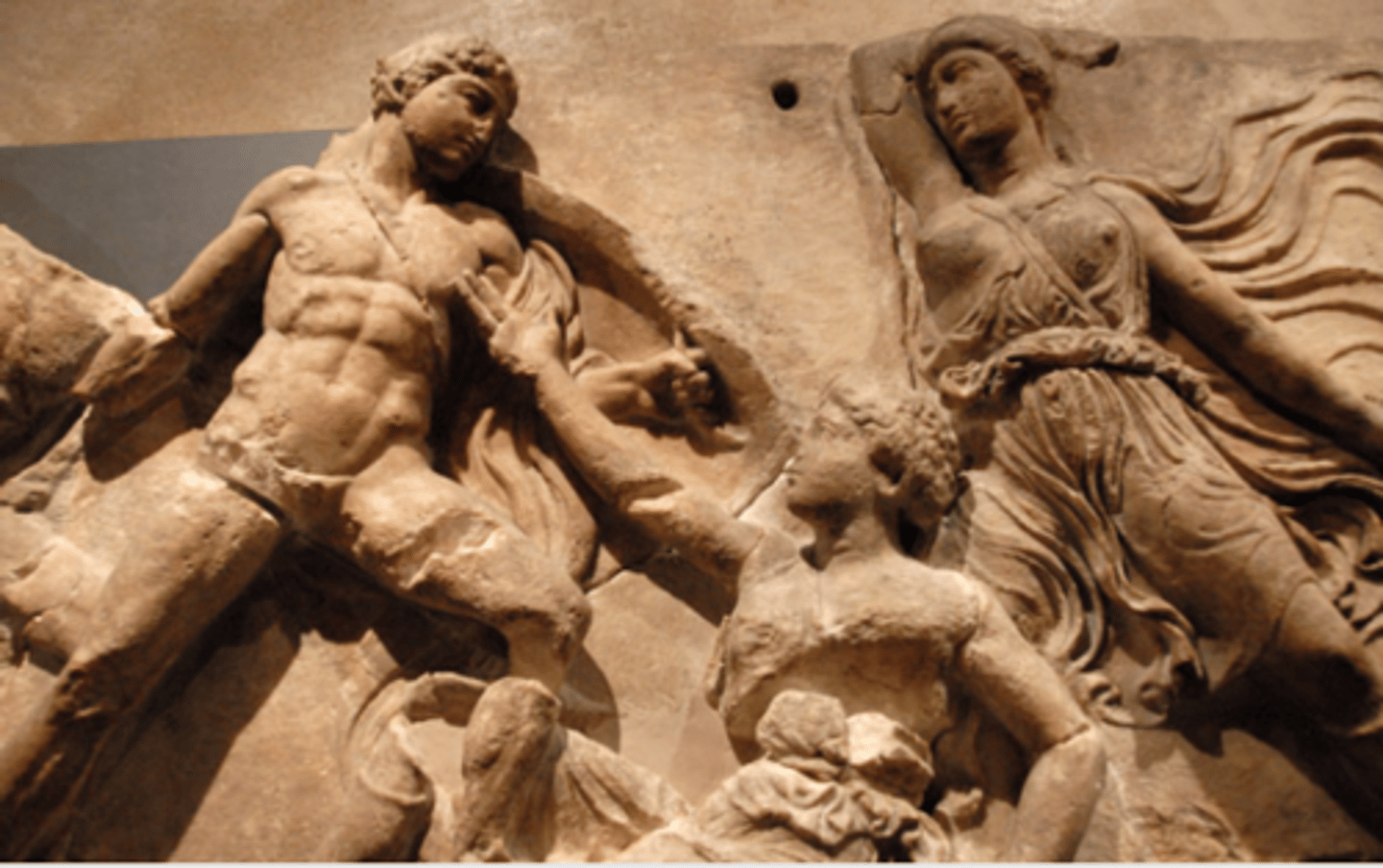
Frieze of the Temple of Apollo at Bassae
5th century BCE, Bassae (Peloponnesian); Greeks and Amazons fighting, shows an Amazon defeating a Greek man on part of it
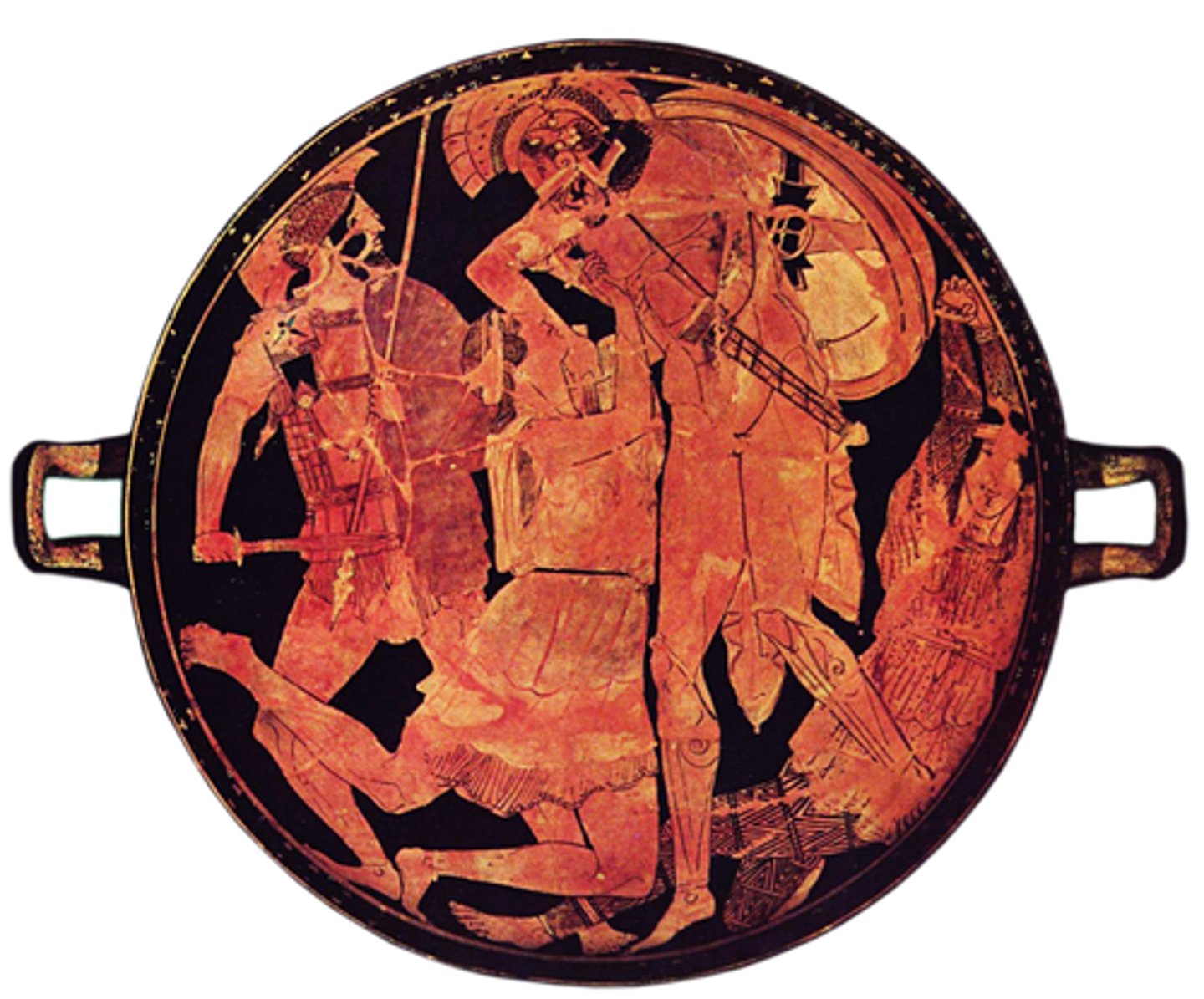
Red-figure kylix of Achilles and Penthesilea
5th century BCE, kylix used at symposia (fascination with Amazons); Achilles standing over Penthesilea killing her, Penthesilea supplication; Amazon on the outside facing forward (striking) with either tattoos or patterned clothes
Red-figure bell-krater of Achilles and Penthesilea
5th century BCE; she is clothed while he is naked, they are at the same eye level and matching poses which suggests some equality however he is the pursuer while she is the pursued; half moon shield
Appeal of the Amazons
To men, desirable maidens; however women also seemed to like them as they are depicted on women's perfume containers and as girls dolls; they were an image of freedom and gender equality
Amazons difference from the Greek women
Nomads, lived outside, sexual freedom, fought
Jason
Modern depiction is that he is unsympathetic, ancient would have been more understanding of him however he still broke an oath to the gods; supposedly wants what was best but Medea suspects he just wants a young, Greek wife; dismissive of women; easily tricked by Medea; blamed for deaths of children by chorus
Creon
Deceived and manipulated by Medea; underestimates Medea by thinking she won't be able to do anything in one day; dies not understanding the poison used on his daughter trying to help her
Aegeus
Swears an oath to protect Medea; she promised him that she would help him conceive with his wife; chorus surprised that he would take a child-killer as it could pollute the city of Athens; understands Medea's side unlike Jason and Creon
Medea family theme
Choral interlude focused on parents anguish; Aegeus wants children; Medea almost wavers because of her love for her children
Medea men and women theme
Jason and Medea clash on ideas of marriage; Medea says marriage is a "plight"; Medea is not trusted because she is a clever woman
Medea gods theme
Both Jason and Medea try to appeal to the gods in their arguments; in the end, Medea appears in her grandfather's (Helios') chariot with gift of prophecy, does she become a god; divine sanction of murder, or is she supposed to be more of an instrument of the gods or a something goddess-like herself the whole time (gods do immoral things)
Euripides' Medea first performance
431 BCE
Medea political context
Athens proud of democracy, so kings (Aegeus and Creon) are weak
Medea gender context
In Athens women could not vote/be elected or divorce their husband; Medea comments on inequality between sexes, saying she would rather fight on the front line 3 children than bear children
Medea as a Barbarian
Jason thinks he did Medea a service by taking her to Greece away from her "primitive" country" and sees Greece as a place of justice and law; use of poisons is 'Barbarian'; "Medea" = Mede, constant reminder of her foreignness; Medea thinks that Jason leaving her because she is foreign; Jason says that no Greek woman would kill her child
Medea as 'non-Barbarian'
Her deception, as Persians were believed to always tell the truth; her magic is never described as foreign; Creon fears Medea for intelligence more than her being foreign; Jason thinks she is 'emotional' and 'irrational' because she is a woman, not because she is barbarian; is her behaviour because she is related to the gods (gods do immoral things)
Sea motif in Medea
Chorus use a sea motif which is a reminder of the distance between Medea's homeland and Grece
Gender and "other"
Medea is a young, intelligent, foreign, woman; Euripides could be using Medea as an outsider as a device to look objectively at Greek marriage (she complains that a woman is powerless, their family have to buy one for her and then she cannot leave and has to have children; on the other hand Medea chose Jason for herself); Medea believes she's speaking for all women
Medea's masculinity
Her anger is heroic and male - "wild bull"; kills children with sword
Medea's femininity
Medea uses manipulation and deceit; poison to kill princess in the end
Medea as barbarian woman
Medea feared for unpredictability, unpredictable because she is a barbarian woman; feared because she is a mystery, in binary opposition a barbarian woman is the opposite of a Greek man