cognitive post stroke
 Call Kai
 Learn
Learn Practice Test
 Spaced Repetition
 Match
Match Flashcards
 Knowt Play
1/21

There's no tags or description
Looks like no tags are added yet.
Name | Mastery | Learn | Test | Matching | Spaced | Call with Kai |
|---|
No analytics yet
Send a link to your students to track their progress
22 Terms
What are the two types of stroke?
A haemorrhagic stroke, and an ischemic stroke
What is a haemorrhagic stroke?
Where blood leaks into brain tissue, creating dangerous pressure
What is an ischemic stroke?
When a blood clot prevents blood supply to an area of the brain
Why are patients more likely to recover from haemorrhagic strokes?
As they do not necessarily result in neuronal death
What is hemineglect?
When a patient neglects an entire side of their visual field - e.g when drawing a clock, every number will be only on the right side
What disorder does hemineglect typically present alongside?
Anosognosia - an inability to recognise the patients own condition
What are the three types of spatial neglect?
Personal neglect, peripersonal neglect, and extrapersonal neglect
Where does personal neglect include?
The contralateral (to the damage) side of the patient’s own body
Where does peripersonal neglect include?
The space immediately surrounding the body, typically within arms reach
Where does extrapersonal neglect include?
The space outside of arms reach, typically in the surrounding environment
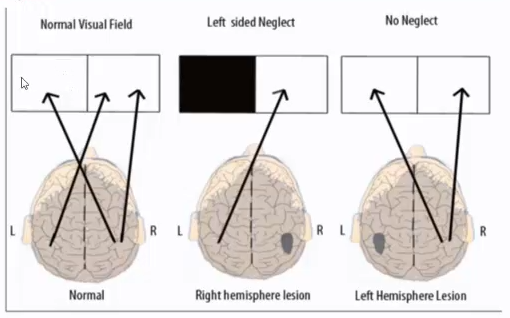
What are the neural correlates of hemineglect?
Since the right hemisphere is responsible for directing attention either side, damage to the right hemisphere will create hemispatial neglect on the left side
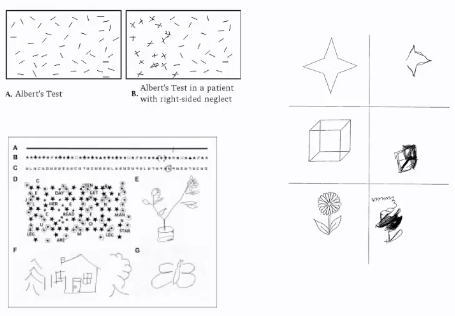
What are tasks used to test for hemineglect?
Bisection of lines, Albert’s test (bisecting lots of lines in a box) or copying figures
What is hemianopia, as opposed to hemineglect?
The inability to see half of the visual field - where patients are aware that they have been physically blinded
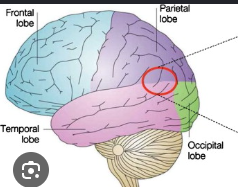
What is the typical lesion causing hemineglect?
A lesion in the right tempoparietal area
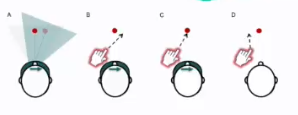
What is prism adaptation?
A treatment for hemineglect, making use of glasses that force the eyes to focus at a different angle than attempted, causing a temporary reduction in symptoms
How is cognitive rehabilitation used to treat hemineglect?
By asking the patient to complete tasks that force them to direct their attention towards the damaged area, making small steps towards improvement
How is brain stimulation used to treat hemineglect?
By creating activation in the damaged areas
How is VR used to treat hemineglect?
VR has not been extensively used, but studies are moving towards its usage as a way to forcibly shift attention
What is apraxia?
A loss of the ability to carry out specific motor actions - e.g understanding how using a toothbrush works, but being unable to physically do it
What are different classifications of apraxia?
Motor output, Speech, constructional, conceptual (use of tools), dressing
What is visual agnosia?
Damage to the area that allows for recognition/identification of objects or the environment - but physical vision remains intact
What is prosopagnosia?
The inability to recognise faces, caused by damage to the face fusiform area