manuf 2
 Call Kai
 Learn
Learn Practice Test
 Spaced Repetition
 Match
Match Flashcards
 Knowt Play
1/62

There's no tags or description
Looks like no tags are added yet.
Name | Mastery | Learn | Test | Matching | Spaced | Call with Kai |
|---|
No analytics yet
Send a link to your students to track their progress
63 Terms
Tablet manufacturing
This involves the compression of materials within a die cavity by the pressure exerted by the movement of 2 punches.
Hopper function in a tablet machine
This holds the materials to be compressed.
Feed shoe function
This transfers materials into the die.
Purpose of the die in tablet manufacturing
This defines the size and shape of the tablet.
Punches in a tablet machine
These compress materials within the die.
Cam tracks
These guide the movement of punches.
Single station tablet machine
This involves compression of the upper punch only.
Multiple station tablet machine
This involves movement of both punches.
Flowability in tablet manufacturing
This facilitates transfer of materials.
Direct compression
This is tablet processing without granulation, requiring good flowability and compressibility.
Punches in a tablet machine
These compress materials within the die.
Cam tracks
These guide the movement of punches.
Single station tablet machine
This involves compression of the upper punch only.
Multiple station tablet machine
This involves movement of both punches.
Direct compression
This is tablet processing without granulation, requiring good flowability and compressibility.
Capping
Partial or complete separation of top or bottom crown due to air entrapment.
Lamination
Separation into 2 or more distinct horizontal layers due to air entrapment.
Cracking
Occurrence in concave tablets; rapid expansion of tablets.
Sticking
Adhesion of material to die wall or face of the punch due to excessive moisture.
Picking
Adhesion of material to the design embedded on the punch tip due to excessive moisture.
Chipping
Removal of a small portion of tablet edges due to lack of binder.
Double Impression
Involves 2 engravings on the surface due to free rotation of punches with engravings on faces.
Mottling
Uneven color distribution due to different color material or improper mixing.
Coating
Application of coating material to a moving bed of solids with concurrent use of heated air.
Pan Pouring
Method for viscous solutions.
Pan Spraying
Method that increases efficiency of the coating process.
Standard Coating Pan
Consists of a rotating circular metal pan with ducts (e.g., Peiligrini Pan; immersion tube/sword system).
Perforated Coating Pan
Heated air is exhausted through the perforations in the drum (e.g., Accela-Cota Pan; Driacotter; Giat Coater).
Sugar Coating
The oldest method of coating, involving successive coating of a sucrose-based solution.
Steps of Coating
Include sealing, subcoating, smoothing, color coating, and polishing.
Film Coating
Involves deposition of a thin film of polymer around the tablet core.
Film Former
Produces smooth, thin films.
Examples of Film Formers
Non-enteric: celluloses, methacrylate, PVA, PVP; Enteric: shellac, CAP, PVAP, salol.
Plasticizer
Produces flexibility and elasticity.
Examples of Plasticizers
Castor oil, glycerin.
Surfactant
Enhances spreadability of the film.
Example of Surfactant
Polysorbates (Tween).
Alloying Substance
Provides water solubility/permeability to the film.
Glossant
Provides luster or shine to the tablets without a separate polishing operation.
Volatile Solvent/Vehicle
Allows the spread of the other components over the tablets.
Example of Volatile Solvent/Vehicle
Alcohol + acetone.
Mottling
Uneven color distribution due to poor mixing, uneven spray patterns, or migration of additives during drying.
Sweating
Oily film or droplets of liquid due to humid conditions.
Bridging
Markings are obscured due to coating solution filling in the logo of the tablet.
Erosion
Removal of coating from the tablet surface due to friction among themselves.
Cratering
Crater appear exposing the tablet surface due to disruption of coating at the crown when the surface is more porous.
Blistering
Reduced adhesion and detachment of the film due to entrapment of gases underneath the film.
Blooming
Fading or dulling of the film due to high concentration and low MW of plasticizer.
Blushing
Whitish specks or haziness of the film due to precipitation of polymer at high temperature.
Twinning
Two tablets stick together due to inappropriate tablet shape or tracky coating formulation.
Orange Peel
Rough, non-glossy film surface due to inadequate spreading; remedy: add polysorbate surfactant.
Flaking
Type I – due to thermal expansion of tablet cores caused by over drying; Type II – due to core swelling caused by excessive moisture uptake.
Delayed Distribution
Associated with the exposure of tablet cores to coating process conditions rather than a direct effect of the applied coating.
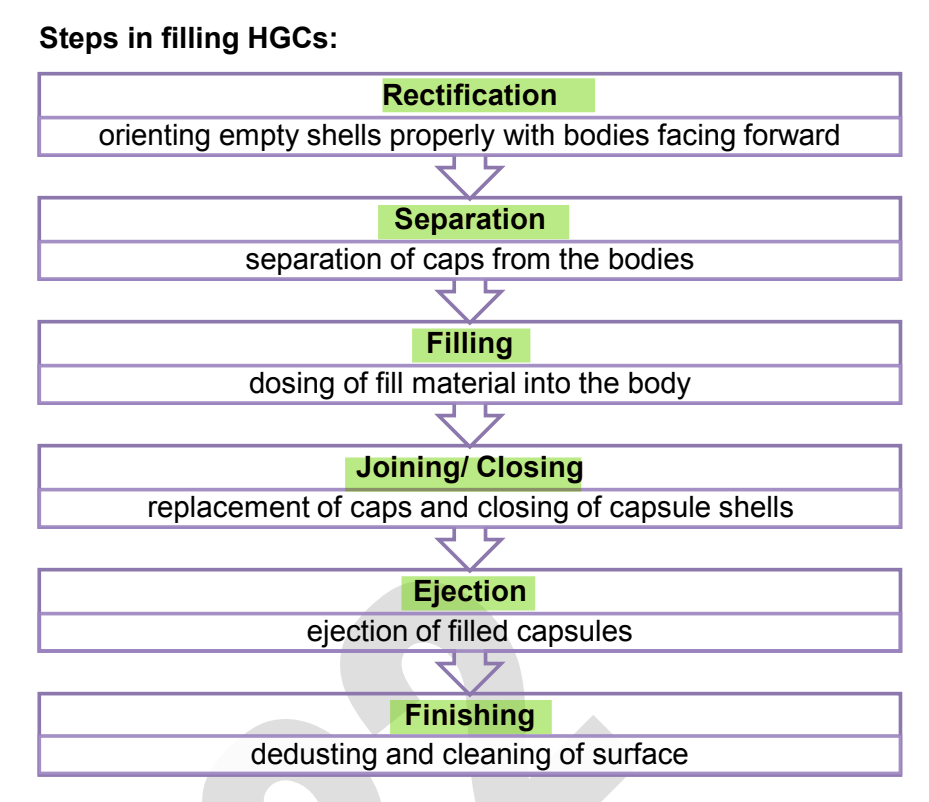
Pin method/Reciprocating die method
Method ± most common method of manufacturing HGCs
Sealing
The process that involves methods to securely close gelatin capsules.
Gelatin Banding
Seals with a band of gelatin.
Heat Welding
Fuses cap to body through double wall thickness.
Thermal Coupling
Uses liquid wetting agent to lower melting point between cap and body then bonds.
Coating
Modifies solubility characteristics of the capsule (e.g., shellac, cellulose acetate phthalate, salol).
Soft Gelatin Capsules (SGC)
Formed, filled, and sealed in a single operation.
Plate Process
The oldest method which uses gelatin sheets.
Rotary Die Process
Uses gelatin ribbons brought together between 2 rotating dies.
Reciprocating Die Process
Uses gelatin ribbons brought together between 2 rotating dies.