Populations in ecosystems
 Call Kai
 Learn
Learn Practice Test
 Spaced Repetition
 Match
Match Flashcards
 Knowt Play
1/39

Earn XP
Description and Tags
Name | Mastery | Learn | Test | Matching | Spaced | Call with Kai |
|---|
No analytics yet
Send a link to your students to track their progress
40 Terms
Define population.
A group of organisms of the same species living in the same area at the same time that can interbreed to produce fertile offspring.
Define habitat.
The specific area within an ecosystem in which an organism lives.
Define community.
All the individuals of all the species in the same area at the same time.
Define niche.
An organisms role within an ecosystem.
Define ecosystem.
The community and the abiotic factors of an environment at a particular time.
Define carrying capacity.
The maximum population size an ecosystem can support.
Define abiotic factors.
Non-living conditions of an ecosystem.
Define biotic factors.
The impact of the interactions between organisms within an ecosystem.
List six abiotic factors.
Light intensity.
Oxygen concentration.
Carbon dioxide concentration.
Soil pH.
Soil conditions.
Temperature.
How do adaptations that make organisms adapted to the abiotic factors of their ecosystem develop over time?
Through natural selection.
True or false? The less harsh the abiotic factors, the larger the range of species and the larger the population sizes.
True.
Give two examples of biotic factors.
Competition.
Predation.
Name the two types of competition.
Interspecific competition.
Intraspecific competition.
What is interspecific competition?
When members of different species are in competition for the same resource that is in limited supply.
Who is more likely to win in interspecific competition?
The individual who is better adapted to the environment.
What is intraspecific competition?
When members of the same species are in competition for resources in limited supply and a mate.
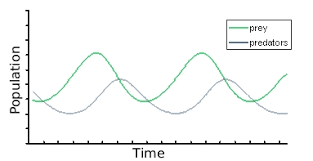
True or false? There will always be more predators than prey.
False. THERE WILL ALWAYS BE MORE PREY THAN PREDATORS.
Sketch a predator-prey graph.
Why is random sampling used when estimating population sizes in uniform areas?
Random sampling avoids bias.
When is systematic sampling used when estimating population size?
If the area is non-uniform as there is change over distance.
Using a transect line is an example of what type of sampling?
Systematic sampling.
How can you ensure your results are representative of the population?
Take large samples (that are big enough to represent the population, usually 30+).
What sampling method would you use to estimate the population size of slow-moving or non-motile organisms?
Quadrats.
What method would you use to estimate the population size of motile organisms?
The mark-release-recapture method.
Talk me through how you would use quadrats to estimate a population size.
1) Use tape measures to plot coordinates out on the area.
2) Use a computer to randomly generate at least 30 coordinates.
3) Place a quadrat on each coordinate.
4) Work out the frequency of each organism/percentage cover of the organism in each quadrat.
5) Calculate a mean average for your results.
6) Use tape measures to work out the area of the area.
7) Multiply the mean result by the number of quadrats that would fit into the area of the area, this value is the population size estimation.
Give two areas where you would use a line transect to estimate population size.
Rocky and sandy beach shores.
Across rivers.
What is different between a belt transect and an interrupted belt transect?
Quadrats are placed along every point on a belt transect while quadrats are placed at uniform intervals along an interrupted belt transect.
Talk me through how you would estimate population size using an interrupted belt transect.
1) Place a tape measure at a right angle along the area.
2) Place a quadrat every x amount of distance (same distance between each quadrat).
3) Collect the density/percentage cover/frequency in each quadrat.
4) Repeat steps 1-3 a large number of times.
Talk me through how you would use the mark-release-recapture method to estimate the population size of a motile species.
1) Capture an initial sample of the population.
2) Mark every individual in the initial sample with a weather-resistant mark.
3) Release every individual in the initial sample.
4) Wait for a period of time while those in the initial sample randomly disperse throughout the habitat.
5) Capture a second sample of the population.
6) Record the total number of individuals in the second sample who are marked.
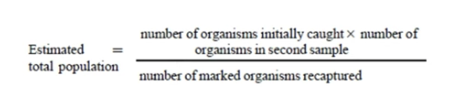
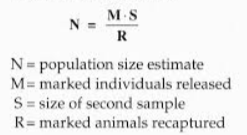
7) Work out the population size using the assumption that the proportion of individuals marked in the second sample is the same as the proportion of those marked in the population.
8) Repeat this several times to increase the reliability of your results.
Give the equation used to estimate population size when following the mark-release-recapture method.
What must you take into account when marking individuals for ethical reasons?
Cause no permanent harm.
Use a non-toxic marker.
Use a marker that does not increase chances of predation.
Use a marker that does not reduce chances of reproduction.
Give four assumptions you make when using the mark-release-recapture method to estimate population size.
No death.
No birth.
No migration.
The organisms always redistribute evenly.
Why might organisms that have been marked not redistribute evenly after being release?
They might all stay nearer to where food or water is concentrated.
Define succession.
The change in an ecological community over time.
What are pioneer species often?
Species that can survive in harsh abiotic factors.
Talk me through the process of succession.
1) Primary succession: a pioneer species colonises a hostile area.
2) When the pioneer species die they change the environment, leaving humus (a thin layer of soil) that makes the environment less harsh.
3) Increase in biodiversity.
4) Secondary succession: a different species colonises the now more hospitable environment.
5) This continues, each time the environment being made less harsh by the previous colonisers (that were outcompeted by a new species colonising), until climax community (dominated by trees) is reached.
True or false? Succession increases biodiversity (both species richness and number of organisms).
True.
Why is succession often managed?
To conserve habitats.
How does managing succession conserve habitats?
When earlier stages of succession are maintained, climax community being reached is prevented, this means a greater variety of habitats is conserved and therefore a greater range of species.
How is succession managed in woodland in a way that also benefits human needs?
Trees are coppiced so that we can obtain wood, leave some wood for organisms to inhabit, and allow the three to continue growing.