Exam Two | American History 1877-Present
 Call Kai
 Learn
Learn Practice Test
 Spaced Repetition
 Match
Match Flashcards
 Knowt Play
1/267

There's no tags or description
Looks like no tags are added yet.
Name | Mastery | Learn | Test | Matching | Spaced | Call with Kai |
|---|
No analytics yet
Send a link to your students to track their progress
268 Terms
Ida B. Wells
An American investigative journalist, educator, and early leader in the civil rights movement.
Plessy v. Ferguson
A landmark decision that upheld the constitutionality of racial segregation laws for public facilities.
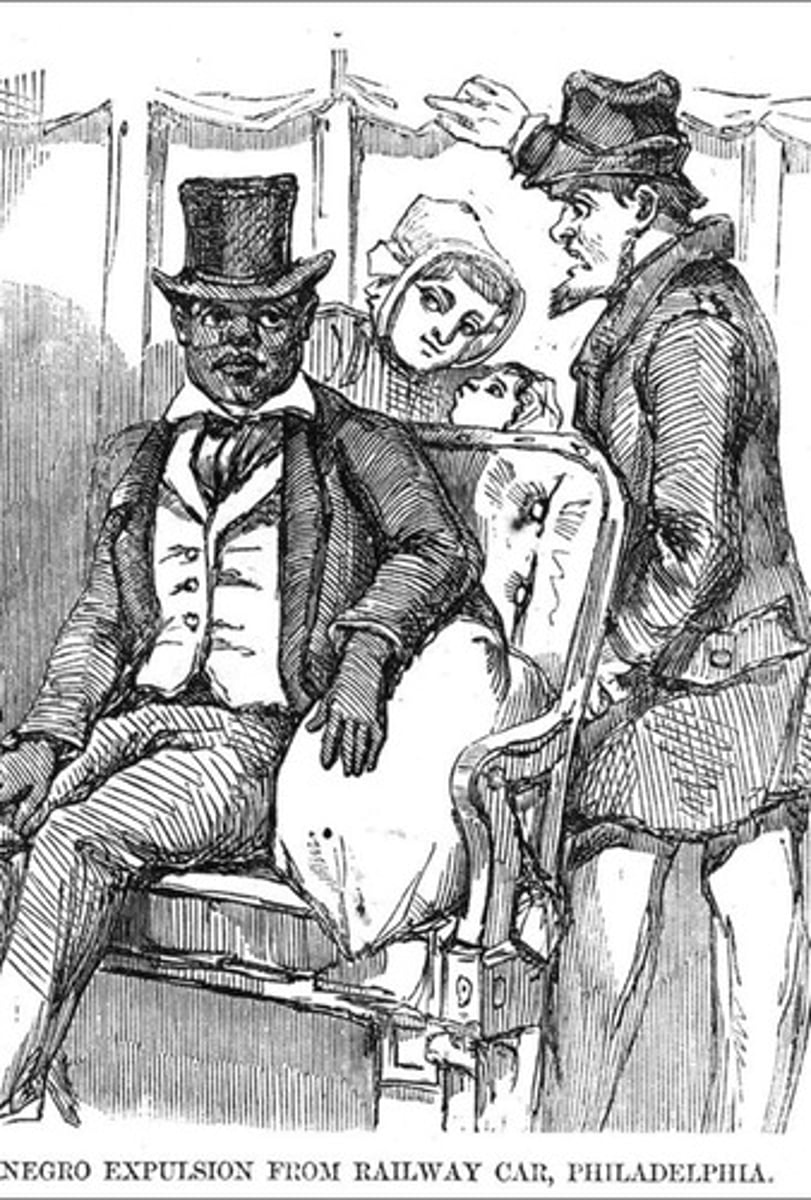
Separate but equal
A doctrine established by Plessy v. Ferguson that allowed racial segregation as long as facilities were equal.
Brown v. Board of Education
A 1954 Supreme Court case that held the 'separate but equal' doctrine unconstitutional in public schools.
Insular Cases
A series of Supreme Court opinions in 1901 about the status of U.S. territories acquired in the Spanish-American War.
Downes v. Bidwell
A case that referred to inhabitants of insular areas as 'alien races' and suggested administration of them may be 'impossible'.
Wilmington Insurrection of 1898
A coup d'état and massacre carried out by white supremacists to overthrow a biracial government in Wilmington.
Isaac Woodard
An African American WWII veteran who was attacked by police, sparking national outrage and galvanizing the civil rights movement.
Executive Order 9981
An order issued by President Truman that abolished discrimination in the United States Armed Forces.
Groveland Four
Four African American men wrongfully accused of rape in 1949, leading to serious questions about their treatment and convictions.
Thurgood Marshall
The first African-American Associate Justice of the Supreme Court, serving from 1967 to 1991.
Harry and Harriet Moore
Pioneer activists and the first martyrs of the Civil Rights Movement, killed in a bombing in 1951.
Civil Rights Movement
A social movement in the United States aimed at ending racial discrimination and promoting equal rights.
Vietnam War
A conflict that led to public disillusionment and contributed to the development of the counterculture movement.
Counterculture Movement
A social movement that defined itself in opposition to the norms of mainstream American society during the 1960s.
Thawing of the Cold War
A period characterized by improved relations between the U.S. and USSR, leading to significant geopolitical changes.
Space Race
A competition between the U.S. and USSR during the Cold War to achieve significant milestones in space exploration.
Richard Nixon
The 37th President of the United States, known for his landslide re-election and subsequent resignation.
Racial Segregation
The enforced separation of different racial groups in a country, particularly prevalent in the U.S. South post-Civil War.
Disenfranchisement
The removal of the right to vote from a group, often used against African Americans in the South after Reconstruction.
NAACP
The National Association for the Advancement of Colored People, founded to combat racial prejudice and advocate for civil rights.
Civil Rights Bill
Legislation aimed at ending discrimination based on race, color, religion, sex, or national origin.
Federal Investigation
An inquiry conducted by federal authorities, often in response to civil rights violations or injustices.
All-White Jury
A jury composed solely of white individuals, often criticized for bias in cases involving racial minorities.
Posthumous Exoneration
The act of officially clearing a person's name after their death, often due to wrongful convictions.
Moral Priority
A principle or issue considered of utmost importance in ethical discussions, particularly in civil rights contexts.
Board of Education of Topeka (1954)
A landmark decision of the U.S. Supreme Court ruling that racial segregation in public schools is unconstitutional.
Little Rock Nine
A group of nine African American students enrolled in Little Rock Central High School in 1957, facing racial segregation.
Little Rock Crisis
The event where the Little Rock Nine were initially prevented from entering the racially segregated school by Governor Orval Faubus.
Executive Order 10730
Issued by President Eisenhower, federalizing the Arkansas National Guard to support the integration of Little Rock Central High School.
Emmet Till (1941-1955)
A 14-year-old African American lynched in Mississippi in 1955, becoming an icon of the Civil Rights Movement.
Montgomery Bus Boycott
A protest campaign against racial segregation on public transit in Montgomery, Alabama, lasting from December 5, 1955, to December 20, 1956.
Ralph Abernathy (1926-1990)
An American civil rights activist and close friend of Martin Luther King Jr., co-founder of the Southern Christian Leadership Conference.
Greensboro Sit-Ins
Nonviolent protests in Greensboro, North Carolina, in 1960 that led to the removal of racial segregation policies at Woolworth stores.
Freedom Riders
Civil rights activists who rode interstate buses into the segregated southern U.S. in 1961 to challenge non-enforcement of Supreme Court rulings.
Morgan v. Virginia (1946)
A Supreme Court decision ruling that segregated public buses were unconstitutional.
Boynton v. Virginia (1960)
A Supreme Court decision reinforcing that segregation on public buses is unconstitutional.
Executive Order 10925
Signed by President John F. Kennedy, requiring government contractors to take affirmative action regarding employment without racial discrimination.
George Wallace (1919-1998)
The 45th Governor of Alabama known for his staunch segregationist views and opposition to desegregation during the Civil Rights Movement.
Wallace's Stand in the Schoolhouse Door
An event where George Wallace attempted to block the entry of two African American students at the University of Alabama on June 11, 1963.
Executive Order 11111
Issued by President John F. Kennedy to federalize the Alabama National Guard during Wallace's Stand in the Schoolhouse Door.
Medgar Evers (1925-1963)
A civil rights activist from Mississippi who was assassinated in 1963 after advocating for desegregation at the University of Mississippi.
Rosa Parks (1913-2005)
An African-American woman whose arrest for refusing to give up her bus seat sparked the Montgomery Bus Boycott.
Browder v. Gayle
A federal ruling that declared the segregation laws of Alabama and Montgomery unconstitutional.
Civil Rights Acts of 1964 and 1965
Legislation aimed at ending discrimination based on race, color, religion, sex, or national origin.
Jim Crow Laws
State and local laws enforcing racial segregation in the Southern United States.
Poor People's Campaign
A movement led by Ralph Abernathy after Martin Luther King Jr.'s assassination to address economic injustice.
National sentiment
The collective attitudes and beliefs of the public, particularly regarding social issues like civil rights.
Segregation
The enforced separation of different racial groups in a country, community, or establishment.
Integration
The process of ending the separation of two groups, typically referring to racial groups in schools and public facilities.
Civil disobedience
The active refusal to obey certain laws or commands of a government, often in a peaceful manner.
Nonviolent protests
Demonstrations that do not involve physical violence, aimed at achieving social or political change.
Malcolm X
Activist and public voice of the Black Muslim faith who challenged the civil rights movement.
Malcolm X's original name
Malcolm Little, changed to X to signify rejection of his 'slave' name.
Nation of Islam
A religious movement combining Islam with black nationalism, encouraging young blacks.
The Autobiography of Malcolm X
Bestselling book that popularized Malcolm X's ideas and influenced the Black Power movement.
1963 Birmingham Campaign
Movement by SCLC to highlight integration efforts in Birmingham, Alabama.
Eugene Bull Connor
Birmingham Police Department leader who used high-pressure hoses and dogs against protesters.
Letter from a Birmingham Jail
Open letter by Martin Luther King Jr. defending nonviolent resistance to racism.
Bayard Rustin
African-American leader in civil rights, socialism, and nonviolence, organizer of the March on Washington.
Rustin's sexuality
Rustin was a gay man who faced criticism and often worked behind the scenes.
March on Washington
Event on August 28, 1963, demonstrating support for civil rights legislation proposed by Kennedy.
16th Street Baptist Church Bombing
Terrorist act by the Ku Klux Klan that killed four girls in Birmingham, Alabama, in 1963.
Civil Rights Act of 1964
Legislation that ended segregation in public places and banned employment discrimination.
November 22, 1963
Date when President Kennedy was assassinated by Lee Harvey Oswald in Dallas, Texas.
Lyndon B. Johnson
President who assumed office after Kennedy's assassination and launched the Great Society.
Great Society
Set of domestic programs aimed at eliminating poverty and racial injustice, launched by Johnson.
St. Augustine Movement
Civil rights protests in St. Augustine, Florida, influencing the passage of the 1964 Civil Rights Act.
Barry Goldwater
U.S. Senator known for fiscal conservatism and opposition to Communism, nominated in 1964.
Goldwater's book
The Conscience of a Conservative, which publicized his views against Communism.
Johnson's campaign strategy
Used groundbreaking TV ads to address voter anxieties during the 1964 election.
Goldwater's election outcome
Lost the 1964 election to Johnson but won Arizona and five Southern states.
Freedom Rides
Civil rights actions aimed at desegregating interstate bus travel.
Southern Christian Leadership Conference (SCLC)
Civil rights organization founded to coordinate nonviolent protests against segregation.
Humanitarian missions
Efforts by Rustin in the 1970s and 1980s to aid refugees from Vietnam and Cambodia.
Presidential Medal of Freedom
Award posthumously given to Rustin by President Obama in 2013.
Impact of the Birmingham Campaign
Led to changes in the city's discrimination laws and increased national attention on civil rights.
Political Watershed
The 1968 election was the turning point, marking the South as a dependable Republican stronghold.
Selma to Montgomery Marches
Three protest marches in 1965 organized to demonstrate African-American citizens' desire to vote.
Voting Rights Act of 1965
A landmark federal legislation that prohibits racial discrimination in voting.
General Provisions of Voting Rights Act
Provide nationwide protections for voting rights and prohibit discriminatory voting laws.
Section 2 of Voting Rights Act
Prohibits any voting law that results in discrimination against racial or language minorities.
Loving v. Virginia (1967)
A Supreme Court decision that struck down laws banning interracial marriage.
French Indo-China War
Conflict in French Indochina from December 19, 1946, to July 20, 1954, between French forces and the Việt Minh.
Ho Chi Minh
A Vietnamese Communist revolutionary leader who established the Democratic Republic of Vietnam.
Republic of Vietnam
Proclaimed on October 26, 1955, with Ngô Đình Diệm as its first president.
Democratic Republic of Vietnam
Attempted to unify Vietnam by force during the Vietnam War (1955-75).
1963 South Vietnamese Coup
President Ngô Đình Diệm was deposed by Army officers due to his handling of the Buddhist Crisis.
Gulf of Tonkin Incident
August 2, 1964, incident involving the USS Maddox and North Vietnamese torpedo boats.
Gulf of Tonkin Resolution
Granted President Johnson authority to assist Southeast Asian countries against 'communist aggression.'
Operation Rolling Thunder
Aerial bombardment campaign against North Vietnam from March 1965 to November 1968.
Tet Offensive
A large military campaign launched on January 30, 1968, by Viet Cong and North Vietnamese forces.
My Lai Massacre
The mass killing of nearly 500 unarmed civilians in South Vietnam by U.S. Army soldiers on March 16, 1968.
Constitutional Right to Vote
The right guaranteed by the Constitution for citizens to participate in elections.
Racial Integrity Act of 1924
Virginia law that criminalized interracial marriage, leading to Loving v. Virginia case.
Việt Minh
A communist-led independence movement in Vietnam, founded by Ho Chi Minh.
Socialist Republic of Vietnam
Formed in 1976 after the unification of North and South Vietnam.
U.S. Department of Justice
Federal agency that considers the Voting Rights Act the most effective civil rights legislation.
Buddhist Crisis
A series of protests in South Vietnam against the Diệm regime's treatment of Buddhists.
Communist Insurgency
The armed struggle by communist forces in South Vietnam against the government and U.S. forces.