Cardio Exam 3
 Call Kai
 Learn
Learn Practice Test
 Spaced Repetition
 Match
Match Flashcards
 Knowt Play
1/86

There's no tags or description
Looks like no tags are added yet.
Name | Mastery | Learn | Test | Matching | Spaced | Call with Kai |
|---|
No analytics yet
Send a link to your students to track their progress
87 Terms
A positive (i.e., upright) P wave before each QRS
complex, P waves that look alike, A constant PR interval, A regular atrial and ventricular rhythm (usually), are characteristics of a wave that begins in the _____ node
SA
the name given to a normal heart rhythm
sinus
In adults and adolescents, the SA node usually fires at a regular rate of____________ beats per minute
60-100
If the SA node fires at a rate slower than normal for the patient’s age, the rhythm is called
sinus bradycardia
Rate less than 40 beats/min
severe sinus bradycardia
sinus bradycardia occurs during
sleep
sinus bradycardia is common in what group of patients
well-conditioned athletes
if sinus bradycardia is asymptomatic, what is the treatment
no treatment
Blocks chemicals at endings of vagus nerves, allows more sympathetic activity
atropine
If the SA node fires at a rate faster than normal for the patient’s age, the rhythm is called
sinus tachycardia
Looks like a sinus rhythm only faster, at very fast rates, it may be hard to tell the difference
between a P wave and T wave describes
sinus tachycardia
Occurs for no apparent physiologic cause, heart rate may rapidly increase to more than 100 beats/min with minimal exertion, at rest, or both. Accompanying symptoms are usually nonspecific.
inappropriate sinus tachycardia
which sinus tachycardia treatment is directed towards correcting the underlying cause
physiologic
which sinus tachycardia treatment is directed towards lifestyle modifications
inapporpriate
When the SA node fires irregularly, the resulting rhythm is called
sinus arrhythmia
Associated with the phases of breathing and changes in intrathoracic pressure
respiratory sinus arrythmia
Associated with phases of breathing and changes in intrathoracic pressure. Most commonly observed in children and young adults
respiratory sinus arrhythmia
Can be seen in people with normal hearts but is more likely to be found in older individuals and in those with heart disease. Common after inferior wall MI. May be seen with increased intracranial pressure. May be a result of the effects of medications or carotid sinus pressure
nonrespiratory sinus arrythmia
does sinus arrythmia usually require treatment
no
if sinus arrythmia is associate with hemodynamic compromise what treatment can be used
IV atropine
Disorder of impulse conduction, SA node generates impulses, impulses are blocked as they exit the SA node, results in periodically absent PQRST complexes
sinoatrial block
what medications cause sinoatrial block
Digitalis, quinidine, procainamide, or salicylates
if hemodynamic compromise is present with a sinoatrial block, besides atropine what can be done to treat?
pacemaker
Disorder of impulse formation. The SA node’s pacemaker cells do not initiate an
electrical impulse for one or more beats, results in absent PQRST complexes
sinus arrest
Most often affects adults over age 70, usually related to degenerative SA node tissue
changes. On the ECG, ________ can appear as alternating patterns of bradycardia and tachycardia (bradycardia-tachycardia syndrome) or skipped beats caused by episodes of SA block or sinus arrest
sick sinus syndrome
diagnosis of SSS usually requires ______ monitoring
Holter
glucose normal range
70-110 g/dL
BUN normal range
7-25
creatinine normal range
0.2-1.5 mg/dL
sodium normal range
135-145 (mEq/L)
Potassium normal range
3.5-5.0 mmol/L
troponin normal range
3-54 pg/ml
normal WBC
5.0-10.0 thousand
normal RBC
4.2-6.2 mil
normal hemoglobin count for women
12-16 g/dL
normal hemoglobin count for men
14-18 g/dL
normal hematocrit
36-53%
normal platelet count
150-450 thousand
normal activated partial thromboplastin time range
24-40
normal prothrombin time range
10.4-13.0
average international normalized ratio range
0.75-1.2
average pH
7.35-7.45
normal pCO2
35-45 mmHg
normal paO2
80-100 mmHg
normal HCO3
21-28 mmol/L
normal O2 stat
94-100%
Altered automaticity and triggered activity are disorders in impulse ________
formation
Reentry is a disorder in impulse _________
conduction
T or F: most atrial dysrhythmias are life threatening
false
Premature beats are identified by their ______ _ _____
site of origin
PACs stands for
premature atrial complexes
PJCs stand for
premature junction complexes
PVCs stand for
premature ventricular complexes
two premature beats in a row
couplet
three or more premature beats in a row
runs or bursts
every other beat is premature
bigeminy
every third beat is a premature beat
trigeminy
every fourth beat is a premature beat
quadrigeminy
Occur when an irritable site within the atria discharges before the next SA node impulse is due to discharge
PAC
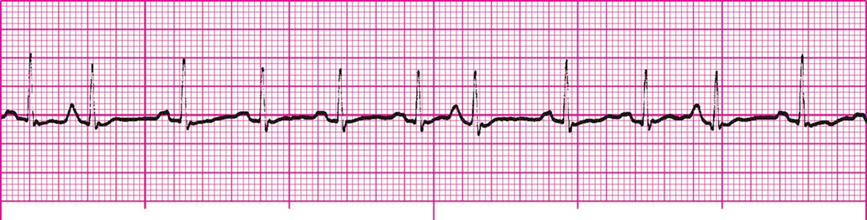
PAC ECG
A ____________ pause is present if the period between the complex before and after a premature beat is the same as two normal R-R intervals
compensatory
• Early (premature) P waves
• Positive (upright) P waves (in lead II) that differ in shape from sinus P waves
• Early P waves that may or may not be followed by a QRS complex
PACs (premature atrial contraction)
PACs associated with a wide-QRS complex are called
aberrantly conducted
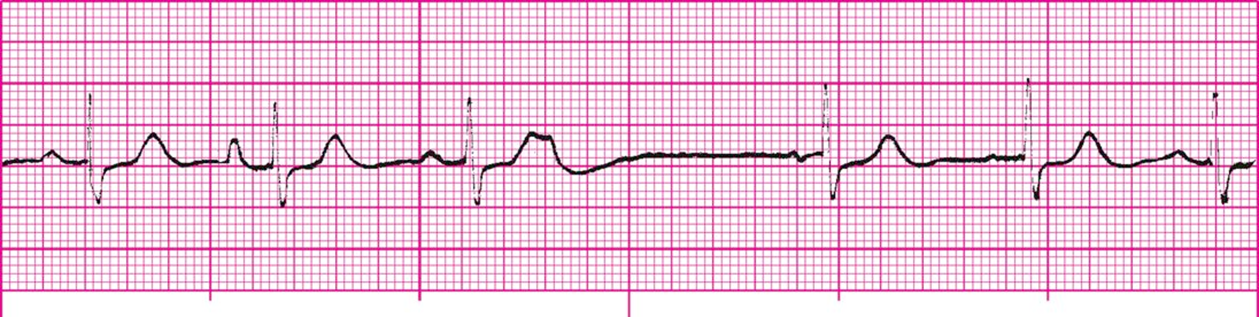
blocked or nonconducted PAC
When wandering atrial pacemaker is associated with a ventricular rate faster than 100 beats/min, the rhythm is called
multifocal atrial tachycardia
Exact mechanism of ________ is unknown but may involve altered automaticity or triggered activity
MAT (multifocal atrial tachycardia)
begin above the bundle of His; include rhythms that begin in the SA node, atrial tissue, or the AV junction. rhythms with a ventricular rate faster than 100 beats/min at rest
supraventricular tachycardia
T or F: Some SVTs need the AV node to sustain the rhythm, and some do not
true
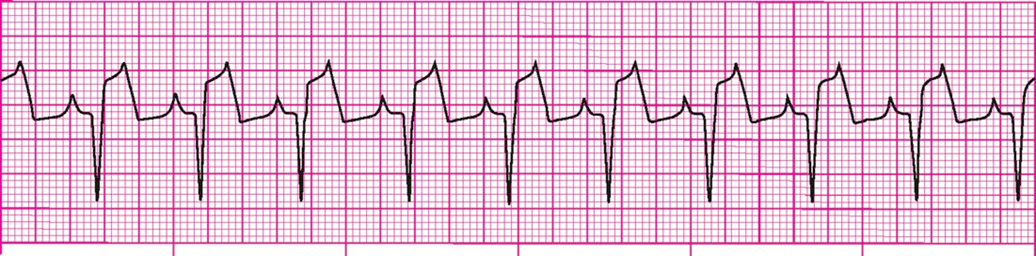
atrial tachycardia with 2:1 block
Carotid sinus massage, Application of a cold stimulus to the face, and Valsalva maneuver are all considered _______ maneuvers
vagal
What medication can interrupt reentry pathways involving the AV node, Rapid onset of action, short half-life
adenosine
Delivery of an electrical shock to the heart timed to occur during QRS
synchronized cardioversion
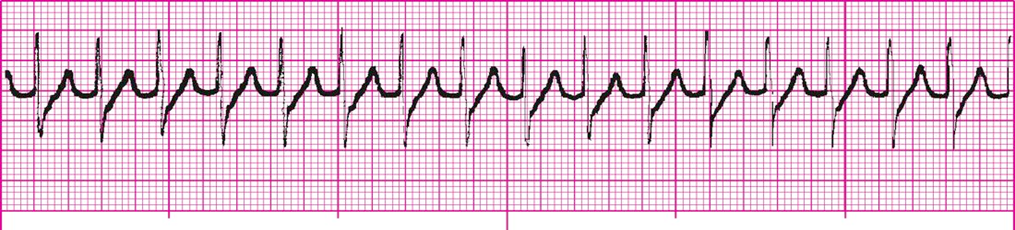
atrial ventricular nonreentrant tachycardia (AVNRT)
Results from a reentry circuit that uses two separate pathways leading into the AV node
AV node reentrant tachycardia
Ectopic atrial rhythm in which an irritable site within the atria fires regularly at a very rapid rate
atrial flutter
Occurs because of altered automaticity in one or several rapidly firing sites in the atria or reentry involving one or more circuits in the atria
atrial fibrilation
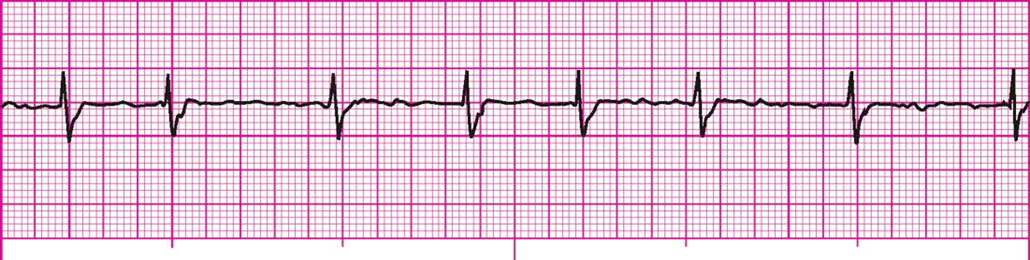
A-fib
Ventricular rhythm usually irregularly irregular
Atrial rate usually 300 to 600 beats/min; ventricular rate variable
No identifiable P waves, fibrillatory waves present; erratic, wavy baseline
PR interval: Not measurable
QRS duration: 0.11 second or less unless abnormally conducted
A-fib
If the ventricles function as the heart’s pacemaker, they typically generate impulses at a rate of
20-40 bpm
Ventricular beats and rhythms are typically characterized by_____ ______ that are abnormally shaped and longer than normal Ventricular Depolarization
QRS complexes
Occurs earlier than the next expected beat of the underlying rhythm, QRS width is typically 0.12 second or greater, T wave is usually in the opposite direction of the QRS complex
premature ventricular complex
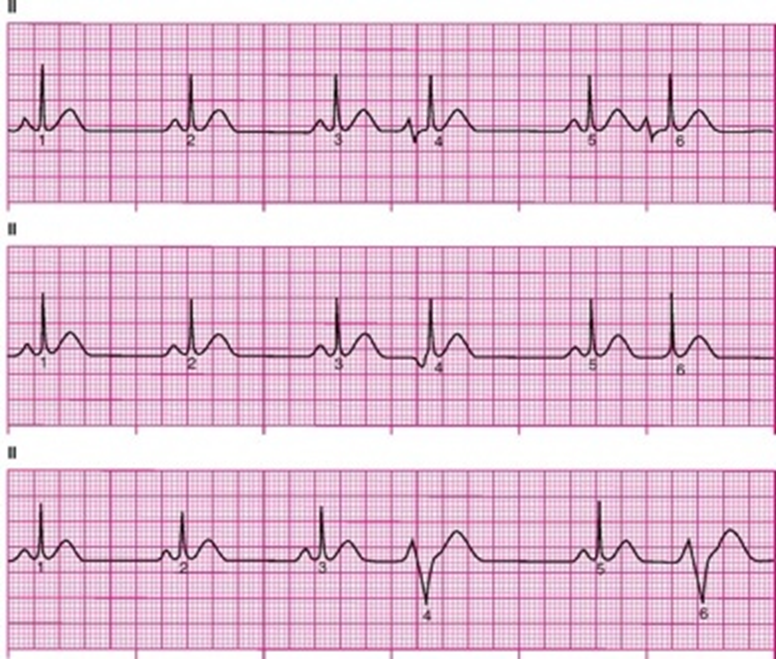
C shows
PVC
Result from an electrical impulse from a supraventricular site firing at the same time as an ectopic site in the ventricles. Do not resemble normally conducted beats, nor do they resemble true ventricular beats
fusion beats
every other beat is a PVC
Ventricular bigeminy
every third beat is a PVC
Ventricular trigeminy
Premature ventricular beats that look the same in the same lead and originate from the same anatomical site (focus)
PVC