The Circulatory System
 Call Kai
 Learn
Learn Practice Test
 Spaced Repetition
 Match
Match Flashcards
 Knowt Play
1/15

There's no tags or description
Looks like no tags are added yet.
Name | Mastery | Learn | Test | Matching | Spaced | Call with Kai |
|---|
No analytics yet
Send a link to your students to track their progress
16 Terms
Why do mammals need mass transport systems?
Need oxygen and glucose to produce energy in aerobic respiration. Small organisms, e.g. bacteria, obtain this by diffusion bc of short diffusion distance. In multicellular, diffusion distance too large and slow.
What is an open circulatory system?
Not enclosed in blood vessels
E.g. insects → blood flows out of heart and into body cavity
What is a closed circulatory system?
Blood is enclosed inside blood vessels
e.g. All vertebrates
Arteries take blood away from heart and towards organs. Substance move between bloodstream and tissues at capillaries
Veins take blood from tissues back to heart
Waht is a single circulation?
Blood travels in one loop → pass through heart once
i.e. fish, heart pumps blood to gills, then body tissues, then heart
What is a double circulation?
Blood travels in two loops
Heart → lungs → heart → body
2 loops are known as pulmonary system (to lungs) and systemic system (to body)
What is the structure and function of arteries?
Carry blood away from heart to organs
Thick muscular wall, elastic tissues → cope with high pressure
Endothelium is folded, withstand high pressure
Small lumen
What is the structure and function of veins?
Carry blood from organs to heart
Lower pressure, so has large lumen and thinner walls
Valves prevent blood from flowing back
What is the structure and function of capillaries?
Connect arteries and veins
Substances move out of blood to tissues, e.g. Oxygen, glucose, mineral ions. Waste products move out of tissues and into capillaries
Small pores
One cell thick
What happens at the arteriole end of the capillary in the formation of tissue fluid?
Arteriole end of capillary → hydrostatic pressure in capillary exceeds that of tissue fluid
Forces fluid and dissolved substances out of capillary down pressure gradient and into space around cells
Forms tissue fluid
What happens at the venule end of the capillary in the formation of tissue fluid?
Less water because it moved out of capillary at arteriole end
Water potential lower inside capillary compared to tissue fluid
Water moves back into capillary by osmosis down a water potential gradient
What happens to excess tissue fluid?
Drains into lymphatic system which eventually returns the fluid back into the bloodstream
What’s on the left side of the heart?
Thicker wall
Pulmonary vein
Semilunar valve
Aorta
Deliver blood all around the body
Carries oxygenated blood
Whats on the right of the heart?
Pulmonary artery
Atrioventricular valve
Vena cava
Carry blood to lungs
Carries deoxygenated blood
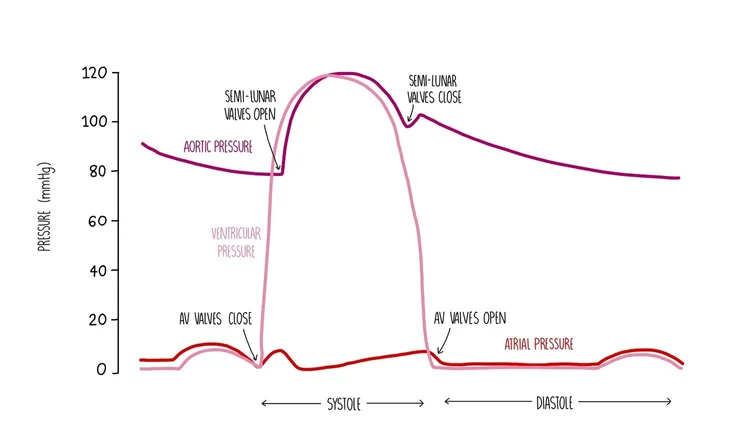
What is atrial systole?
Increase pressure in atria
Atrioventricular valves open
Blood flows into ventricles
What is ventricular systole?
Increased pressure in ventricles
Atrioventricular valves close
Semi-lunar valves open
Blood flows into arteries
What is diastole?
Semi-lunar valves close
Decreased pressure in veins and atria
Blood flows into atria