Economics Section III: Macro
 Call Kai
 Learn
Learn Practice Test
 Spaced Repetition
 Match
Match Flashcards
1/106

There's no tags or description
Looks like no tags are added yet.
Name | Mastery | Learn | Test | Matching | Spaced | Call with Kai |
|---|

107 Terms
What is the equation for Aggregate Demand?
C + I + G + NX
C = Consumption
I = Investment
G = Government Spending NX = Net Exports
What are the three reasons Aggregate Demand slopes downwards?
1. Wealth effect: increases real value of income
2. Interest rate effect: lowers interest rates, increasing investment
3. Exchange rate effect: makes domestic goods cheaper, increasing net exports.
What is the long run aggregate supply curve referred to as?
Potential GDP, Y*, or AS(LR)
What is the output gap?
When actual output is below potential output, indicating that the economy's productive resources are not fully utilized.
What does Arthur Melvin Okun's Law state?
A 1% increase in unemployment will lead to a 2% decrease in GDP.
What is the definition of Potential Output?
The quantity of goods and services that the economy can produce when using its resources at normal rates.
What characterizes the short run aggregate supply curve?
Upward sloping, indicating that changes in prices temporarily lead to changes in amounts sold
What happens in the transition from short run to long run equilibrium?
Expectations about prices adjust, shifting the short run AS curve until all three curves (AD, short run AS, long run AS) intersect.
What are the three functions of money?
1. Medium of Exchange: used to purchase goods and services
2. Unit of Account: measures and compares the value of different goods and services
3. Store of Value: transfers purchasing power from the present to the future.
Commodity Money
Has intrinsic value (e.g., gold, silver)
Fiat money
Has no intrinsic value (e.g., paper money)
What is M0 (in terms of money supply)
M0 = Monetary Base
All coins and currency + bank reserves.
What is M1 (in terms of money supply)
Monetary Base + Savings + Demand Deposits (Checking) + Other Checkable Deposits.
What is M2 (in terms of money supply)
M1 + Other 'Small' Short Term Deposits (<$100K) + Retail Money Market Funds.
What is the time frame for the long run in economic terms?
The long run is typically defined as the amount of time for all prices to adjust, usually 1 to 3 years.
What is the primary focus of the Keynesian model?
The Keynesian model focuses on short run fluctuations and business cycles.
What causes the upward sloping AS curve in the short run, according to the Keynesian model?
Higher prices temporarily lead to more sales, as not all prices change at the same time.
What is the relationship between Aggregate Demand and short run AS in equilibrium?
In short run equilibrium, Aggregate Demand = the short run AS curve.
What happens to the short run AS curve when expectations about prices adjust?
The short run AS curve shifts, leading to a new equilibrium where AD equals the long run AS curve.
What is the significance of the Output Gap?
The Output Gap indicates the degree to which an economy is underperforming relative to its potential output.
How does an increase in cyclical unemployment affect the output gap?
If cyclical unemployment increases from 1% to 2%, the output gap would rise from 2% to 4%.
What is primarily behind Aggregate Supply?
Production or sales (expenditures)
What is 'Real GDP'?
The measure of a country's economic output adjusted for price changes (inflation or deflation).
What is the responsibility of the Federal Open Market Committee (FOMC)?
To control the monetary base
What is fractional reserve banking?
A system where consumers and businesses deposit money into banks, which keep a fraction of deposits and loan the rest.
What is the reserve requirement in the US since March 2020?
0%
What are a bank's reserves and loans called?
Assets
What are the deposits in a bank referred to as?
Liabilities
What is the relationship between bank loans and the money supply?
Bank loans expand the money supply but do not increase the total amount of wealth in the economy.
What does a T-account illustrate in banking?
It shows a bank's assets and liabilities.
What is the money multiplier effect?
Deposits turn into loans, some held as currency, some as reserves, and the process repeats.
What is the formula for the money multiplier (m)?
[1 + C/D] / [R + C/D].
What is the relationship between monetary base and money supply?
Change in Money Supply = m * Monetary Base.
What are the three primary tools of the Federal Reserve for monetary policy?
Open Market Operations, Discount Rate, and Interest on Reserve Balances.
What is Open Market Operations?
The purchase or sale of short-term government bonds (Treasury bills or T-bills).
What is the Discount Rate?
The rate for overnight loans of reserves from the Federal Reserve.
What is the target range for the Fed Funds Rate (FFR)?
0.25% range, announced at FOMC meetings.
What happens when the FOMC purchases bonds?
It expands bank reserves, allowing banks to make additional loans.
What does the Quantity Equation (MV=PY) represent?
It relates the money supply (M), velocity of money (V), price level (P), and real GDP (Y).
How is the velocity of money calculated?
V = (P × Y) / M.
What does the velocity of money indicate?
The average number of transactions supported by each dollar of the money supply.
What is nominal GDP?
The product of the price level (P) and real GDP (Y). It is is measured without adjustment
Uses current prices, includes inflation
What effect does a $1 increase in deposits have on the money supply?
It leads to a multiplied increase in the money supply due to the money multiplier effect.
What is the formula for the Quantity Equation in relation to the velocity of money?
V × M = P × Y
V is the velocity of money
M is the money supply
P is the price level
Y is real GDP
What are the three potential effects of an increase in the money supply?
1) A fall in the velocity of money
2) An increase in real GDP
3) An increase in the price level
In the long run, what is the effect of money on real GDP?
Money is neutral, meaning it has no impact on real GDP (Y); increases in money supply only increase the price level (P).
Dual Mandate of the Federal Reserve
Includes maximum employment and price stability, aiming for an average of 2% yearly inflation.
What is Gross Domestic Product (GDP)?
The market value of final goods and services produced within a country in a specific time frame, typically a year or quarter.
What is the formula for calculating GDP?
GDP = C + I + G + NX
C is consumption
I is investment
G is government spending
NX is net exports
Durable goods
Manufactured items that have a life span longer than three years (cars, appliances)
Nondurable goods
Items that are consumed within a short time (food, clothing)
What does 'GDP per capita' mean?
It refers to the average output per person, calculated as total GDP divided by the population.
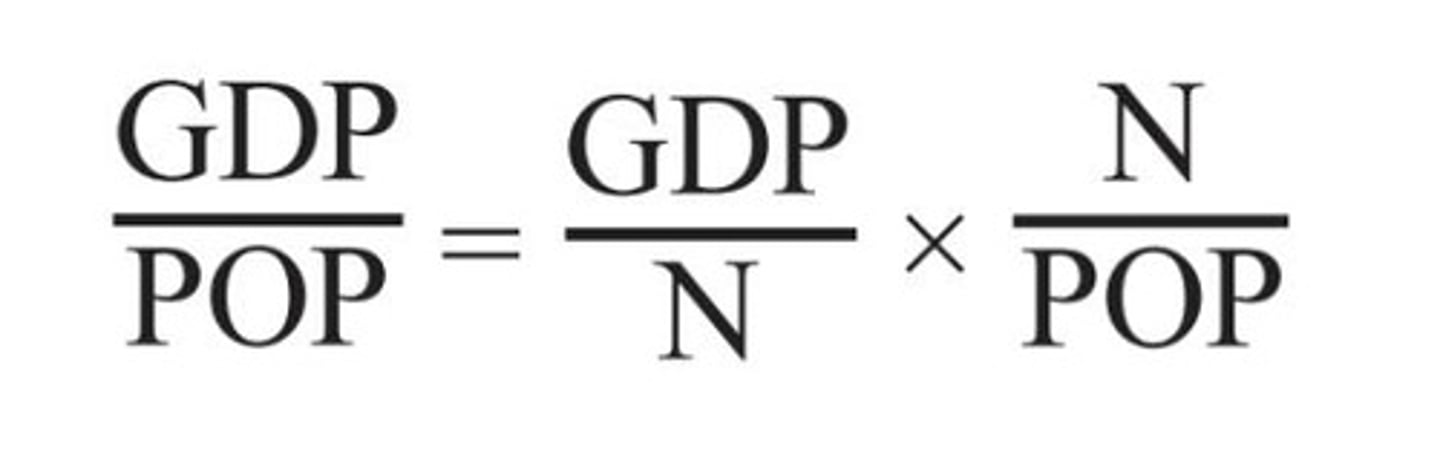
How has real GDP per capita changed since 1900?
It has increased by a factor of nine between 1900 and 2019.
What factors determine real GDP per capita?
Real GDP per capita is equal to real GDP per worker multiplied by the fraction of the population employed.
What is the difference between nominal GDP and real GDP?
Nominal GDP is measured using current prices and includes inflation, while real GDP adjusts for inflation using base year prices.
What is 'Market Failure'?
A situation in which a market does not allocate goods and services efficiently as theorized.
What is the significance of the velocity of money in economics?
It reflects the rate at which money circulates in the economy and is crucial for understanding the relationship between money supply and economic activity.
What role does the Federal Reserve play in monetary policy?
The Fed changes the money supply to influence interest rates and stabilize the economy.
What are externalities in economics?
Externalities are costs or benefits incurred by third parties who did not choose to incur those costs or benefits.
Excludable Goods Definition
Can be restricted from use - you can control who consumes it
Private Goods
High excludability and high rivalry
Pizza, Gasoline, Haircuts, Clothing
Collective Goods
High excludability and low rivalry
Often natural monopolies because non-rivalry in consumption means that the marginal cost of producing them is zero or close to zero.
Satellite radio, Wifi, Cable TV, Toll roads
Rival Goods Definition
Cannot be consumed by more than one person at a time; reduces the amount that is available for others
Common Resources
High rivalry, low excludability
These suffer from the "tragedy of the commons" - tend to be over-utilized
Fish in the ocean, city streets, the environment
Public Goods
Low excludability, low rivalry
Many are provided by the government
Radio broadcasts, tornado sirens, national defense, public education
What is the concept of 'Creative Destruction'?
It refers to the process where new innovations replace outdated technologies or processes, leading to economic growth.
What are economies of scale?
Economies of scale occur when the cost per unit of production decreases as the scale of production increases.
What is the relationship between nominal GDP and the money supply?
Nominal GDP and the money supply have followed similar growth trajectories, with the velocity of money remaining relatively stable.
What is the role of fiscal policy in economics?
Fiscal policy involves tax changes and government spending decisions made by Congress to influence the economy.
What is a market failure?
A situation where competitive markets fail to produce socially desirable outcomes, often leading to inefficient allocation of goods and services.
What are the two broad categories of market failure?
Externalities and breakdown of private property institutions.
What is an externality?
When the actions of one person affect the wellbeing of someone else, without compensation.
What is a positive externality?
A beneficial effect of an action on a third party, such as bee pollination increasing apple crop value.
What is a negative externality?
A harmful effect of an action on a third party, such as pollution decreasing property values.
Give an example of a negative externality related to pollution.
Runoff from fields with fertilizers can pollute drinking water, leading to community costs for treatment.
What is the Coase Theorem?
The idea that private negotiations can resolve inefficiencies from externalities if parties can negotiate without high costs.
Why might private bargaining fail in the case of pollution?
Individuals affected have little incentive to negotiate, and the costs of negotiation can be prohibitively high.
How can government regulation address externalities?
By implementing taxes or fees, such as charging drivers in certain areas or auctioning pollution rights.
What is the Tragedy of the Commons?
A situation where a jointly owned resource is overused, leading to negative externalities.
How can private property combat the Tragedy of the Commons?
By allowing an owner to manage the resource efficiently, such as limiting boat access to a lake.
What are complementary assets?
Possessions that allow a firm to gain more value from an invention than competitors, such as a strong reputation or effective marketing.
What is Creative Destruction?
The process by which new technologies render older technologies obsolete, as described by economist Joseph Schumpeter.
What is Technological Unemployment?
Job loss due to technological advancements, although new jobs may also be created.
What is Structural Unemployment?
Unemployment that occurs when workers' skills become obsolete due to technological progress, making it hard to transition to new jobs.
How do big producers gain a competitive advantage over smaller rivals?
By being able to sell at lower prices while still earning a profit due to economies of scale.
What is an example of a positive externality in the film industry?
The release of Blu-ray disks increases demand for Blu-ray players, benefiting manufacturers.
What is a consequence of a neighbor's house being run-down?
It can decrease the value of your own home.
What is an example of government intervention in pollution control?
The EPA auctioning off rights to emit sulfur dioxide to the highest bidders.
Why is structural unemployment a real threat compared to technological unemployment?
Because workers may struggle to transition to new jobs that require different skills.
What happens to the typewriter industry due to the development of computers?
The typewriter industry becomes obsolete, illustrating Creative Destruction.
What is the current labor force participation rate in the U.S.?
About 61.4%.
What are the three types of unemployment?
1. Frictional, 2. Structural, 3. Cyclical.
What is the typical unemployment rate?
Hovers around 5%.
What is the Consumer Price Index (CPI)?
An index that measures the average change over time in the prices paid by consumers for a market basket of goods and services.
How does the Bureau of Labor Statistics (BLS) gather data for the CPI?
Through Consumer Expenditure Surveys, which collect records of household expenditures.
What is the purpose of the GDP deflator?
To measure inflation by comparing nominal GDP to real GDP.
How is the GDP deflator calculated?
GDP Deflator = 100 × (Nominal GDP)/(Real GDP).
What is substitution bias in the context of CPI?
The tendency of the CPI to overstate the effect of rising prices on the cost of living due to consumers shifting to less expensive goods.
What is unmeasured quality change in CPI?
The upward bias in CPI due to improvements in the quality of goods and services over time.
What is the business cycle?
The fluctuations in economic activity characterized by periods of expansion and contraction.