chapter 2 flashcards with ai
 View linked note
 Call Kai
 Learn
Learn Practice Test
 Spaced Repetition
 Match
Match Flashcards
 Knowt Play
1/143

There's no tags or description
Looks like no tags are added yet.
Name | Mastery | Learn | Test | Matching | Spaced | Call with Kai |
|---|
No analytics yet
Send a link to your students to track their progress
144 Terms
how to know what we are talking about
know the definition of things and how to build the puzzle, that’s it.
what are we TALKING ABOUT?
electrical signaling
SEPTEMBER 3RD LECTURE
why do charges move in solution?
Charges move in solution to cancel electric fields
charges will move to follow the field until they _______
cannot/are unable to
positive charges cancel negative charges (and vice versa), which cancels out the field
slide 4
-the conc stays the same
-when voltage is at 0 (battery is off), diffusion occurs
when voltage is at -58mV (battery is on), there is the equilibrium (because diffusion occurs at 0, then the battery cancels out the diffusion)
when voltage is at -116mV (battery is on, but voltage is more negative, therefore the electrical gradient overrides diffusion and K+ goes fully to the negative side)
what are the important things in lecture?
the FORMULAS
what kind of gradient controls voltage?
CHEMICAL GRADIENT
what is the only thing that will change the voltage?
electrochemical
what do the neurons have control over?
the concentration gradient and the ion pump
charges will move in solution until there are no electric fields, true or false
true
will currents flow across insulators?
NO, because current is the RATE of charge movement, and there is no charge moving across the insulator, unless there is a channel in the insulator (ion channel in membrane)
what do you need to concentrate on?
Why is the membrane potential of neurons around -65 mV? (mechanism)
What is the purpose of having neurons sit at -65 mV?
What are ions doing at rest?
How does this set the neuron up for electrical signaling?
LECTURE
what are the events that verified the electrical properties of neurons (1791,1879,1930)?
in other words, what did Luigi Galvani do?
what did Eduard Hitzig and Gustav Fritsch do?
what did Wilder Penfield do?
Luigi Galvani accidentally stimulated a frog leg with a conductor and it kicked – he verified that electrical current can activate muscle
Eduard Hitzig and Gustav Fritsch electrically stimulated the cortex of a dog: stimulation in certain places could get the limbs to move
Wilder Penfield was looking for the source of seizure in the brain, and could stimulate (with awake patients) to cause muscle twitches, but also evoke vivid memories and cause someone to laugh
Why does the nervous system use electrical activity?
electricity is fast and efficient
Why does salt water conduct electricity?
Water is polar
electrons spend more time around the oxygen than hydrogens (even though it is electrically neutral)
Ions in salt are more energetically stable being surrounded by water
“Salt water” has charge that can freely move,
following electric fields
what is the setup for electricity in neurons?
the resting membrane potential
Why is the resting membrane potential -65 mV?
(what is the main reason)
Because the membrane is permeable to potassium at rest
ON WITH THE BOOK
why do neurons generate electrical signals?
to encode information
electrical signals are transmitted over long distances, true or false?
true
movements of _____ produces electrical signals
ion
what forces create membrane potentials?
electrical and chemical forces
what type of ions generate the resting membrane potential?
potassium ions
how many types of ions can generate electrical signals?
more than one type of permeant ion can generate electrical signals, because they have charges.
from what type of ions to action potentials arise?
sodium and potassium permeability
neurons can generate a variety of electrical signals to transmit and store information, true or false?
true
Are neurons intrinsically good conductors of electricity?
No, neurons are not intrinsically good conductors of electricity, in order to compensate they have elaborate mechanisms that generate electrical signals based on the flow of ions across their plasma membranes.
What is the resting membrane potential in neurons?
The resting membrane potential is the negative potential generated by neurons, measurable as the voltage difference between the inside and outside of nerve cells.
what is an action potential?
what is another word for action potential?
The electrical signal generated and conducted along axons (or muscle fibers) by which information is conveyed from one place to another in the nervous system (or within muscle fibers).
they are also referred to as spikes or impulses
where are action potentials propagated?
what is the point of action potentials?
Action potentials are propagated along the length of axons and carry information from one place to another within the nervous system.
What types of external stimuli can produce electrical signals in sensory neurons?
Electrical signals in sensory neurons can be produced by the actions of external forms of energy, such as light and sound.
What are the main mechanisms that generate the electrical signals in nerve cells?
The electrical signals in nerve cells arise from ion fluxes brought about by the selective ion permeability of nerve cell membranes, produced by ion channels, and the nonuniform distribution of these ions across the membrane, created by active transporters.
CONCEPT 2.1
why do nerve cells generate electrical signals?
to encode for information
what are the learning objectives of 2.1? (which is the entire point of this section of the chapter?)
List the basic types of electrical signals used to process information within the brain.
Describe the properties that differentiate these electrical signals from each other.
what are the four basic types of electrical signals in the brain? what are they used for?
1 Resting membrane potential
2 Receptor potentials
3 Synaptic potentials
4 Action potentials
these signals are used to process information in the brain
What is the resting membrane potential, and what does it indicate when measured?
Answer: The resting membrane potential is the constant negative voltage across the neuronal plasma membrane when the neuron is at rest.
It indicates that neurons have a means of generating and maintaining a steady voltage difference between the inside and outside of the cell, typically ranging from −40 to −90 mV, depending on the type of neuron.
what is the range of the resting membrane potential?
-40 to -90mV
what are receptor potentials?
what are they caused by?
what is an example of a receptor potential?
Answer: Receptor potentials are transient changes in the resting membrane potential caused by the activation of sensory neurons in response to external stimuli, such as light, sound, or heat.
For example, when the skin is touched, it activates nerve endings in Pacinian corpuscles, generating a receptor potential that momentarily changes the resting membrane potential, which is the first step in generating sensations like vibration.

What are synaptic potentials, and how do they contribute to neural communication?
Answer: Synaptic potentials are electrical signals generated by the activation of synapses, facilitating the transmission of information from one neuron to another. They cause brief changes in the resting membrane potential of the receiving neuron and are essential for communication within complex neural circuits in both the central and peripheral nervous systems
Explain what an action potential is and its role in the nervous system.
Answer: An action potential is a special type of electrical signal that travels along the axon of a neuron. It is also referred to as a spike or impulse. Action potentials are crucial for the long-range transmission of information within the nervous system, enabling the nervous system to communicate with target organs, such as muscles, and coordinate responses.
Differentiate between passive and active electrical responses in neurons.
Answer:
Passive electrical responses occur when the membrane potential changes in proportion to the magnitude of an injected current, such as when the membrane potential becomes more negative (hyperpolarization). These responses do not involve any unique properties of neurons.
Active electrical responses involve the generation of action potentials. When the membrane potential becomes more positive than the resting potential (depolarization) and reaches a certain threshold, an action potential is triggered, which is an active process essential for neural communication.
What is the threshold potential, and why is it important in the generation of action potentials?
The threshold potential is the critical level of membrane depolarization that must be reached for an action potential to occur.
It is important because it determines whether the neuron will fire an action potential, thus enabling the transmission of electrical signals along the neuron and throughout the nervous system.
what is the origin, function, and behavior of resting membrane potentials?
Resting Membrane Potential:
Origin: The resting membrane potential is a steady-state electrical charge across the neuronal membrane when the neuron is not actively sending signals. It results from the selective permeability of the membrane to certain ions, particularly potassium (K+), and the activity of ion pumps like the sodium-potassium pump.
Function: It provides a stable baseline voltage that is essential for the proper functioning of neurons, setting the stage for other types of electrical signals.
Behavior: It is typically a constant, negative voltage (usually between −40 to −90 mV) that does not change unless the neuron is stimulated.
Resting membrane potential is a constant baseline, receptor and synaptic potentials are graded and local, while action potentials are all-or-none and propagate over long distances.
what is the origin, function, and behavior of receptor potentials?
Origin: Receptor potentials are generated in sensory neurons in response to external stimuli, such as light, sound, heat, or mechanical pressure.
Function: They serve as the initial response of sensory neurons to environmental changes, leading to the perception of sensory inputs like touch, sound, or light.
Behavior: Receptor potentials are graded in magnitude depending on the intensity of the stimulus and are usually transient, meaning they return to the resting membrane potential after the stimulus is removed. They do not follow the all-or-none principle like action potentials.
Resting membrane potential is a constant baseline, receptor and synaptic potentials are graded and local, while action potentials are all-or-none and propagate over long distances.
what is the origin, function, and behavior of synaptic potentials?
Origin: Synaptic potentials occur when neurotransmitters released by a presynaptic neuron bind to receptors on a postsynaptic neuron, causing ion channels to open or close.
Function: They enable communication between neurons, facilitating the transfer of information across synapses in neural circuits.
Behavior: Synaptic potentials are typically graded, meaning their amplitude varies depending on the strength of the synaptic input. They can be either excitatory (depolarizing) or inhibitory (hyperpolarizing), influencing whether the postsynaptic neuron will generate an action potential.
Resting membrane potential is a constant baseline, receptor and synaptic potentials are graded and local, while action potentials are all-or-none and propagate over long distances.
what is the origin, function, and behavior of action potentials?
Origin: Action potentials are generated when the membrane potential of a neuron reaches a certain threshold, usually due to depolarization caused by receptor or synaptic potentials.
Function: They serve as the primary means of long-range communication within the nervous system, allowing neurons to transmit signals over long distances, such as from the brain to muscles.
Behavior: Action potentials follow the all-or-none principle, meaning they either occur fully or not at all, regardless of the stimulus strength (as long as the threshold is reached). They are rapid, transient events that reverse the membrane potential from negative to positive and then back to negative. Unlike receptor and synaptic potentials, action potentials are actively
Resting membrane potential is a constant baseline, receptor and synaptic potentials are graded and local, while action potentials are all-or-none and propagate over long distances.
PASSIVE AND ACTIVE ELECTRICAL SIGNALS
how can electrical current suitable for action potentials be readily produced?
In the laboratory, however, electrical current suitable for initiating an action potential can be readily produced by inserting a microelectrode into a neuron and then connecting the electrode to a battery
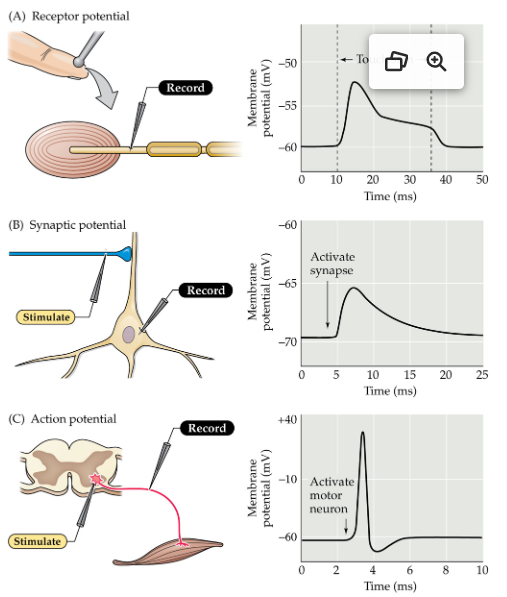
which graph is a receptor potential, synaptic potential, and action potential?
1) receptor potential is the one that has the rm at -60mV, rises to -53 then goes roughly back down.
2) synaptic potential is at -70, goes to -65mV, then goes smoothly back down
3) action potential is at -60, goes to positive, and then hyperpolarizes
RESTING MEMBRANE POTENTIAL VIDEO
when the neuron is at rest, MOST ion channels are closed, BUT a few potassium channels are open.
potassium diffuses OUT of the cell because the channels are open, this creates a chemical gradient (this is when the cell is becoming negative)
an electrical gradient (the negative charges banked up against the membrane) then pull potassium back in (pulls it back in until the cell reaches the Nernst potential )
How can an action potential be elicited in a neuron in a laboratory setting?
Answer: An action potential can be elicited in a laboratory setting by passing electrical current across the neuron's membrane. This is typically done by inserting a microelectrode into the neuron and connecting it to a battery to generate the current.
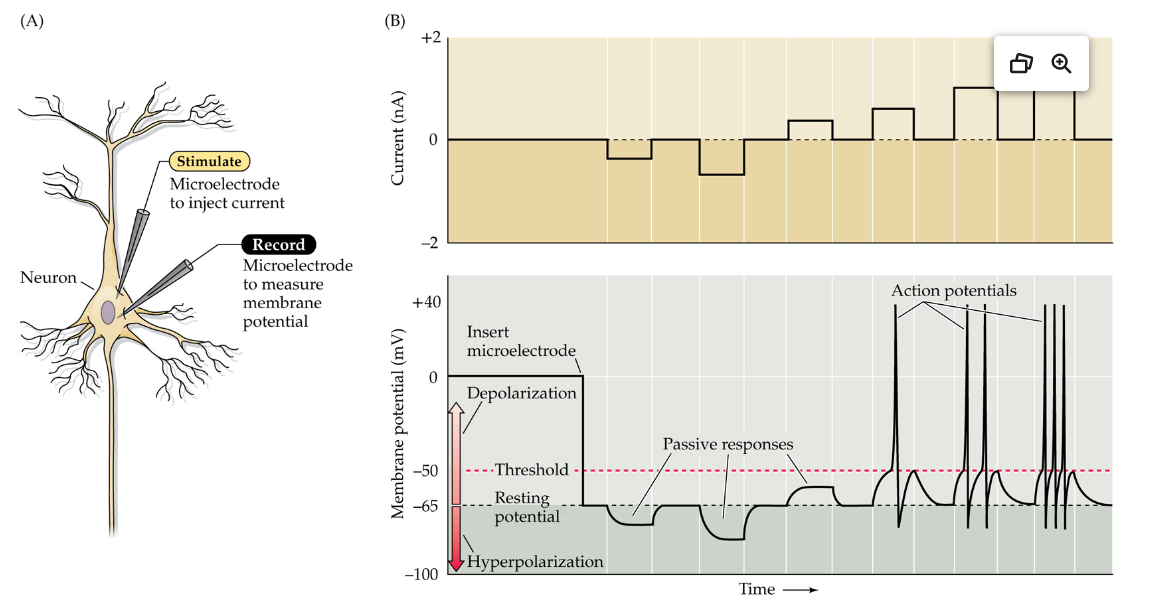
figure 2.2
What happens to the membrane potential if the applied electrical current makes it more negative (hyperpolarization)?
Answer: If the applied electrical current makes the membrane potential more negative (hyperpolarization), the membrane potential simply changes in proportion to the magnitude of the injected current. No action potential occurs, and this response is considered a passive electrical response.
What is a passive electrical response in neurons?
Answer: A passive electrical response occurs when the membrane potential changes in proportion to the injected current without triggering an action potential. This happens when the membrane potential becomes more negative (hyperpolarization).
What occurs when the applied current makes the membrane potential more positive than the resting potential (depolarization)?
Answer: When the applied current makes the membrane potential more positive than the resting potential (depolarization), and it reaches a certain threshold level, an action potential is generated. This is an active response that triggers the neuron to fire.
What is the threshold potential, and why is it significant?
Answer: The threshold potential is the critical level of membrane depolarization that must be reached for an action potential to occur. It is significant because it determines whether the neuron will fire an action potential, initiating the process of transmitting an electrical signal.
CONCEPT 2.2 Neuronal Electrical Signals Can Be Transmitted Over Long Distances
Explain the difference between passive and active current flow in a neuron.
Explain the significance of active current flow for information spread within the long axons of neurons
What fundamental problem do neurons face in conducting electrical signals over long distances?
Answer: Neurons face the challenge that their axons, which can be very long (up to a meter or more in some cases), are not good electrical conductors, making it difficult to effectively transmit electrical signals over long distances.
How do the electrical properties of neurons compare to those of ordinary wires?
Answer: The electrical properties of neurons compare poorly to those of ordinary wires. While both can passively conduct electricity, neurons are much less efficient, as the voltage change resulting from a current pulse in a neuron decays rapidly with distance from the site of injection
What happens to the magnitude of a potential change in a neuron when a current pulse is below the threshold for generating an action potential?
Answer: When a current pulse is below the threshold for generating an action potential, the magnitude of the resulting potential change in the neuron decreases with increasing distance from the site of current injection, typically falling to a small fraction of its initial value within just a few millimeters.
How does the passive current flow in neurons compare to that in wires?
Answer: Passive current flow in neurons is much less effective than in wires. While a wire can allow passive current flow over distances many thousands of times longer, the potential change in a neuron decays rapidly, making neurons poor conductors over long distances.
What causes the progressive decrease in the amplitude of the induced potential change in a neuron?
Answer: The progressive decrease in the amplitude of the induced potential change in a neuron is caused by the leakage of the injected current across the axonal membrane. As a result, less current is available to change the membrane potential farther along the axon.
Why do neurons struggle with effective passive conduction of electrical signals along long axons?
Answer: Neurons struggle with effective passive conduction of electrical signals along long axons because of the leakiness of the axonal membrane, which causes the injected current to dissipate, reducing the strength of the signal as it travels
How do neurons compensate for their poor passive electrical properties when transmitting signals over long distances?
Answer: Neurons compensate for their poor passive electrical properties by using action potentials as a “booster system.” Action potentials allow neurons to conduct electrical signals over great distances, overcoming the limitations of passive signal conduction.
FIGURE 2.3
What happens when a depolarizing current pulse large enough to produce an action potential is applied in an experiment?
Answer: When a depolarizing current pulse large enough to produce an action potential is applied, an action potential of constant amplitude is observed along the entire length of the axon. This indicates that the electrical signal is actively conducted without any loss of strength (decrement) as it travels.
Why is active conduction via action potentials effective for long-distance signal propagation in neurons?
Answer: Active conduction via action potentials is effective because it prevents the signal from decaying over distance, which is a problem with passive conduction due to the inherent leakiness of neurons. Action potentials maintain a constant amplitude as they propagate, ensuring reliable long-distance communication within the nervous system.
Why are action potentials critical in the nervous system?
Answer: Action potentials are critical because they form the basis of information transfer within the nervous system. They enable neurons to transmit electrical signals over long distances, which is essential for coordinating complex bodily functions. Additionally, action potentials are the target of many clinical treatments, including anesthesia.
How are all types of neuronal electrical signals produced?
Answer: All types of neuronal electrical signals are produced by similar mechanisms that rely on the movement of ions across the neuronal membrane. This ion movement generates electrical potentials that underlie the various types of electrical signals observed in neurons.
What is anesthesia, and what are its primary purposes in clinical practice?
Answer: Anesthesia refers to procedures that reduce sensation, often to alleviate pain or create a state of unconsciousness during surgical procedures. It is an essential part of clinical practice and is used to prevent pain sensation or to ensure the patient is unconscious during surgery.
What are the three broad categories of anesthesia?
Answer: The three broad categories of anesthesia are:
Local anesthesia
Regional anesthesia
General anesthesia
How do local anesthetics work, and what is a common example of their use?
Answer: Local anesthetics work by blocking action potential propagation along peripheral nerves by inhibiting Na+ channels involved in action potential generation. A common example of their use is the injection of lidocaine into the mandible to block pain sensation in a portion of the mouth during dental procedures.
What is regional anesthesia, and how does it differ from local anesthesia?
Answer: Regional anesthesia desensitizes a larger region of the body by injecting local anesthetics near the spinal cord, nerve plexuses, or major nerves. Unlike local anesthesia, which is confined to a specific area, regional anesthesia affects a broader area of the body, such as during childbirth when anesthetics are injected into the epidural space to prevent pelvic pain.
What role do sedatives play in anesthesia, and what are some common sedatives used?
Answer: Sedatives, also known as tranquilizers, are often used in conjunction with anesthesia to reduce anxiety, induce sleep, or enhance the effects of anesthesia. Common sedatives include benzodiazepines like diazepam (Valium), midazolam, and lorazepam. These sedatives enhance the activity of GABA receptors, which strengthens synaptic inhibition and reduces neuronal activity.
How does general anesthesia differ from local and regional anesthesia?
Answer: General anesthesia causes unconsciousness, an absence of sensation, and muscular relaxation, making it suitable for major surgical procedures. It can be induced through intravenous injection or inhalation and often requires the use of analgesics like fentanyl to manage pain, as general anesthetics alone may not prevent pain sensation.
What are some examples of intravenous anesthetics used in general anesthesia?
Answer: Examples of intravenous anesthetics used in general anesthesia include propofol, which enhances GABA receptor activity and blocks Na+ channels, and ketamine, which blocks NMDA-type glutamate receptors and also works on GABA and opiate receptors.
What are inhalation anesthetics, and how do they work?
Answer: Inhalation anesthetics are volatile liquids that vaporize at room temperature and can be inhaled. They are thought to work by hyperpolarizing the resting membrane potential of neurons, making it more difficult to fire action potentials, possibly by opening 2-P K+ channels. They also enhance the activity of synaptic GABA receptors
Why is understanding the mechanisms of anesthetic action important?
Answer: Understanding the mechanisms underlying anesthetic action is important because it illuminates how these clinically valuable agents work and underscores the fundamental role of neuronal electrical signaling in the nervous system's function. This knowledge is crucial for the safe and effective use of anesthetics in clinical practice
make sure you go back in chapter 2 and compare the figure for anesthesia on page 44
CONCEPT 2.3 Ion Movements Produce Electrical Signals
2.3.1Describe the types of membrane proteins that control ion fluxes across a cellular membrane.
2.3.2Explain how ion fluxes across membranes generate electrical signals.
2.3.3Define electrochemical equilibrium and describe how it determines ion flux across a membrane
TWO REQUIREMENTS FOR GENERATING ELECTRICAL SIGNALS
What are the two main requirements for generating electrical potentials across the membranes of neurons?
Answer: The two main requirements for generating electrical potentials across the membranes of neurons are:
Differences in the concentrations of specific ions across nerve cell membranes.
Selective permeability of the membranes to some of these ions.
What roles do active transporters and ion channels play in generating cellular electrical signals?
Answer:
Active transporters: These proteins actively move ions into or out of cells against their concentration gradients, establishing ion concentration gradients across the membrane.
Ion channels: These proteins allow certain ions to cross the membrane in the direction of their concentration gradients, contributing to the selective permeability of the membrane
How do active transporters and ion channels work together to generate the resting membrane potential?
Answer: Active transporters and ion channels work against each other to generate the resting membrane potential. Active transporters create ion concentration gradients by moving ions against their gradients, while ion channels allow ions to flow down their concentration gradients, resulting in the generation of electrical potentials across the membrane.
What happens to the electrical potential across a membrane that is permeable only to potassium ions (K+) when the concentration of K+ is the same on both sides?
Answer: If the concentration of K+ is the same on both sides of a membrane that is permeable only to potassium ions, no electrical potential will be generated across the membrane.
What occurs when there is a higher concentration of K+ inside the membrane compared to the outside?
Answer: When there is a higher concentration of K+ inside the membrane compared to the outside, potassium ions will flow down their concentration gradient from the inside to the outside. This movement of K+ ions, which carry a positive charge, generates an electrical potential with the inside of the membrane becoming negative relative to the outside.
How does the efflux of K+ contribute to the resting membrane potential in living nerve cells?
Answer: In living nerve cells, the efflux of K+ through potassium-permeable channels, driven by the concentration gradient established by ion pumps, carries positive charges out of the cell. This movement of K+ creates a negative electrical potential inside the cell relative to the outside, contributing to the resting membrane potential.
What analogy can be made between the simple system of a membrane permeable to K+ and the situation in neurons?
Answer: The analogy is that just as in the simple system where a K+-permeable membrane with different K+ concentrations on each side generates an electrical potential, in neurons, the accumulation of K+ inside the cell by pumps and the presence of K+-permeable channels in the membrane lead to the generation of the resting membrane potential through the efflux of K+ ions.
figure 2.4
paragraph 3
figure 2.5
video
ELECTROCHEMICAL EQUILIBRIUM
What is electrochemical equilibrium, and how is it achieved in the context of potassium ion (K+) movement across a membrane?
Answer: Electrochemical equilibrium is achieved when the movement of K+ ions across a membrane results in an exact balance between two opposing forces: the concentration gradient that drives K+ from the inside to the outside of the membrane and the electrical gradient that opposes further movement of K+ due to the positive charge accumulation outside the membrane. At this point, the net movement of K+ stops.
What happens to the potential gradient as K+ moves from the inside to the outside of the membrane?
Answer: As K+ moves from the inside to the outside of the membrane, the outside becomes increasingly positive relative to the inside. This positive charge accumulation creates a potential gradient that repels further movement of K+ ions across the membrane, eventually leading to electrochemical equilibrium.
What are the two opposing forces that balance each other at electrochemical equilibrium?
Answer: The two opposing forces that balance each other at electrochemical equilibrium are:
The concentration gradient, which drives K+ ions from the inside to the outside of the membrane, carrying positive charge with them.
The electrical gradient, which increasingly opposes the movement of K+ ions as the outside of the membrane becomes more positive.
How many K+ ions need to move across the membrane to generate the electrical potential at electrochemical equilibrium?
Answer: A very small number of K+ ions (approximately 10−12 moles of K+ per cm² of membrane) need to move across the membrane to generate the electrical potential at electrochemical equilibrium. This small flux is sufficient to create the potential difference without significantly altering the overall concentrations of K+ on either side of the membrane.