Chemistry
 Call Kai
 Learn
Learn Practice Test
 Spaced Repetition
 Match
Match Flashcards
 Knowt Play
1/154

There's no tags or description
Looks like no tags are added yet.
Name | Mastery | Learn | Test | Matching | Spaced | Call with Kai |
|---|
No analytics yet
Send a link to your students to track their progress
155 Terms
Solid distinguishing properties
Fixed volume and shape
Packed very closely, regular arrangement
More dense
Particles vibrate in fixed positions but cant change location
Liquids distinguishing properties
Fixed volume, takes shape of the container
Particles very close together but arranged irregularly
Usually less dense than solids but more than gasses
Particles can move and slide past each other
Gas distinguishing properties
No fixed volume, take shape of the container
Low density
Far apart move randomly and quickly in all directions
Can be compresses
Collide with each other and sides of the container
Melting
Solid changes into a liquid
Requires heat energy which transforms into kinetic energy allowing particles to move and slide past each other and not only vibrate in fixed positions
Occurs only at the melting point
Freezing
Liquid into solid
Requires loss of heat energy which leads to less kinetic energy so particles don’t have enough energy to move and only vibrate in fixed positions
Occurs only at freezing point
Evaporation
Liquid turns into a gas over a range of temperatures
Only at the surface of the liquid where high energy particles escape below the boiling point
Larger surface area and warmer temperature increase evaporation
Boiling
Liquid changes into gas
Requires heat which causes bubbles of gas to form below the surface of the liquid
Occurs at a specific temperature, the boiling point
Condensation
Gas changes into a liquid over a range of temperatures,
When gas is cooled, its particles lose energy so they bump into each other and lack energy to bounce away so they clump together to form a liquid
Why is there no increase in temperature during a change of state
Thermal energy is used to overcome attractive forces between particles rather than increase the kinetic energy
Why is there no decrease in temperature during a change of state
Thermal energy lost is used to build intermolecular forces rather than decrease kinetic energy
Combined Gas Law
(P1V1)/T1 = (P2V2)/T2
Why does temperature increase the volume of a gas
As the temperature increases, the kinetic energy will also increase
The gas particles will move faster and spread out
Why does Pressure affect the volume of a gas
As the pressure increases, the particles will collide more frequently
Same number of particles in a lower space
So lower volume
Diffusion definition
Net movement of particles from a region of higher concentration to lower concentration due to their random movement
Molecular mass effect on diffusion
Bigger molecules diffuse slower as they have a higher mass so move slower and travel less in the same amount of time
Physical Changes
New chemical substance is not produced
Easy to reverse and separate
Chemical Changes
New Chemical Substance is formed that have different properties to reactants
Difficult to reverse
Signs like colour change, temperature change and effervescence
Factors effecting Rate of reaction
Concentration
Pressure
Surface Area
Temperature
Catalyst
What does a catalyst do
Increases the rate of reaction and is unchanged by the end of the reaction
Collision Theory
In order for reactions to occur, the particles must collide with each other with sufficient energy
How to increase successful collisions
Number of particles per unit volume
Frequency of collisions per particles
Kinetic energy of particles
Activation Energy
How increasing concentration affects rate of reaction
More reactants in a given volume→ more collisions per second → more successful and frequent collisions→ Rate of reaction increases
How increasing pressure affects rate of reaction
Same number of particles in a smaller volume →more collisions per second →more frequent and successful collisions per second → rate of reaction increases
How increasing surface area affects rate of reaction
Greater area of particles exposed to reactant → more collisions per second→ more frequent and successful collisions per second → rate of reaction increases
How increasing temperature affects rate of reaction
Particles have more kinetic energy →more collisions per second → more frequent and successful collisions per second→ rate of reaction increases
How catalysts affects rate of reaction
Different reaction pathway with lower activation energy → higher proportion of particles have energy greater than the activation energy→ more successful reactions per second
How to measure the time
Stopwatch
How to measure temperature ?
Thermometer
How to measure mass
Digital Balance
How to measure approximate volumes of a liquid
Measuring Cylinder
How to accurately measure a fixed volume of liquid
Volumetric Pipette
How to accurately measure a variable volume of liquid
Burrettes
How to measure volume of Gas precisely and accurately
Gas Syringe
Disadvantage of Gas Syringe
Limited volume
Expensive
Fragile
Solvent
Substance that dissolves a solute
Solute
Substance that is dissolved in a solvent
Solution
Mixture of one or more solutes dissolved in a solvent
Saturated Solution
Solution containing the maximum concentration of a solute dissolved in the solvent at a specific temperature
Residue
Substance that remains after evaporation, distillation, filtration or any other substance
Filtrate
Liquid or solution that has passed through a filter
Chromotography process
Pencil line is drawn on chromatography paper and spots of the sample are placed on it
Paper is lowered into to the solvent container, ,making sure the pencil line sits above the level of the solvent so the samples don’t was into solvent container
Solvents travel up the paper taking some of the substance with it, different substances have different so they will travel at different rates causing them to spread apart#
Substance with higher solubility will travel farther
Substances with the same solubility will be
The same substance
Substances with multiple substances will have
produce more than one spot
Locating Agent
Used to see spots which aren’t visible with the human eye
Rf
Distance travelled by substance/ Distance travelled by solvent
How to identify carbon dioxide?
Using limewater, turns cloudy
How to test for chlorine
Bleaches damp litmus paper
How to test for hydrogen
Squeaky pop of lighted splint
How to test for oxygen
Glowing splint goes out than relights
How to test if substance is pure or impure
Fixed boiling/ melting points if pure, range of temperatures if not
How to use a suitable solvent to separate
Solids with different solubility, one dissolves in solvent other doesn’t
Place both in solvent
One will dissolve other won’t
How to use Filtration for separation
Used on mixture containing a insoluble solid in a liquid or solution
Filter paper placed in funnel above another beaker
Mixture powered placed in filter funnel above beaker
Filter paper will only let small liquid particles through into the filtrate
Solid particles will be too large too pass and stay behind as residue
Crystillisation
Dissolved solid from a solution
Solution heated allowing solvent to evaporate and leave a saturated solution behind
Dip clean dry cold rod into solution, crystals should begin to form when removed and allowed to cool
Saturated solution is allowed to cool
Solid will come out the solution as solubility decreases, crystals growing
Crystals collected by filtration
Washed with distilled water to purify, then allowed to dry
Simple Distillation
Liquid and soluble solid from a solution
Solution is heated, and the substance with the lower boiling point evaporates and boils producing a vapour which rises through the neck of the round bottom flask
Vapour passes through the condenser where it condenses and turns into pure water collected in a beaker
Only solid solute left
Fractional Distillation is used instead of simple distillation when
The liquids have a closer boiling point or a greater degree of accuracy is needed
Fractional Distillation
Used for miscible liquids
Substance raised to the boiling point of the substance with the lower boiling point
This substance will evaporate first
Rise and pass through fractionating column
Passes through condenser where they will cool and condense
Condensed liquid is collected in beaker
All of the substance is evaporated and collected
Exothermic Energy
Transfers thermal energy to surroundings leading to an increase in the temperature of the surroundings. Enthalpy change is negative
Endothermic Energy
Takes in thermal energy from surroundings leading to a decrease in the temperature of the surroundings. Enthalpy change is positive
Activation Energy
Minimum energy particles must have to react
Bond breaking is an_____ process
endothermic
Bond making is a _____ process
Exothermic
Enthalpy Change=
Bond breaking - Bond Making
Exothermic Reaction pathway diagram
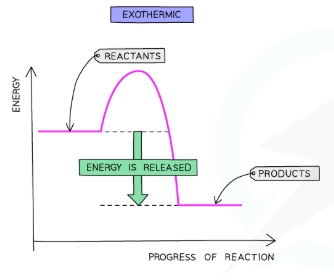
Endo thermic reaction pathway diagram
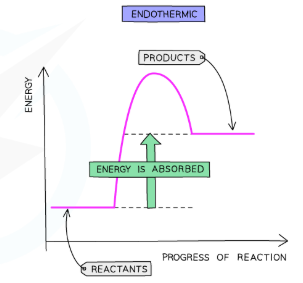
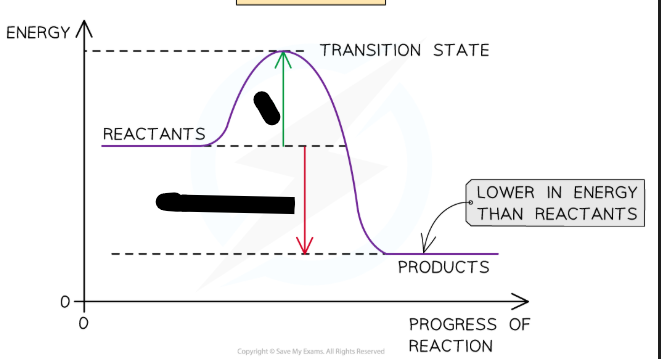
Label
Red arrow is enthalpy Change
Green arrow is activation energy
Enthalpy Change
Transfer of thermal energy during a reaction
Are sodium salts soluble
Yes
Are Potassium salts soluble
Yes
Are Ammonium salts soluble
Yes
Are Nitrates Soluable
Yes
Are Chlorides soluble
Yes except pms
Are Sulfates soluble
Yes except pms and casr ba
Are Carbonates Soluble
No except with other soluble things
Are Hydroxides Soluble
No
Electrolysis
Decomposition of an ionic compound when molten or in an aqueous solution through the passage of an electric current
Anode
Positive Electrode
Cathode
Negetive Electrode
Electrolyte
Molten or aquaeous substance that goes electroysis
Which substance can be formed at the cathode
Metal and Hydrogen
What is formed at the anode
Non metals except hydrogen
Why might metals might be electroplated
Improve their appearance and resist corrosion
How do electrons move through the external circuit to transfer charge
Electrons flow from the negative terminal of the power supply to the cathode giving the cathode its negative charge
How does charge transfer during electrolysis from loss or gain of electrons at the electrodes
At the cathode, cations gain electrons to form atoms
Anions move to the anode and lose electrons
These electrons then flow back to the external circuit back to the power supply completing the circuit
Where do cations move to?
The cathode
Where do anions move
Anode
Identify products made in the electrolysis of molten lead (II) bromide
Brown Bromine Gas is given off
Grey lead deposits on the surface of the electrode
Identify the products made in the electrolysis concentrated aqueous sodium chloride
Hydrogen gas made at the negative electrode
Chlorine gas made at the positive electrode
Na + ions and OH- ions react to form NaOH solution which is left behind
Identify substances produced in electrolysis of dilute sulfuric acid
Hydrogen gas produced at cathode
Oxygen gas and water produced at anode
Sulfuric acid stays in electrolyte
What will form at the anode if concentrated group 7 elements are present
halogen will be formed
What will form at the anode if there are no halogens or dilute halogens
Oxygen
What will form at the cathode if it the metal is more reactive than hydrogen
Hydrogen gas
What will happen in the metal is less reactive than hydrogen
Metal will produce and plate onto the cathode
Describe the electrolysis of aqueous copper sulfate using inert carbon electrodes
Copper forms at the Cathode and will coat the cathode in a pink-brown colour
Oxygen will form at the anode
Blue colour of copper sulfate solution fades over time
OH- ions are oxidized to form oxygen in the equation
4OH- → O2 + 2H2O + 4e-
Describe the electrolysis of aqueous copper sulfate with a copper electrode
Copper is formed at the Cathode increasing its mass
Blue colour of copper sulfate remains the same
Anode decreases in mass as it dissolves as copper atoms are oxidised there by the battery taking away electrons
Copper plated on Cathode is the same lost at the anode
Copper sulfate concentration reamins the same
How does electroplating happen
Surface of one metal coats another metal
The cathode gets electroplated
The anode is made from the pure metal which will coat the other substance
The electrolyte is an aqueous solution of a soluble salt of the pure metal at the anode