U2O3 Staffing a Business
 Call Kai
 Learn
Learn Practice Test
 Spaced Repetition
 Match
Match Flashcards
 Knowt Play
1/15

Earn XP
Description and Tags
Textbook
Name | Mastery | Learn | Test | Matching | Spaced | Call with Kai |
|---|
No analytics yet
Send a link to your students to track their progress
16 Terms
What is the employment cycle?
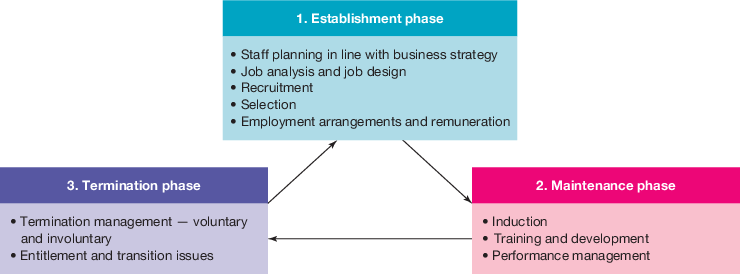
The relationship between a business and its employee, from the initial planning and decision to hire a new employee until the time that employee leaves the business.
The three stages are;
The Establishment phase
The Maintenance phase
The Termination phase
Explain the first phase of the employment cycle
The establishment phase
The establishment phase involves the planning of staffing needs, the recruitment and selection of staff, and the determination of employment arrangements and remuneration.
Planning
The staff planning process begins with the identification of staffing needs. This may involve increasing the number of employees who carry out existing functions within the business, or identifying new tasks that need to be performed and the particular skills that will be needed to perform those tasks. In either case job analysis is carried out, which consists of two parts:
Job description: the duties, tasks and responsibilities associated with the job
Job specification: the qualifications, skills and experience that an employee would need to have to carry out the job.
Recruitment
Recruitment is the process of attracting suitable applicants to the position using advertisements, employment agencies and word of mouth. A business may choose to recruit externally, which involves bringing in a new employee from outside the business. Alternatively, it may choose to recruit internally, which usually involves transferring an existing employee into a new position, or promoting an existing employee into a position of greater responsibility.
Selection
This is the process by which the most suitable applicant is chosen to fill the position. It may involve:
requiring applicants to provide detailed information on an application form
carrying out interviews
various forms of testing, including aptitude testing and psychological testing
examining references and other background checks.
The applicants will then be ranked, with the highest ranked applicant offered the position. If that person does not accept the offer, the next highest ranked applicant can be approached.
Employment arrangements and remuneration
Employment arrangements can include ongoing permanent employment, casual employment or fixed-term employment for a designated period of time. Remuneration refers to the payment made to the employee. Most industries are governed by Awards, which establish a minimum set of wages and conditions for employees. Employers may choose to pay above this minimum and may also build in a variety of additional financial incentives for employees.
Explain the second phase of the employment cycle
The maintenance phase
This phase covers the period of time during which the employee works for the business. It involves induction, training and development, and performance management.
Induction
This is a process of acquainting the new employee with the business — its history, structures, objectives, culture, policies and practices. It also involves ensuring that the new employee has the opportunity to gain full knowledge of the tasks and responsibilities associated with their new job. If the employee is to become a new member of an established team, it is important that they be given opportunities to get to know other members of that team. One or more existing team members may take on the responsibility of mentoring the new employee.
Training
Training is important at all stages of the employment cycle. This may include training at the start of a new job to provide the employee with the necessary skills. It is also important as the business introduces new processes or if an employee’s duties change.
Performance management
All businesses seek to achieve their objectives by improving productivity and getting the best value from employees. It is important to monitor the performance of all employees and find ways of improving that performance over time. We have already seen how employee motivation can be a powerful driver of improved performance.
Explain the third phase of the employment cycle
The termination phase
All employees will eventually leave a business. This phase involves managing the termination of the employment relationships and dealing with entitlement and transition issues.
Managing termination
The employment relationship may end voluntarily, when an employee retires at the end of their working life, or if they resign to take up a position at an alternative business. Departures of this nature will be managed differently from involuntary departure. Involuntary departure of an employee from a business means that the employee has not chosen to leave. This includes when a position becomes redundant (the situation where a job no longer exists, usually due to technological changes, restructuring, or a merger or acquisition) and the person in that job can no longer be retained. It also includes dismissal, which may occur following warnings over unsatisfactory job performance or inappropriate behaviour.
Entitlement and transition issues
An employee leaving a business may be entitled to the payment of outstanding benefits, such as accumulated annual leave or long service leave. It is important that accurate records are kept to allow these benefits to be calculated and paid. In some cases of involuntary termination of employment, counselling and support for affected employees may be appropriate. This may include the provision of assistance to the departing employee to help them transition to a new job elsewhere.
What is a business’s most valuable profit? Why is it important to maintain them?
Its Employees.
It is important to take care to recruit the best people for the needs of the organization. When an employee turns out to be an excellent worker, retaining that employee may be crucial to ongoing business success. Developing good working relationships with staff and motivating them to do their best in the workplace should be a high priority for the business owner.
What are employees often referred to as in a business?
Human resources
What are employees responsible for?
Responsible for directing and combining other resources to produce goods and services.
What is staffing?
What happens in a larger business vs a smaller business?
The process of finding, acquiring , preparing and retaining the right employee for a position in the business.
Larger: specialist human resource manager for staffing.
Smaller: business owner is likely to take responsibility for staffing, often with the assistance of existing employees.
What is human resource management?
The responsibility for effectively managing the relationship between the employer and employees, involving the recruitment, selection, development, appraisal and dismissal of staff.
What is a business objective?
A desired outcome or specific result that a business intends to achieve. Typically, business objectives include:
making a profit
expanding the business
increasing market share
What should human resource management focus on to achieve a business’ objectives?
Why?
Recruiting suitable employees, motivating them and increasing their productivity in order to achieve a business’s objectives.
The activities of employees generate most of a business’s revenue, and ultimately its profit. Despite being a major expense to the business, having highly skilled and qualified employees can improve the business’s productivity. Improvements in productivity come about because of an increased or improved output from the same quantity of inputs or maintaining the same level and quality of product with a reduced level of inputs. Improvements in productivity can bring increases in revenue without increasing expenses and can thus lead to improved profits. Motivated employees will work hard to improve the performance of the business, and these extra efforts can contribute to business growth and market share.
How can staffing strategies be used to achieve business objectives?
The human resource manager in a larger business will work closely with other managers in the business. The human resource manager may, for example, work closely with the marketing manager to recruit and select new staff. Thus, staffing strategies can be used to achieve business objectives by supporting strategies in other areas of the business. The table that follows provides more examples of how staffing strategies can be used to help the business achieve its objectives.
How staffing strategies can support business objectives
Business objective | Human resources objective | Staffing strategy |
|---|---|---|
|
|
|
|
|
|
|
|
|
|
|
|
How does the performance of staff help determine how successful a business will be?
One method of measuring staff performance
Related to the business objective
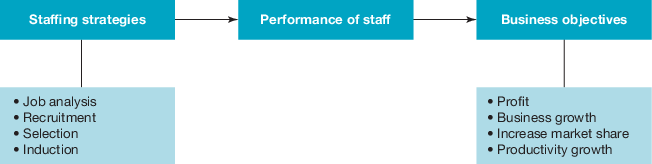
One common way of measuring the performance of staff is in terms of an employee’s efficiency. This considers how well an employee uses resources. Staff performance can also be measured by their ability to work as part of a team, their ability to change or by their willingness to adjust to change. Where staff performance is below expectations, the objectives of the business are likely to be jeopardised. If staff are inefficient in their work processes, higher business costs will result, which in turn will negatively impact on a business’s objective to maximise profit. In such a situation, a business may need to develop strategies to improve staff performance so that its objectives will be met. As we have already noted, these strategies for staffing a business will include recruitment, selection and induction. When staff are working productively, they will be lowering costs, increasing sales and assisting the business in achieving its objectives.
What are staffing needs?
The human resource requirements of a business, such as the knowledge, skills, and ideas that staff can contribute to the business, before commencing the process of recruitment and selection.
What is human resource planning?
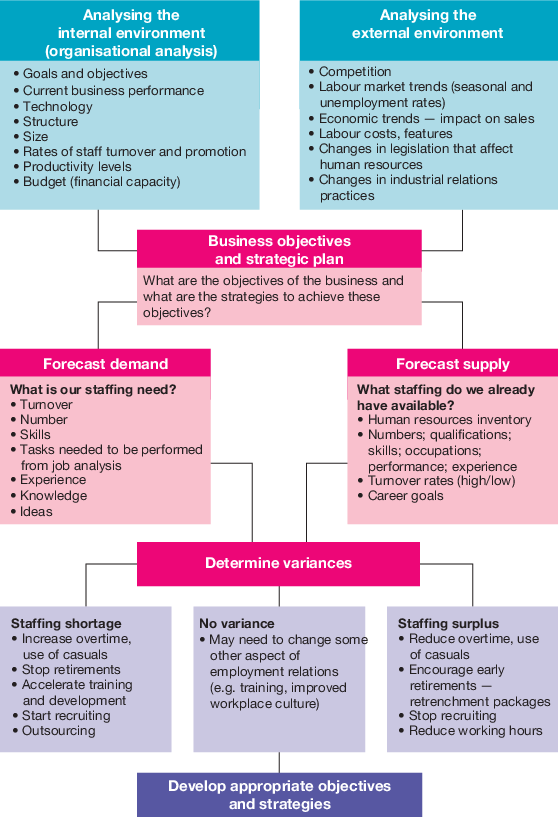
The process of determining current and future staffing needs for a business and the development of strategies to meet those needs.
It must be related to business strategies (the actions taken to achieve a business’s objectives).
eg. objective of increased profit is to reduce business costs. Human resource planning must forecast the future demand for employees and estimate the supply available to meet that demand in order to avoid having too many employees on the payroll.
What does human resource planning need to do when forecasting the demand for employees?
Internal and External Factors.
Internal factors may include budget constraints, changes in production, a planned expansion or contraction in operations, the purchase of new equipment, improved customer service, or likely retirements. External factors may include the state of the economy, social and technological change, government regulation and the degree of competition in the market. Given the pace of today’s technology and the global economy we now operate in, businesses must respond to change quickly. If a business does not plan its human resource needs in line with its business strategy, it is unlikely that the business will succeed.
A business should combine all of this information when planning for its staffing needs, to help determine:
the number of employees required
the qualifications of employees and their knowledge, skills, previous experience and ideas
when and where employees will be needed.