(3) Earths Interior
 Call Kai
 Learn
Learn Practice Test
 Spaced Repetition
 Match
Match Flashcards
 Knowt Play
1/24

There's no tags or description
Looks like no tags are added yet.
Name | Mastery | Learn | Test | Matching | Spaced | Call with Kai |
|---|
No analytics yet
Send a link to your students to track their progress
25 Terms
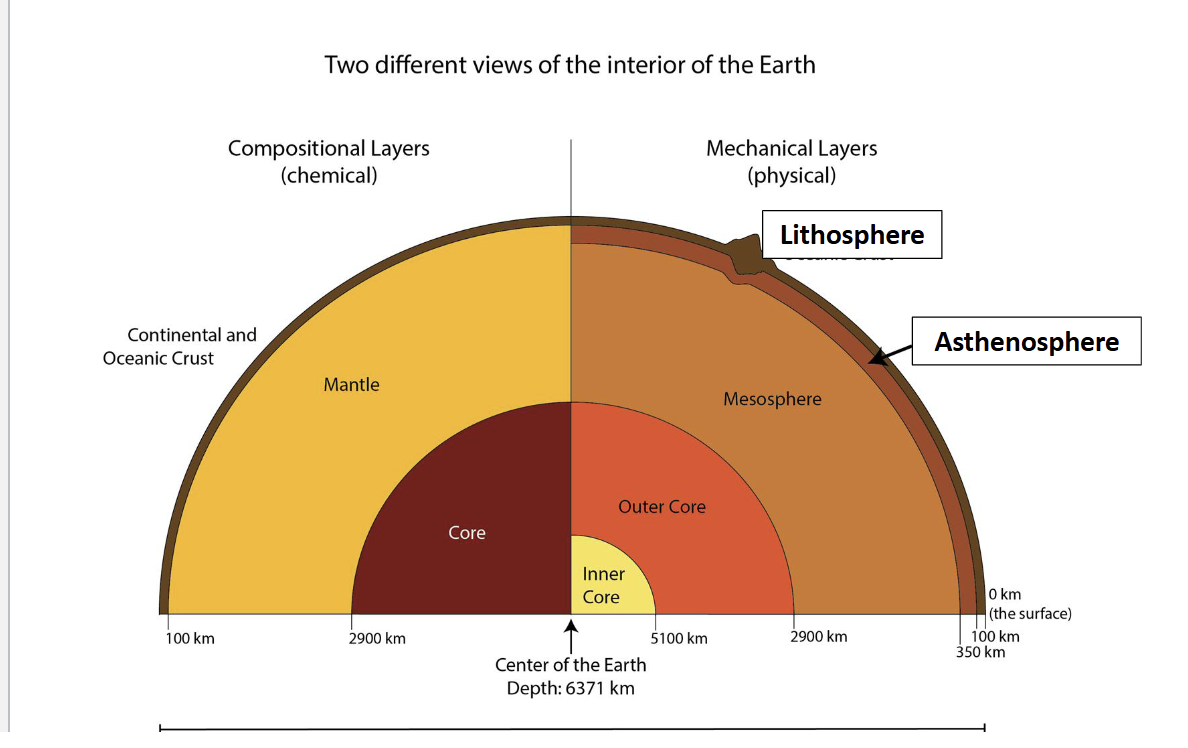
Draw the interior of the earth.
Crust
Solid rock (basalt & granite). Thin, outermost layer of rock.
Mantle
Solid rock (periodotite). Thick, middle zone. Composed of solid rock but can flow.
Core
Central zone on Earth that consists of two parts. Liquid iron outer core and a solid iron inner core.
Oceanic Crust
Thinner (<8 km), denser, mafic (basalt).
Continental Crust
Thicker (<70 km), less dense, felsic (granite). Continental crust contains older rocks than oceanic crust.
Outer Core
Liquid iron and nicken (30.8% of Earth’s mass). Generates Earth’s magnetic field.
Inner Core
Solid iron and nickel (1.7% of Earth’s mass).
Lithosphere
Rigid outer layer including the crust and uppermost mantle.
Asthenosphere
Weaker, ductile layer of the upper mantle beneath the lithosphere, allowing for plate movement.
Mesosphere
The remaining part of the mantle below the asthenopehere.
Geothermal Gradient
Temperature increases with depth. Averages about 25 degrees C per km, but varies geographically.
Geopressure Gradient
Pressure increases with depth at a relatively constant rate everywhere.
Lithostatic Pressure
Confining pressure occuring equally in all directions.
Directed Pressure
Pressure applied in a particular direction (e.g., from plate tectonics).
Isostacy
The equilibrium of adjacent blocks of lithosphere “floating” on the asthenosphere. Less dense lithosphere floats higher.
Isostatic Adjustment
Vertical movement of the lithosphere to achieve equilibrium (e.g., mountains rising as they erode).
Glacial Isostacy
Crust is depressed by the weight of glaciers and rebounds after ice melts.
Hydroisostacy
Crust is loaded by water during sea-level rise.
Mantle Convection
Circulation of warm, less dense material rising and cooler, denser material sinking. Drives plate tectonics.
Magma Formation
Magma is generayed by decompression melting, flux melting, and partial melting.
Decompression Melting
Hot rock rises, reducing pressure and lowering its meling point. Occurs at divergent plate boundaries.
Flux Melting
Water or other volatiles are introduced, lowing the melting point of rocks. Occurs at subduction zones (convergent plate boundaries).
Partial Melting
As temperature increases, minerals with lower melting points melt first.
Earth’s Magnetic Field (Geodynamo)
Generated by the convection of liquid iron in the outer core. This field protects Earth from solar wind. The magnetic poles wander over time, and the field can reverse polarity.