Cell and Molec Bio (Exam 2)
 Call Kai
 Learn
Learn Practice Test
 Spaced Repetition
 Match
Match Flashcards
 Knowt Play
1/322

There's no tags or description
Looks like no tags are added yet.
Name | Mastery | Learn | Test | Matching | Spaced | Call with Kai |
|---|
No analytics yet
Send a link to your students to track their progress
323 Terms
Carbon Cycle (2)
describes the flow of carbon atoms on earth
used to examine how energy is captured and released by living things
What processes make up the carbon cycle? (2)
photosynthesis
cellular respiration
Photosynthesis (2)
processes through which energy from sunlight is captured and used in a two-step process to synthesize energy rich carbon-containing compounds
reduces CO2 and uses light energy to push electrons to a high energy state
Cellular Respiration (3)
collection of metabolic reactions within cells that use O2 to oxidize and break down food molecules to produce energy in the form of ATP
results in the release of the light energy from the electrons
involves orchestration of cellular processes
Oxidation
reactions in which an atom fully or partially loses one or more electrons
Reduction
reactions in which an atom fully or partially gains one or more electrons
Why are oxidation and reduction reactions coupled?
when one molecule is gaining electrons another is losing them
What happens as electrons move to lower states?
they release free energy that will be harnessed for ATP synthesis
What is specifically being transferred in cellular respiration and photosynthesis?
hydrogens, which includes one 1 proton and 1 electron
What is happening to electrons during the multistep oxidation of glucose? (2)
electrons are moved to lower energy states as they are passed from donor to acceptor through multiple redox reactions
energy is given off in small packets that can be harnessed by biological systems
What does a multi-step series of redox reactions require?
small inputs of activation energy
What does a one step oxidation of glucose require? (2)
a lot of activation energy
energy is given off in a a large burst
How can we ensure that the breakdown of glucose is energetically favorable?
an electron shuttle
Electron Shuttle (2)
a molecule that can take electrons from one reaction to another
used to store and transfer energy of electrons
What are examples of an electron carriers? (2)
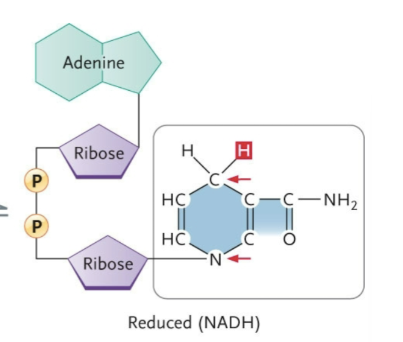
NAD
FAD
What is NAD derived from?
niacin
What are NAD and FAD reduced to? (2)
NADH
FADH
Where can an electron be added to NAD? (2)
carbon
nitrogen
What is the final electron acceptor?
oxygen
Why is oxygen a good final electron acceptor?
it is very electronegative
What are the stages of cellular respiration? (3)
glycolysis
pyruvate oxidation and the citric acid cycle
oxidative phosphorylation
Where does glycolysis occur?
in the cytosol
What does glycolysis yield? (3)
2 pyruvates
2 ATP
2 NADH
Where does pyruvate oxidation and the citric acid cycle occur?
mitochondrial matrix
What does pyruvate oxidation yield? (4)
2 acetyl CoA
1 NADH
2H+
2 CO2
What does the citric acid cycle yield? (5)
oxaloaceate
2 CO2
1 ATP
2 NADH
1 FADH
Where does oxidative phosphorylation occur?
mitochondrial matrix across the inner membrane
Oxidative Phosphorylation
transfer system that delivers electrons from NADH and FADH2 to oxygen and energy from electrons used to make ATP
What does oxidative phosphorylation yield?
34 ATP
Glycolysis
glucose and other molecules are partially oxidized and broken into smaller molecules
How many reactions occur in glycolysis?
10
What are the stages of glycolysis? (2)
energy requiring
energy releasing
What happens in the energy requiring steps of glycolysis? (2)
1 glucose → 2 glyceraldehyde-3-phosphate (G3P) molecules
2 ATP are hydrolyzed
What happens in the energy releasing steps of glycolysis? (3)
2 G3P → 2 pyruvate molecules
4 ATP are generated by substrate level phosphorylation
2 NAD+ are reduced to 2 NADH
What happens in Step 3 of glycolysis? (3)
fructose-6-phosphate phosphorylated by phosphofructokinase to fructose-1,6-bisphosphate
hydrolyzes ATP to provide Pi for kinase reaction
directly burning energy to drive this reaction
Which steps in glycolysis lead to the release of energy? (3)
Step 6
Step 7
Step 10
What happens in Step 10 of glycolysis? (3)
phosphoenolpyruvate dephosphorylated by pyruvate kinase to pyruvate
substrate level phosphorylation
phosphorous on substrate is transferred to ADP to form ATP
What steps does substrate level phosphorylation occur? (2)
Step 7
Step 10
What are the major enzymes in glycolysis? (3)
dehydrogenases
isomerases
kinase
Dehydrogenase (2)
enzymes in cellular respiration that transfer electrons in redox reactions
done by transferring hydrogen
Isomerases (2)
enzymes that convert molecules to different isomers
converts mainly structural isomers
Kinases
enzymes that phosphorylate substrates
How is glycolysis regulated?
ATP and AMP regulate phosphofructokinase allosterically
How is ATP involved in the regulation of glycolysis?
ATP negatively regulates phosphofructokinase if it is in abundance
How is AMP involved in the regulation of glycolysis? (2)
AMP positively regulates phosphofructokinase if it is in abundance
this increases the production of ATP
What does it mean if AMP is in high abundance?
ATP is low
What is a good example of substrate level phosphorylation? (2)
the pyruvate kinase reaction
the production of ATP in the citric acid cycle
What are the structural features of the mitochondria? (3)
outer membrane
inner membrane
mitochondrial matrix
Double Membrane of Mitochondria (2)
outer membrane
inner membrane
Mitochondria (2)
contain their own DNA and protein making machinery that make proteins important for cellular respiration
use nuclear-gene derived products for mitochondria function
Why do mitochondria have their own DNA?
they come from prokaryotes
Where is most of the machinery in mitochondria made?
in the nucleus so those proteins have to be transported to the mitochondria
What happens to the mitochondrial proteins as a result of 2 genomes being involved?
they become complex quaternary structures
Which cellular respiration steps occur in the mitochondria? (2)
pyruvate oxidation/citric acid cycle
oxidative phosphorylation
What generally happens in pyruvate oxidation and the citric acid cycle? (5)
1 pyruvate is oxidized for every glucose to an acetyl group
acetyl group is attached to CoA
CoA bound to acetyl group goes through citric acid cycle by being bound to oxaloacetate
carbons equivalent to the 2 made in a pyruvate molecule are lost as CO2
molecule of oxaloacetate remains at the end of the cycle to go through it again
What are the specific steps of pyruvate oxidation? (4)
pyruvate is transported across the mitochondrial membrane by pyruvate transporter
pyruvate will be oxidized to form an acetyl group (2C), which is transferred to CoA
Carbon is lost as CO2
NAD is reduced to NADH
What is the mechanism used for the pyruvate transporter? (2)
symporter that uses a hydrogen gradient
secondary active transport
What is CoA made from? (2)
vitamin B5
cysteine
What is pyruvate oxidation performed by?
multienzyme complex
What is the chemical equation for pyruvate oxidation?
2 pyruvate + 2CoA + 2NAD+ = 2 acetyl CoA + NADH + 2H+ + 2CO2
What happens in the first step of the citric acid cycle? (2)
oxaloacetate is joined with acetyl-CoA to form citric acid by citrate synthase
results in the release of CoA from the complex
What molecules regulate the first step of the citric acid cycle? (3)
citrate (negatively)
ATP (negatively)
NADH (negatively)
How could citrate be negatively regulating the first step of the citric acid cycle?
allosterically
What are some of the key features of the cyclic nature of the cyclic acid cycle? (4)
acetyl CoA is the input substrate
8 reactions in a cycle, so it is not linear
in one cycle, the 2C acetyl unit that is input ends up in oxaloacetate
2 CO2 in oxaloacetate are released
When in the citric acid cycle is there a removal of CO2? (2)
Step 3
Step 4
Oxidative Phosphorylation (2)
the electron transport chain (ETC) plus chemiosmosis by ATP synthase
biggest payoff for ATP produced
Chemiosmosis
production of H+ gradient that provides energy for ATP production
ATP Synthase
composed of multiple proteins encoded by mitochondrial and nuclear genomes
What delivers electrons to oxygen in oxidative phosphorylation?
a series of electron carriers with increasing affinity for electrons
What happens to electrons as they pass through the system in oxidative phosphorylation?
H+ ions are pumped out of the matrix into the intermembrane space
What happens as a result of generating an H+ gradient in oxidative phosphorylation?
H+ gradient provides energy to ATP synthase to phosphorylate ADP to ATP
What happens in the electron transport chain? (3)
electron shuttle molecules pass high energy electrons to protein complexes in the ETC
as electrons pass down the series of redox reactions, energy is siphoned off in small packets to drive H+ transport against the gradient
electrons finally end up with oxygen
What are the electron carriers in oxidative phosphorylation? (2)
NADH
FADH
What are the proton pumps in oxidative phosphorylation? (3)
Complex I
Complex III
Complex IV
How is NADH delivered in oxidative phosphorylation?
through Complex I
How is FADH delivered in oxidative phosphorylation?
through Complex II
What happens when the electrons combine with oxygen and H+?
they make water
What is the equation for cellular respiration?
C6H12O6 + 6O2 → 6CO2 + 6H2O + ~32 ATP
How efficient is cellular respiration?
30%
What does the efficiency of cellular respiration demonstrate?
the inefficiency of living systems
How can glycerol enter cellular respiration?
it can enter glycolysis as G3P
How can fatty acids enter cellular respiration?
it can enter the citric acid cycle as citrate
What happens when different macromolecules are entered into cellular respiration?
differing amounts of NADH, FADH, and ATP will be produced depending on where they are input into the cycle
What can cellular respiration be referred to?
central carbon metabolism (CCM)
What is required to perform oxidative phosphorylation?
oxygen
Fermentation (2)
substrate level ATP synthesis occurs in glycolysis
NADH is recycled to go back into the system the, transfers electrons to electron acceptor molecule
What happens in lactate fermentation? (2)
glycolysis produces 2 ATP and 2 pyruvate
pyruvate is converted to lactic acid
Why is lactate fermentation wasteful?
it barely produces ATP
Light-Dependent Reactions (2)
energy of the sun is converted to chemical energy in the form of NADPH and ATP
uses chemical energy
Light-Independent Reactions
energy from light-dependent reactions is used to convert inorganic CO2 into organic C-containing molecules (carbon fixation)
Where are H+ and e- derived? (2)
water
oxygen is released as a byproduct
How can C-containing molecules fixed by photosynthesis be used?
by animals and plants cellular respiration
What do plants do with glucose?
they use cellular respiration to break it down
Why do plants use amylose as a storage molecule?
ATP is not the best storage molecule
Chloroplast (4)
metabolic organelle where photosynthesis occurs
originally a prokaryote that coevolved to become a symbiote
contain own DNA and protein making machinery
use nuclear-gene derived product for function
What are the components of chloroplasts? (3)
double membrane
stroma
thylakoids
Double Membrane of Chloroplast (2)
outer and inner membrane
between is the intermembrane space
Stroma (2)
internal space
where light independent reaction takes place
Thylakoids (3)
membrane bound structures inside the stroma
elaborated in structure to increase in surface area
where light dependent reaction takes place
What is light energy absorbed by in photosynthesis? (2)
chlorophylls
carotenoids