4 - States of Matter/Gas Laws
 Call Kai
 Learn
Learn Practice Test
 Spaced Repetition
 Match
Match Flashcards
 Knowt Play
1/57

There's no tags or description
Looks like no tags are added yet.
Name | Mastery | Learn | Test | Matching | Spaced | Call with Kai |
|---|
No analytics yet
Send a link to your students to track their progress
58 Terms
What is the formula for converting kPa to atm?
kPa/101.3 kPa
According to the kinetic theory, collisions between molecules in a gas
are perfectly elastic
The particles in a gas are best described as
small, hard, fast-moving spheres with insignificant volumes that travel in straight lines between collisions.
Standard conditions when working with gases are defined as
0 degrees Celsius and 101.3 kPa
How does the atmospheric pressure at altitudes below sea level compare with atmospheric pressure at sea level?
The atmospheric pressure below sea level is higher.
What causes gas pressure in a container such as a helium balloon?
the simultaneous collisions of fast-moving particles with the container
What is the relationship between atmospheric pressure and altitude?
inverse
As altitude increases, atmospheric pressure
decreases
The pressure of a gas in a container is 30.4 kPa. This is equivalent to
0.300 atm
The temperature at which the motion of particles theoretically ceases is ____.
0 K (absolute zero)
With which temperature scale is temperature directly proportional to average kinetic energy?
Kelvin
Which are the first particles to evaporate from a liquid?
particles with the highest kinetic energy
In a dynamic equilibrium between the liquid state and the gas state, what is true about the rate of evaporation?
it is equal to the rate of condensation
Water could be made to boil at 105°C instead of 100°C by
increasing the external pressure
What best describes the motion of the particles in a piece of steel?
all are moving
Most solids
are dense and difficult to compress
The physical properties of liquids are determined by
the interplay between the disruptive motions of particles in a liquid and the attractions among the particles.
The escape of molecules from the surface of a liquid is known as ____.
evaporation
The direct change of a substance from a solid to a gas is called ____.
sublimation
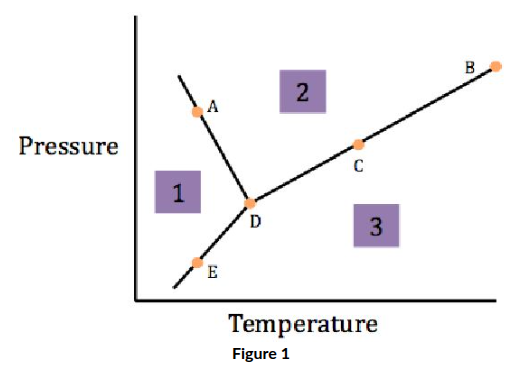
The labeled point in Figure 1 at which sublimation can occur is
E
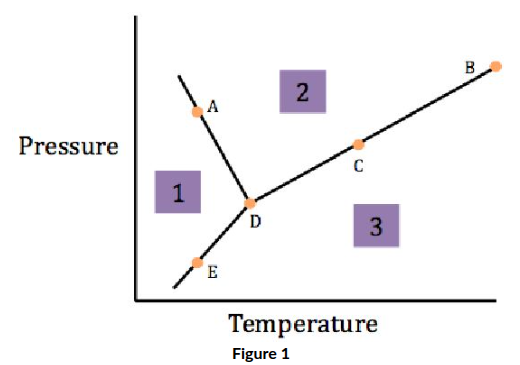
In Figure 1, which sections represent solid, liquid, and gas?
1 = solid, 2 = liquid, 3 = gas
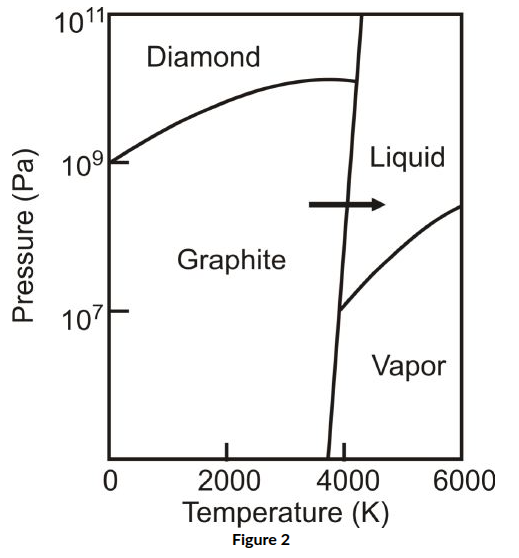
Refer to Figure 2: the combination of temperature and pressure at which carbon can exist simultaneously as solid, liquid, and gas (triple point) is about
3950 K and 10,000 kPa
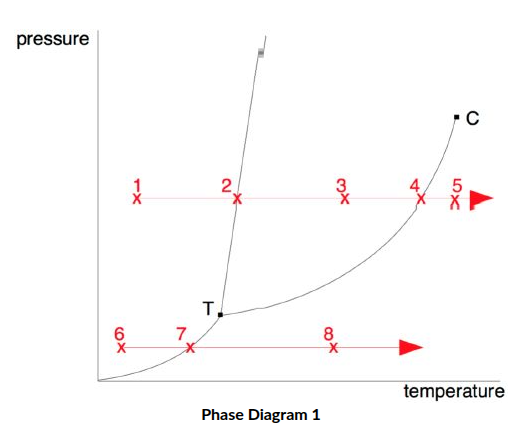
The substance is only a gas at point ____ on the diagram.
5
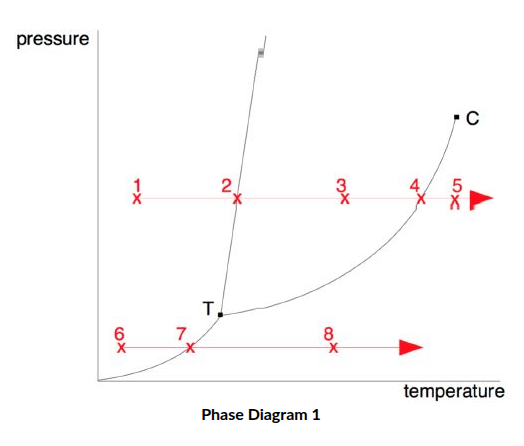
Boiling is occurring at point ____ on the diagram.
4
Why is a gas easier to compress than a liquid or a solid?
The volume of a gas’s particles is small compared to the overall volume of the gas.
Why does the pressure inside a container of gas increase if more gas is added to the container?
There is an increase in the number of collisions between particles and the walls of the container.
If the volume of a container of gas is reduced, what will happen to the pressure inside the container?
the pressure will increase
Which of these changes would cause a decrease in the pressure of a contained gas?
The volume of the container is increased.
The volume of a gas is doubled while the temperature is held constant. How does the gas pressure change?
it is reduced by one half
The volume of a gas is reduced from 4.0 L to 0.5 L while the temperature is held constant. How does the gas pressure change?
it increases by a factor of eight
Boyle's law states that the ____.
volume of a gas varies inversely with pressure when temperature is constant
Charles's law states that the ____.
volume of a gas is directly proportional to its temperature in kelvins when pressure is constant
Gay-Lussac’s Law states that the ____
pressure of a gas is directly proportional to the Kelvin temperature when volume is constant
What is the formula for Boyle’s Law?
P1 x V1 = P2 x V2
What is the formula for Charles’ Law?
V1/T1 = V2/T2
What is the formula for Gay-Lussac’s Law?
P1/T1 = P2/T2
What is the formula for the Combined Gas Law?
(P1 x V1)/T1 = (P2 x V2)/T2
If a balloon is heated, what happens to the volume of the air in the balloon if the pressure is constant?
it increases
As the temperature of a fixed volume of a gas increases, the pressure will ____.
increase
If a sealed syringe is plunged into cold water, in which direction will the syringe piston slide?
in
A gas occupies a volume of 2.4 L at 14.1 kPa. What volume will the gas occupy at 84.6 kPa?
0.40 L
If a sealed syringe is heated, in which direction will the syringe plunger move?
out
A sample of gas occupies 17 mL at –112 degrees Celsius. Assuming the pressure is held constant, what volume does the sample occupy at 70 degrees Celsius?
36mL
How do you convert temperature in Celsius to Kelvin?
Add 273.15
How do you find V2 in a problem using Charles’s Law?
V2 = V1 x T2/T1
How do you find V2 in a problem using Boyle’s Law?
V2 = (P1 x V1)/P2
In general, for a gas at a constant volume, the
pressure of the gas is directly proportional to its temperature in kelvins.
What does the combined Gas law relate to?
temperature, pressure, and volume
If a balloon containing 3000 L of gas at 39 degrees Celsius and 99 kPa rises to an altitude where the pressure is 45.5 kPa and the temperature is 16 degrees Celsius, the volume of the balloon under these new conditions would be calculated using the following conversion factor ratios (units not shown): ____.
3000 L x (99/45.5) x (289/312)
How do you find V2 in a problem using the combined gas law?
V2 = V1 x (P1/P2) x (T2/T1)
If the volume of a container of air is reduced by one-half, what happens to the pressure within the container?
it is doubled
What is a barometer
A device used to measure atmospheric pressure
Average atmospheric pressure is
101.3 kPa
A vacuum is
An empty space with no particles and no pressure
Do attractive or repulsive forces exist between gas particles?
No
What is an elastic collision
one where kinetic energy is transferred from one particle to another with no overall loss of kinetic energy
What is the formula for finding volume of a gas at STP?
V = nRT/P
What is the ideal gas constant?
0.08206 L x atm/mol x K