Lecture 37 (mainly a case study)
 Call Kai
 Learn
Learn Practice Test
 Spaced Repetition
 Match
Match Flashcards
 Knowt Play
1/8

There's no tags or description
Looks like no tags are added yet.
Name | Mastery | Learn | Test | Matching | Spaced | Call with Kai |
|---|
No analytics yet
Send a link to your students to track their progress
9 Terms
Experiments to predict effects of global change
Many studies focus on “natural experiments”
- thermal clines
- Natural disasters
- areas of notable anthropogenic changeThese are hugely helpful but may have confounding factors
*Manipulative experiments are rare andcrucial to confirming predictions about
adaptations to climate change
New Zealand experiment
Deforestation by humans is a series anthropogenic effect on the landscape
Stoneflies are relatively common insect with two distinct color morphs
The black morph mimics a toxic relative and is thought to be protected against predators
Morph frequencies in stone flies
Data from more than 1200 specimens indicated that the black morph was more common in forested vs. unforested sites
Testing the hypothesis
To test if bird predation is driving differences in morph frequency, Ni et al. placed models of both morphs into two forested and two deforested sites
They recorded damage by predators:
- Birds
- Rodents
- insects
Doom and gloom?
If we keep with current CO2 emission rates, loss of biodiversity is inevitable
We are getting close to a tipping point, where global climate changes will be irreversible
Where do we go from here, in terms of climate change?
Reducing Co2 emissions can curtail impacts
Some species are adapting to the changing climate
Research is essential to predicting which species will adapt and which need help to avoid extinction
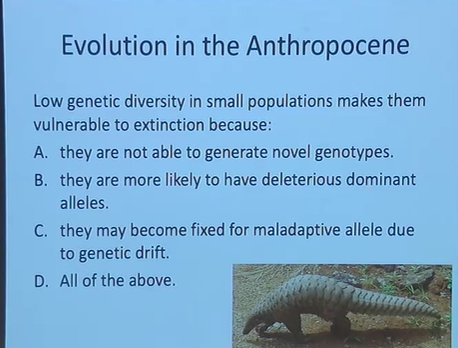
C
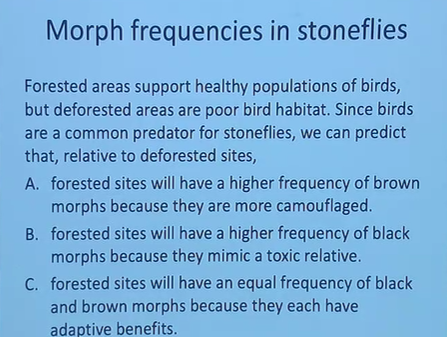
case study quesiton
B, no wrong answer but this is what the class chose
There are more case study questions, but its a case study class so watch the video to answer the questions lecture on 4/22