ARRT Boards review (Patient Care) (radiation safety)
 Call Kai
 Learn
Learn Practice Test
 Spaced Repetition
 Match
Match Flashcards
 Knowt Play
1/59

There's no tags or description
Looks like no tags are added yet.
Name | Mastery | Learn | Test | Matching | Spaced | Call with Kai |
|---|
No analytics yet
Send a link to your students to track their progress
60 Terms
Patient Rights
-Consent (Informed, verbal, implied, and written)
- confidentiality (HIPPA)
- Patients Bill of Rights (DNR, Living will, health care proxy, advanced directives, research participation)
Battery
intentional and unathorized acts (ex. performing an exam a patient refused)
Negligence
Failure to exercise reasonable care, causing injury or damage ( Ex: failure to lock a wheelchair and pt. falls)
Malpractice
professional negligence when a professional deviates from accepted standards of care
Tort: (2 types: intentional and unintentional)
intentional: assault, battery
unintentional: negligence
Respondeat Superior
"Let the master answer" an employer is vicariously liable for the behavior of an employee working within his or her scope of employment
Res Ispa Loquitur "the thing speaks for itself"
situation in which a particular injury could not have occurred in the absence of negligence, patient is not at fault
Tort Law Doctrine
allowing the plaintiffs to infer a defendant's negligence through evidence
Image requisition requirements
- identification
- allergies
-specific exam
-clinical history (indications/ symptoms)
-diagnosis
-referring provider name
ARRT standards of ethics (3 parts)
Code of ethics- guide
Rules of ethics- mandatory
Ethics review process- investigates and handles violations
* know specifics of each
standard precautions
A strict form of infection control that is based on the assumption that all blood and other body fluids are infectious.
chain of infection
Infectious agent, reservoir, portal of exit, means of transmission, portal of entry and susceptible host
contact precautions
gloves and gowns
Droplet precautions
surgical mask
Airborne precautions
N95 mask, negative pressure room
Neutropenic precautions
immunocompromised, strict hand washing, private room, no raw veggies/fruits, daily baths, visitors are restricted
BUN
blood urea nitrogen
Normal: 7-21 mg/dl
Creatine
0.6-1.2 normal range
waste product (do not want it high)
GFR (glomerular filtration rate)
90-120 mL/min
Renal function
filtration (want this number high)
*tested before given contrast to check kidney function
Inverse relationship between Creatine and BUN to GFR
^ BUN or creatine = Decreased GFR
photoelectric effect
Photon completely absorbed and inner shell electron injected
-Increases PT dose
Compton effect (scatter)
* Contributes most to occupational dose
increased kvp does what to attenuation
decreases it
exposure
number of ionizations produced in air
unit: coulumbs/Kilogram (c/Kg)
absorbed dose
the amount of energy absorbed per unit mass
- cause for biological damage
-measured in Gray
Equivalent Dose (EqD)
used absorbed dose adjusted for type of radiation used
absorbed dose x radiation weighing factor
Effective dose (EfD)
*Best overall risk dose
- adjusted for tissue type
absorbed dose x weight factor x tissue factor
x-ray has weighing factor of 1
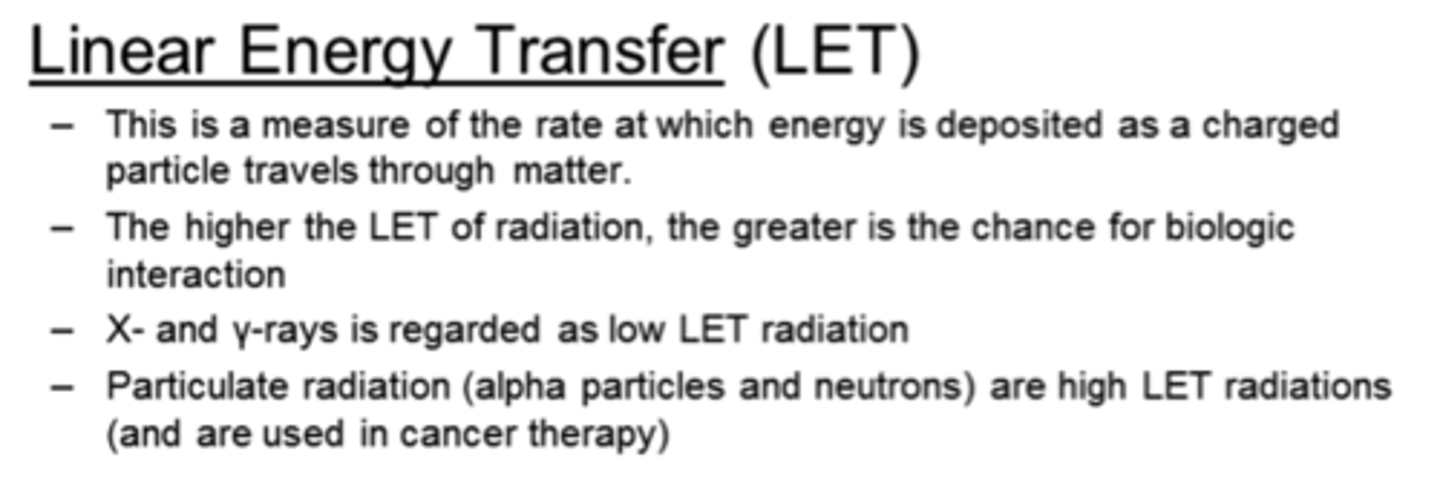
Linear Energy transfer
LET=total energy deposited/ track traveled
Relative Biological Effectiveness (RBE)
measurement unit used to compare the biological effects of different tissues irradiated by different forms of radiation
*different radiation = different damage
^LET=^RBE
LD 50/30
lethal dose for 50% or irradiated population to cause death in 30 days
*3-4 Gy without medical support
Radiolysis
The disassociation of water molecules following irradiation
-creates free radicals and toxic substances (hydrogen peroxide)
- indirect damage to DNA and cell functions
protraction
dose delivered continuosly over a long period of time
- gives healthy cells less time to recover
fractionation
dose is divided into multiple exposure times
-gives tissue a
Mitosis
prophase: chromosomes begin to become visible
M- Metaphase: chromosomes fully exposed; meet in the middle
*most radiosensitive phase
tele
interphase (apoptosis)
controlled self destruction of cell to prevent further damage before division
mitotic death
"genetic death" occurs when a cell dies after one or more divisions
Mitotic delay
Exposing a cell to as little as 0.01 Gy (1 rad) of ionizing radiation just before it begins dividing can result in failure of the cell to start dividing on time
Dose response relationships
nonlinear, nonthreshold: any dose can be harmful; harm increases nonlinearly with dose
Linear, nonthreshold: risk is proportional to dose, no safe level
linear, threshold: risk proportional to dose, with safe level
nonlinear, threshold: below this threshold there is no effect
non-stochastic effects
- determined threshold has to be met
- early or late effects ( ex: burns (early), cataracts (late)
Nonlinear: ^ dose = ^ severity and probability
*think about a sunburn: the longer you are in the sun the more chance yu have of sunburn
stochastic effects ( probabilistic or non-threshold)
- cancer or genetic mutations
Linear: ^dose = ^ probability but NOT severity
*think about playing the lottery: the more you play the more chances you have of winning, but the prize is the same
Early non-stochastic effects
fetal stages
Preimplantation 1st week (when egg is implanted, all or nothing)
Organogenesis: 10 days-6 weeks (most radiosensitive)
fetal stage: 6 weeks - term: exposure can cause cancer/functional disorders
Acute radiation syndrome
Hematopoietic: affects bone marrow causing infection and hemorrhage (1-10 Gy_
Gastrointestinal (GI): destroys lining, causing nausea, vomiting dehydration (> 10 Gy)
Central Nervous system syndrome: Neurological failure (>50 Gy)
stages of acute radiation syndrome
1. prodromal (right after dose is received (nausea, vomiting, skin reddening)
2. Latent: symptoms temporarily disappear (length of period dependent on dose)
3. Manifest Illness: full effects in place (ex: neurological damage-> seizures)
4. recovery or death
who should you last choose to radiate/hold
1. a technologist since they are around radiation most
2. woman of childbearing age (cannot reproduce reproductive cells)
3. Male (can reproduce sperm)
beam restriction requirement
must be accurate within 2% of SID
Fi
removes low energy photons, reducing skin and organ dose to PT
NCRP #102
2.5 mm lead requirement for filtration
Increased grid ration dose what to patient dose
increased due to need for use of higher exposure factors
minimum source to skin dose for fluoro (21 CFR)
fixed = 15"
Mobile (c-arm)= 12"
where should the image intensifier always be placed
above patient
secondary radiation consists of
leakage and scatter radiation
Primary barrier
blocks direct radiation
1/16 pb eq
secondary barrier
walls
1/32 pb ed
note: must be 1/2 inch overlap of barriers
protective tube housing
limit radiation leakage from tube to less than 0.88 mGy/hr at 1 meter (even at tubes maximum capacity)
minimum lead equivalents for protective wear
aprons- .50 mm
thyroid shield- .50
glasses- .35mm
gloves- .25 mm
curtain- .25 mm
bucky slot cover- .25 mm
NCR #102 and CFR fluoro requirement
cumulative timer: required to track exposure
exposure rates: normal mode < 10 R/min
dosimeter requirement
anyone receiving >10 mGy
Dosimeters
TLD: extremity detector
Pocket: uses gas as sensing material and gives immediate dose reading
OSL: uses aluminum oxide w/ copper, tin, and aluminum filters
NCRP #116 dose limit
Annual: 50 mSv
cumulative :10 mSv X age
Public: 15 mSv to eye and 50 mSv for skin, hands, and feet
eye: 150 mSv