4.1 National Income Statistics
 Call Kai
 Learn
Learn Practice Test
 Spaced Repetition
 Match
Match Flashcards
 Knowt Play
1/44

There's no tags or description
Looks like no tags are added yet.
Name | Mastery | Learn | Test | Matching | Spaced | Call with Kai |
|---|
No analytics yet
Send a link to your students to track their progress
45 Terms
What is national income
The total value of all final goods and services produced in an economy over a given period of time, usually one year.
- A country's total output
- Total output = total income = total expenditure
What are national income statistics
Measures of the total output (income and expenditure) of an economy
- It is a general term for a number of measures of a country's economic activities in terms of its output, expenditure and income
Why are national income statistics measured/calculated
It's calculated by governments to assess the performance of an economy and compare to others.
- An economy is considered to be doing well if its output is growing at a sustained and sustainable rate.
Why is it important that economists examine both the level and rate of growth
Because a country with a larger economy can have a bigger absolute increase in output but a smaller percentage growth rate, so both measures are needed to accurately compare economic performance (e.g. the USA vs Malaysia).
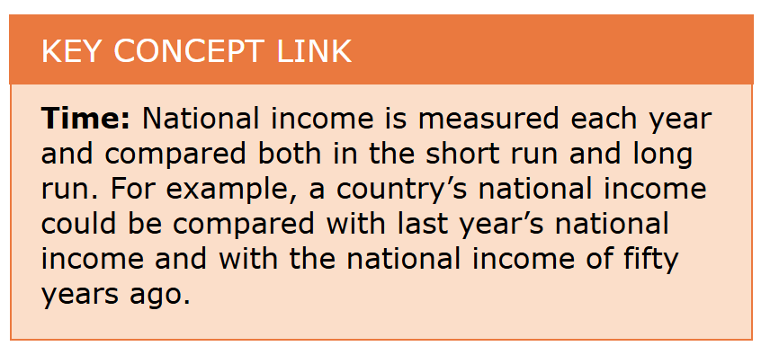
Key concept link - time
What is Gross Domestic Product (GDP)
The total value of all final goods and services produced within a country’s borders in a given time period.
- The total output produced in a country
- GDP is the most widely used measure of national income
What does 'gross' and ‘domestic’ mean in GDP
Gross = total
Domestic = production that takes place within a country, regardless of the nationality of the firm or workers.
What is GDP per capita
GDP per capita is the total output (GDP) of a country divided by its population, showing the average output or income per person.
Why is GDP per capita useful for measuring economic growth
It adjusts for population size, showing how economic growth translates into average living standards.
What are the three methods of measuring GDP
The output, income or expenditure method
Why should all three methods of GDP give the same outcome
Because they all measure the circular flow so the value of output is equal to the incomes that are earned producing it, meaning wages, rent, profit and interest. If it is assumed all incomes are spent, expenditure will, by definition, equal income.
What is the output (production) method of measuring GDP
A method that calculates GDP by adding the value of output produced by all firms in the economy.
- A way of measuring GDP by calculating the total production of goods and services of the country
- Sometimes called the production method
In the output method of measuring GDP how is double counting of items avoided e.g. counting the car and the tires made for the car
To avoid double counting, output is measured either by totalling the value of the final product or by adding the value at each stage of production.
What is value added
The difference between the price at which the products are sold and the price of goods and services used in their production
What is the income method of measuring GDP
A method that calculates GDP by adding together all incomes earned from production, such as wages, rent, interest and profit (all these payments represent income paid to factors of production).
- A way of measuring GDP by totalling all the incomes earned in producing the country's output
In the income method of measuring GDP, what is it important to only include
It is important to only include payments received in return for providing a good or service
- Transfer payments, like welfare payments & subsidies, are not included
What is the expenditure method of measuring GDP + what does it include(5)
A method that calculates GDP by adding total spending on final goods and services in the economy.
- A way of calculating GDP by totalling all the spending on the country's output
- Adds up/Includes consumer expenditure, government spending on goods and services, total investment, changes in stocks and the difference between imports and exports (add expenditure on exports and deduct spending on imports).
- Transfer payments are not included
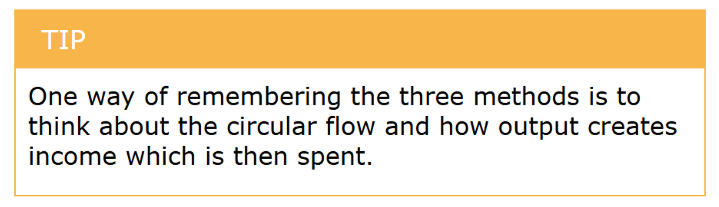
Tip - way of remembering methods
What is Gross National Income (GNI) + what does it include
GDP plus net property income from abroad.
- Goes further than GDP in changing the focus from output produced in a country to income earned by the country's residents and firms, regardless of where it is earned.
- Includes net property income from abroad as well as other sources of income that residents receive from abroad and deducts other sources of income that residents receive from the country. (These payments are net receipts of compensation of employees and net taxes less subsidies on products)
What is compensation of employees
Income of workers who work in another country for a short period of time e.g. seasonal and cross boarder workers
What is net property income from abroad
Income earned by residents from abroad minus income earned by foreign residents in the domestic economy.
- Receipts of profit, rent and interest earned on the ownership of foreign assets minus the payments of profit, rent and interest to non-residents.
What is gross national disposable income (that governments also measure)
GNI plus net transfers of workers' income to their relatives to and from other counties
Why can GNI differ from GDP
Because profits and income may flow into or out of the country due to foreign ownership of firms.
Why would a country's GDP be noticeably higher than their GNI, e.g. Ireland
Because foreign multinational companies (MNCs) and foreign workers make an important contribution to the output of these countries.
- Ireland's GDP has increased rapidly in recent years due to their ability to attract foreign investment, however his has also resulted in a net outflow of profits and other income.
Why would a country's GNI be higher than their GDP (3), e.g. Germany & Nepal
Because they receive a net inflow of property income from abroad
- Germany firms, for example, have invested large amounts in other countries in the past and now receive an inflow of profits from their MNCs operating in other countries
- A number of countries receive a significant inflow of income from their citizens working abroad e.g. Nepal
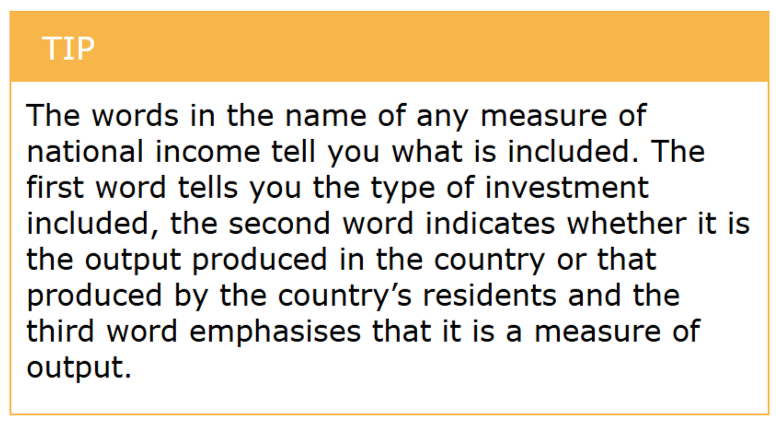
Tip
What are GDP and GNI both measured in
Both market prices and basic prices
What are market prices
Prices paid by consumers for goods and services, including indirect taxes and excluding subsidies.
- Prices paid by consumers that take into account indirect taxes and subsidies
What are basic prices (also referred to as factor cost)
Prices received by producers for goods and services, excluding indirect taxes and including subsidies.
- Prices charged by consumers before the addition of indirect taxes and the deduction of subsidies
- Prices which would be charged without government intervention
What are indirect taxes
Taxes imposed on expenditure, such as VAT and excise duties, that increase market prices.
What are subsidies
Payments made by the government to firms to reduce production costs and lower prices.
How do you adjust national income from market prices to basic prices
By subtracting indirect taxes and adding subsidies.
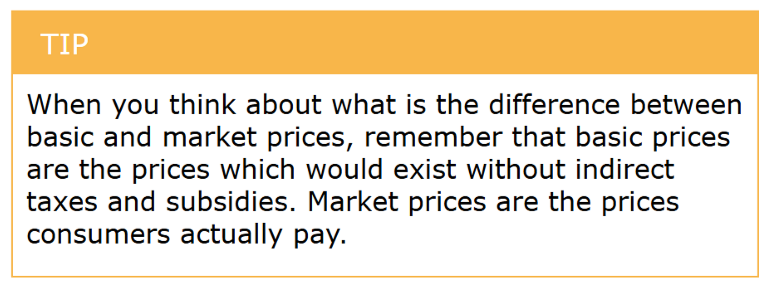
Tip - difference between basic and market prices
What is the formula for converting market prices to basic prices
Basic prices = Market prices − indirect taxes + subsidies.
What is gross investment
Total spending on capital goods
- Includes the output of capital goods both used to replace existing capital goods that have depreciated and capital goods required to expand capacity
What is Net National Income (NNI)
Gross national income minus depreciation.
What is net domestic product (NDP)
GDP minus depreciation
- Only includes net investment -> the deduct the value of the replacement of capital goods
What is depreciation (of capital goods)
The wear and tear of capital goods such as machinery, buildings and equipment over time.
- The value of capital goods that have worn out of become out-of-date
What is net investment
Additions to the capital stock
What does net investment give an indication towards
Net investment gives an indication towards whether the country's ability to produce goods and services in the future will increase, stay the same or even decrease.
Why is depreciation subtracted to calculate net national income
Because depreciation does not contribute to current consumption and overstates the sustainable level of income.
What is the difference between gross and net national income
Gross national income includes depreciation, while net national income excludes depreciation.
Why are net measures of national income often preferred to gross measures
Because net measures better reflect sustainable income and living standards.
Why might GDP overstate living standards
Because it includes depreciation and does not account for income flowing out of the country.
Why is national income data useful to governments
It helps assess economic performance, economic growth and inform policy decisions.