Freshwater Stream Ecology: Macroinvertebrates, Biodiversity & Human Impact
 Call Kai
 Learn
Learn Practice Test
 Spaced Repetition
 Match
Match Flashcards
 Knowt Play
1/79

There's no tags or description
Looks like no tags are added yet.
Name | Mastery | Learn | Test | Matching | Spaced | Call with Kai |
|---|
No analytics yet
Send a link to your students to track their progress
80 Terms
What is the primary objective of the labs on freshwater ecology?
To examine biodiversity and stream quality using macroinvertebrate communities.
What sampling technique is used to collect stream macroinvertebrates?
Kick sample.
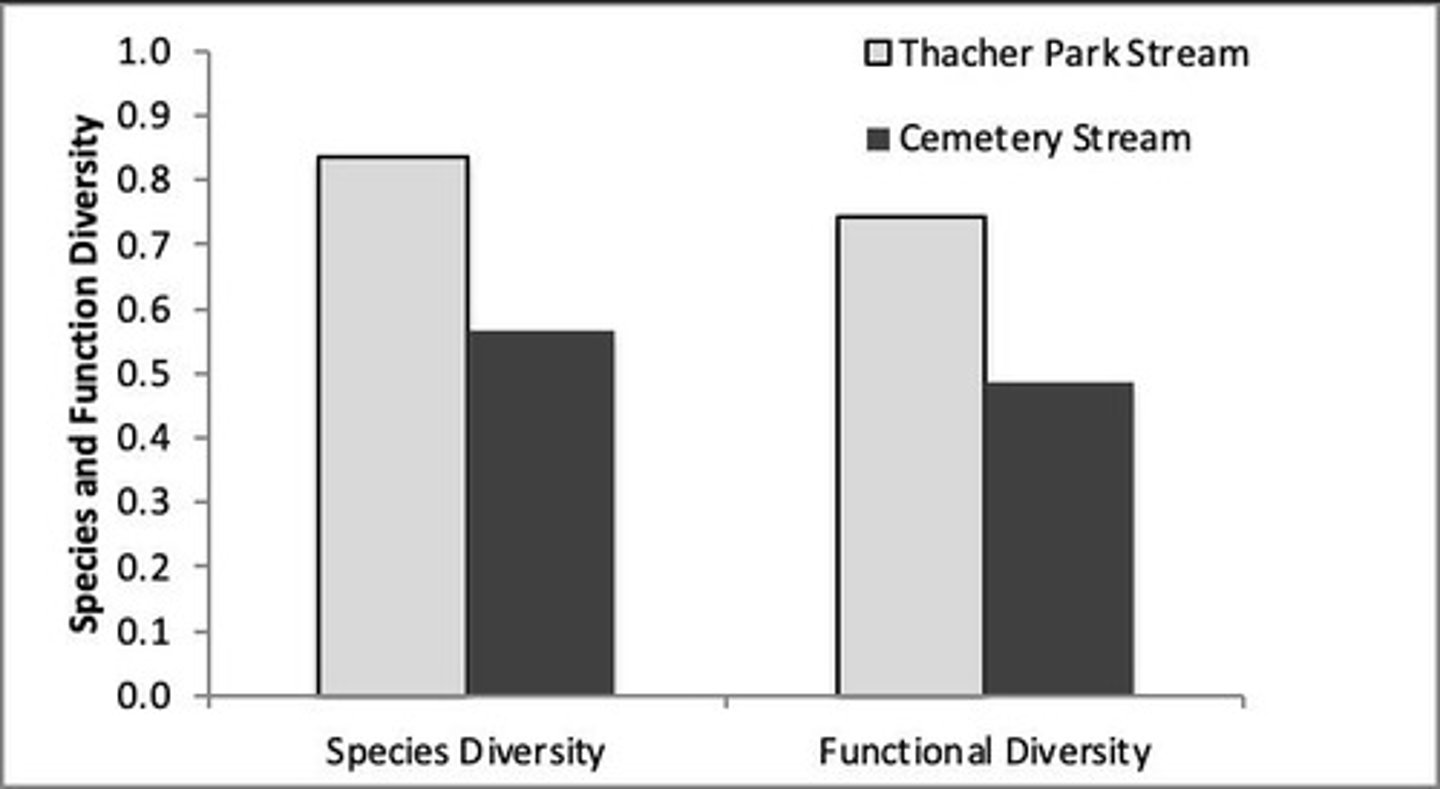
What two types of diversity are measured in stream ecosystems?
Species diversity and functional diversity.
What is a biome?
An area on the planet identified by its climate, animals, and plants.
How many major biomes are recognized by the National Geographic Society?
5 major biomes: aquatic, grassland, forest, desert, and tundra.
Define habitat.
A place within a biome where a given organism lives, supporting its needs.
What is a population in ecological terms?
All individual organisms of a given species living in a particular geographical area.
What constitutes a community in ecology?
Populations of two or more different species occupying the same geographical area at the same time.
Define ecosystem.
A community of interacting organisms and their physical environment.
What are two ways human activities can impact streams?
Runoff from precipitation and groundwater movement.
How can stream quality be assessed using macroinvertebrates?
By studying the presence and abundance of certain taxa that vary in their tolerance to human impacts.
What is detritus in a stream ecosystem?
Natural debris such as leaves, twigs, and wood particles that provide energy for the ecosystem.
What role do shredders play in a stream ecosystem?
They break down coarse particulate organic matter (CPOM) into fine particulate organic matter (FPOM).
What is species diversity (SD)?
A measure that includes both species richness and the relative abundance of each species in a community.
What is functional diversity (FD)?
The variety of functions or biological processes present in a particular ecosystem.
What are the two components of functional diversity?
Functional richness and the relative abundance of individuals of each functional role.
Why is functional diversity important for ecosystem productivity?
It has a more direct effect on productivity and nutrient cycling than species diversity.
List the seven different feeding modes in aquatic streams.
Predation, shredding, collecting, scraping, grazing, filtering, and deposit feeding.
What is the purpose of using the Biotic Index in stream health assessment?
To assess stream health based on the presence and abundance of macroinvertebrate taxa.
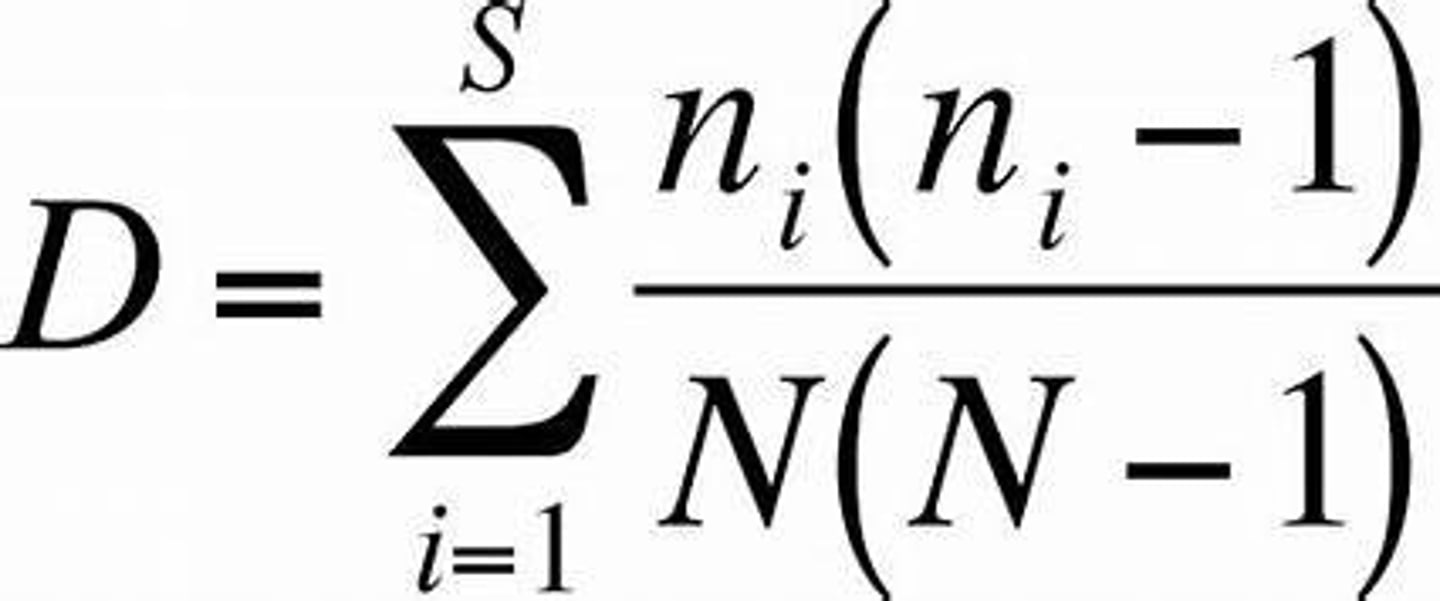
What is the Simpson Diversity Index used for?
Calculating species diversity in a community.
What is the significance of measuring both species richness and relative abundance?
It provides a more comprehensive understanding of community diversity.
How do human activities like logging and development affect streams?
They can introduce pollutants and alter the natural flow of water, impacting stream quality.
What is CPOM?
Coarse particulate organic matter that serves as an energy source in stream ecosystems.
What is FPOM?
Fine particulate organic matter that results from the breakdown of CPOM.
What is the role of bacteria and fungi in stream ecosystems?
They decompose organic matter, recycling nutrients within the ecosystem.
What is the relationship between watershed disturbances and stream health?
Disturbances can lead to increased pollutants and altered habitats, negatively affecting stream health.
What is the importance of studying macroinvertebrate communities in freshwater ecology?
They serve as indicators of stream health and biodiversity.
What is the purpose of the macroinvertebrate study?
To survey the macroinvertebrate community of two local stream ecosystems and assess the impact of human development on health, species diversity, and functional diversity.
What are the two streams being sampled in the study?
Fox Stream, located far from human impacts, and a stream near campus in Albany Rural Cemetery.
What is the kick sample technique?
A standard method for sampling invertebrates where nets are held downstream while sediment is disturbed upstream to capture organisms.
What is the first step in the laboratory procedure after collecting a kick sample?
Pour a small portion of the kick sample into a white sorting pan to pick out large, visible invertebrates.
How do you identify taxa in the macroinvertebrate samples?
Use identification charts to classify organisms to the ordinal level with the aid of dissecting needles and forceps.
What does %EPT stand for?
Ephemeroptera (Mayflies), Plecoptera (Stoneflies), and Trichoptera (Caddisflies), which are sensitive to pollution.
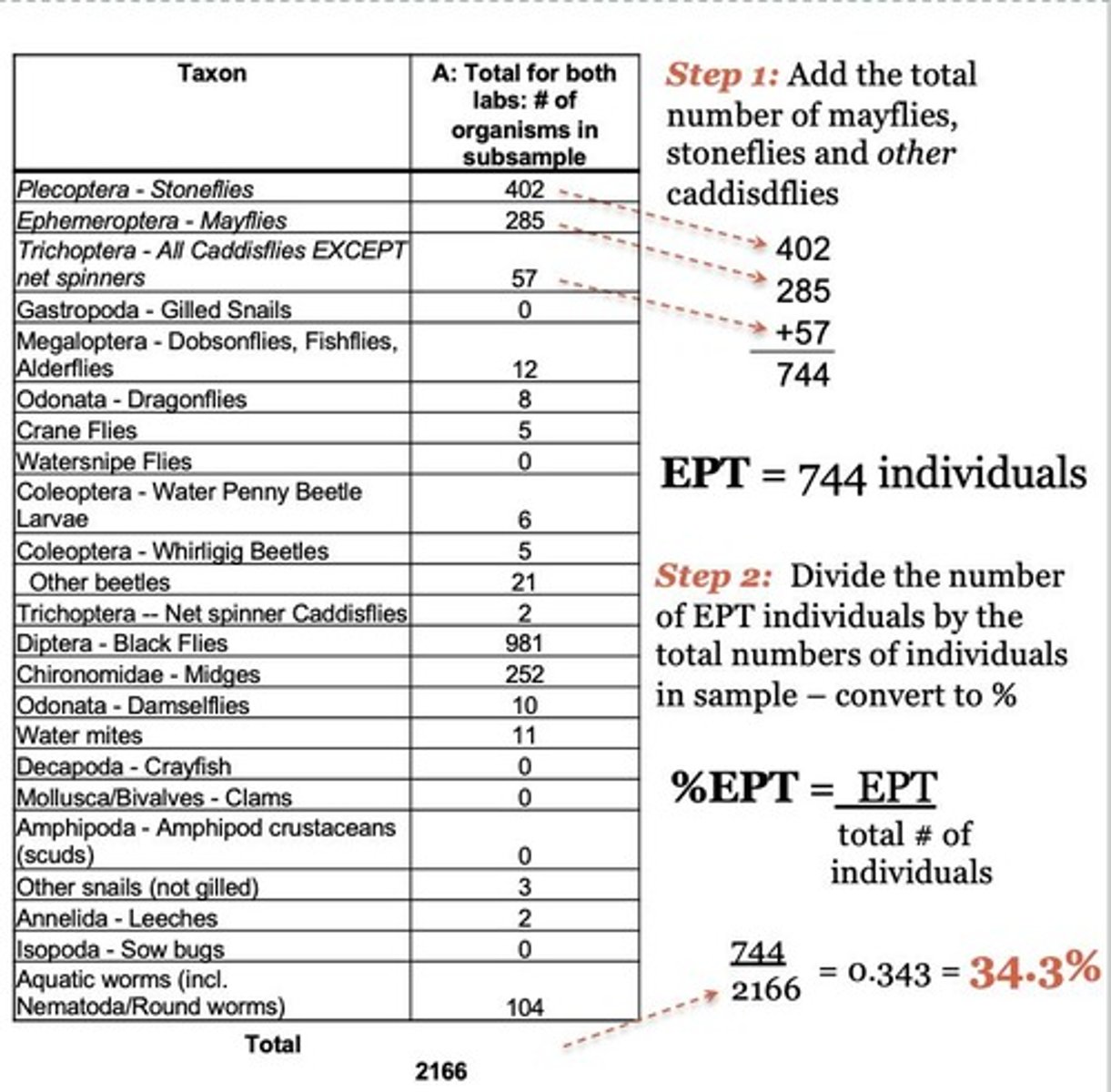
How is the %EPT calculated?
It is the ratio of the total number of EPT individuals found in a sample divided by the total number of individuals from all groups.
What does a higher %EPT indicate about a stream?
It suggests that the stream is less impacted by pollution.
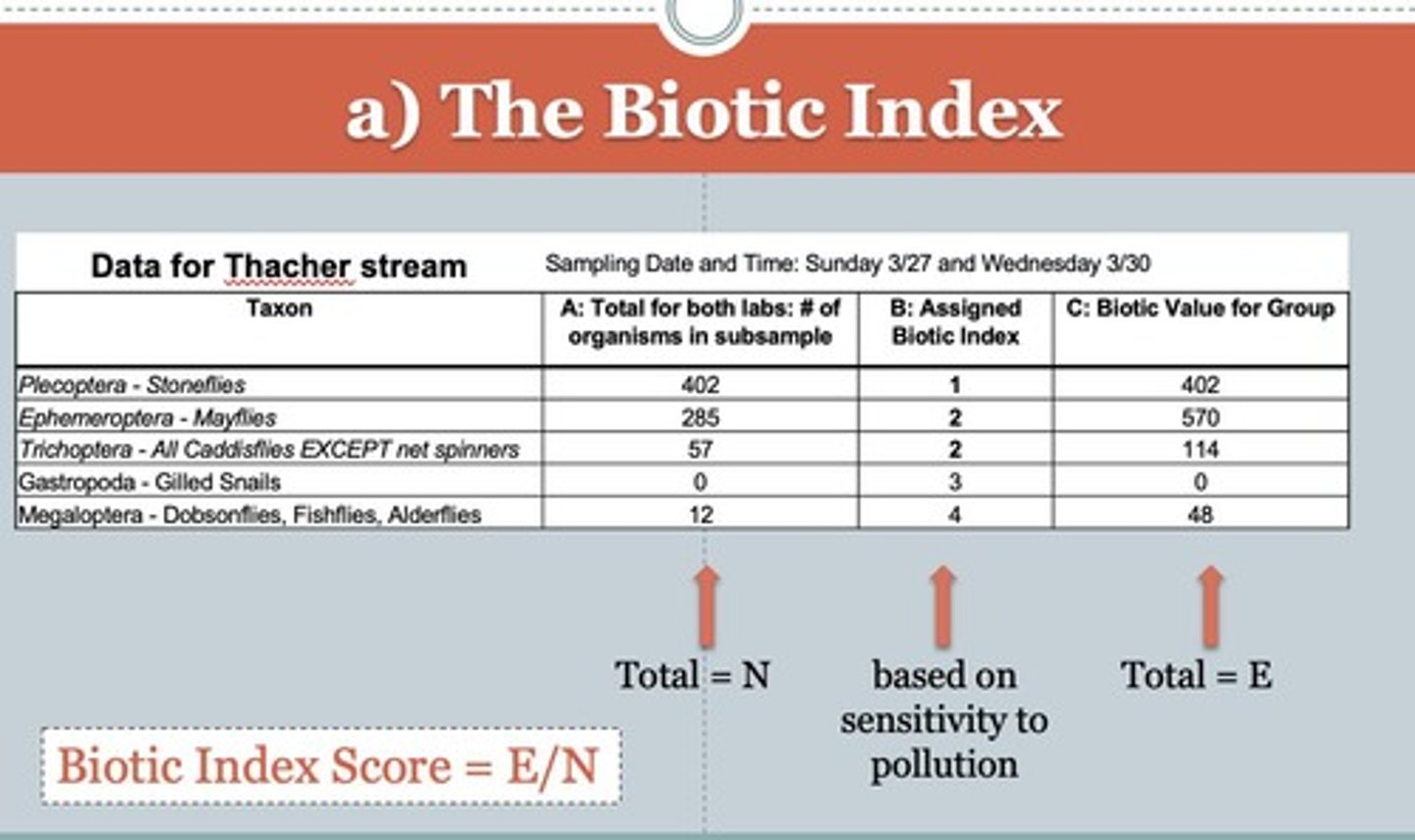
What is the Biotic Index score?
A measure that accounts for the number of individuals of each taxon found and their sensitivity to pollution.
What does a Biotic Index score of 0 - 4.50 indicate?
The stream is considered non-impacted.
What does a Simpson Diversity Index value nearing 1 indicate?
A more diverse community with a higher probability that two individuals sampled are different species.
What are shredders in the context of stream ecosystems?
Organisms with smaller jaws and tiny teeth that break down larger coarse particulate organic matter (CPOM) into fine particulate organic matter (FPOM).
What is the role of scrapers in stream ecosystems?
They graze on bacteria, diatoms, and microalgae from submerged surfaces using plate-like jaws.
What is filter feeding?
A method where organisms filter food from the water using specialized mouthparts or structures.
What is fluid feeding exemplified by?
Leeches that feed on vertebrate blood and some aquatic beetles that use oral stylets to pierce other animals.
What is deposit feeding?
A feeding strategy where organisms consume sediment and obtain nutrition from bacteria and diatoms in the mud.
What is an omnivore in the context of stream macroinvertebrates?
An organism that exhibits a mixture of various feeding modes.
What is the significance of netspinner caddisflies in the study?
They are more tolerant to pollution and need to be counted separately due to their unique characteristics.
What features identify gilled snails?
Presence of an operculum and gills that allow them to remain underwater while breathing.
What is the first step in the kick sampling procedure?
Two people hold nets against the stream bottom while others disturb the sediment upstream.
What should be done with the kick sample material after collection?
Invert the net over a bucket of water and wash the material out using two liters of water.
What is the expected outcome of the kick sampling technique?
To trap animals within the nets as silt and debris rise in the water.
What is the importance of recording data in the study?
To analyze the macroinvertebrate community and assess stream health and diversity.
What does a Biotic Index score of 7.01 - 10 indicate?
The stream is considered severely impacted.
What is the significance of species richness in diversity measurement?
It helps in understanding the number of different species present but does not account for abundance.
What is the relationship between the Biotic Index and pollution sensitivity?
Higher values are assigned to species more resistant to pollutants, affecting the overall Biotic Index score.
What do low values in species diversity indicate?
Low values indicate a low probability that two individuals sampled at random are different species, suggesting less community diversity.
How is Functional Diversity (FD) calculated using the Simpson Index?
FD is measured by substituting functional groups for species in the Simpson Index to determine the probability that two individuals will come from different functional groups.
What is the purpose of pooling data from multiple lab sections?
Pooling data allows for a comprehensive analysis of the stream diversity by combining counts from all students in the lab section.
What is the significance of the % EPT value in stream quality assessment?
% EPT includes Ephemeroptera (Mayflies), Plecoptera (Stoneflies), and Trichoptera (Caddisflies), which are sensitive to pollution and indicate stream health.
Why are net-spinner Caddisflies excluded from the % EPT calculation?
Net-spinner Caddisflies are excluded because they are less sensitive to pollution compared to other EPT taxa.
What does a higher Biotic Index (BI) score indicate?
A higher BI score indicates better stream quality and less impact from human activity.
What is species richness?
Species richness is the total number of different species found in a given area.
Is species richness alone sufficient to compare community diversity?
No, species richness alone does not account for the relative abundance of species, which is important for understanding overall diversity.
What does the Simpson Diversity Index measure?
The Simpson Diversity Index measures species diversity by weighting richness using the relative abundance of each species.
What are the three most abundant taxa in the Thacher Stream?
Specific taxa will vary; students should identify and list the three most abundant taxa based on their data.
What ecological roles do the most abundant taxa play?
Students should describe the ecological roles of the identified taxa, such as predators, shredders, or filter feeders.
How do functional diversity and species diversity differ in what they reveal about an ecosystem?
Functional diversity focuses on the roles species play in the ecosystem, while species diversity focuses on the variety of species present.
What factors does the Biotic Index take into account?
The BI considers factors such as the presence of sensitive species, overall species diversity, and the abundance of pollution-tolerant species.
What is the purpose of constructing graphs in the lab assignment?
Graphs visually represent data comparisons, such as relative abundance of taxa and functional diversity between streams.
What is the significance of comparing % EPT values between streams?
Comparing % EPT values helps assess which stream is more impacted by human activity based on the presence of sensitive taxa.
What might be assessed to collect more data on stream characteristics?
Other characteristics could include water temperature, pH levels, and the presence of pollutants or habitat types.
What does the term 'functional groups' refer to in stream ecology?
Functional groups refer to categories of organisms that share similar ecological roles, such as predators, shredders, or filter feeders.
What is the role of predators in a stream ecosystem?
Predators help control populations of other organisms, contributing to the balance and health of the ecosystem.
What is the impact of human disturbance on functional diversity?
Human disturbance can reduce functional diversity by altering habitats and affecting the abundance and variety of functional groups.
What is the role of shredders in stream ecosystems?
Shredders break down leaf litter and organic matter, contributing to nutrient cycling and energy flow in the ecosystem.
How do filter feeders contribute to stream health?
Filter feeders help clean the water by consuming suspended particles, thus improving water quality.
What is the ecological significance of aquatic worms?
Aquatic worms play a role in nutrient cycling and serve as a food source for various predators in the stream.
What is the importance of collecting raw data in the lab?
Collecting raw data is essential for accurate analysis and understanding of stream diversity and health.
What does the term 'relative abundance' refer to?
Relative abundance refers to the proportion of each species in relation to the total number of individuals in a community.
What is the function of a figure legend in graphing?
A figure legend explains the symbols, colors, or patterns used in a graph, aiding in the interpretation of data.
What are some examples of taxa that might be overrepresented in a community?
Examples will vary; students should identify specific taxa based on their data analysis.
What is the role of ecological roles in understanding stream ecosystems?
Understanding ecological roles helps clarify how different species interact and contribute to the overall functioning of the ecosystem.