BIOL 2804 Final Exam Review (Barrett VT)
 Call Kai
 Learn
Learn Practice Test
 Spaced Repetition
 Match
Match Flashcards
 Knowt Play
1/168

There's no tags or description
Looks like no tags are added yet.
Name | Mastery | Learn | Test | Matching | Spaced | Call with Kai |
|---|
No analytics yet
Send a link to your students to track their progress
169 Terms
The term "ecology" is defined as the study of the?
environment.
natural economics
impact of humans on the environment.
a bunch of tree-hugging crapola.
relationships among organisms and their environment.
relationships between organisms.
Relationships among organisms and their environment
The mechanism of evolution on which Darwin focused in The Origin of Species was?
finchification
plasticity.
acclimatization.
genetic drift.
Hardy Weinberg equilibrium
natural selection.
Hardy Weinberg equilibrium
The characteristics that give an organism an advantage in a given environment are called?
genes.
phenotypes.
genets
mutations.
ramets
adaptations.
Adaptations
Evolution by natural selection requires?
that migrations do not occur.
that mating is random.
large populations
none of the above.
all of the above.
heritable variation in traits within a population.
Heritable variation in traits within a population.
The power law distribution illustrates the observation that in natural systems
A small number of types of observations are common, while a larger number of types of observations are uncommon or rare.
The fittest organisms survive.
That larger body organisms congregate near the poles.
Most observations cluster at an extreme value.
The distribution of resources is according to needs and abilities.
A small number of types of observations are common, while a larger number of types of observations are uncommon or rare.
Evolution is a change in _____________ over time.
Inheritance.
Acquired traits.
Phenotypes.
Gene frequencies.
Mutations.
Gene frequencies.
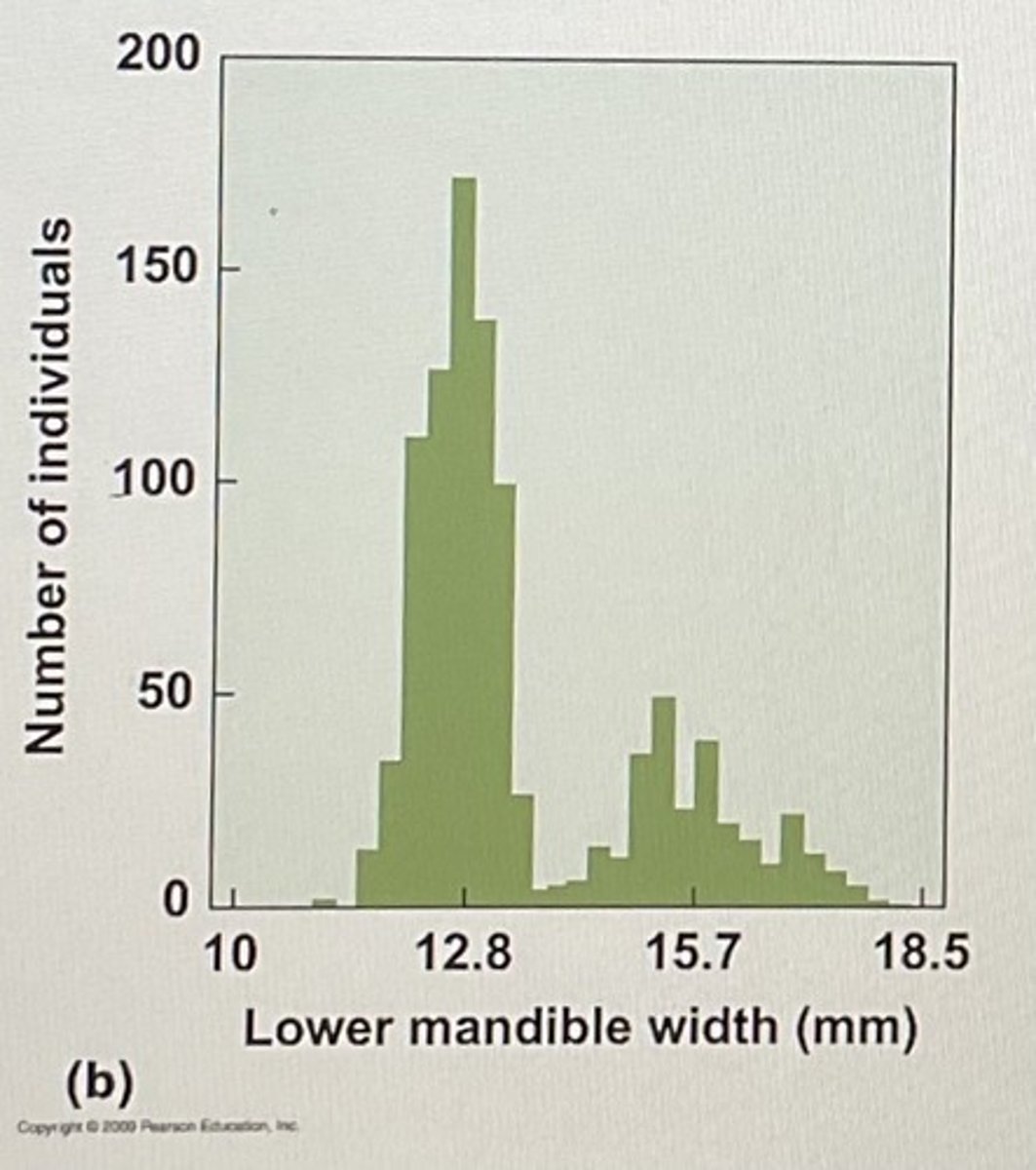
What evolutionary process is illustrated in the following figure showing the distribution in bill size for the Black-Bellied Seedcracker (Pyrenestes ostrinus)?
Scramble competition
Stabilizing selection
Life History Speoliorization
Disruptive selection
The Allee effect
Disruptive selection
Which of the following statements is not a requirement of Hardy-Weinberg equilibrium?
the population is large.
mutations do not occur.
migrations do not occur.
mating is random.
predation does not occur.
predation does not occur.
Fundamental evolutionary trade-offs among growth, reproduction, and survival are best illustrated by:
The conditional asexuality of the nematode C. elegens.
The remarkably tenacious tardigrades
Darwin's stupid Finches
Maternal cannibalism
The general observation that small-bodied organisms tend to have a large number of small offspring with short life-expectancy.
The general observation that small-bodied organisms tend to have a large number of small offspring with short life-expectancy.
The figure above illustrates _________________________ for a population of Darwin's Finches in the Galapagos Islands before and after a major drought.
density dependent population regulation
density independent population regulation
directional selection
a founder effect
Directional selection
Structural aspects of populations include which of the following?
#'s of juveniles and adults, females and males.
#'s of organisms per unit area or volume
all of these answers
distribution of organisms in space
all of these answers
For which organism would it be advantageous to allocate more resources to reproduction than to growth?
One in which fecundity increases with increased body size
One in which offspring survival is very low
One with a long life span
One with low adult survival rates
One with low adult survival rates
The process of allopatric speciation is best Illustrated by:
Melanieation in Peppered Meths following the Industrial Revolution in Landen
the domestication of maize in southern Mexico approximately
The distribution in size classes of mammal species across high and low latitudes,
The biogeography of salamanders in the in the Southern Appalachians.
The biogeography of salamanders in the in the Southern Appalachians.
Increasing probability of local extinctions among meta population distributed over a series of islands of varying sizes is most likely associated with ________________.
Local population size, smaller populations are more susceptible to local extinction.
The landscape heterogeneity of the island
Rate of emigration of individuals to the mainland
Development pressure from the mainland
Local population size, smaller populations are more susceptible to local extinction.
Which of the following graphs (left-, and right-hand) are most likely to exhibit rabid population growth?
It cannot be determined from the information given.
The graph on the right-hand side.
The two graphs illustrate equal potentials for population growth.
The graph on left hand-side.
The graph on the right-hand side.
Which type of organisms regulates its body temperature by internal metabolic processes?
Heterothermic.
Poikilothermic.
Endothermic.
Ectothermic.
Endothermic
Assuming that the body shape of an animal is at least somewhat spherical, a considerable decrease in body size would __________ the surface area-to-volume ratio, and the ability to exchange heat with the
environment would __________.
increase; decrease
increase; stay about the same
stay about the same; decrease
decrease; increase
increase; increase
increase; increase
Compared with large endotherms, small endotherms require_______________ feeding rates, partly because they have a __________ surface area-to-volume ratio.
lower; lower
lower; higher
similar; similar
higher; higher
higher; higher
Which of the following distribution types are you least likely to encounter in natural populations?
power
normal
clumped
uniform or regular
random
power
In some trees and shrubs, competition among seedlings causes individuals to be spaced relatively evenly throughout the habitat. These plants exhibit a ___________ type of dispersion pattern.
ramet or genet
random
regular or uniform
clumped
regular or uniform
What are the advantages of sex?
Increased variation in traits due to genetic recombination.
Sex tends to stabilizes traits in the population through dissassociative mating.
Sex facilitates hybridization of closely related species.
Sex maximizes the proportion of maternal genes in the population.
Increased variation in traits due to genetic recombination.
A powerful ice storm in 1998 felled a large proportion of trees across much of northern New England, New York State, and southeast Canada. Although the storm led to declines in abundance for many species of birds, it created opportunities for other bird species. With regard to its effects on the populations of bird species, the 1998 storm would be considered a(n)?
a nor'easter.
Gap Dynamic.
weather whiplash event.
density-dependent control.
Allee Effect
density-independent control.
density-independent control.
The regulation of an animal's body temperature using external mechanisms is described as?
ectothermic.
adiabatic
piezometric
homothermic.
homeostatic
endothermic.
ectothermic.
What is the most common reason that ecologists encounter discontinuous distributions of meta-populations across species geographic ranges?
founder effects
dispersal limitations
landscape heterogeneity
ecological disturbance
climate change
landscape heterogeneity
The basal metabolic rate per unit of body mass is highest in a:
large ectotherm.
large endotherm.
small ectotherm.
small endotherm.
large heterotherm.
small ectotherm.
Identify different scales of species distribution in order from smallest to largest areas and number of individuals.
Geographic range < Population < Metapopulation
Population < Metapopulation < Geographic range
Metapopulation < Population < Geographic range
Geographic range < Metapopulation < Population
Population < Metapopulation < Geographic range
In cod fishing, older and larger fish are more likely to be retained in nets than younger and smaller fish.
Despite the removal of these large breeders, the population is still reproducing. How do you think cod characteristics have changed due to the selection pressure from over-fishing?
Selection has led to increased growth rates.
Selection has led to decreases in the size of fish at the age of maturity.
Selection has led to increases in the age of fish at the age of maturity.
Selection has led to decreased growth rates.
Selection has led to decreases in the size of fish at the age of maturity.
According to Bergmann's Rule, an Arctic rodent species will be _____________________ relative to a related sub-tropical species.
larger
smaller
faster
furrier
more endothermic
more tenacious.
larger
The ¾ biomass-metabolism scaling law probably arises from?
all of these answers.
biophysical constraints on maintaining energy balance.
biophysical constraints on distributing nutrients and energy through biological volumes.
the cube-square law.
all of these answers.
Fill in the necessary spaces in the table below to calculate the proportion of rabbits that survive to age three.
10%
9
5%
2.5%
1%
1%
A species of turtle grows for several years before becoming sexually mature. It mates, reproduces, and dies soon afterward. This species of turtle would best be described as
gametophytic.
semelparous.
iteroparous.
sporophytic.
promiscuous.
semelparous.
The term "r-selection" refers to selection
under crowded conditions.
for iteroparity.
that increases age at sexual maturity.
for high population growth rates.
for high population growth rates.
Which organisms would be most likely to be K-selected?
Mayflies
Daffodils
Mice
Lions
Lions
In a mark-recapture study to estimate the size of a rodent population, researchers catch and mark 180 individuals. Two days later, they again capture a number of rodents and find that 40% of the individuals are marked. Assuming that there have been no births, deaths, or migrations, the estimated size of the population is
360
720
600
450
450
Certain species of grasses in the semiarid prairies of Colorado, Kansas, and Nebraska find refuge from grazing in the vicinity of the prickly pear cactus (Opuntia polycantha), which has a roughly uniform or regular distribution across most landscapes. These grasses mostly closely resemble a ______________ type of dispersion pattern.
regular or uniform
random
ramet
clumped
stochastic
clumped
When English ivy first arrived in Virginia in 1800, it had no natural competitors or herbivores to consume it. What initial growth type would you expect for this population?
Logistic increase
Extinction vortex
Malthusian
Exponential increase
Exponential decrease
Exponential increase
What pattern of population dynamics best describes the one exhibited by sheep introduced to the island of Tasmania depicted in the figure above?
Outbreak
Logistic growth
Population oscillation
Exponential growth
Malthusian growth
Logistic growth
Which equation best describes density dependent population dynamics?
dN/dt = rN
dN/dt = rK(1 - K/N)
dN/dt = rN(1 - N/K)
dN/dt = rK(1 - N/K)
dN/dt = rN(1 - N/K)
Consider a population of cute bunnies that colonize a pasture previously unoccupied by rabbits. Doing what rabbits do, their numbers rise exponentially until they reach a population of 1,000 rabbits, after which their populations crashes to 700 due to resource limitations and the inherent sensitivity of bunnies (they are very delicate). Over time, the population rises and falls until it stabilizes around a population of 850. What does this population size likely represent in terms of population growth?
Fluctuation
Carrying capacity
Effective population size
Outbreak
Maximum population size
Carrying capacity
Based on the data in the figure, which number is the best estimate of the carrying capacity in this environment?
42
5
39
28
10
28
Assuming that their average population growth rates and all other factors are equal, which population would most likely be at risk for extinction?
A large population with high variation in its growth rate
A small population with high variation in its growth rate
A large population with low variation in its growth rate
A small population with low variation in its growth rate
A small population with high variation in its growth rate
Which of the following is a likely reason for the decline in population growth at low population density in the figure above?
Decreased environmental stochasticity
The Allee Effect
The Paradox of Choice
Increased biodiversity
Increased intra specific competition
The Allee Effect
A fictional animal from the Star Trek Universe, the tribble, reproduces in synchrony at regular intervals.
When the logarithm of a particular tribble population was plotted against time by Dr. Spock, the result was a straight and increasing line. Which statement about the tribble population is false?
If the actual population size were plotted against time, the result would be an increasing J-shaped curve.
The tribble population is increasing in size geometrically.
The lambda of the tribble population is constant and greater than 1.
r= 0.
r = 0
Which population would be expected to remain stable in size?
A population with a lambda of 0 and an r of 1
A population with an r of < 1
A population with an r of > 0
A population with a lambda of 1 or an r of 0
A population with a lambda of 1 or an r of 0
When did the world human population first reach 1 billion?
1347
2019
1804
1544
1930
1804
Population regulation occurs when
the population is close to zero.
the population has reached a stable age distribution.
density-independent factors affect birth, death, and emigration rates.
density-dependent factors affect birth, death, and emigration rates.
density-dependent factors affect birth, death, and emigration rates.
The top five countries currently add approximately 40 million people a year to the world's population.
Which of the following countries is not one of these top five?
India
Nigeria
China
Italy
United States
Italy
What is the current global human population?
5.2 billion
7.7 billion
9.2 billion
11.2 billion
6.5 billion
8.1 billion
8.1 billion
What is the current human population of the Unites States?
511 million
337 million
450 million
275 million
770 million
337 million
Which of the following has been shown to decrease fertility rates in developing nations?
soil conservation programs
hosting the Olympics
natural childbirth education
increasing female literacy rates
US AID food programs
increasing female literacy rates
Long-term trends in human population growth are most associated with:
Developments in energy technology
Availability of medicine
Developments in agriculture technology
Climate change
Pandemics
Developments in metal technology
Developments in agriculture technology
What is the most significant single contributor to increases in human populations over the past 100 years?
Electrification.
The development of industrial nitrogen fixation.
Enhanced transportation.
Vaccination programs.
Soap.
The development of industrial nitrogen fixation.
Test 2:
Competition between species arises due to:
natural selection of antagonistic traits.
scarcity of resources in the environment.
natural selection of antagonistic traits.
overlapping rank abundance curves.
the tendency of species interactions to become more amensal over evolutionary time.
scarcity of resources in the environment.
When two or more organisms use a portion of the same resource simultaneously, it is referred to as
mutualism.
competitive release.
commensalism.
niche overlap.
amensalism.
niche overlap.
The biologist G. F. Gause used Paramecium species grown in test tubes to illustrate which prediction of Lotka-Volterra competition models?
Tilman equilibrium
consumption competition
coexistence
resource pre-emption
competitive exclusion
competitive exclusion
The full range of space, resources and environmental conditions to which an organism is adapted to live in and/or use is referred to as the ___________________ of that organism.
fundamental niche
territory
habitat
geographic range
realized niche
fundamental niche
The portion of potential resources and habitat that an organism actually uses in the presence of competitors is called the _________________ of that organism.
realized niche
territory
geographic range
meta-community
fundamental niche
realized niche
Which of the following would NOT be expected to result from competition?
decrease in populations of one or both species
evolution of character displacement
competitive exclusion
evolution of increased niche overlap
evolution of increased niche overlap
In the graphical depiction of the Lotka-Volterra competition equations, the diagonal lines representing
combinations of densities of two species for which dN/t = 0 are called the?
zero-growth isoclines.
competition zones
ley lines
competition coefficients.
competitive exclusion parameters.
zero-growth isoclines.
If "x" marks the spot of the initial population levels of species 1 and species 2 populations, what is the stable equilibrium point in the figure shown below?
Position C
Position D
Position A
Position E
Position B
Position E
What is the outcome of competition in the graph shown below?
Stabilization at point E.
Stabilization at point C.
Stabilization at point A.
Stabilization at point D.
Stabilization at point B.
Stabilization at point C.
The net outcome of predator-prey interactions in the Lotka-Volterra equations is that
the prey population influences the mortality of the predator populations when prey populations are low.
the predator switches to omnivory when prey populations are low.
the predator drives its prey extinct, and then goes extinct itself.
predator and prey populations oscillate.
predator and prey populations oscillate.
The figure above shows the interaction between predator (P) abundance and prey abundance (N).
Given populations of lynx and hares are located at the star. Based on the Lotka-Volterra predator-prey model, we would expect the number of prey to __________and the number of predators to ____________.
decrease; stay the same
decrease; increase
increase; increase
increase; decrease
increase; increase
The Lotka-Volterra predator-prey model of population growth:
assumes that the prey population does not change when the predator population declines.
does not depend on the availability of the predator's resources.
assumes that predators are eating multiple prey species.
assumes that when predators are absent the prey population grows exponentially.
assumes that when predators are absent the prey population grows exponentially.
In Lotka-Volterra predator-prey models, predators regulate prey populations by functioning as a?
Müllerian facilitator.
source of density dependent mortality.
numerical response regulator.
obligate symbiont.
source of density dependent fecundity.
source of density dependent fecundity.
Which of the following describes a system of species interactions in which an individual of one species lives in or on its host, feeding on it but usually not killing it.
cannibalism
parasitism
parasitoidism
amensalism
predation
parasitism
The ______________________ describes reciprocal co-evolutionary changes observed in species of:
predators and prey, host and pathogen, and competitor species living in close associations over evolutionary time.
Directional Selection Axiom
Green Witch Hypothesis
Red Queen Hypothesis
Hardy-Weinberg Equilibrium
Convergent Evolution Principle
Red Queen Hypothesis
A host species which harbors only a developmental phase of a parasite is called a(n)
intermediate host.
direct host.
obligate mutualist.
definitive host.
macrobiome.
intermediate host.
Which of the following describe species interaction where two or more organisms of different species live together in close physical and/or biochemical association?
amensalism.
symbiosis.
parasitism.
mutualism.
commensalism.
symbiosis.
The figure below illustrates which of the following types of species interactions?
interspecific competition
predator prey
mutualism
Lotka-Volterra
intraspecific competition
mutualism
Which of the following is the least likely outcome of a host-parasite interaction?
The host population evolves stronger defenses against the parasite.
The species Zero-Growth Isolines converge.
The parasitism evolves into a mutualism.
The parasite population evolves better means of avoiding host defenses.
The host population evolves to become more susceptible to the parasite.
The host population evolves to become more susceptible to the parasite.
Which of the following symbiotic mutualism involves a fungus?
gut microbe-ruminant interactions
lichens
lichens and mycorrhizae
mycorrhizae
legume-Rhizobium interactions
lichens and mycorrhizae
The group of species that occupy a given area, interacting either directly or indirectly, is a(n):
ecosystem.
assembly
population.
community.
biome.
guild.
community.
Which description is true for most communities?
Diversity scales as the ¾ power of biomass
All species are rare.
All species are common.
All species have approximately equal abundances.
A few species are very common and many are rare.
Common species have the greatest biomass.
A few species are very common and many are rare.
Which of the following terms best describes the relationship between a flowering plant and an animal that harvests its pollen?
herbivory
commensalism
carnivory
amensalism
mutualism
parasitism
competition
mutualism
A "dominant" species in a community may
all of these answers.
occupy the most space.
make the largest contribution to energy flow or nutrient cycling.
possess the highest biomass.
be the most numerous.
all of these answers.
Which statement about biodiversity is true?
Metacommunities arise from sympatric speciation events.
The equilibrium number of species in a community can be estimated using Zolterra's J.
Diversity scales as a function of area.
Dominant species are responsible for trophic cascades.
Alpha diversity is always greater than gamma diversity.
Diversity scales as a function of area.
One of the goals of restoration ecology is to increase the complexity of structure within a degraded habitat. Based upon Huffaker's work with mites and mite predators on artificial substrates, how would an increase in habitat complexity affect predator-prey dynamics in the restored habitat?
Prey populations would be driven to extinction while prey populations would dramatically increase.
Prey populations would ultimately overwhelm predator populations, leading to a decline in predator numbers.
Predator search effort would ultimately decline driving the prey to extinction.
Both predator and prey populations will ultimately persist due "hide-and-seek" predator-prey cycles.
Both predator and prey populations will ultimately persist due "hide-and-seek" predator-prey cycles.
Plant community structure along an environmental gradient can often be explained by ________________.
differences among species in their competitive abilities.
differences among species in their abilities to tolerate stress.
gamma diversity.
differences among species in their resistance to herbivores.
a tradeoff among species with respect to competitive ability and stress tolerance.
a tradeoff among species with respect to competitive ability and stress tolerance.
Which vegetation type supports the insect community with the greatest species richness?
Site 336, low herbaceous cover.
Site 101, intermediate herbaceous cover
All the vegetation types shown have similar species richness.
Site 73, wiregrass dominated cover
Site 336, low herbaceous cover.
In the figure above, which vegetation type supports the insect community with the lowest species evenness?
Site 101, intermediate herbaceous cover
Site 336, low herbaceous cover.
All the vegetation types shown have similar species evenness.
Site 73, wiregrass dominated cover
Cannot be determined with the information available.
Site 73, wiregrass dominated cover
In general, the degree of environmental heterogeneity of a community has a ____________ effect on the species diversity of that community.
positive
logistic
factorial
negative
neutral
logistic
The view of communities, advocated by Frederick Clements, that communities are deterministic and integrated units of species, is referred to as the ______________ concept of communities.
unified
individualistic continuum
food web
organismic
individualistic
organismic
In contrast to the deterministic view of plant communities that prevailed in the early 20th Century, ecologists now believe that community composition at any given location is determined by:
disturbance.
responses of multiple species to environmental conditions and landscape history.
community physiology.
bottom-up effects.
species interactions.
responses of multiple species to environmental conditions and landscape history.
Changes in community composition over time are called
succession
zonation
floristic evolution
stratification
robustification
Which of the following is/are critical to maintaining diversity in successional communities.
Disturbance.
The Yellow King.
Shade tolerant tree species.
The Red Queen.
Climax communities.
Competition.
Disturbance.
The progressive series of changes in community composition that follows abandonment of an agricultural field is called:
eutrophication.
primary succession.
secondary succession.
speciation.
Devolution.
secondary succession.
__________________________ changes in environmental conditions, which are common in plant succession, are brought about by the actions of organisms.
Autozygous.
All of these answers.
Allogenic.
Autogenic.
Allergenic.
Allopatric.
Autogenic.
Groups of sites within an area with similar climate and soils that are at different stages of succession are known as
clines.
ecotypes.
old fields.
chronosequences.
autosequences.
chronosequences
During the early stages of succession, diversity typically
decreases.
increases.
stays the same.
varies frequently.
approaches gamma diversity.
increases.
Succession that occurs on a site not previously occupied by a community, for example a lava field or a glacier moraine, is called _______________ succession.
allogenic
secondary
initial
basic
primary
primary
Nitrogen fixation by Alder trees early in the growth of an Alaskan forest is an example of
floristic succession
symbiotic convergence
commensual development
facilitation
allogenic succession
facilitation
Beta diversity refers to diversity observed
in a climax successional sere.
at the local scale.
between two sites.
in a primary successional sere.
at a regional scale.
between two sites.
Alpha diversity is to gamma diversity as community is to ________________
biome
meta-community
meta-population
rank abundance
ecosystem
meta-community
Which of the following are not drivers of alpha diversity?
Average distance of habitat from other habitat patches
Topology (i.e., connections and geometry) of patches in region
Landscape history
Size of habitat
Number of bird species
Number of bird species
MacArthur's Warblers occupying different parts of coniferous trees are an example of which of the following:
niche partitioning
Boreal exclusion
natural selection.
competitive exclusion
niche partitioning
What doesn't control alpha diversity?
Connection among habitats in a region
Patch heterogenity.
Gamma diversity
Beta diversity
Environmental gradients
Beta diversity
How many dimensions are there in Hutchenson's n-dimensional hyper-volume?
Three: temperature, water availability, and PAR.
Two: populations of zooplankton and phytoplankton.
Correct!
n dimensions, where n = number of limiting nutrients and physical drivers
Four:, temperature, water availability, PAR, and nitrogen.
One: The Zero-scape Dimension that describes a plant species niche in water-temperature space.
k dimensions, where k = number of species - n of limiting nutrients
n dimensions, where n = number of limiting nutrients and physical drivers
When a predator enhances the success of inferior competitors by suppressing a superior competitor, the interaction is called :
predaceous
indirect commensalism.
facilitation.
keystone predation.
indirect predation.
keystone predation.
Two species of birds feed on berries. The birds are active at different times of the day and do not come into contact with one another. Nonetheless, the presence of one species limits the survival and reproduction of the other. What type of competition is this?
Interference
Logistic
Antagonism
Exploitation
Allelopathy
Exploitation